The urban transportation landscape across Canada in 2026 is undergoing a massive micro-mobility revolution. As cities face increasing traffic congestion and commuters look for cleaner alternatives to traditional vehicles, electric scooters have transitioned from simple novelty toys into essential, daily transit assets. However, for micro-mobility fleet managers, personal buyers, and daily commuters, navigating the exact regulatory speed boundaries is critical. Determining exactly how fast can an e-scooter go in Canada requires looking past standard factory settings and evaluating a complex mix of federal definitions, provincial pilot programs, and localized municipal bylaws.

From our experience at TopRiding, many micro-mobility users frequently misunderstand the legal limits governing public roads versus private properties. A standard commercial electric scooter might feature immense raw motor power, but software governors and regional traffic laws enforce strict speed thresholds on public pathways. When a commuter operates an uncalibrated, high-velocity machine inside public zones, they risk receiving heavy law enforcement fines and face immediate hardware impoundment. Understanding exactly how fast can an e-scooter go in Canada balances public safety compliance with the desire for exhilarating, fast commutes.
1. The Legal Matrix: Canadian Federal and Provincial Micro-Mobility Laws
To accurately understand how fast can an e-scooter go in Canada on public infrastructure, one must evaluate the division of Canadian transportation laws. Transport Canada establishes baseline safety requirements for import vectors, but the explicit rules governing public road access, maximum speeds, helmet laws, and minimum operating age limits are controlled strictly by individual provincial governments and local city councils.
We recommend verifying your specific city council codes before taking any micro-mobility device into active bike lanes or urban paths. On public city streets, the legal speed limit for an electric scooter across most of Canada is capped between 20 km/h and 32 km/h (roughly 12 mph to 20 mph). These intentional limits are engineered to protect pedestrian traffic and ensure that a scooter operator can decelerate safely in an emergency situation without losing handling balance or risking a severe collision.
2. Province-by-Province Speed Limit Profiles
The practical answer to how fast can an e-scooter go in Canada varies distinctly depending on the provincial borders of your daily transit routes.
Ontario (Toronto, Ottawa, and Municipal Pilot Programs)
Ontario operates under a comprehensive five-year provincial e-scooter pilot framework. Under these explicit rules, electric scooters are allowed on public roads where the car speed limit is 50 km/h or lower, but the device's maximum speed must be software-governed to exactly 24 km/h (15 mph). Furthermore, individual cities like Ottawa permit riding in designated bike lanes, whereas Toronto has opted out of the pilot, restricting public sidewalk and road usage entirely.
Commuters who want to maintain an efficient, legal pace across active city streets without breaking local pilot boundaries should explore our curated breakdown of the Best 25 mph electric scooters. These balanced commuter platforms provide excellent real-world acceleration while remaining fully adaptable to municipal speed rules.
British Columbia (Vancouver, Victoria, and Kelowna)
British Columbia leads the country in progressive micro-mobility integration, allowing electric scooters across multiple municipal pilot regions. On public roads and paved multi-use commuter trails, the maximum legal speed limit is capped at 24 km/h (15 mph). City infrastructure systems often use GPS-based geofencing to automatically lower maximum speeds to 15 km/h when entering busy pedestrian seawalls or crowded public markets, protecting public safety.
Alberta (Calgary and Edmonton)
Alberta features highly popular shared and personal micro-mobility networks across its major urban centers. In Calgary and Edmonton, electric scooters are permitted on bike lanes, shared pathways, and secondary roadways, with a legal speed cap of 20 km/h (12.4 mph). If a rider takes a device onto designated public sidewalks where local bylaws allow it, they must reduce their speed further to ensure pedestrian safety.
Quebec (Montreal and Quebec City)
Quebec enforces strict road safety codes regarding micro-mobility devices. Electric scooters are permitted on public roads with a car speed limit under 50 km/h, and the maximum allowed device speed is capped at 32 km/h (20 mph). Operators must be at least 16 years of age and hold a valid scooter or moped license, representing a more structured approach compared to other provinces.
3. Summary Table: Canadian E-Scooter Speed and Age Limit Framework
To provide a clear reference for logistics managers, commuters, and fleet buyers evaluating how fast can an e-scooter go in Canada, the following table details the public speed caps, minimum age targets, and pathway classifications across key Canadian regions.
| Province / Territory |
Max Legal Speed (Public Roads) |
Equivalent Speed (MPH) |
Minimum Operator Age |
Permitted Public Riding Zones |
| Ontario Pilot Cities |
24 km/h |
15 mph |
16 Years Old |
Bike lanes, secondary roads (Max 50 km/h zones) |
| British Columbia Pilot |
24 km/h (Geofenced lower) |
15 mph |
16 Years Old |
Paved multi-use pathways, local bike paths |
| Alberta (Calgary/Edmonton) |
20 km/h |
12.4 mph |
16 Years Old |
Shared commuter pathways, local bike lanes |
| Quebec Framework |
32 km/h |
20 mph |
16 Years Old (License Req) |
Public roadways, designated bicycle infrastructure |
| Private Land / Closed Track |
Unlimited (Hardware Max) |
Up to 55+ mph |
No Statutory Limit |
Private trails, race tracks, closed off-road properties |
4. Mechanical Realities vs. Software Electronic Speed Governors
When analyzing how fast can an e-scooter go in Canada, it is essential to separate software restrictions from raw mechanical capabilities. Most premium personal electric scooters are engineered with high-efficiency hub motors and high-voltage lithium batteries that can naturally exceed 40 km/h or 50 km/h. To comply with local safety rules, manufacturers install software governors inside the main electronic controller, capping the maximum speed output to match regional laws right out of the box.
For daily urban riders who prioritize lightweight porting, matching your device's weight with local speed limits is an excellent strategy. Commuters can look over our reviews of the Best lightweight electric scooters for adults to balance portable carrying weights with a steady, legally compliant pace. Alternatively, riders searching for a more durable platform with plenty of low-end torque can check out our extensive guide outlining top-tier Fast electric scooters for adults lines.
5. Private Properties and Off-Road Exploration: Unlocking Extreme Power
The moment an electric scooter transitions away from public city blacktop onto closed racing tracks or private off-road properties, municipal pilot speed governors no longer apply. On private land, how fast can an e-scooter go in Canada is limited only by the mechanical layout of the motors, battery discharge thresholds, and your chosen suspension geometry.
From our experience, off-road exploration and extreme speed tracks demand ruggedized, military-grade hardware builds to handle severe terrain stresses. Enthusiasts looking to balance heavy-duty performance against reasonable budgets can browse our evaluations of the Best off-road electric scooters under 1000. For riders seeking premium models with superior ground clearance and heavy shock-absorption capabilities, our deep-dive into the Top off-road scooters for adults provides an excellent blueprint for wilderness exploration.
For advanced riders who demand high performance on private land, exploring extreme high-velocity brackets reveals incredible capabilities. Extreme riders can study our engineering reviews covering the Best 50 mph electric scooters 2026 category, or discover the world's most impressive micro-mobility achievements by reading our global report on the Most powerful electric scooters in the world.
6. Premium Micro-Mobility Engineering: The TopRiding Philosophy
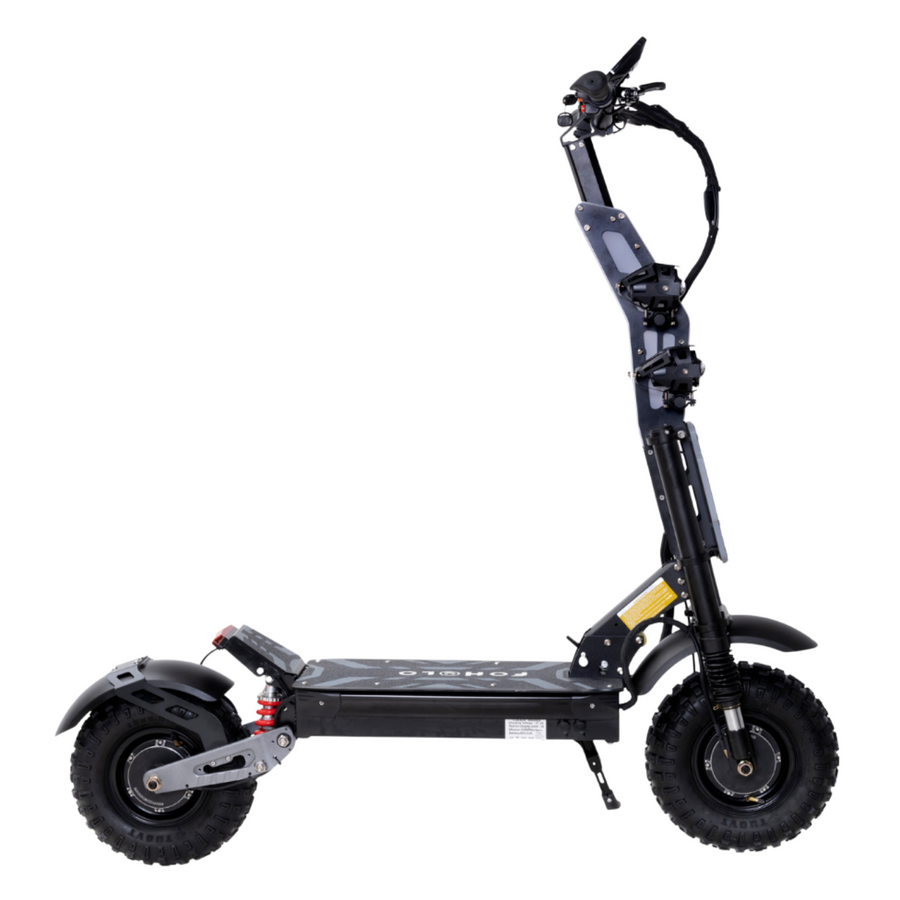
While mastering regional speed regulations is vital for legal compliance, enjoying your micro-mobility journey relies on selecting an experienced, high-tier manufacturing partner. TopRiding specializes in the research, development, and global manufacture of high-performance electric scooters and smart low-speed vehicles. Our flagship model, the TopRiding FOHOLO F19, represents the pinnacle of private-track power and extreme off-road durability. Driven by a massive 7000W dual brushless motor system (3500W x 2), the FOHOLO F19 can hit a top speed of 55 MPH on private courses, conquering up to 45° inclines with absolute ease.
Equipped with rugged 13-inch all-terrain explosion-proof fat tires, 6+1 riding modes (including Sport, Standard, and ECO), and a high-capacity 60V 33AH lithium battery managed by an intelligent BMS, this robust machine delivers a maximum range exceeding 65 miles on a single charge. For rider comfort and safety, the FOHOLO F19 incorporates a triple clamp hydraulic fork suspension, dual spring rear dampening, and responsive hydraulic disc brakes, all supported by a large multi-function LCD screen, an adjustable handlebar height (49–57 inches), 4 front LED headlights, and 360° ambient lighting.
This heavy-duty design handles a maximum rider load of up to 440 lbs while maintaining a net weight of 105 lbs, featuring a quick-folding frame and a removable seat for easy transport—all backed by certified UL2272 compliance. For larger operators looking for heavy-duty structural frames, our platform matches the rigorous criteria detailed in our industry handbook on the premier Electric scooter for 400 lbs weight capacity. Sourcing directly from our quality-certified facilities eliminates retail markups, shortens delivery timelines, and guarantees fully traceable performance parameters to safeguard your global micro-mobility investments.
7. Frequently Asked Questions (FAQs)
How fast can an e-scooter go in Canada on public streets and bike paths legally?
On public roads and city bike paths, the legal speed limit across most Canadian provincial pilot programs is capped between 20 km/h and 32 km/h (12.4 mph to 20 mph). For example, Ontario and British Columbia enforce a strict 24 km/h cap, while Alberta limits devices to 20 km/h.
Can I buy a fast electric scooter that goes over 50 km/h in Canada?
Yes. You can legally purchase high-performance electric scooters that exceed 50 km/h or 80 km/h in Canada. However, these high velocities are legally restricted to private lands, closed racing tracks, and off-road properties, and must be software-governed when entering public streets.
Do Canadian provinces require a driver's license or vehicle registry to ride an e-scooter?
Most Canadian provinces do not require a standard driver's license, vehicle registration, or insurance for legally compliant low-speed electric scooters under pilot rules. However, Quebec requires operators to be at least 16 years old and hold a valid moped or scooter license to access public streets.
What are the mechanical safety advantages of four-wheel hydraulic disc brakes at higher speeds?
Hydraulic disc brakes utilize fluid pressure to clamp brake pads evenly onto steel rotors, delivering immediate, fade-free stopping power. This system outperforms standard mechanical cable drum brakes, providing significantly shorter stopping distances and superior safety control during quick stops on wet asphalt.
8. Transport Regulations and Safety Metrology References
1. Transport Canada. (2024). Motor Vehicle Safety Regulations: Definitions, Lighting Requirements, and Import Restrictions for Low-Speed Power-Assisted Micro-Mobility Configurations. Ottawa, ON: Government of Canada. Available via the official repository at https://tc.canada.ca/)
2. Ontario Ministry of Transportation. (2025). Five-Year Electric Scooter Pilot Program: Structural Framework, Software Speed Caps, and Municipal Bylaw Opt-In Standards. Toronto, ON: Queen's Printer for Ontario.
3. Underwriters Laboratories. (2026). Standard for Electrical Systems for Personal E-Mobility Devices (UL 2272 Compliance Framework). Global Materials Safety and Mechanical Engineering Database.