TopRiding electric scooters are certified to meet UL 2272 safety standards, covering critical electrical and fire safety requirements for the electrical system and battery.
This certification helps ensure safer, more reliable riding.
Over 100,000 electric scooters sold, backed by 5,000+ verified reviews and an average rating of 4.7+ stars.
Chosen by riders worldwide for reliable performance, and everyday riding confidence.
Expert support. local service.
Expert Customer Service
As a U.S.-based company, TopRiding provides 24/7 expert customer service and local after-sales support across multiple regions in North America.
Our dedicated support team is here to ensure fast responses, professional assistance, and reliable service — whenever you need it.
TEST RIDES AND SERVICE
Safety Certified
Designed to Meet UL 2272 Safety Standards
Our electric scooters are designed in accordance with UL 2272 safety requirements for electrical and battery systems, helping enhance overall safety and reliability.
Trusted by a global riding community
100,000+ Units Sold
Over 100,000 electric mobility vehicles sold, backed by 5,000+ verified reviews and an average rating of 4.7+ stars.
Chosen by riders worldwide for reliable performance, safety, and everyday riding confidence.
Expert Support. Local Service.
Expert Customer Service
As a U.S.-based company, TopRiding provides 24/7 expert customer service and local after-sales support across multiple regions in North America.
Our dedicated support team is here to ensure fast responses, professional assistance, and reliable service—whenever you need it.
What Makes an E-Bike All-Terrain? 7 Features That Matter Most
What Makes an E-Bike All-Terrain? 7 Features That Matter Most
senkan
Real-world capability comes from more than a powerful motor. An E-Bike All-Terrain model combines suitable tires, reliable suspension, usable battery capacity, dependable brakes, and a durable frame to handle changing surfaces with greater control.
Whether you ride gravel paths, uneven back roads, woodland trails, or city streets with rough pavement, this guide explains which features are worth paying for, which specifications can mislead you, and how to choose an e-bike that matches your actual riding conditions.
The Direct Answer: What Makes an E-Bike All-Terrain?
An E-Bike All-Terrain is designed to handle a wider range of surfaces than a conventional road-focused electric bicycle. The strongest models combine traction-focused tires, capable suspension, adequate motor assistance, a battery suited to the intended distance, a robust frame, and brakes that remain predictable on descents and loose ground.
Our recommendation is straightforward: choose components as a system, not as isolated headline specifications. A high-powered motor cannot compensate for poor tire grip, weak brakes, or suspension that is unsuitable for the terrain. For mixed riding, balanced handling and dependable control usually matter more than chasing the highest advertised wattage or top speed.
Quick Answer
What it is
An electric bike designed for varied surfaces, from pavement and gravel to suitable light off-road trails.
How it works
Motor assistance works with the battery, tires, gearing, frame, suspension, and brakes to support controlled riding across different conditions.
Key benefits
More versatility, traction, comfort, and confidence on uneven routes.
Limitations
Often heavier and more expensive than a basic commuter e-bike; wide tires and extra suspension can reduce efficiency on smooth roads.
Who should use it
Riders who regularly encounter gravel, rough pavement, mixed routes, or suitable recreational trails.
Who may not need it
Riders who travel almost exclusively on smooth pavement and prioritize low weight, easy storage, and maximum road efficiency.
Common mistakes
Buying based only on peak power, assuming fat tires guarantee grip, or treating advertised range as a real-world guarantee.
Buying considerations
Tire tread and width, suspension design, battery capacity, braking system, frame quality, payload, service support, and local regulations.
Expert recommendation
For genuinely mixed terrain, prioritize suitable tires, predictable brakes, useful suspension, and sufficient battery capacity before paying extra for performance figures you may rarely use.
Quick Summary: All-Terrain E-Bike Features
Feature
What to look for
Why it matters
Tires
Width, tread pattern, casing, and pressure range suited to your route
Traction, stability, comfort, and puncture resistance
Suspension
Front suspension or full suspension where appropriate
Better control and reduced impact on rough surfaces
Motor
Useful torque and power delivery, within local legal limits
Assistance on climbs, starts, and demanding routes
Battery
Capacity in watt-hours (Wh), plus charging and replacement support
Practical range and fewer charging interruptions
Brakes
Reliable disc brakes with suitable rotor and pad specifications
Consistent speed control, especially on descents
Frame
Appropriate geometry, rated payload, and sound construction
Stability, durability, and fit
Support
Warranty, replacement parts, and service access
Lower long-term ownership risk
What Is an All-Terrain E-Bike?
An all-terrain electric bike is built to remain useful when the riding surface changes. It may travel on asphalt, compact gravel, dirt roads, uneven paths, and selected trails without being optimized exclusively for one of those environments.
The term is not a universal technical certification. A bike marketed as all-terrain may be suitable for gravel and rough streets but not for steep, rocky mountain-bike trails. The manufacturer's intended use, component ratings, frame design, tire specifications, and warranty restrictions matter more than the label on the product page.
From our experience evaluating buying criteria, the most important question is not whether a bike can cross a rough patch once. It is whether it can handle your regular route comfortably, safely, and consistently, with realistic maintenance requirements.
All-Terrain Does Not Automatically Mean Extreme Off-Road
A wide-tire electric bike can be excellent on gravel, sand, and uneven rural roads while still being unsuitable for aggressive downhill riding. Frame geometry, suspension travel, wheel strength, tire construction, brakes, and the manufacturer's approved use all affect the bike's limits.
If your plans involve technical trails, large drops, deep mud, or steep loose descents, look for a purpose-built electric mountain bike whose frame and components are approved for that riding. For commuting combined with occasional dirt paths, a versatile all-terrain design is often the more practical purchase.
7 Features That Make an E-Bike All-Terrain
1. Tires That Match the Surface
Tires are the first point of contact between the bike and the ground. Their width, tread pattern, rubber compound, casing, and pressure range influence grip, rolling resistance, cornering stability, and comfort.
Wide tires, including 20 × 4.0-inch fat tires, can provide a larger contact area and useful flotation when pressure is adjusted appropriately. They are attractive for loose gravel, packed dirt, and some sandy routes. However, width alone does not guarantee traction. A tread pattern designed for pavement may perform poorly in loose soil, while aggressive knobs can create unnecessary rolling resistance on smooth roads.
Our recommendation: choose tires for the surface you ride most often. For mixed commuting and occasional gravel, a moderate tread may offer a better balance than an extreme off-road pattern. For loose terrain, prioritize suitable tread and casing as well as width.
2. Suspension That Improves Control
Suspension helps the wheels follow uneven ground and reduces the impacts transmitted to the rider. Front suspension is often sufficient for rough urban roads, gravel, and moderate trails. Full suspension can add comfort and traction on rougher routes, but it increases cost, weight, complexity, and maintenance.
Travel figures are only part of the picture. Suspension quality, setup, damping, spring rate, rider weight, and geometry all influence how the bike behaves. A poorly tuned suspension system can feel harsh or unstable even when the advertised travel looks impressive.
For riders who regularly cross potholes, roots, washboard gravel, and uneven dirt roads, useful suspension can be worth the added expense. If your riding is mostly smooth pavement, good tires and a comfortable riding position may provide better value than a heavier full-suspension design.
For another perspective on ride comfort and suspension choices, see our guide to electric scooters with suspension for adults. The vehicle category differs, but the practical lesson remains: suspension should match the surface and intended speed.
3. Motor Assistance Suited to Climbs and Load
A capable motor makes hills, headwinds, and loaded riding more manageable. Rated power and peak power are not interchangeable: rated power describes sustained output under specified conditions, while peak power generally refers to a temporary maximum. Torque also matters, particularly when starting on a slope or moving at lower speeds.
For all-terrain use, smooth and predictable power delivery can be more useful than an impressive peak figure. Excessive or abrupt assistance can reduce control on loose surfaces, especially when the rider applies power aggressively while cornering or climbing.
Always verify whether the advertised power and speed configuration is legal for the intended use in your area. An electric bicycle with a throttle, high output, or a factory speed limit may be classified differently from a conventional pedal-assist e-bike depending on local rules.
4. A Battery Sized for Realistic Range
Battery capacity is commonly expressed in watt-hours (Wh), calculated by multiplying nominal voltage by amp-hour capacity. For example, a 52V, 25Ah battery has a nominal energy capacity of approximately 1,300Wh. That figure describes stored energy, not a guaranteed distance.
Actual range depends on rider and cargo weight, elevation, wind, tire pressure, temperature, surface type, assist level, acceleration, and battery condition. Loose terrain and repeated climbs generally demand more energy than steady riding on level pavement.
For planning, estimate your typical distance, then allow a practical reserve rather than assuming the maximum advertised range will be available every day. If your route has steep climbs or you carry cargo, battery capacity and the availability of a replacement battery deserve extra attention.
Our guide to the best electric scooter for the money in 2026 also illustrates a useful purchasing principle: compare usable capability and ownership cost, not just a headline range or price.
5. A Frame Designed for the Intended Workload
An all-terrain frame needs to balance strength, handling, rider fit, and weight. Aluminum is common because it offers a practical combination of stiffness, corrosion resistance, and relatively low mass. Other frame materials can work well when properly engineered for their intended use.
Look beyond material names. Inspect the geometry, welds or machining quality, component mounting points, wheel specifications, and the manufacturer's stated payload limit. A higher payload rating can be useful for larger riders or cargo, but it does not automatically mean every component is designed for aggressive off-road use.
Fit is just as important. A bike that is too large or difficult to control may be a poor choice even if its frame looks rugged. Check stand-over clearance, reach, saddle adjustment, handlebar position, and the ability to mount and dismount safely.
6. Dependable Brakes and Predictable Handling
Brakes are essential when an e-bike carries extra weight or descends on uneven ground. Hydraulic disc brakes can offer strong modulation and reduced hand effort, but performance depends on rotor size, pad compound, brake setup, maintenance, and the bike's total mass.
Four-piston calipers can provide useful braking capacity for certain heavier or higher-performance setups, but the number of pistons alone does not establish stopping distance. Tires, surface conditions, rider technique, brake temperature, and system compatibility all matter.
Before buying, check that the brakes are suitable for the bike's rated load and intended terrain. Learn to brake progressively, inspect pads and rotors, and avoid assuming that more power eliminates the need for careful speed management.
7. Weather Resistance and Serviceable Components
All-terrain riding can expose electrical components, bearings, connectors, and moving parts to dust, mud, splashes, and vibration. A stated ingress-protection rating can help you understand tested protection against particular conditions, but it should not be interpreted as permission to submerge the bike or use high-pressure washing.
Ask about replacement batteries, brake pads, tires, suspension parts, chargers, and electronic components. A slightly cheaper bike can become expensive if essential parts are difficult to source or repairs require shipping the entire unit to a distant service center.
For commercial users, delivery riders, rental operators, and frequent riders, serviceability is a core buying criterion. A bike that can be maintained quickly may deliver better long-term value than one with more impressive specifications but limited parts support.
How All-Terrain E-Bike Performance Works as a System
Motor, battery, tires, suspension, brakes, and frame influence each other. Treating each specification separately can lead to a poor buying decision.
On climbs: the motor assists, while suitable gearing, tire grip, and controlled power delivery help maintain traction.
On gravel: tire tread and pressure affect grip; stable geometry and measured braking help the rider maintain a predictable line.
On rough trails: suspension and frame design help manage impacts, but the bike must be rated for the trail's actual demands.
On long rides: battery capacity, riding position, tire efficiency, and the ability to service the bike determine how practical it is.
On descents: brake capacity, tire condition, rider technique, and weight distribution work together to control speed.
Practical insight: an all-terrain e-bike is only as capable as its weakest relevant component. A powerful motor paired with poor tires or inadequate brakes is not a balanced off-road setup.
All-Terrain E-Bike vs. Standard E-Bike vs. Off-Road E-Bike
The right choice depends on the surface you ride most often, how much comfort you need, and how much weight and maintenance you are willing to accept.
Trails and demanding off-road routes within its rating
Tires
Versatile width and tread
Usually optimized for rolling efficiency
Trail-specific tread and casing
Suspension
Front or full suspension, depending on design
Often rigid or front suspension
Typically designed around trail control and impact demands
Motor tuning
Balanced assistance for changing terrain
Efficiency and predictable urban acceleration
Power delivery suited to climbing and trail control
Weight
Often moderate to heavy
Often lighter
Varies; robust suspension models can be heavy
Maintenance
Moderate, depending on components and use
Often lower with a simple setup
Can be higher due to suspension and trail wear
Best for
Riders who need one bike for varied routes
Daily commuters prioritizing efficiency
Riders who regularly tackle technical or steep trails
If your route is almost entirely paved, a commuter model may be lighter, more efficient, and easier to store. If you regularly ride technical trails, a dedicated electric mountain bike may be a better match than a general-purpose all-terrain model. For genuinely mixed use, all-terrain designs provide a useful middle ground.
Handles more types of surfaces than a road-focused model
Often heavier and harder to carry upstairs
Wide tires and suitable suspension can improve comfort and stability
Fat tires and suspension can increase rolling resistance and maintenance
Motor assistance makes hills and longer mixed routes more manageable
Battery range can fall substantially in demanding conditions
Can combine commuting, recreation, and rural riding in one vehicle
Usually costs more than a basic city e-bike with comparable simple components
Can reduce the need to own separate bikes for different casual routes
General-purpose models may not be suitable for technical mountain-bike trails
Useful for riders who encounter rough pavement, gravel, and uneven access roads
Replacement parts and specialist servicing may be more expensive
The main benefit is versatility, not unlimited capability. If your route changes from pavement to gravel several times a week, paying for appropriate tires and suspension can be worthwhile. If you rarely leave smooth roads, the added weight and cost may not produce enough practical value.
Who Should Use an All-Terrain E-Bike?
Commuters with Rough Roads or Mixed Routes
All-terrain models make sense for riders whose commute includes potholes, broken pavement, gravel shortcuts, or poorly maintained paths. Comfort can improve when the tire and suspension setup matches the route. Still, do not buy a heavy, aggressive trail bike if your daily journey is mostly smooth pavement and secure bike storage is limited.
If commuting is your primary goal, compare practical range, lighting, fenders, rack compatibility, locking options, and ease of charging. Our collection of commuter electric scooters is another option to consider if a standing scooter fits your route and local rules better than a bicycle.
Outdoor Enthusiasts and Weekend Explorers
Riders exploring rural roads, campgrounds, gravel paths, and moderate trails often benefit from an adaptable bike. Wide tires and useful suspension can improve confidence, while motor assistance makes longer routes and climbs more accessible. Check access restrictions before entering trails: some parks and natural areas limit e-bike classes or prohibit motorized vehicles altogether.
Riders Who Need a More Stable, Comfortable Setup
Riders who prioritize a planted feel may prefer wider tires and a stable frame geometry. However, comfort is individual. Saddle shape, handlebar reach, frame size, tire pressure, and suspension setup can matter as much as tire width. Test riding is particularly valuable if you are unsure about fit or handling.
Who Does Not Need an All-Terrain E-Bike?
You may not need one if you ride only smooth roads, need to carry the bike frequently, have limited storage, or prioritize a lightweight design. A simpler commuter e-bike may cost less, require less maintenance, and deliver better efficiency on pavement.
You should also avoid choosing a general-purpose all-terrain bike for jumps, high-speed downhill routes, or technical trails unless the manufacturer explicitly rates it for those activities. The label is not a substitute for a defined use rating.
Common Mistakes When Buying an All-Terrain E-Bike
Mistake 1: Choosing by Peak Motor Power Alone
Peak power does not tell you everything about hill performance, control, heat management, or legal classification. Compare rated power, torque, controller behavior, and how smoothly the bike delivers assistance. More power is not automatically better on slippery surfaces.
Mistake 2: Treating Advertised Range as Guaranteed
Maximum range usually depends on favorable conditions and conservative power use. Riders who weigh more, climb frequently, carry cargo, ride on loose ground, or use high assistance should expect different results. Ask how the range claim was measured and plan a reserve for the route you actually ride.
Mistake 3: Assuming Fat Tires Make Every Trail Easy
Wide tires can help on some surfaces, but they do not replace appropriate tread, casing strength, pressure adjustment, suspension, and rider skill. Deep mud, wet roots, loose rocks, and steep descents each require different techniques and equipment.
Mistake 4: Ignoring Total Weight and Payload
Consider the bike's weight together with the rider, bags, child seats, and other cargo. Confirm the manufacturer's payload limit and check whether accessories are approved for the intended use. A high payload figure alone does not establish that a bike is safe for every off-road scenario.
Mistake 5: Overlooking Parts and Warranty Support
Ask whether batteries, chargers, tires, brake pads, displays, controllers, and suspension components are available as replacements. Clarify what the warranty covers and whether modifications affect it. Long-term support can matter more than a small discount at checkout.
Buying Considerations: How to Choose the Right All-Terrain E-Bike
Start with Your Most Frequent Route
Write down the surfaces you encounter during a normal week, including the steepest climb, roughest section, typical distance, and whether you carry cargo. Buy for the conditions you regularly face, with some margin for occasional variation. It is rarely good value to pay for extreme off-road capability that you will not use.
Compare Battery Capacity and Expected Range
Compare watt-hours rather than voltage alone. Voltage is part of the battery system, but capacity in Wh gives a more useful indication of stored energy. Ask about charging time, battery replacement cost, storage guidance, and warranty coverage. If you cannot charge at your destination, consider whether the available range comfortably covers the round trip.
Evaluate Suspension and Tires Together
For moderate gravel and rough pavement, a quality front suspension and suitable tires may provide enough control. For consistently rougher routes, full suspension may be worth the cost if the bike is engineered for that use. Tire pressure should be adjusted within the manufacturer's limits to account for rider weight, load, and surface conditions.
Check Brakes, Payload, and Fit
Confirm the brake system is appropriate for the bike's total load and expected descents. Verify the frame size and riding position before ordering whenever possible. If you are close to a stated payload limit, ask the manufacturer for clarification about rider weight, accessories, and cargo.
Confirm Legal Classification Before Paying
E-bike definitions, maximum assisted speeds, motor-power limits, throttle rules, age restrictions, helmet requirements, and trail access vary by jurisdiction. A bike that is legal on private property may not be legal on public roads or shared paths in the same configuration. Check current local regulations and the manufacturer's documentation before purchase.
Use a Practical Cost-Benefit Test
The best value is the bike that meets your requirements without paying for capabilities you rarely need. Consider the purchase price, maintenance, replacement battery, tires, brake pads, charging, accessories, and likely resale value. If an all-terrain model replaces both a commuter bike and a recreational bike, the additional upfront cost may be justified. If it simply adds weight to a short pavement commute, a simpler model may be the smarter investment.
Buying rule: prioritize tires, brakes, frame suitability, battery capacity, and service support before optional connectivity or cosmetic features. For frequent rough-surface riding, these core components directly affect the experience and the cost of ownership.
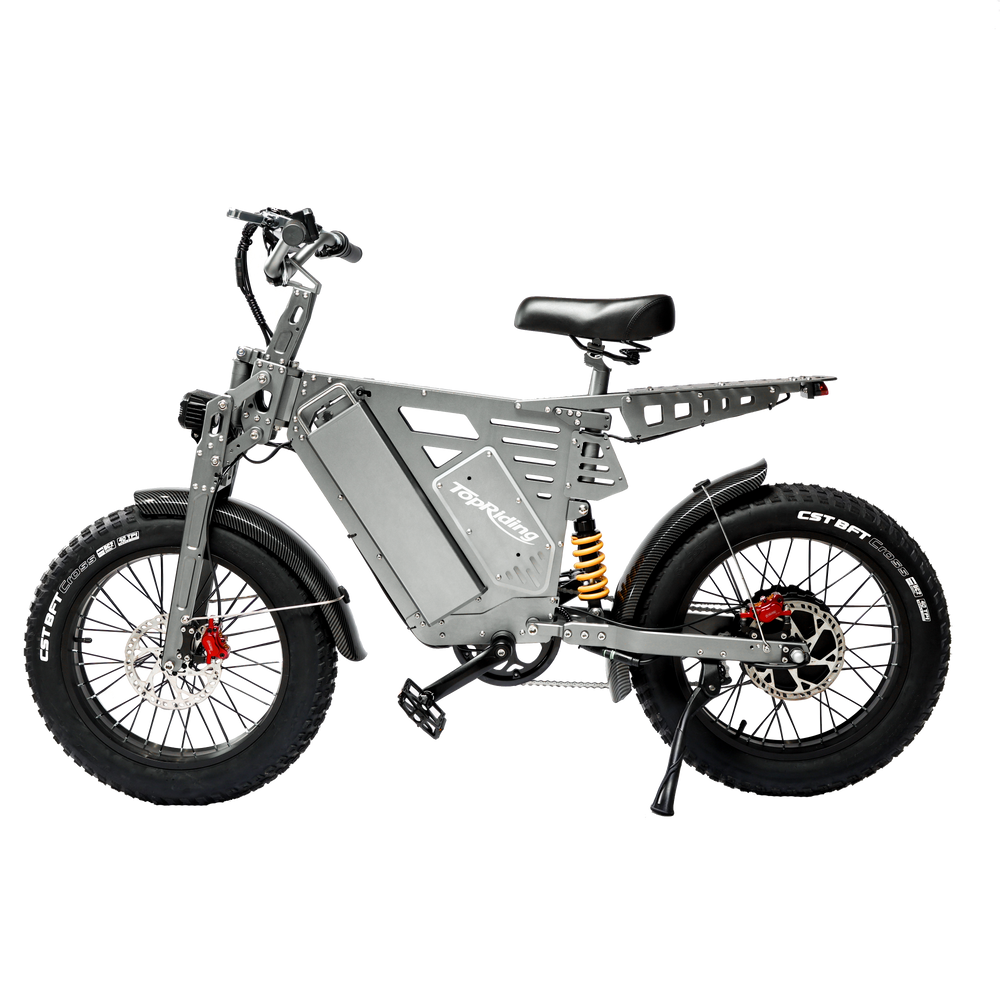
Product Example: TopRiding R2 Full CNC Moto-Style eBike
The TopRiding R2 Full CNC Moto-Style eBike illustrates how several all-terrain-oriented features can come together in a single product. Its wide tires, full suspension, large stated battery capacity, and hydraulic disc brakes make it relevant to riders comparing comfort, power, and mixed-surface capability.
TopRiding R2 - Full CNC Moto-Style eBike
$1,999.00
A high-capacity, full-suspension electric bike for riders who want a robust, motorcycle-inspired design and broad everyday versatility. Confirm current specifications, availability, intended-use limits, and local classification with the seller before ordering.
Motor
750W rated rear hub motor
Peak power
1,500W
Maximum torque
100 Nm
Factory speed limit
20 mph
Battery
52V, 25Ah lithium-ion
Nominal energy
1,300Wh
Advertised range
Up to 60 miles; actual range varies
Charging
6.5 hours with two chargers, according to listed specifications
Frame
Full CNC-machined aluminum
Bike weight
82 lbs
Maximum payload
330 lbs
Suspension
Full suspension; 100mm front and rear travel listed
For riders who want wide tires, full suspension, substantial battery capacity, and a strong motor in a single package, the R2 is worth evaluating against their needs and budget. Its listed 1,300Wh battery provides a useful basis for range comparisons, while the 82-pound bike weight is an important trade-off to consider for storage, stairs, car racks, and transport.
The stated range of up to 60 miles should be treated as a maximum claim rather than a promise for every rider or terrain. Frequent climbing, high assistance, cold conditions, and loose surfaces can increase energy use. If you depend on a specific round-trip distance, ask for test conditions behind the range claim and leave a reasonable battery reserve.
Full suspension and 20 × 4.0-inch tires can be attractive for mixed surfaces, but they do not prove that the bike is appropriate for every technical trail. Confirm the approved riding category, frame and component limitations, maintenance guidance, and warranty terms before taking it onto demanding terrain.
The R2's factory speed limit is listed as 20 mph. That specification alone does not determine its legal classification in every location, particularly because rules may also consider motor power, throttle operation, and the way assistance is delivered. Verify the applicable rules for your planned routes.
The Real Benefits of Choosing the Right E-Bike All-Terrain Setup
The benefit of an all-terrain bike is not simply that it can travel over dirt. A properly matched setup can make your normal rides more comfortable and give you practical flexibility when road conditions change.
More route flexibility: you can consider suitable gravel and dirt routes rather than being limited to smooth pavement.
Better comfort on uneven surfaces: suitable tires and suspension can reduce harsh impacts and rider fatigue.
More manageable climbs: motor assistance can help with hills, headwinds, and moderate loads.
Greater confidence: predictable handling, traction, and braking help riders respond to changing conditions.
Potentially better value for mixed use: one versatile bike may cover commuting and recreational riding without needing separate bicycles.
These benefits depend on fit, setup, maintenance, and realistic expectations. They do not eliminate the need to slow down for poor surfaces, inspect equipment, wear suitable protective gear, and respect route restrictions.
Expert Recommendation: Which All-Terrain E-Bike Should You Choose?
We recommend choosing the least complicated bike that comfortably handles your most demanding regular route. That usually produces a better ownership experience than buying the most powerful model available.
For city commuting with occasional gravel: look for suitable tires, dependable brakes, a comfortable riding position, and enough battery for your normal round trip. Full suspension may be optional.
For frequent mixed-surface riding: prioritize traction, appropriate suspension, a durable frame, and battery capacity with a realistic reserve.
For heavier riders or cargo: verify payload ratings, wheel and tire suitability, brake capability, and handling under load. Do not rely on motor power as a substitute for a rated frame and components.
For technical mountain-bike trails: choose a purpose-built electric mountain bike explicitly rated for the intended use rather than assuming any fat-tire model will be suitable.
For low-maintenance daily transport: consider a simpler commuter design if your route is paved and you do not need the extra off-road capability.
TopRiding's R2 is a possible option for riders attracted to a moto-style frame, wide tires, full suspension, and a large listed battery. Before committing, compare its weight, range assumptions, service support, and approved use against at least one lighter commuter model and one purpose-built off-road alternative.
The final decision should be based on the route you ride, not just the route you imagine riding someday. A well-matched all-terrain e-bike can be a useful long-term investment; an oversized or poorly supported model can turn that versatility into unnecessary cost.
Frequently Asked Questions About All-Terrain E-Bikes
1. What makes an e-bike all-terrain?
An all-terrain e-bike combines tires, frame design, braking, motor assistance, battery capacity, and often suspension to handle multiple surfaces. Its actual capability depends on the manufacturer's intended-use rating and component specifications, not just the product label.
2. Are fat tires necessary for an all-terrain e-bike?
No. Fat tires can be useful on loose ground and some rough surfaces, but they are not essential for every all-terrain setup. Tire tread, casing, pressure, and the surfaces you ride matter as much as width.
3. Is full suspension worth it on an all-terrain e-bike?
Full suspension can be worthwhile for frequent rough-surface riding because it can improve comfort and wheel contact. For mostly paved commutes and moderate gravel, a well-designed front-suspension or rigid bike may be lighter, cheaper, and easier to maintain.
4. How much motor power do I need?
There is no single ideal wattage for every rider. Consider terrain, total load, torque, power delivery, and local e-bike rules. A balanced motor that assists smoothly and stays within legal limits may be more useful than a higher peak-power figure.
5. What battery capacity is good for all-terrain riding?
Choose battery capacity based on your route distance, elevation, rider and cargo weight, and preferred assistance level. Comparing watt-hours is useful, but no capacity guarantees a particular distance under all conditions. Plan with a reserve rather than relying on maximum advertised range.
6. Can an all-terrain e-bike be used for daily commuting?
Yes, particularly if your commute includes rough pavement, gravel, or mixed surfaces. Consider the bike's weight, tire efficiency, lighting, fenders, rack compatibility, storage, and charging routine. A dedicated commuter bike may be better for smooth urban routes.
7. Are all-terrain e-bikes suitable for mountain-bike trails?
Not automatically. Some are suitable for moderate dirt trails, while technical mountain-bike routes require a bike specifically designed and rated for those demands. Check the manufacturer's guidance and local trail access rules before riding.
8. Is the TopRiding R2 suitable for all-terrain riding?
The R2's listed full suspension, 20 × 4.0-inch tires, hydraulic disc brakes, and 1,300Wh battery make it worth considering for riders who need a versatile setup. However, suitability depends on the approved use, terrain, rider fit, payload, and maintenance. Confirm these details with TopRiding before purchase.
9. How can I improve my e-bike's performance on rough terrain?
Start with tire pressure within the manufacturer's limits, inspect tire condition, maintain the brakes, and set the suspension for your weight and riding conditions. Use smooth power input and reduce speed on loose or uneven surfaces. Do not modify components beyond their approved specifications.
10. What should I check before buying an all-terrain e-bike?
Review tire specifications, suspension design, motor output, battery capacity, brakes, frame fit, payload rating, warranty, parts availability, and local legal requirements. Test ride if possible and compare the bike with alternatives designed for your most common route.
References
These authoritative resources provide useful context for e-bike safety, legal classification, and safe cycling practices. Local regulations and product specifications should always be checked for the jurisdiction and model you intend to use.
An E-Bike All-Terrain model is worth considering when your riding includes more than smooth pavement and you want one bike to cover a broader range of conditions. The most useful features are those that match your actual route: suitable tires, predictable braking, appropriate suspension, a durable frame, and enough battery capacity for the distance you ride.
Do not buy on motor power, tire width, or maximum range alone. Compare the whole system, verify the manufacturer's intended-use guidance, and consider long-term service support before you spend more for additional capability.
TopRiding's R2 offers a combination of wide tires, full suspension, a 750W rated motor, and a listed 1,300Wh battery. It may suit riders seeking a powerful, moto-style platform, provided its weight, specifications, local legal classification, and approved terrain align with their needs.
The best all-terrain e-bike is not the one with the most aggressive specifications. It is the one that gives you the control, comfort, range, and reliability you need on the routes you actually ride.
Choosing a selection results in a full page refresh.