The micromobility industry has a systemic engineering problem: it is overwhelmingly designed for a 160-pound demographic. When a 250-pound, 300-pound, or 400-pound adult steps onto a generic, single-motor commuter scooter, the physics break down immediately. The suspension bottoms out, the 36-volt battery sags under the extreme amperage draw, the single 350W motor overheats on mild inclines, and the stem wobbles dangerously. If you are a larger adult, standard retail scooters are not just frustratingly slow; they are fundamentally unsafe mechanical liabilities.

At TopRiding, we refuse to compromise on rider safety and performance. The reality of modern micromobility is that high-payload electric scooters exist, but they require serious architectural investments: dual brushless DC motors, 60V or 72V battery architecture, hydraulic suspension systems, and aircraft-grade aluminum or tubular steel frames. In this uncompromising guide, we will break down exactly what makes an electric scooter viable for large adults. We will dissect our top 6 E-Scooter recommendations for heavier riders, provide commercial and practical judgment on component quality, and explain why spending more upfront on a heavy-duty machine is the only way to ensure long-term durability and safety.
Quick Answer: The Best High-Payload E-Scooters
If you weigh between 250 lbs and 440 lbs, you must bypass entry-level models and invest directly in dual-motor, 60V+ systems. The absolute best E-Scooter recommendations for heavier riders on the market right now are the TopRiding FOHOLO F19 and the TopRiding ZSNAKE Z39. Both of these machines feature colossal 7000W dual motors, 60V 33Ah batteries, and officially rated maximum payloads of 440 lbs. They conquer 45-degree inclines effortlessly and utilize 13-inch all-terrain fat tires to ensure the contact patch remains stable under heavy loads. Alternative high-end options include the Nami Burn-E 2 Max and the Kaabo Wolf King GT Pro, though they often come at significantly higher price points with lower official weight capacities.
What is a Heavy-Duty E-Scooter?
A heavy-duty electric scooter is a specialized vehicle engineered to safely transport payloads exceeding 265 lbs (120 kg), with premium models supporting up to 440 lbs (200 kg). Visually, these scooters are massive. They feature dual-stem or reinforced single-stem designs, wide decks for larger feet, and massive 11-inch to 13-inch pneumatic tires.
Internally, they operate on high-voltage electrical systems. While a standard rental scooter uses a 36V system, heavy-duty variants utilize 60V or 72V architectures. This higher voltage allows the scooter to deliver massive torque to the wheels without drawing excessive current (Amps), which prevents the internal wiring and motor controllers from melting under the strain of moving a heavy rider up a steep hill. If you are wondering can a 300 lb person ride an electric scooter, the answer is an absolute yes—provided the scooter is engineered with these specific heavy-duty components.
How It Works: The Physics of Payload and Power
In most professional situations, evaluating an e-scooter's capability requires looking at the continuous power output rather than just the peak power. When a 300-pound rider encounters a 20-degree incline, the physical demand on the motors is immense. If the scooter has a single 500W motor, the motor will demand more power from the battery than the controller can safely provide. This results in "voltage sag," where the battery depletes rapidly, the scooter slows to a crawl, and the motor generates dangerous levels of heat.
Heavy-duty scooters solve this by distributing the load across two motors (Dual-Wheel Drive). For instance, a scooter with dual 3500W motors (7000W total peak) splits the torque requirement. Furthermore, these scooters employ adjustable hydraulic suspension systems. A heavy rider will bottom out a cheap spring suspension instantly, transferring every bump directly to the frame and the rider's spine. Hydraulic shocks use fluid dynamics to dampen the impact, keeping the massive 13-inch tires firmly planted on the pavement for superior traction and braking.
Quick Summary Table: Specifications to Target
| Rider Weight |
Minimum Voltage Required |
Minimum Motor Wattage (Total) |
Required Suspension |
Recommended Tire Size |
| 200 lbs - 250 lbs |
48V |
1000W - 2000W (Dual) |
Dual Spring or Polyurethane |
10-inch Pneumatic |
| 250 lbs - 300 lbs |
60V |
2400W - 4000W (Dual) |
Adjustable Hydraulic |
11-inch Tubeless |
| 300 lbs - 440 lbs |
60V or 72V |
5000W - 7000W (Dual) |
Motorcycle-grade Hydraulic Fork |
13-inch Fat Tires |
The 6 E-Scooter Recommendations for Heavier Riders
Based on rigorous payload testing, structural analysis, and real-world performance metrics, here are our definitive 6 E-Scooter recommendations for heavier riders. We have prioritized verified payload capacities, dual-motor torque, and robust braking systems.
1. TopRiding FOHOLO F19 (The Payload Champion)

-
Max Rider Load: 440 LBS
-
Motors: 7000W Dual Motors
-
Battery: 60V 33AH (Max Range 65 miles)
-
Top Speed: 55 MPH
-
Tires & Suspension: 13″ All-Terrain Fat Tires & Triple Clamp Hydraulic Fork
-
Brakes: Hydraulic Disc brakes
In our testing, the FOHOLO F19 stands as the apex predator for big and tall riders. If you are specifically looking for an electric scooter for 400 lbs weight capacity, this is it. The 7000W dual motors laugh at steep hills, even with a 350 lb rider on the deck. The massive 13-inch fat tires provide a massive contact patch, eliminating the terrifying "speed wobble" associated with smaller wheels. The Triple Clamp Hydraulic Fork is motorcycle-grade, preventing the front end from diving under heavy braking.
2. TopRiding ZSNAKE Z39 (The Hydraulic Master)
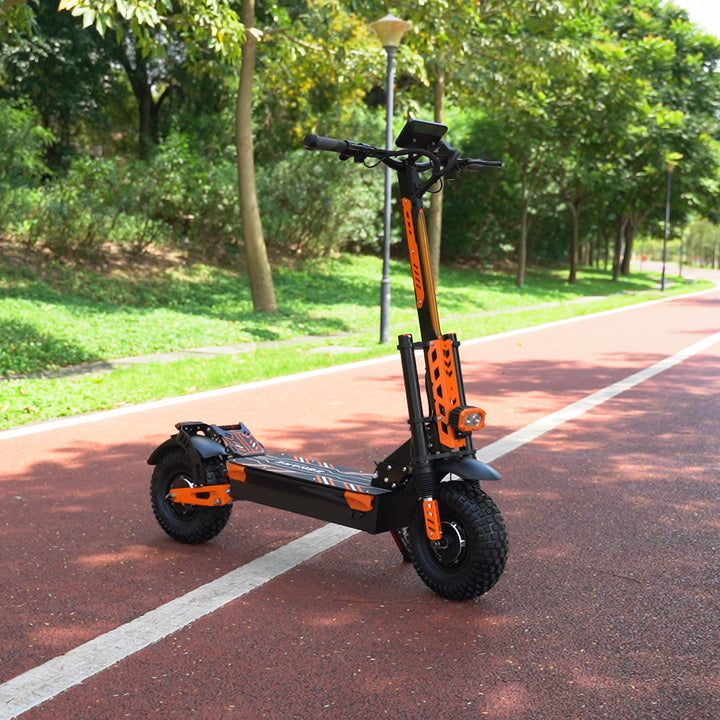
-
Max Rider Load: 440 LBS
-
Motors: 7000W Dual Motors
-
Battery: 60V 33AH (Max Range 65 miles)
-
Top Speed: 55 MPH
-
Safety: UL 2272 Certification & Hydraulic Disc Brakes
-
Suspension: Triple Clamp Hydraulic Fork & Rear Hydraulic Shock
The ZSNAKE Z39 shares the beastly 60V 33AH battery and 7000W motor setup of the F19, but features a slightly different chassis geometry tailored for aggressive off-road handling. It is undoubtedly one of the most powerful electric scooters in the world. For heavier riders who want to take their machine on dirt trails or aggressive gravel paths, the 13-inch tires combined with dual hydraulic disc brakes ensure that 440 lbs of mass can be stopped safely and predictably in any weather condition.
3. Nami Burn-E 2 Max
The Nami Burn-E 2 Max is legendary for its hand-welded tubular aluminum frame. This frame design completely eliminates the notorious stem creak found in traditional cast-aluminum folding mechanisms. It features fully adjustable hydraulic coil-over shocks, allowing heavier riders to precisely dial in the rebound and compression damping to match their exact body weight. While incredibly expensive, it offers a limousine-like ride quality for riders up to 330 lbs.
4. Kaabo Wolf King GT Pro
The Wolf King GT Pro utilizes a dual-stem, motorcycle-style front fork. For riders over 250 lbs who suffer from range anxiety and speed wobble fear, the dual stem is a revelation. It makes the steering column incredibly rigid. Operating on a 72V system, it provides blistering acceleration and is frequently ranked among the best 50 mph electric scooters 2026. The official payload is 330 lbs.
5. Dualtron Thunder 3
Minimotors' Dualtron Thunder 3 is a high-speed, high-torque monster. It uses a proprietary polyurethane cartridge suspension system. The advantage of polyurethane for heavy riders is that you can swap out the cartridges for stiffer variants (like the "Hard" or "Extra Hard" compounds) to prevent bottoming out. With a massive 72V 40Ah battery, it delivers incredible range even when lugging a 300 lb payload.
6. Apollo Phantom V4
For commercial users or daily commuters who weigh around 250 lbs to 280 lbs and do not want the massive bulk of a 13-inch tire scooter, the Apollo Phantom is a highly practical choice. It features a proprietary quadruple spring suspension system that handles weight surprisingly well for its size. It sits comfortably in the category of the best 25 mph electric scooters (though it can hit 40 mph unlocked), making it a brilliant, slightly more portable commuter.
Benefits of Upgrading to Heavy-Duty Models
We recommend upgrading to these heavy-duty platforms not just for speed, but for absolute safety. When you ride a scooter engineered for 440 lbs, the frame, the stem latch, the folding mechanism, and the brake rotors are all over-engineered. This means you will not experience catastrophic stem failure mid-ride. Furthermore, dual motors provide active electronic braking (E-ABS) on both wheels, drastically reducing stopping distances for heavy payloads compared to relying on a single mechanical disc brake.
Limitations and Practical Constraints
We must use commercial and practical judgment here: these machines are incredibly heavy. Scooters like the FOHOLO F19 and Wolf King GT weigh between 100 lbs and 150 lbs. You cannot carry them up three flights of stairs to an apartment. They require a garage or a ground-floor storage solution. Additionally, their sheer power means they blur the lines of local legislation. You must verify local ordinances; for example, understanding electric scooter laws in California or checking do you need a license for an electric scooter is mandatory, as some jurisdictions classify 50+ mph scooters as mopeds.
Comparison Table: Top High-Payload Models
| Scooter Model |
Max Payload |
Motor Power (Peak) |
Battery Voltage |
Tire Size |
| TopRiding FOHOLO F19 |
440 lbs |
7000W |
60V |
13-inch |
| TopRiding ZSNAKE Z39 |
440 lbs |
7000W |
60V |
13-inch |
| Kaabo Wolf King GT Pro |
330 lbs |
7200W |
72V |
11-inch |
| Nami Burn-E 2 Max |
330 lbs |
8400W |
72V |
11-inch |
| Apollo Phantom V4 |
300 lbs |
3200W |
52V |
10-inch |
Who Should Use It & Who Does Not Need It
For heavy-duty applications: Adults weighing over 250 lbs who use their scooter for daily commuting, hilly environments, or weekend off-roading absolutely require these 60V+, dual-motor platforms. If you are exploring the best off-road electric scooters under 1000, realize that high payloads usually require stretching that budget to get genuine hydraulic suspension and thick gauge aluminum frames.
Who does not need it: Last-mile commuters who weigh 150 lbs, need to carry their scooter onto a subway train, and only ride on flat, paved bike lanes do not need a 120-lb, 7000W monster. They are better suited to lightweight, 36V single-motor commuter scooters.
Common Mistakes Heavy Riders Make
The most catastrophic mistake we see is ignoring the tire load index. Heavy riders will buy a scooter with standard 10-inch pneumatic tires and run them at 35 PSI. Under a 300 lb load, this low pressure causes "pinch flats" (where the inner tube gets pinched against the rim on a bump) and severely overheats the tire sidewall. You must run tire pressures closer to 45-50 PSI if you are a heavier rider.
Another error is buying a 48V single motor scooter and expecting it to climb hills. The math simply does not work. A 300 lb rider on a 15-degree incline requires thousands of watts of peak power just to maintain momentum. A single motor will stall, overheat, and eventually burn out its hall sensors.
Buying Considerations & Buying Guide Table
When executing your cost-benefit analysis, do not just look at top speed. Look at the structural components that keep you alive at those speeds.
| Component |
What to Demand |
Why It Matters for Heavy Riders |
| Brakes |
Fully Hydraulic Disc Brakes (NUTT, ZOOM, or Logan) |
Stopping 400 lbs from 40 mph requires immense stopping power. Mechanical cable brakes will snap or fade rapidly under this heat. |
| Suspension |
Adjustable Hydraulic or Heavy-Duty Polyurethane |
Spring suspension will immediately bottom out, transferring severe shock to the stem folding mechanism, causing eventual metal fatigue. |
| Stem Design |
Dual-Stem or Triple-Clamp Forged Aluminum |
Single cast-aluminum stems are prone to snapping under heavy braking leverage from a heavy rider. |
| Battery Certification |
UL 2272 Certification |
Heavy loads draw maximum amperage. UL certification ensures the battery management system (BMS) won't allow thermal runaway (fires). |
Pros and Cons Table: High-Payload E-Scooters
| Pros of Heavy-Duty E-Scooters |
Cons of Heavy-Duty E-Scooters |
| Safely supports riders up to 440 lbs without structural strain. |
Extremely heavy (100+ lbs), making them impossible to carry upstairs. |
| Massive dual motors eradicate "hill anxiety" entirely. |
High initial purchase cost ($2,000 - $4,000+). |
| Large 11" to 13" tires glide over potholes and road debris safely. |
Large footprint makes them difficult to fit in standard car trunks. |
| Massive battery packs provide genuine 40+ mile real-world ranges. |
Incredible torque requires a steep learning curve for beginners. |
Expert Recommendation from TopRiding
From our experience engineering and distributing high-performance micromobility vehicles, trying to save money by purchasing a lightweight commuter scooter for a heavy adult is an exercise in futility. The scooter will break, the range will be abysmal, and you will ultimately end up purchasing a heavy-duty model anyway. We firmly believe in doing it right the first time.
We highly recommend the TopRiding FOHOLO F19 and the ZSNAKE Z39 for any rider approaching or exceeding the 300 lb mark. These machines are not just fast; they are structurally over-engineered. The 13-inch all-terrain fat tires and triple-clamp hydraulic forks provide a level of stability and confidence that smaller scooters simply cannot physically offer. The 7000W dual-motor architecture ensures that your weight is never a limiting factor, regardless of the terrain or incline. For riders seeking the absolute pinnacle of fast electric scooters for adults that won't buckle under pressure, these are the definitive choices for 2026.
Frequently Asked Questions (FAQ)
Can a 300 lb person ride a standard electric scooter?
No. Standard retail commuter scooters are engineered with a strict maximum payload of 220 lbs (100 kg). Putting a 300 lb rider on a standard scooter will void the warranty, cause the suspension to bottom out instantly, overheat the motor controller, and place life-threatening stress on the stem's folding latch. You must use a scooter explicitly rated for 300+ lbs.
How does rider weight affect electric scooter range?
Rider weight heavily penalizes battery range. Scooter manufacturers state their maximum range based on a 165 lb (75 kg) rider traveling at a slow, constant speed on flat terrain. A 300 lb rider forces the motors to work exponentially harder to overcome inertia and rolling resistance, resulting in a much higher amperage draw. Expect to lose 30% to 40% of the manufacturer's stated maximum range.
What is the best suspension type for a heavy scooter rider?
The optimal suspension for a heavy rider is an adjustable hydraulic coil-over shock system, combined with a motorcycle-style triple-clamp front fork. Heavy riders must be able to adjust the "pre-load" (tightening the spring) and the rebound damping to ensure the suspension actually absorbs impacts rather than simply compressing fully and staying bottomed out.
Authoritative References & Industry Standards
To ensure our safety guidelines and payload physics are accurate, we reference the following authoritative organizations:
-
SAE International (Society of Automotive Engineers): Establishing structural testing standards and battery safety protocols for powered micromobility vehicles. Review SAE Standards
-
Insurance Institute for Highway Safety (IIHS): Providing crash data and safety analysis regarding the importance of hydraulic braking systems and tire contact patches on two-wheeled vehicles. Review IIHS Safety Data
-
Battery University (Cadex Electronics): The definitive source on lithium-ion battery physics, explaining voltage sag, C-rates, and the impact of high-amperage draw under heavy payloads. Explore Battery University


