TopRiding electric scooters are certified to meet UL 2272 safety standards, covering critical electrical and fire safety requirements for the electrical system and battery.
This certification helps ensure safer, more reliable riding.
Over 100,000 electric scooters sold, backed by 5,000+ verified reviews and an average rating of 4.7+ stars.
Chosen by riders worldwide for reliable performance, and everyday riding confidence.
Expert support. local service.
Expert Customer Service
As a U.S.-based company, TopRiding provides 24/7 expert customer service and local after-sales support across multiple regions in North America.
Our dedicated support team is here to ensure fast responses, professional assistance, and reliable service — whenever you need it.
TEST RIDES AND SERVICE
Safety Certified
Designed to Meet UL 2272 Safety Standards
Our electric scooters are designed in accordance with UL 2272 safety requirements for electrical and battery systems, helping enhance overall safety and reliability.
Trusted by a global riding community
100,000+ Units Sold
Over 100,000 electric mobility vehicles sold, backed by 5,000+ verified reviews and an average rating of 4.7+ stars.
Chosen by riders worldwide for reliable performance, safety, and everyday riding confidence.
Expert Support. Local Service.
Expert Customer Service
As a U.S.-based company, TopRiding provides 24/7 expert customer service and local after-sales support across multiple regions in North America.
Our dedicated support team is here to ensure fast responses, professional assistance, and reliable service—whenever you need it.
9 Top Long-Range E-Bike Categories & Models: How to Choose the Right One
9 Top Long-Range E-Bike Categories & Models: How to Choose the Right One
senkan
TopRiding E-Bike Buying Guide | 2026
Shopping for a long-range electric bike is not simply about finding the largest battery or the highest advertised mileage. The right choice depends on how far you ride, how much weight you carry, the terrain you encounter, and whether you value comfort, speed, cargo capacity, or portability. A bike advertised with 100 miles of range may be a poor choice for someone regularly climbing steep hills, while a well-equipped 60-mile model may be more practical for demanding everyday use.
From our experience evaluating e-bike specifications, battery capacity, measured in watt-hours (Wh), is a more useful starting point than a manufacturer's maximum range claim. Motor efficiency, rider weight, tire resistance, elevation changes, temperature, and riding mode all influence the distance you can actually travel.
Which Long-Range E-Bike Should You Choose?
For most riders, a long-range commuter or all-terrain e-bike with a battery of approximately 700–1,000Wh is a sensible starting point. Riders who regularly travel long distances, carry cargo, or ride in hilly areas should consider a larger battery or a compatible dual-battery system. If you want a balance of substantial battery capacity, full suspension, fat tires, and motorcycle-inspired styling, the TopRiding R2 is a model worth considering.
Quick Answer: The 9 Best Long-Range E-Bike Categories
Best for everyday commuting: Long-range commuter e-bikes.
Best for mixed terrain: All-terrain electric bikes.
Best for cargo and family transport: Dual-battery cargo e-bikes.
Best for rough roads: Full-suspension long-range e-bikes.
Best for recreational trails: Fat-tire electric bikes.
Best for portability: Folding long-range e-bikes.
Best for premium lightweight riding: Lightweight e-bikes with range extenders.
Best for extreme-distance applications: High-capacity adventure e-bikes.
Best for motorcycle-inspired versatility: Moto-style long-range e-bikes such as the TopRiding R2.
Our recommendation: Compare battery watt-hours, braking performance, total bike weight, and realistic riding conditions before paying extra for a high advertised range.
What Makes an E-Bike a Long-Range Electric Bike?
A long-range electric bike is designed to cover more distance per charge than a typical entry-level e-bike. It generally achieves this through a larger battery, an efficient motor and controller, suitable gearing, and a riding position that supports extended journeys.
However, there is no single battery size that automatically makes a bike long-range. A 750Wh battery may be sufficient for a 40-mile daily commute, while a rider carrying equipment through mountainous terrain may need considerably more energy.
Understand battery capacity in watt-hours
Battery energy capacity is calculated by multiplying voltage by amp-hours:
Watt-hours (Wh) = Voltage (V) × Amp-hours (Ah)
For example, a 52V 25Ah battery provides 1,300Wh of nominal energy. This is a substantial battery capacity for a recreational or commuting e-bike. It gives the rider more energy available than a comparable bike with a smaller battery, although the final mileage still depends on power consumption.
Why advertised range is not guaranteed range
Manufacturers usually publish maximum range figures under favorable conditions. Lower assist levels, lighter riders, flat roads, moderate temperatures, and properly inflated tires can all improve mileage. High assist settings, frequent acceleration, steep climbs, heavy loads, and low tire pressure reduce it.
For practical planning, we recommend treating the advertised maximum as an optimistic reference rather than a guaranteed riding distance. Leave a meaningful battery reserve instead of planning every trip around the last mile of the manufacturer's claim.
9 Top Long-Range E-Bike Categories & Models Worth Considering
1. Long-Range Commuter E-Bikes: Best for Daily Transportation
A long-range commuter e-bike is designed for riders who need dependable transportation throughout the working week. Its priorities are battery efficiency, predictable handling, practical accessories, and a comfortable riding position.
Look for a battery of approximately 600–900Wh, integrated lighting, reliable brakes, mudguard compatibility, and a frame that suits your daily route. A torque sensor is particularly useful for commuters because it adjusts assistance according to how much effort the rider applies.
Model direction: The Aventon Aventure.2 is an example of a comfort-oriented, battery-equipped model worth comparing when shopping for a versatile daily ride. Riders who commute mainly on paved roads may prefer a more conventional commuter frame with less aggressive tires.
Our verdict: This is the best category for people who want one electric bike to replace regular short- and medium-distance car trips. Do not pay extra for extreme off-road suspension if your route consists almost entirely of paved streets.
2. All-Terrain Long-Range E-Bikes: Best for Mixed Surfaces
All-terrain e-bikes are designed for riders who move between pavement, gravel, dirt roads, and uneven recreational trails. They need more than a large battery. Tire traction, suspension, frame stability, and braking performance are equally important.
A battery around 700–1,000Wh is a reasonable starting point for riders planning longer mixed-terrain trips. Wider tires can improve comfort and traction, but they may also create additional rolling resistance. This is why the most aggressive-looking bike is not necessarily the most efficient long-distance choice.
Model direction: The TopRiding R2 is a moto-style option in this category, combining a 52V 25Ah battery with full suspension and 20 × 4.0-inch tires. Its specification makes it particularly interesting for riders who prioritize comfort and versatility over lightweight portability.
Before deciding, read our guide to what makes an e-bike all-terrain. It explains why tire design, suspension, and frame construction matter just as much as motor output.
Our verdict: Choose this category if your riding environment changes frequently. It offers a more useful balance than buying a road-focused commuter and expecting it to perform like a trail bike.
3. Dual-Battery Cargo E-Bikes: Best for Heavy Loads and Extended Trips
For commercial users, delivery riders, parents, and people transporting equipment, cargo capacity can be more important than outright speed. A dual-battery cargo e-bike provides additional energy capacity while supporting longer journeys under heavier loads.
The Lectric XPedition2 Dual Long Range is a model worth investigating in this category. Its published configuration includes a combined 1,680Wh battery capacity, illustrating how dual-battery systems can extend the distance available to riders who need to carry cargo.
However, a larger battery does not eliminate the energy cost of carrying additional weight. Cargo, passengers, accessories, and the bike itself all increase the work required from the motor.
Our verdict: A dual-battery cargo e-bike is worth the investment when long daily distances and substantial payloads are routine. For occasional grocery trips, the extra battery and larger frame may be unnecessary.
4. Full-Suspension Long-Range E-Bikes: Best for Rough Roads
Full-suspension electric bikes use front and rear suspension to reduce the impact of uneven surfaces. They are particularly useful for riders covering long distances on broken pavement, gravel roads, and recreational trails.
The advantage is not simply comfort. Better suspension can help maintain tire contact with uneven surfaces, improving control and reducing rider fatigue. The disadvantage is additional weight, mechanical complexity, and potentially greater maintenance requirements.
Our verdict: Choose full suspension when your actual route justifies it. If you ride smooth asphalt every day, a rigid or front-suspension commuter may provide better value and efficiency.
5. Fat-Tire Long-Range E-Bikes: Best for Traction and Comfort
Fat-tire e-bikes typically use tires approximately 4 inches wide. Their larger contact area and ability to run at suitable lower pressures can improve comfort and traction on sand, loose gravel, snow, and uneven ground.
They are popular with recreational riders who want one bike for several environments. The trade-off is weight and rolling resistance. Fat tires can consume more energy than narrower tires, particularly on smooth paved roads.
Our verdict: Fat tires are worth choosing when terrain and comfort justify their additional weight. They are not an automatic upgrade for every long-distance commuter.
6. Folding Long-Range E-Bikes: Best for Limited Storage Space
Folding electric bikes combine a compact storage design with electric assistance. They are useful for apartment residents, RV travelers, commuters with limited storage, and riders who need to transport their bike in a vehicle.
The Lectric XP 4.0 Long-Range configuration is one example to investigate when comparing folding e-bikes with larger battery options. Buyers should verify the exact battery configuration because standard and long-range versions may have different specifications.
There is a practical compromise: folding hinges and compact frames can add weight and introduce additional structural considerations. A folding bike with a large battery may also be much heavier than its compact appearance suggests.
Our verdict: Buy a folding long-range e-bike when storage and transport are major priorities. If you rarely fold your bike, a conventional frame may deliver better ride comfort and simplicity.
7. Lightweight Premium E-Bikes with Range Extenders: Best for Natural Pedaling
Not every long-range rider wants a heavy bike with a huge battery. Lightweight electric bikes use efficient drive systems and optional range-extender batteries to provide additional distance without carrying a large battery at all times.
The Specialized Turbo Vado SL 2 platform is an example worth comparing in this category. Its range-extender approach appeals to riders who want a more conventional cycling experience while retaining the option of additional battery capacity.
The cost is usually higher than that of many entry-level and mid-range e-bikes. Riders also need to consider whether the smaller standard battery and additional extender purchase make financial sense for their travel requirements.
Our verdict: This category is worth the premium for riders who value low weight, natural handling, and active pedaling. It is less suitable for people who expect maximum motor assistance throughout every journey.
8. High-Capacity Adventure E-Bikes: Best for Extreme-Distance Riding
High-capacity adventure e-bikes are designed for riders who want to cover unusually long distances or spend extended periods away from charging facilities. They may use large battery packs, dual-battery arrangements, or specialized high-energy configurations.
The Optibike R22 is an example of a specialist long-distance model associated with exceptionally high advertised range figures. This type of bike is aimed at a narrower market than ordinary commuter e-bikes.
Before buying, evaluate the complete package: bike weight, charging time, battery replacement cost, support availability, and whether the bike is practical for your intended routes. A very large battery is useful only when the rest of the bicycle supports the journey.
Our verdict: Choose this category when extreme distance is a genuine requirement, not simply an attractive specification. Most everyday riders will get better value from a moderately sized battery and a more practical bike.
9. Moto-Style Long-Range E-Bikes: Best for Power, Comfort, and Distinctive Design
Moto-style e-bikes combine motorcycle-inspired styling with wide tires, substantial frames, and powerful-looking proportions. They appeal to riders who want a distinctive appearance and a stable, comfortable riding platform.
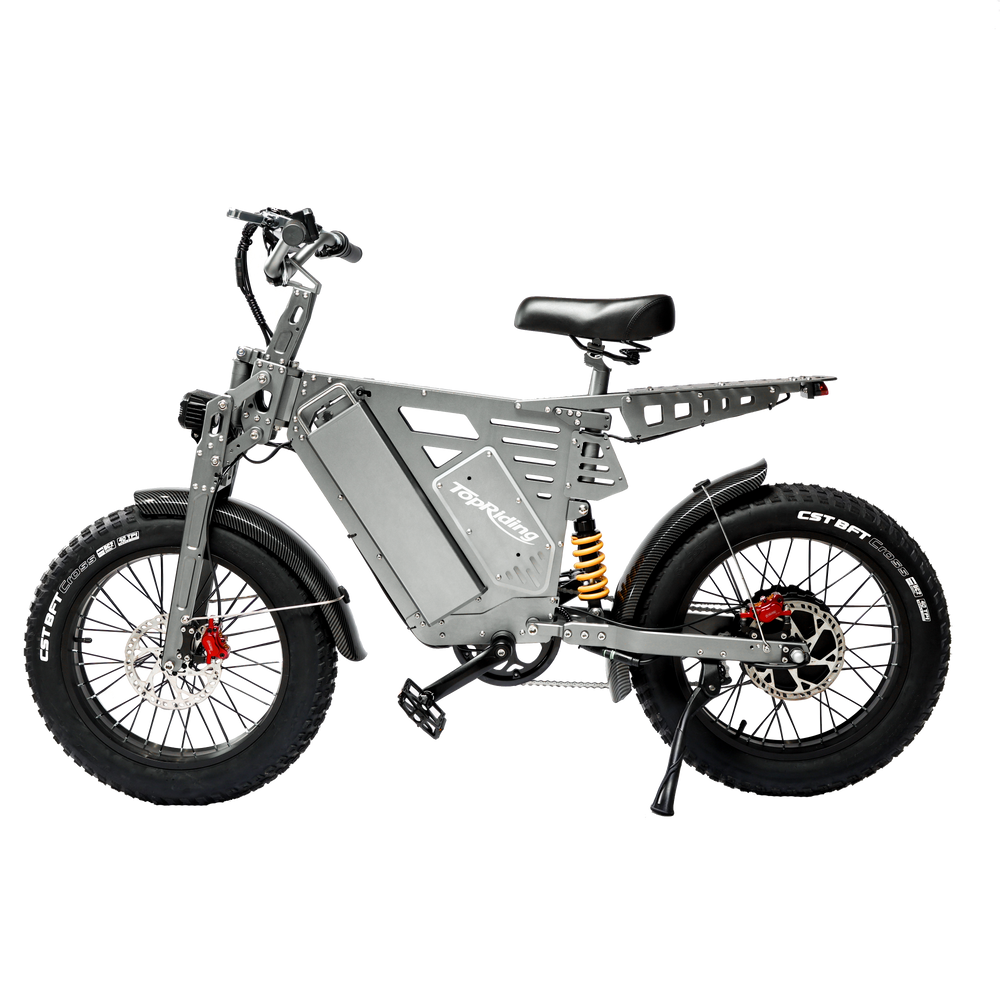
The TopRiding R2 is a strong example of this category. It combines a 1,300Wh battery, full suspension, 4-piston hydraulic disc brakes, and a CNC-machined aluminum frame. The configuration is aimed at riders who value battery capacity and a substantial chassis rather than a lightweight bicycle experience.
Its 82 lb weight is an important consideration. It is not the right choice for someone who regularly carries an e-bike upstairs or needs to load it onto a lightweight vehicle rack.
Our verdict: Moto-style models are worth considering when design, stability, suspension, and battery capacity are important. Buyers should evaluate the actual riding position, legal classification, and total weight before treating them as ordinary commuter bicycles.
Featured Model: TopRiding R2 Full CNC Moto-Style E-Bike
TopRiding R2 – 52V 25Ah Long-Range Electric Bike
The TopRiding R2 is designed for riders who want a substantial battery, full suspension, and motorcycle-inspired construction in one electric bike. Its 1,300Wh battery provides a meaningful energy reserve for longer recreational rides and everyday transportation.
Listed price in the supplied product configuration: $1,999.00. Check the product page for current pricing and availability.
Specification
TopRiding R2
Motor
Rear hub motor
Rated / Peak Power
750W / 1,500W
Maximum Torque
100Nm
Battery
52V 25Ah lithium-ion
Energy Capacity
1,300Wh
Battery Cells
21700 cells
Claimed Range
Up to 60 miles
Charging
Dual charging ports; approximately 6.5 hours with two chargers
In our assessment, the R2 is most interesting for riders who want a large battery without moving into an extremely expensive specialist adventure-bike category. Its 1,300Wh capacity is a strong specification for its intended use, and the full-suspension setup gives it an advantage over basic rigid-frame models on uneven surfaces.
There are two trade-offs buyers should understand. First, 82 lbs is substantial for a bicycle, so storage, lifting, and transportation need consideration. Second, its advertised range of up to 60 miles should be treated as a maximum claim, not a guaranteed result under every riding condition.
The 750W rated motor and 20 mph factory speed limit also matter when evaluating local e-bike classifications. Buyers should not assume that a high peak-power specification automatically makes a vehicle legal for every public road, trail, or bike lane.
Comparison Table: Which Long-Range E-Bike Category Is Best?
The following comparison focuses on practical use rather than simply ranking bikes by advertised mileage. Battery ranges are indicative shopping targets for the category, not verified specifications for every model.
Category
Representative Model / Example
Battery Direction
Best Use
Main Trade-Off
Commuter
Aventon Aventure.2
Approximately 600–900Wh
Daily transportation
May lack extreme off-road capability
All-terrain
TopRiding R2
1,300Wh on R2
Mixed surfaces
Higher bike weight
Dual-battery cargo
Lectric XPedition2 Dual Long Range
1,680Wh example configuration
Heavy loads and deliveries
Large frame and weight
Full suspension
TopRiding R2
1,300Wh on R2
Rough roads and trails
More maintenance components
Fat tire
TopRiding R2
1,300Wh on R2
Loose surfaces and comfort
Higher rolling resistance
Folding
Lectric XP 4.0 Long-Range
Check exact battery version
Storage and transport
Weight and hinge complexity
Lightweight premium
Specialized Turbo Vado SL 2
Standard battery plus extender option
Efficient active riding
Premium purchase cost
Adventure
Optibike R22
High-capacity specialist system
Extreme-distance riding
High cost and limited practicality
Moto-style
TopRiding R2
1,300Wh on R2
Comfort and distinctive styling
Not lightweight or universally road-legal
Pros and Cons of Buying a Long-Range E-Bike
Advantages
Disadvantages
Fewer charging stops on longer journeys.
Larger batteries generally increase purchase cost.
More flexibility for commuting and recreational trips.
Additional battery weight can affect handling and portability.
More energy available for hills and heavier loads.
High motor assistance can still consume energy quickly.
Dual-battery configurations can support demanding daily use.
Replacement batteries and compatible chargers can be expensive.
Some models combine range with suspension and cargo versatility.
Maximum range claims can be misleading without test conditions.
Less frequent charging can simplify a regular riding routine.
More electrical capacity makes battery safety and maintenance especially important.
How to Choose the Right Long-Range E-Bike
1. Calculate your actual daily distance
Start with your normal journey, not the longest ride you might take once a year. A 25-mile round trip does not necessarily require a 1,500Wh battery. However, if you commute 40 miles daily and cannot charge at work, a larger battery provides a useful reserve.
We recommend choosing a model whose realistic usable range exceeds your normal daily requirement by a comfortable margin. This protects against weather changes, detours, aging batteries, and unexpected elevation gains.
2. Compare watt-hours instead of voltage alone
Voltage is important for electrical system design, but it does not tell you how much total energy a battery stores. Compare watt-hours when evaluating battery capacity. A 52V 20Ah battery stores 1,040Wh, while a 48V 20Ah battery stores 960Wh.
Do not assume that a higher-voltage bike automatically travels farther. Actual range also depends on the motor, controller, rider input, and riding environment.
3. Match motor performance to your terrain
Flat urban routes place different demands on an e-bike than steep hills or loose trails. Torque, controller tuning, gearing, and heat management all affect how effectively a motor delivers assistance.
For riders in hilly areas, a model with suitable torque and efficient assistance can be more useful than one selected solely for a high peak-wattage figure. If off-road use is important, read our guide to whether e-bikes are good for off-road riding.
4. Evaluate brakes, tires, and suspension
A long-range e-bike carries a large battery and may weigh considerably more than a conventional bicycle. When the bike is loaded, braking performance becomes especially important.
Hydraulic disc brakes are worth considering for heavier or more powerful models. Tire width and tread should match the terrain, while suspension should be selected according to actual road conditions. Do not pay for suspension travel you will rarely use.
5. Check battery safety and certification
Battery quality should never be treated as a secondary specification. Ask about the battery management system (BMS), cell sourcing, charger compatibility, warranty coverage, and applicable electrical safety certification.
UL 2849 is an important reference because it addresses the e-bike electrical system, including the battery, drive unit, BMS, wiring, and charging components. Ask the manufacturer for documentation rather than relying on an unsupported certification badge.
6. Consider the total weight and payload
Battery capacity is only one part of the ownership equation. A heavy bike may be difficult to carry, store, transport, or maneuver without electrical assistance. Check the maximum payload and remember that this figure generally includes the rider and any carried equipment.
7. Check local speed and road-use regulations
Motor power and advertised top speed do not determine legal classification by themselves. In California, for example, the three e-bike classes have specific pedal-assistance, throttle, and speed requirements. Vehicles that exceed the relevant legal definitions may be treated differently from ordinary electric bicycles.
Before purchasing, verify the bike's factory configuration, labeling, local trail access rules, and applicable state and municipal requirements. This is particularly important for high-powered and moto-style models.
7 Common Mistakes When Buying a Long-Range E-Bike
Trusting the maximum range claim: Maximum mileage is not a promise of everyday performance. Look for the conditions behind the figure.
Comparing voltage instead of watt-hours: Battery energy capacity is a better starting point for comparing stored energy.
Ignoring bike weight: A heavy e-bike can be inconvenient even when its battery performance is excellent.
Buying more motor power than necessary: Higher output is not automatically more efficient or more suitable for public-road use.
Overlooking battery certification: A large battery without credible safety documentation is not a bargain.
Choosing tires based only on appearance: Wide tires can be excellent off-road but may reduce efficiency on pavement.
Ignoring replacement and service costs: Battery replacement, brake maintenance, tires, and specialist components affect long-term ownership cost.
Professional buying tip: Ask the seller for the battery's exact Wh capacity, the tested range conditions, charger specifications, warranty terms, and battery replacement availability. If these details are unclear, do not make the purchase based on a headline mileage figure.
Cost-Benefit Analysis: Is a Bigger Battery Worth the Money?
A larger battery usually increases the purchase price, but the decision should be based on how often you need the extra capacity. For a rider covering 15 miles per day, a moderately sized battery may be more economical. For someone traveling 40–60 miles daily, a larger battery can reduce charging interruptions and provide more flexibility.
Consider these three buying situations:
Budget-conscious daily commuter
If your daily journey is relatively short and charging is convenient, a 600–750Wh battery may provide enough capacity. Spending extra on an extremely large battery may not produce a meaningful improvement in your routine.
Frequent long-distance rider
If you regularly ride longer distances, climb hills, or carry equipment, moving toward a 900–1,300Wh configuration can be worthwhile. The extra capacity offers a larger energy reserve, although it does not guarantee a fixed mileage increase.
Commercial or heavy-duty user
For delivery operations and regular cargo transportation, downtime has a direct cost. A dual-battery configuration may justify its higher initial investment when it reduces charging interruptions and supports a demanding schedule. However, evaluate battery replacement cost and service availability before committing.
In most professional situations, we recommend paying for the battery capacity and structural quality that match the workload, rather than buying the largest specification available.
Who Should Use a Long-Range E-Bike, and Who Does Not Need One?
Who should consider buying one?
Commuters with long daily round trips.
Riders who frequently travel between towns or across large urban areas.
Outdoor enthusiasts exploring trails and mixed terrain.
Delivery operators and commercial users carrying regular loads.
RV owners and travelers who want extended recreational rides.
Riders who cannot conveniently charge their bikes during the day.
Who does not need an oversized battery?
Riders who only travel a few miles per day.
People with convenient charging access at home and work.
Riders who prioritize a lightweight bicycle for stairs and public transport.
Occasional users who do not need extended daily mileage.
People who mainly ride short, flat routes with low assistance.
If portability is more important than extended riding distance, a folding electric scooter or compact transportation option may be worth comparing. TopRiding also offers long-range electric scooters and commuter electric scooters for different transportation needs.
Expert Recommendation: Which Long-Range E-Bike Is the Best Investment?
There is no single model that is best for every rider. The right purchase depends on the distance, load, terrain, and ownership expectations. Our recommendations are straightforward:
For daily commuting: Choose an efficient commuter with enough battery capacity for your round trip and reserve.
For mixed terrain: Prioritize suitable tires, suspension, and battery capacity together.
For heavy cargo: Consider a dual-battery cargo platform with a suitable payload rating.
For portability: Choose a folding model only if you will regularly use its folding function.
For demanding recreational riding: Look for a durable frame, effective brakes, and a battery that supports your actual route.
For moto-style versatility: Consider the TopRiding R2 if its 1,300Wh battery, full suspension, and 82 lb weight match your needs.
We believe the best long-range e-bike is not the one with the highest advertised mileage. It is the one that consistently completes your normal journeys without unnecessary weight, excessive cost, or compromises in safety.
Final verdict: For buyers seeking a balance of battery capacity, suspension, and a distinctive moto-style platform, the TopRiding R2 deserves a place on the shortlist. Its 52V 25Ah, 1,300Wh battery and claimed range of up to 60 miles make it an interesting option for riders who need more capacity than a basic commuter offers. Confirm the current product configuration, local legal requirements, and your own range expectations before purchasing.
Frequently Asked Questions About Long-Range E-Bikes
1. What is considered a long-range e-bike?
A long-range e-bike is generally designed to travel farther per charge than a basic everyday model. There is no universal battery threshold, but models with approximately 700Wh or more are a useful starting point for buyers seeking extended riding distance. The actual range depends on terrain, rider weight, assistance level, and battery condition.
2. How far can a long-range e-bike travel on one charge?
Depending on battery size and riding conditions, some models may cover 40–60 miles, while larger battery or dual-battery configurations can claim substantially more. Maximum advertised range should not be treated as guaranteed real-world mileage.
3. Is a 1,000Wh e-bike battery good for long distances?
Yes. A 1,000Wh battery offers substantial stored energy for many commuting and recreational applications. It may be sufficient for extended journeys, but steep hills, high assistance, heavy payloads, and wide tires can increase energy consumption.
4. Is a dual-battery e-bike better than a single-battery model?
A dual-battery e-bike can provide greater total energy capacity and reduce charging interruptions. It is particularly useful for cargo transport and frequent long-distance riding. However, it typically adds weight and cost, so it is not necessary for every rider.
5. Does a more powerful motor increase e-bike range?
Not automatically. A powerful motor can provide stronger acceleration and climbing performance, but using more electrical power can drain the battery faster. Range depends on the complete system, including battery capacity, motor efficiency, controller settings, and rider input.
6. Is a fat-tire e-bike suitable for long-distance riding?
Yes, particularly when the route includes gravel, sand, uneven surfaces, or other terrain where wider tires improve traction and comfort. On smooth roads, however, fat tires may create additional rolling resistance and reduce efficiency compared with narrower tires.
7. Is the TopRiding R2 a good long-range e-bike?
The TopRiding R2 is worth considering if you want a 1,300Wh battery, full suspension, 20 × 4.0-inch tires, and a motorcycle-inspired frame. Its advertised range is up to 60 miles. Its 82 lb weight means it is better suited to riders who prioritize capacity and comfort over easy lifting and portability.
8. How long does it take to charge a long-range e-bike?
Charging time depends on battery capacity, charger output, and whether the bike supports multiple charging ports. Larger batteries generally take longer to recharge. Check the manufacturer's charging specifications and use compatible chargers only.
9. What should I check before buying a long-range e-bike?
Check battery watt-hours, real-world range conditions, motor specifications, brakes, tires, suspension, total weight, payload rating, warranty, replacement battery availability, and electrical safety documentation. Also verify whether the bike's factory configuration complies with local road and trail regulations.