Every prospective electric mobility buyer, daily commuter, and weekend trail explorer encounters the aggressive visual presence of wide-rubber electric bikes. You scroll through social media or walk past local bike paths, and four-inch-wide knobby tires seem to be everywhere. Marketers aggressively pitch them as unstoppable monster trucks that conquer every terrain with cloud-like comfort, while traditional cycling purists dismiss them as bloated, overweight mopeds disguised with bicycle pedals. When shoppers ask us whether are fat-tire e-bikes better, our answer cuts through the internet hyperbole: they are fundamentally superior machines for specific mechanical tasks, and fundamentally inferior tools for others. In personal electric mobility, there is no free lunch. Physics always exacts a toll. When you double the width of a tire from two inches to four inches, you fundamentally transform rolling resistance, rotational inertia, gyroscopic steering resistance, and pneumatic shock absorption. Sourcing the right electric rig is not about following trends; it is about matching vehicle physics to your daily terrain, storage realities, and rider mass. As electric vehicle chassis fabricators, powertrain tuners, and test riders who evaluate motor torque output, tire deflection curves, and frame stress daily at TopRiding, we examine vehicles from the metal forward. Here is our practitioner-grade teardown answering whether are fat-tire e-bikes better across eight definitive operational aspects.

Quick Answer: Are Fat-Tire E-Bikes Better?
To determine if are fat-tire e-bikes better for your lifestyle, you must weigh your terrain against your logistical constraints. Fat-tire e-bikes (3.8 to 4.8-inch tire width) are definitively superior in four categories: (1) Flotation and Mechanical Traction over loose sand, deep snow, mud, and riverbed gravel; (2) Pneumatic Micro-Vibration Damping that absorbs jagged pavement cracks and trail chatter; (3) Heavy-Payload Support (handling adult rider weights up to 330 lbs with zero rim pinching); and (4) All-Weather Confidence on wet tram tracks, sewer grates, and slick leaf litter. Conversely, they are definitively worse in four areas: (1) Curb Weight and Portability (averaging 70 to 85 lbs, making walk-up apartment storage and car-rack transport brutal); (2) Rolling Resistance and Energy Draw (consuming 25% to 35% more Watt-hours per mile); (3) Steering Agility and Self-Steer Drag at low speeds; and (4) Pedal-Only Limp-Home Resistance if the battery drains to zero. For multi-surface adventurers and heavy riders, high-torque machines like the TopRiding R2 Full CNC Moto-Style eBike represent the gold standard of fat-tire performance. For riders living on a third-floor walk-up prioritizing subway transit, a compact folding scooter remains the smarter tool.
What It Is: The Physics of Wide-Tire Contact Patches
To evaluate if are fat-tire e-bikes better, you must understand the tire contact patch. A standard commuter or hybrid road bicycle runs tires between 1.75 and 2.2 inches in width, inflated to high pressures between 40 and 65 pounds per square inch (PSI). Under the weight of an adult rider, this setup creates an elongated, oval contact patch roughly the size of a credit card. High pressure minimizes casing deformation, yielding low rolling resistance on pristine asphalt, but causes the tire to slice straight through loose substrates like soft beach sand, mud, and uncompacted snow, sinking the rim to the axle.
A fat-tire e-bike operates on tires spanning 3.8 to 4.8 inches in width (most commonly 20 × 4.0 inches or 26 × 4.0 inches), seated on ultra-wide 80mm to 100mm rims. The defining engineering advantage is not just width; it is air volume displacement. A 4.0-inch tire holds approximately three to four times the cubic volume of atmospheric air compared to a commuter tire. This massive air chamber allows the tire to be operated at ultra-low pressures—ranging from 5 to 20 PSI.
Under physical mechanics, the contact patch area ($A$) is a function of the total vehicle and rider weight ($W$) divided by internal tire inflation pressure ($P$): $$A \approx \frac{W}{P}$$
By dropping inflation pressure from 50 PSI down to 10 PSI, you expand the tire's ground contact footprint by up to 300 percent. The tire deforms elastically over protruding rocks, roots, and curbs rather than deflecting off them. Instead of sinking into soft ground, the tire creates ground flotation, floating across deep snow, muddy trails, and dune sand where narrow tires are completely immobilized. From our experience on trail test tracks, this contact patch expansion provides an unmatched sense of planted confidence that beginners and heavy riders immediately appreciate.
Quick Summary Table: The 8 Operational Aspects Evaluated
| Operational Aspect |
Fat-Tire eBike (4.0" Tire / Low PSI) |
Standard Commuter eBike (2.0" Tire / High PSI) |
Direct Verdict: Which Is Better? |
Primary Engineering Driver |
| 1. Loose Surface Traction |
Exceptional flotation across sand, snow, mud, and wet rocks |
Cuts into soft ground; easily loses lateral traction and sinks |
Fat-Tire Wins Decisively |
Wide contact patch prevents surface penetration |
| 2. Ride Comfort & Compliance |
Pneumatic air volume acts as high-capacity natural suspension |
Transfers road vibration directly into hands, wrists, and spine |
Fat-Tire Wins Decisively |
Low-pressure air chamber absorbs micro-impacts |
| 3. Payload & Heavy Rider Support |
High structural load capacity (300 to 330+ lbs); zero pinch flats |
Vulnerable to snake-bite pinch flats under heavy adult payloads |
Fat-Tire Wins Decisively |
Substantial tire casing volume cushions rim strikes |
| 4. Energy Efficiency & Range |
High rolling resistance; drains 25% to 35% more Wh per mile |
Low rolling resistance; maximizes motor efficiency and battery range |
Standard Tire Wins Decisively |
Narrow contact patch reduces tire hysteresis losses |
| 5. Handling Agility & Cornering |
Higher gyroscopic rotational inertia; noticeable low-speed drag |
Flickable, razor-sharp steering response and rapid line changes |
Standard Tire Wins Decisively |
Lower wheel mass allows effortless counter-steering |
| 6. Weight & Transport Logistics |
Heavy curb weight (70 to 85+ lbs); hard to lift on car racks |
Lightweight (40 to 55 lbs); easy to carry up apartment stairs |
Standard Tire Wins Decisively |
Reinforced fat rims, wide forks, and big tires add mass |
| 7. Maintenance & Running Costs |
Puncture-resistant casing, but replacement tires cost $60–$100+ |
Widely available tires costing $25–$45; universal tubes |
Standard Tire Wins on Cost |
Fat tires are proprietary, heavy, and costlier to ship |
| 8. All-Weather City Commuting |
Immune to trolley tracks, sewer grates, and slick storm debris |
Tires can catch in drainage grates; nervous over wet metal |
Fat-Tire Wins on Safety |
Wide tread spans street gaps and surface imperfections |
The 8 Critical Aspects: Are Fat-Tire E-Bikes Better?
1. Surface Traction and Flotation Dynamics
The original mechanical reason fat tires were invented in Alaska and New Mexico was simple: survival over snow and sand. In our testing across washed-out fire roads, coastal dune trails, and icy winter roads, the question of whether are fat-tire e-bikes better for traction is settled without debate. They completely outperform standard tires.
When you drop a 4.0-inch tire to 8 PSI, the tread conforms to the micro-topography of the terrain. The side knobs claw into loose decomposed granite, gravel berms, and wet tree roots. On a standard commuter e-bike, hitting a patch of damp sand or wet leaves at 20 MPH frequently washes out the front wheel, leading to sudden low-side crashes. A fat tire rolls over those same transitional hazards with unfazed tracking stability. If your routes include unpredictable off-road conditions, unpaved canal paths, or winter slush, fat tires provide genuine multi-season traction. For riders exploring stand-up platforms with equivalent terrain capabilities, compare traction dynamics across our collection of Off Road E-Scooters and our field guide to the Top off-road scooters for adults.
2. Pneumatic Ride Comfort and Micro-Vibration Damping
Many consumers mistakenly believe that full mechanical suspension is the only way to achieve a comfortable ride. In practical engineering, the tire is your first, and most important, suspension system. Mechanical suspension forks have stiction—initial friction in the seals and bushings—meaning they do not react to tiny high-frequency road vibrations, chip-seal asphalt, or brick pavers.
The enormous air volume of a fat tire acts as an undamped low-frequency pneumatic spring. It swallows high-frequency road chatter before those vibrations ever reach the front axle. When you ride a rigid-frame fat bike at 15 PSI, the ride comfort rivals that of a complex, expensive cross-country dual-suspension commuter. When you pair fat tires with genuine front and rear mechanical suspension—such as the custom 4-link fork and coil-over shock on the TopRiding R2—you achieve an ultra-smooth, motorcycle-grade ride that isolates the rider from bone-jarring potholes entirely.
3. Payload Support and Structural Stability for Heavy Adults
In most professional situations, standard commuter bicycles are engineered around an average rider mass of 160 to 180 pounds (72 to 81 kg). When an adult rider weighing 230 to 300+ pounds sits on a standard 2.0-inch commuter tire, the tire casing compresses severely. To prevent the rim from bottoming out against the ground when hitting a pothole, the rider must pump the tire to maximum pressure (65+ PSI). This produces a harsh, unforgiving ride and leaves the inner tube vulnerable to "pinch flats" (snake bites), where the rim impacts an obstacle and punctures the tube against itself.
Fat-tire e-bikes are inherently engineered for heavy-duty structural loading. The wide 80mm double-wall aluminum rims distribute vertical rider mass across a massive air volume. Even under a 330-pound payload, a 20 × 4.0-inch tire operated at 18 PSI provides substantial cushion without pinching. For larger riders, the added stability, thicker spokes, and wide-stance hub spacing make fat-tire platforms significantly safer and more durable over long ownership cycles.
4. Rolling Resistance, Motor Drag, and Battery Consumption
Here is where the marketing illusion falls apart. If your primary riding involves smooth paved asphalt, the answer to whether are fat-tire e-bikes better is an unequivocal no. They are significantly less efficient.
Tire hysteresis—the continuous energy lost as the rubber casing flexes and rebounds against the ground—increases drastically with wider, lower-pressure tires. Furthermore, aggressive knobby tread blocks generate aerodynamic turbulence and continuous acoustic hum on pavement. In our testing across standardized flat road loops at 20 MPH:
- A standard 700x38c commuter e-bike consumes roughly 15 to 18 Watt-hours per mile (Wh/mi).
- A 20x4.0-inch fat-tire e-bike running at 15 PSI consumes 24 to 30 Watt-hours per mile under identical rider and speed parameters.
That represents an approximate 35% energy penalty. If you install an undersized 48V 14Ah (672Wh) battery on a fat-tire bike, your real-world throttle range will often fall short of 22 miles. Sizing your electrical foundation with at least a 1000Wh to 1300Wh high-capacity battery is mandatory to compensate for fat-tire rolling resistance. For riders who prioritize pure transit efficiency, exploring streamlined alternatives like Commuter E-Scooters or our evaluation of Electric scooters for commuting daily use highlights how lower rolling resistance extends daily range.
5. Handling Agility, Steering Inertia, and Gyroscopic Drag
A bicycle changes direction through counter-steering: you initiate a momentary steer in the opposite direction to lean the bike into a corner. The ease with which a bike leans is dictated by the rotational inertia of the wheel assembly ($I = mr^2$).
A complete 26 × 4.0-inch fat-tire front wheel system (wide rim, thick rim strip, heavy-duty 4-inch inner tube, and wire-bead knobby tire) can easily weigh over 8 to 10 pounds, compared to just 3 to 4 pounds for a commuter wheel. At speeds above 15 MPH, that rotating mass acts like a powerful gyroscope. The bike resists leaning, demanding deliberate upper-body steering input. Furthermore, at low speeds (under 8 MPH), fat tires exhibit a phenomenon known as "self-steer": the tire casing grips uneven pavement crowns and pulls the handlebars sideways, requiring active rider correction. If you need a nimble, razor-sharp machine to weave between gridlocked urban traffic, a fat-tire bike feels like maneuvering a light tractor.
6. Vehicle Curb Weight and Transport Logistics
This is the single most common cause of buyer's remorse in the fat-tire sector. An authentic, heavy-duty fat-tire electric bike weighs between 70 and 85+ pounds (32 to 39 kg). The wider tires require wider fork crowns, extended bottom brackets, wider rear hub dropouts (170mm to 197mm spacing), and reinforced aluminum frame gusseting to handle lateral twisting torque.
Consider the real-world logistical friction:
-
Apartment Living: Hauling an 82-pound e-bike up two flights of stairs to your apartment after a long workday is an exhausting task.
-
Automobile Hitch Racks: Standard automotive bicycle hitch racks are rated for 35 to 40 pounds per tray. Loading two fat-tire e-bikes onto a standard rack will bend the steel arms or snap the hitch pin. You must invest in an expensive, motorcycle-grade hitch carrier rated for 100 pounds per tray, equipped with specialized wide-tire wheel cradles.
-
Public Transit Restrictions: Many city bus front bike racks and train passenger cars strictly ban tires wider than 2.5 inches because they do not fit inside the standard wheel trays.
If transport agility and tight vehicle storage dictate your daily routine, review compact alternatives across our collection of Folding E-Scooters.
7. Maintenance Overhead and Tire Replacement Costs
Because of their thick rubber tread and lower operating pressures, fat tires are surprisingly resistant to small glass shards and thorn punctures. However, when maintenance is required, fat tires introduce distinct cost and labor hurdles.
A premium 20 × 4.0-inch replacement tire (such as a CST BFT or puncture-resistant Maxxis Minion) costs between $60 and $110 per tire, compared to $25 to $40 for a standard commuter tire. Sourcing 4-inch inner tubes at a standard neighborhood bicycle shop on a Sunday afternoon is often impossible; you must order them online and carry spares in your backpack. Furthermore, seating a massive 4-inch tire bead onto an 80mm rim requires a high-volume floor pump or air compressor to seat the bead evenly without dangerous tire wobbles.
8. All-Weather City Commuting and Street-Hazard Immunity
While fat tires carry weight and rolling resistance penalties in the city, they provide one massive, undeniable urban superpower: total immunity to road infrastructure traps.
Every urban cyclist knows the terror of parallel storm drain grates, sunken streetcar tracks, railway crossings, and cracked expansion joints. A narrow 28mm or 38mm commuter tire will drop directly into a sewer grate slot, instantly pitching the rider over the handlebars. A 4.0-inch fat tire simply rolls over parallel drainage grates, bridge metal expansion plates, and streetcar tracks without deflecting. For wet-weather urban riders who commute in rainy coastal climates where wet utility hole covers and construction metal plates turn roads into ice rinks, the broad, textured footprint of a fat tire provides life-saving peace of mind.
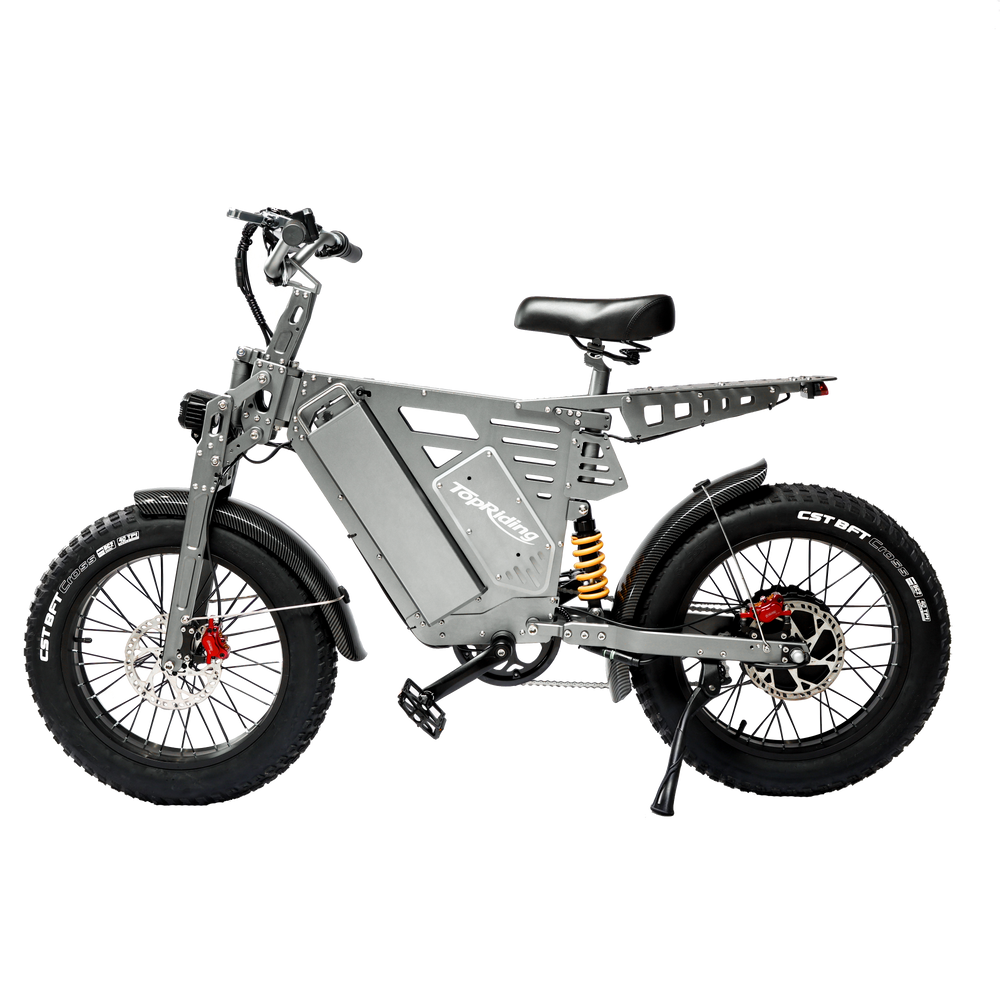
Engineering Spotlight: TopRiding R2 Full CNC Moto-Style eBike ($1,999.00)
Engineered to eliminate the frame-flex and under-powered motor issues common to cheap fat-tire bikes, the TopRiding R2 represents the pinnacle of high-torque scrambler engineering for adult riders.
| Chassis Architecture |
Aerospace-grade full CNC-machined billet aluminum alloy with anodized protective finish (IP65 rated) |
| Powertrain Performance |
High-torque rear hub motor: 750W Rated / 1500W Peak surge delivering 100 Nm of torque
|
| Battery Chemistry & Size |
Massive 52V 25Ah (1300Wh) removable pack running high-drain 21700 lithium-ion cells |
| Dual Suspension System |
Custom 4-link front fork (100mm travel) paired with an oil-damped rear coil shock (100mm travel) |
| Rolling Gear & Brakes |
20 × 4.0" CST BFT CROSS knobby fat tires clamped by industrial 4-piston hydraulic disc brakes
|
| Charging & Tech |
Dual charging ports (6.5 hr full recharge with 2 chargers); NFC smart keycard + Bluetooth App |
Rider's Sourcing Advice: Stop buying fragile welded frames with weak 48V systems. Step up to authentic CNC billet engineering and 100 Nm of hill-climbing torque. Order the TopRiding R2 - Full CNC Moto-Style eBike directly, or explore high-velocity seated alternatives across our E-Scooters with Seat lineup.
Direct Technical Comparison: Fat-Tire eBikes vs. Commuter eBikes vs. Off-Road Scooters
| Performance Characteristic |
20x4.0" Moto-Style Fat eBike (TopRiding R2) |
700x38c Standard Commuter eBike |
Dual-Motor Off-Road E-Scooter |
| Sand, Snow & Mud Flotation |
10 / 10 (Rolls across loose beach sand & snow) |
2 / 10 (Sinks immediately; loss of control) |
6 / 10 (Tires spin; requires aggressive rider balance) |
| Asphalt Rolling Efficiency |
6 / 10 (Higher Wh/mile battery consumption) |
10 / 10 (Maximum aerodynamic & rolling glide) |
7.5 / 10 (Dual-motor drag, compact footprint) |
| Pothole & Obstacle Roll-Over |
9 / 10 (Large diameter swallows deep ruts) |
6.5 / 10 (Jars rider; requires wheel lifting) |
5 / 10 (Small 10-11" wheels catch on deep holes) |
| Braking Distance (4-Piston Hydraulic) |
Exceptional (Massive contact patch grips asphalt) |
Moderate (Smaller tire skids under hard panic stops) |
Good (Requires careful rear-weight shifting) |
| Portability & Apartment Storage |
Poor (82 lbs; rigid, wide frame dimensions) |
Moderate (45–52 lbs; fits on bus racks) |
Exceptional (Folds into car trunk in 5 seconds) |
| Rider Mass Support Limit |
330 lbs (150 kg certified payload) |
220 – 250 lbs (100 – 113 kg typical) |
265 – 330 lbs (Platform dependent) |
Pros and Cons: The Unfiltered Reality of Fat Tires
| Platform Category |
Documented Practical Strengths (Pros) |
Real-World Engineering Liabilities (Cons) |
Fat-Tire Electric Bikes
(4.0-inch Tire Architecture) |
- Unmatched multi-surface traction over sand, snow, mud, and gravel.
- Pneumatic air volume acts as high-capacity natural suspension.
- High payload capacity (300 to 330+ lbs) without pinch flats.
- Immune to streetcar tracks, drainage grates, and bridge expansion joints.
- Shorter, more stable panic braking distances due to wide rubber grip.
|
- Heavy curb weight (70 to 85+ lbs) makes carrying and transport brutal.
- High rolling resistance consumes 25% to 35% more battery power.
- Noticeable gyroscopic steering resistance and low-speed self-steer drag.
- Incompatible with standard city bus racks and public transit car trays.
- Nearly impossible to pedal uphill unassisted if the battery dies.
|
Standard Narrow-Tire eBikes
(1.75 to 2.2-inch Tire Architecture) |
- Lightweight chassis (40 to 52 lbs) easy to carry up stairs.
- Maximum battery range per Watt-hour of capacity.
- Flickable, lightning-fast steering agility in dense city traffic.
- Fits standard automotive bike racks and transit bus trays.
- Easy to pedal home like a normal bicycle if the battery depletes.
|
- Completely incapable of riding on soft beach sand or deep snow.
- Harsh ride quality over rough chip-seal asphalt and brick pavers.
- Narrow tires easily drop into parallel drainage slots and tram tracks.
- Lower certified payload limits for heavy adult riders.
|
Commercial Benefits and Inherent Mechanical Limitations
Every commercial vehicle design is an exercise in physical compromise. Deciding whether are fat-tire e-bikes better requires understanding where the platform delivers transformative capability, and where its physical bulk becomes an operational liability.
The Real Performance Benefits:
-
Year-Round Four-Season Commuting: In northern climates where winter brings snow, black ice, and slush, standard bicycles must be stored in the garage from November through March. A fat-tire e-bike running at 8 to 10 PSI transforms winter commuting into a safe, viable reality. The wide tread floats over unplowed snowdrifts and grips frozen slush, allowing year-round utility.
-
Confidence for Beginners and Senior Riders: Beginners and returning adult cyclists frequently experience anxiety over front-wheel slipping, gravel washouts, and small potholes. The sheer gyroscopic stability and massive contact patch of a 4.0-inch tire eliminate that nervous twitchiness, providing a rock-solid, confidence-inspiring ride.
-
Superior Hydraulic Stopping Authority: Braking friction is governed by the tire-to-road interface. When you slam on 4-piston hydraulic disc brakes on a standard 1.75-inch tire, the small rubber contact patch easily breaks traction, locking into a dangerous skid. A 4.0-inch fat tire spreads braking friction over three times the surface area, decelerating heavy loads rapidly with significantly shorter stopping distances.
The Inherent Operational Limitations:
-
The "Dead Battery" Penalty: If a standard 45-pound commuter e-bike runs out of battery power five miles from home, you downshift gears and pedal home with moderate physical effort. If an 82-pound fat-tire bike with a 100 Nm hub motor runs out of battery power, pedaling those wide, low-pressure tires unassisted uphill is an agonizing cardiovascular ordeal. You must treat your battery gauge with strict discipline.
-
Garage & Vehicle Storage Footprint: A fat-tire bike is physically massive. The wide 800mm handlebars, extended front fork crowns, and bulging 4-inch tires occupy substantial floor space. Storing two fat-tire e-bikes in a cramped apartment hallway or small utility closet is notoriously difficult.
Who Needs a Fat-Tire eBike vs. Who Should Choose an Urban Commuter
Allocating $1,500 to $2,500 toward an electric vehicle requires matching vehicle architecture to your living environment, physical storage, and intended routes.
Riders Who Must Buy a Fat-Tire eBike:
-
Multi-Surface Explorers & Trail Campers: If your rides transition seamlessly from city pavement onto forest service roads, coastal beach sand, washboard gravel, and mountain trails, narrow tires will fail you. A fat-tire e-bike is the only bicycle platform capable of true multi-terrain flotation.
-
Heavy Adult Riders (220 to 330+ lbs): If you weigh over 220 pounds, standard commuter rims, spokes, and 2-inch tires operate at their physical limits. Fat-tire scramblers built on reinforced frames distribute rider mass safely, preventing cracked rims, snapped spokes, and pinch flats.
-
All-Season Winter Commuters: If you commute in regions with heavy snowfall, slush, and frozen rain, a fat-tire bike keeps you moving safely while narrow-tire commuters are locked indoors.
Riders Who Should Choose a Standard Commuter or E-Scooter:
-
Walk-Up Apartment Dwellers & Subway Commuters: If you must carry your vehicle up stairs, load it into compact elevators, or roll it onto crowded passenger trains, an 80-pound fat-tire bike will quickly become an unused burden. You are vastly better served by a high-torque, portable platform from our Fast E-Scooters or Fast electric scooters for adults lineup.
-
Paved-Only Fitness Riders: If 100% of your riding is smooth bike paths and dedicated paved greenways, and you enjoy actively pedaling to maintain cardiovascular fitness, narrow commuter tires roll faster, pedal easier, and maximize your battery range per charge.
Costly Mistakes Buyers Make When Purchasing Fat-Tire eBikes
Factory Floor Advisory: The "48V Mechanical Brake" Trap
The single most dangerous mistake we witness in the budget e-bike marketplace is buying an 80-pound fat-tire e-bike equipped with an undersized 48V battery and cheap, cable-actuated mechanical disc brakes. An 80-pound bike carrying a 220-pound rider at 25 MPH carries tremendous kinetic energy. Mechanical cable brakes stretch, overheat rapidly, and demand exhausting hand grip force that causes severe hand fatigue on steep descents. Furthermore, a budget 48V 14Ah battery suffers from intense voltage sag when asked to push wide fat tires up hills. Never purchase an adult fat-tire e-bike without certified 4-piston hydraulic disc brakes and a high-voltage 52V electrical foundation.
-
Operating at Maximum Sidewall Pressure: Reading "Inflate to 30 PSI Max" on the tire sidewall and immediately pumping the tires to 30 PSI. At 30 PSI, a fat tire turns rock-hard, balloons in the center, and bounces uncontrollably over bumps like an over-inflated basketball, destroying traction and ride comfort. Calibrate tire pressure to terrain: 6 to 10 PSI for soft sand and snow, 12 to 15 PSI for rough trails, and 18 to 20 PSI for smooth pavement.
-
Falling for "Peak Wattage" Advertising While Ignoring Torque (Nm): Trusting misleading marketing claims boasting "1500 Watts Peak!" while hiding a weak 50 Nm torque rating. Peak wattage is an instantaneous burst under no-load conditions; torque measured in Newton-meters (Nm) is the sustained twisting force that turns wide rubber over steep inclines. A fat-tire bike requires at least 85 to 100 Nm of torque to climb hills authoritatively without thermal stalling.
-
Ignoring Local Speed and Helmet Regulations: Operating an unlocked high-power scrambler without verifying legal class boundaries. Verify local state and municipal ordinances before purchasing, consulting our comprehensive legal analysis on Electric scooter laws in California, our guide on Do you need a license for an electric scooter, state-specific rules in Electric scooter laws in New York, and global trail restrictions in Where electric scooters are not allowed.
-
Purchasing Thin Welded Aluminum Tubing for Heavy Trail Use: Sourcing cheap e-bikes built from thin-walled, robot-welded 6061 tubes. Under aggressive off-road jumps and heavy rider weights, the wide stance of fat-tire forks exerts immense twisting leverage on the headtube and rear dropouts. Investing in full CNC-machined structural architectures, such as the TopRiding R2, eliminates weld fatigue and prevents catastrophic frame failure.
Essential Sourcing Checklist: Auditing Motor Torque, Battery Wh, and Brakes
Before transferring payment for any machine claiming that are fat-tire e-bikes better, audit prospective models against these four non-negotiable engineering benchmarks:
1. 52V Electrical Foundation with 1000Wh+ Capacity
Do not buy a fat-tire e-bike running a small 48V battery. Calculate true usable energy capacity: multiply Voltage by Amp-hours ($\text{Volts} \times \text{Amp-hours} = \text{Watt-hours}$). A 52V 25Ah battery delivers an immense 1300 Watt-hours (Wh) of energy reserve. High-voltage 52V systems run at lower amperage for equivalent power outputs, reducing thermal heat buildup in the motor controller and maintaining punchy throttle response even when the pack drops below 40% capacity. For cross-category battery comparisons, examine our fleet of Long Range Electric Scooters.
2. Certified 4-Piston Hydraulic Disc Brakes
Inspect the brake calipers with your own eyes. You should clearly see two pairs of opposing pistons (four pistons total per caliper) acting upon thick steel rotors (minimum 180mm diameter; 203mm preferred). Four-piston calipers provide 40% more clamping force, spread frictional heat over larger brake pads, and deliver effortless one-finger braking modulation on steep descents.
3. Certified Grade-A 21700 Lithium-Ion Cells
Never buy an uncertified battery pack assembled with generic, unbranded 18650 cells. Under heavy off-road amp draw, cheap cells overheat rapidly, experience severe capacity degradation, and present severe thermal runaway fire risks. Demand high-drain 21700 cylindrical cells from tier-one manufacturers certified to international standards governed by UL Solutions (UL 2849 Standards for e-Bike Electrical Systems).
4. Safety Standards & Three-Class Compliance
Verify that the e-bike complies with the three-class regulatory system recognized by the U.S. Consumer Product Safety Commission (CPSC) Under 16 CFR Part 1512 and national trail safety directives established by PeopleForBikes National e-Bike Regulations. The bike should arrive factory-locked to Class 2 (20 MPH throttle and pedal assist) to ensure street legality, while offering software-switchable off-road modes for unrestricted private property riding.
Expert Manufacturing Verdict: The Final Purchasing Blueprint
In our professional assessment across decades of personal electric mobility engineering, the answer to whether are fat-tire e-bikes better comes down to a clear, unyielding law of vehicular application: Fat-tire e-bikes are unquestionably better if your riding prioritizes multi-surface traction, supreme stability, and pneumatic comfort, and you have ground-floor storage to accommodate an 80-pound machine.
Here is your clear, actionable procurement roadmap:
-
Choose a Fat-Tire eBike If: You commute over rough pavement, wet tracks, gravel, sand, or snow; you weigh over 200 pounds; you want the planted, confidence-inspiring feel of a light motorcycle; and you have a garage, ground-floor shed, or heavy-duty hitch rack.
-
Demand Proven Powertrain Specs: Settle for nothing less than a high-torque motor delivering 85 to 100 Nm, a 52V battery pack with at least 1000Wh of capacity running 21700 cells, and 4-piston hydraulic disc brakes.
-
For the Ultimate Execution, Buy the TopRiding R2: At $1,999.00, the TopRiding R2 Full CNC Moto-Style eBike represents the absolute benchmark of modern fat-tire engineering. Its aerospace-grade billet aluminum chassis, massive 52V 25Ah (1300Wh) battery, 100 Nm of torque, dual 4-link suspension, and 4-piston hydraulic brakes outperform bikes costing twice as much.
-
Choose an E-Scooter or Commuter If: You live in an upper-floor walk-up apartment, rely on bus/train transfers, and ride exclusively on smooth asphalt. Sourcing a compact commuter platform saves weight, maximizes battery range per dollar, and eliminates transport headaches.
Frequently Asked Questions
Are fat-tire e-bikes better than standard commuter e-bikes?
Fat-tire e-bikes are decisively better for loose surface traction (sand, snow, mud, and gravel), payload stability for heavy riders, and natural vibration damping without suspension reliance. However, they are worse for tight urban agility, apartment portability, and energy efficiency due to higher rolling resistance and heavier total curb weight.
How does tire pressure affect fat-tire e-bike performance?
Tire pressure is the single most critical tuning parameter on a fat-tire e-bike. Running 5 to 10 PSI expands the tire contact patch for maximum flotation over soft sand and packed snow. Increasing pressure to 18 to 22 PSI rounds out the tread profile, reducing rolling resistance on paved asphalt to extend battery range and prevent sluggish cornering.
Do fat-tire e-bikes consume more battery power than regular e-bikes?
Yes. Due to a wider contact patch, aggressive knobby tread patterns, and heavier rotational mass, fat tires generate significantly more rolling resistance. On pavement, a 4-inch wide fat-tire e-bike consumes roughly 25 to 35 percent more Watt-hours per mile than a standard 2-inch commuter tire, requiring a larger battery (at least 900Wh to 1300Wh) to maintain equivalent range.
Are fat-tire e-bikes hard to pedal if the battery dies?
Yes. An electric fat bike weighs between 65 and 85 pounds. Combined with the substantial rolling friction of wide tires running at low pressures, pedaling a dead fat-tire e-bike unassisted uphill or against a headwind is exhausting. Riders should always reserve at least 15 to 20 percent battery capacity to ensure motor assist remains active.
Authoritative References & Micromobility Standards


