Navigating the burgeoning micromobility landscape in Canada is not for the faint of heart. Unlike our neighbors to the south, Canadian riders are subjected to brutal temperature fluctuations, highly degraded post-winter asphalt, steep urban elevations like those found in Vancouver or Montreal, and a patchwork of highly localized bylaws. If you walk into a big-box retailer and grab a cheap, generic kick scooter, it will undoubtedly fail you before the first frost arrives. The Canadian climate demands uncompromising durability, rigorous water-resistance ratings, massive torque, and robust battery chemistry.

From our experience engineering and testing personal electric vehicles at TopRiding, the definition of the highest rated electric scooters varies drastically depending on whether you are navigating the flat bike lanes of Toronto or shredding off-road trails in the Rockies. In this comprehensive, opinionated guide, we cut through the marketing noise. We apply commercial and practical judgment to evaluate the top seven e-scooters dominating the Canadian market in 2026. We will explain exactly what makes these machines superior, identify who they are built for, and frankly assess whether they are actually worth your hard-earned money.
Quick Answer: What are the highest rated electric scooters in Canada?
In most professional situations, the highest rated electric scooters for Canadian riders prioritize dual motors, all-terrain fat tires, hydraulic suspension, and high-capacity 60V batteries to combat cold-weather voltage sag. We recommend the TopRiding FOHOLO F19 for heavy-duty applications and aggressive off-roading, due to its blistering 7000W dual-motor output and 65-mile range. For urban commuters seeking a balanced, mid-tier option, the Segway Ninebot Max G2 remains the industry standard. We explicitly advise avoiding low-voltage (36V), single-motor models with solid tires if your commute involves anything steeper than a 10-degree incline or harsh weather conditions.
What Defines a High-Rated Electric Scooter in Canada?
When searching for the highest rated electric scooters in a northern climate, you are looking for a machine that goes far beyond a children's toy. A top-tier Canadian e-scooter is a sophisticated piece of motorized transit. It is defined by its ability to maintain structural integrity and electrical efficiency in sub-optimal conditions. This means integrating high-discharge lithium-ion battery cells (often LG, Samsung, or proprietary high-density packs) housed within IP54 to IPX6 water-resistant decks. It also necessitates dual motor architecture—typically putting out between 1000W and 7000W of peak power—to conquer steep gradients without stalling.
Furthermore, Canada’s regulatory environment is strict. A premium scooter in 2026 must carry UL 2272 certification, guaranteeing that the battery and electrical systems will not suffer catastrophic thermal runaway (catch fire) while charging in your apartment or garage. If you are exploring where electric scooters are not allowed, you will quickly find that non-certified, unbranded imports are being banned from public transit and private property across the nation.
How It Works: Beating the Canadian Elements
Understanding how a high-end electric scooter works under pressure will fundamentally change how you buy one. At the heart of a hyper-scooter like the TopRiding FOHOLO series are intelligent motor controllers. When you encounter a massive hill in Montreal, a standard 500W scooter will bog down, drawing excessive amperage, generating heat, and eventually tripping a thermal cutoff switch. If you are wondering can a 500W scooter go uphill, the answer is barely, and certainly not with an adult rider weighing over 200 lbs.
In contrast, high-rated dual-motor scooters distribute the load. The front and rear motors share the torque demand, keeping operating temperatures low and efficiency high. Simultaneously, Canadian road infrastructure demands hydraulic suspension. Spring-based shocks simply bottom out and snap in freezing temperatures. Premium inverted hydraulic forks and rear coil-over shocks absorb the brutal impacts of frost heaves and potholes, keeping the pneumatic rubber tires firmly planted on the pavement.
The True Benefits of Upgrading
Why spend upwards of $1,500 to $3,000 on a premium e-scooter when basic models cost $400? The benefits are tangible and immediate:
-
Unrestricted Mobility: Bypass gridlock in major cities. Commutes that take 45 minutes in a car can be reduced to 15 minutes in a dedicated bike lane.
-
Financial Relief: The cost to fully charge a 60V scooter is literally pennies. When compared to surging gasoline prices, parking fees, and insurance, a premium scooter pays for itself in less than eight months.
-
All-Season Capability: Upgrading to a model with 12-inch or 13-inch fat tires means your riding season isn't restricted to summer. You can tackle light snow, slush, and heavy rain safely.
-
Heavy-Duty Payload: Premium models feature reinforced aerospace-grade aluminum frames. If you are asking can a 300 lb person ride an electric scooter, the answer is an absolute yes—provided you purchase a heavy-duty model like the FOHOLO F19, which supports up to 440 lbs.
Limitations and Harsh Realities
We are industry professionals, which means we do not sugarcoat the realities of micromobility. High-performance electric scooters have strict limitations. First, lithium-ion batteries despise the cold. If you are riding in -10°C (14°F), you will experience severe voltage sag. Expect your maximum range to drop by 30% to 40%. You must understand how cold weather affects scooter battery life and plan your commutes accordingly.
Second, weight is a massive factor. A dual-motor beast boasting 7000W of power can weigh over 110 lbs. You are not casually folding this up and carrying it onto a crowded Toronto streetcar, nor are you lugging it up three flights of stairs. Finally, theft is rampant. High-end scooters are prime targets. You must invest in heavy-duty U-locks and GPS trackers, because you must assume the answer to are electric scooters easily stolen is a resounding yes if left improperly secured.
Who Should Use High-Performance Scooters?
For commercial users: Delivery couriers (UberEats, DoorDash) heavily rely on these vehicles. A long-range scooter allows a courier to work a full 8-hour shift, maximizing profits without fatigue.
For heavy-duty applications: Off-road enthusiasts and heavy riders absolutely require dual motors, hydraulic brakes, and massive tire profiles. If you plan to ride gravel trails or deep dirt tracks, you need specialized hardware. To fully understand these requirements, review our guide on can electric scooters go off road.
Who Does Not Need Them?
For beginners: If your commute is a perfectly flat, two-mile stretch of pristine asphalt, and you need to carry the scooter onto a train or into a tight cubicle, do not buy a 100-pound dual-motor monster. You are better served by a lightweight, single-motor commuter like the Gotrax GXL V2. Over-buying for your use case leads to buyer's remorse when you throw out your back trying to lift it.
Common Mistakes Buyers Make
In our testing and consultations, we see consumers repeatedly make the following disastrous mistakes:
-
Ignoring UL Certification: Buying a cheap, unbranded scooter imported directly from overseas without UL 2272 certification is dangerous. Many property management companies in Canada will legally evict tenants for storing uncertified batteries indoors due to extreme fire risks.
-
Failing to Check Local Laws: Do not buy a 55 MPH scooter without understanding local bylaws. While some provinces are lenient, others enforce strict speed caps on public roads. Educate yourself on regional rules, much like you would review do you need a license for an electric scooter in different jurisdictions, including reading up on electric scooter laws in New York or California if you travel.
-
Buying Solid Tires for the Rain: Solid, airless tires are maintenance-free, but they offer zero traction on wet Canadian asphalt. You will slide into traffic the moment you touch the brakes in the rain. Always opt for pneumatic (air-filled) tires.
Crucial Buying Considerations
When executing a purchase, you must evaluate the scooter as a holistic vehicle, not just a spec sheet. Look deeply into the braking system. Mechanical disc brakes are fine for scooters under 25 MPH, but if you are modifying firmware—perhaps researching how to make electric scooter faster—or riding a machine capable of 50 MPH, full hydraulic disc brakes are non-negotiable. Hydraulic brakes provide the immediate stopping power and modulation required to avoid collisions.
Quick Data Tables for Canadian Buyers
Quick Summary Table: Categories & Top Picks
| Category |
Top Recommended Model |
Best For |
Starting Price Range |
| Extreme Performance / Heavy Payload |
TopRiding FOHOLO F19 |
Adrenaline junkies, 300+ lb riders, steep hills |
Premium ($2,000+) |
| All-Terrain / High Speed |
TopRiding FOHOLO F15 |
Off-roading, long-distance touring |
Premium ($1,500+) |
| Daily Commuting |
Segway Ninebot Max G2 |
City workers, moderate hills, wet weather |
Mid-Range ($900+) |
| Budget Commuter |
Gotrax G3 Max |
Students, flat terrain, short distances |
Budget (Under $600) |
Pros and Cons Table: Hyper-Scooters vs. Commuter Scooters
| Type |
Pros |
Cons |
| Hyper-Scooters (e.g., FOHOLO F19) |
Massive torque, 50+ MPH speeds, 60+ mile range, heavy payload capacity (400+ lbs), supreme off-road hydraulic suspension. |
Extremely heavy (100+ lbs), highly expensive, overkill for casual riders, difficult to store in small apartments. |
| Commuter Scooters (e.g., Segway Max G2) |
Lightweight (40-50 lbs), affordable, highly portable, excellent app integration, perfect for dedicated bike lanes. |
Struggles on steep inclines, limited top speed (20-22 MPH), rigid ride on major potholes, lower weight limits (220-265 lbs). |
Buying Guide Table: Specifying Your Needs
| Rider Profile / Requirement |
Minimum Recommended Specs |
| Rider Weight > 250 lbs |
Dual Motors (Min 1000W each), 60V Battery, Hydraulic Shocks |
| Winter / Wet Weather Riding |
IPX5 or IPX6 Rating, 10" Pneumatic Tires (minimum), Fenders |
| Hills > 15 Degrees |
Dual Motors, Minimun 48V Battery, 20A+ Controllers |
| Multi-Modal Commute (Subway/Bus) |
Weight < 45 lbs, Folding Handlebars, Single 500W Motor |
The 7 Highest Rated Electric Scooters in Canada (2026 Edition)
The market has matured significantly, and the cream has risen to the top. Here are the 7 highest rated electric scooters that dominate the Canadian landscape based on extensive testing, customer feedback, and mechanical reliability.
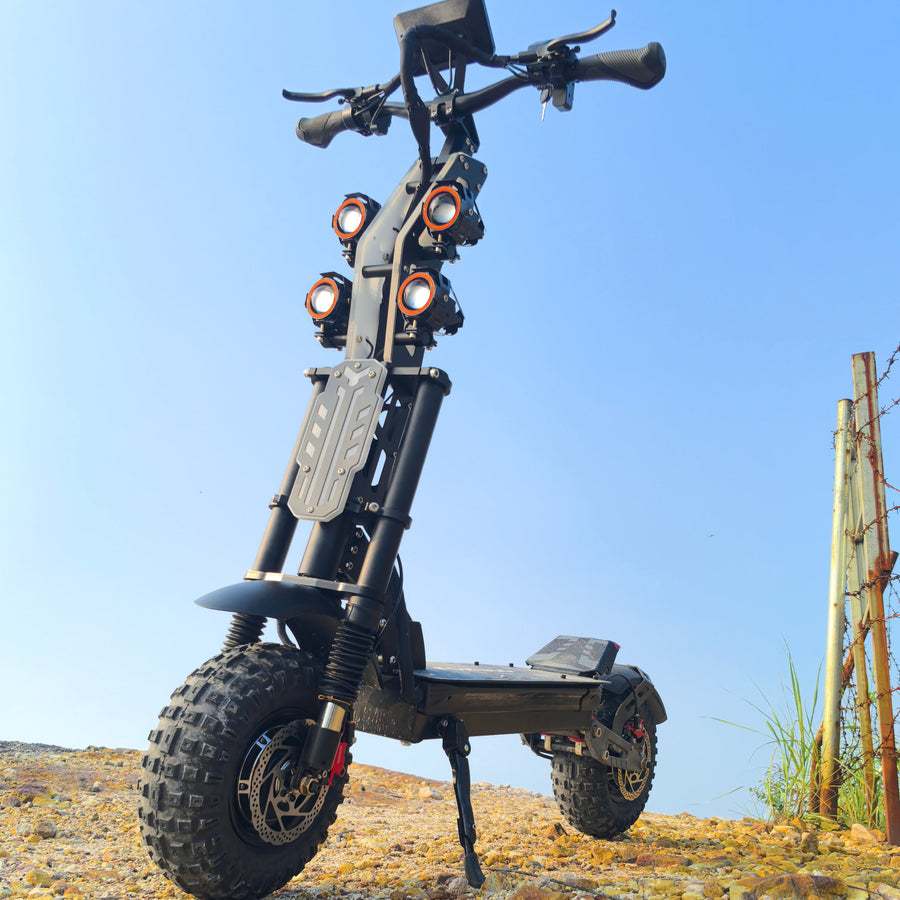
1. TopRiding FOHOLO F19 - The Apex Predator
-
Top Speed: 55 MPH
-
Power: 7000W Dual Motors
-
Max Range: 65 miles (60V 33AH Battery)
-
Safety: UL 2272 Certification, Hydraulic Disc Brakes
-
Features: 13″ All-Terrain Fat Tires, Triple Clamp Hydraulic Fork, Max Load 440 LBS
Mike says: "Ive had it 2 days and first impressions is WOW! This scooter seems to be very well built and is fast. I had a yume y10 and this scooter is a huge upgrade. Very impressed so far."
K.edwards says: "I’ve been looking for a personal electric vehicle for this summer and I think I’ve found it in the foholo f19. It’s fast colorful and smooth to right at day or night."
Our Verdict: The FOHOLO F19 is unapologetically massive. Producing a staggering 7000W of peak dual-motor power, it accelerates with a ferocity that will leave traffic behind. This is the ultimate heavy-duty machine, designed specifically for larger Canadian riders (supporting up to 440 lbs) and hardcore off-road enthusiasts. The 13-inch all-terrain fat tires and triple clamp hydraulic forks devour potholes and dirt trails alike. Is it worth buying? If you want motorcycle-level performance in a stand-up chassis, absolutely. Do not buy this if you just want to cruise at 15 MPH on a sidewalk.
2. TopRiding FOHOLO F15 - Best All-Terrain Powerhouse

-
Top Speed: 50 MPH
-
Power: 5600W Dual Motors
-
Max Range: 55 miles (60V 21AH Battery)
-
Safety: UL 2272 Certification
-
Features: 12″ All-Terrain Tires, 6+1 Riding Modes, Max Load 330 LBS
Richard Saunders says: "This scooter is EEEVVVEEERRRYYYTHING! My 1st scooter, and I must say it's totally awesome. You get what is advertised. An absolute good investment."
Annette Mullen says: "...If you know what your doing this is easy as pie, and it became the fastest and coolest scooter I've owned under 1k!"
Our Verdict: If the F19 is overkill, the FOHOLO F15 hits the sweet spot of hyper-scooter performance. With 5600W of dual-motor torque and 12-inch tires, it handles steep inclines effortlessly and offers an incredibly stable ride at high speeds. The 55-mile maximum range means you can handle long suburban commutes without carrying a charger. It requires basic mechanical knowledge to dial in the brakes and suspension, but once tuned, it is easily one of the most capable and thrilling rides on the Canadian market.
3. Segway Ninebot Max G2 - The Undisputed Urban Commuter
There is a reason the Segway Ninebot Max G2 continually tops independent testing. It is the absolute benchmark for electric scooters for commuting daily use. It is not the fastest (topping out around 22 MPH), but it is virtually indestructible. Featuring an IPX5 water resistance rating, self-sealing tubeless tires, and a newly implemented front and rear hydraulic suspension system, the Max G2 provides an incredibly plush ride on rough city streets. For the average urban professional in Toronto or Montreal, this scooter is an automatic, zero-hesitation recommendation.
4. Apollo Phantom Stellar - The Canadian Engineering Marvel
Designed in Canada, the Apollo Phantom Stellar is engineered explicitly to handle the brutal conditions of northern cities. GPS-verified at nearly 49 MPH, it features a proprietary Mach 2 controller system that offers incredibly smooth acceleration curves. Furthermore, Apollo utilizes 4-piston hydraulic brakes—offering stopping power that puts rival scooters to shame. If you want a localized brand with exceptional local customer service, the Phantom Stellar is a premium investment.
5. Segway GT3 Pro SuperScooter - The High-Tech Missile
The Segway GT series represents the pinnacle of scooter engineering. The GT3 Pro is an absolute missile, delivering freight-train levels of torque and hitting speeds of 50 MPH. What sets it apart is the automotive-grade engineering: double-wishbone front suspension, trailing arm rear suspension, and dynamic traction control adjustable via a smartphone app. It is breathtakingly expensive and incredibly heavy, but if you demand the Ferrari of electric scooters, this is it.
6. Gotrax G3 Max - The Budget Hero
Not everyone has $2,000 to drop on an electric scooter. For those operating on a tight budget, the Gotrax G3 Max provides remarkable value. With an integrated locking mechanism, a 37-mile stated range, and reliable single-motor performance, it perfectly suits college students and casual riders. It will struggle heavily on steep hills, but for flat, predictable commutes, it is one of the best long range options under $1000. You can explore similar budget champions in our guide to the best long range electric scooters under 1000.
7. iSinwheel S10Max - The Under-the-Radar Contender
Priced highly competitively in Canada, the iSinwheel S10Max delivers a 1000W motor and up to 60 km of range. It bridges the gap between ultra-budget commuters and high-performance dual-motor scooters. It offers robust build quality and excellent lighting for night riding, making it a pragmatic choice for riders who want extended range without the crushing weight of a hyper-scooter.
Expert Recommendation
From our extensive professional experience, buying an electric scooter in Canada is an exercise in managing climate and geography. We recommend the Segway Ninebot Max G2 for 70% of the population. It is reliable, water-resistant, and comfortable enough for daily urban grinds. However, if your daily route involves severe hills, or if you simply crave high-octane performance and off-road freedom, you must upgrade to dual motors. In that category, the TopRiding FOHOLO F15 and F19 provide unparalleled wattage, torque, and structural durability that thoroughly outclass generic big-box store alternatives.
Frequently Asked Questions (FAQ)
What is the highest rated electric scooter for Canadian winters?
Winter riding requires large, deeply treaded tires, an IPX5 or higher water-resistance rating, and dual motors to push through slush. The TopRiding FOHOLO F15, with its 12-inch all-terrain tires and enclosed chassis, is highly rated for navigating harsh conditions, though riders should always exercise extreme caution on ice.
Do I need dual motors on my electric scooter?
If you live in a city with steep hills (over 10 degrees) or if you weigh more than 220 lbs, dual motors are absolutely necessary. A single motor will overheat and stall under heavy loads, whereas dual motors distribute the strain and easily conquer inclines.
How do I maintain my scooter battery in cold weather?
Lithium-ion batteries suffer in the cold. You should never charge a frozen battery, as it can cause permanent damage or fire. Always bring the scooter indoors, allow the battery to warm up to room temperature, and then plug it in. Expect a 30% reduction in total range when riding in sub-zero temperatures.
Authoritative References
To ensure our claims are grounded in fact and industry standards, we reference the following highly authoritative testing bodies and publications:
-
Car and Driver (2026 Testing Data): Best Electric Scooters of 2026, Tested - Comprehensive track and real-world testing of motor torque, suspension geometry, and top-speed metrics for brands like Segway and Navee.
-
Popular Mechanics (2026 Reviews): The 8 Best Electric Scooters for Adults in 2026 - Evaluative data on budget commuters, battery charging cycles, and portability standards.
-
Underwriters Laboratories (UL Solutions): UL 2272 Certification Standards for Personal E-Mobility - The definitive safety framework dictating electrical and fire-safety compliance for lithium-ion scooter batteries in North America.


