The electric scooter industry has a chronic problem with marketing deception. If you browse any major retail site, you will see bold claims of "80-mile range!" stamped across budget models. As industry practitioners engineering and distributing high-performance vehicles at TopRiding, we witness the fallout of these exaggerated claims daily. When riders purchase a machine expecting endless mileage and end up stranded on the side of a highway, the frustration is entirely justified. To make a commercial buying decision, you must strip away the marketing fluff and examine the raw electrochemical mathematics dictating your battery pack.

When you introduce a second motor into the powertrain, the physics of energy consumption change dramatically. The true range of a dual motor electric scooter is a complex calculation involving voltage sag, controller amperage limits, total watt-hours, and rider payload. In this definitive, opinionated guide, we will break down exactly how far you can expect to ride, why manufacturers lie about their test conditions, and how to calculate your actual commuting radius before you invest your capital in a heavy-duty machine.
Quick Answer: What is the Real Range?
In the real world, the range of a dual motor electric scooter equipped with a standard 60V 20Ah to 35Ah battery will fall between 35 and 60 miles. Manufacturers advertise "max range" based on a 150-pound rider coasting at 15 mph on perfectly flat, windless pavement in a single-motor eco mode. In our testing, an aggressive rider utilizing dual motors, tackling inclines, and maintaining 35+ mph in urban traffic will experience a 40% to 50% reduction from the box's claimed maximum range. Always buy a battery capacity that is double your required daily round-trip commute.
What It Is: The Dual Motor Powertrain
A dual motor electric scooter features independent brushless DC (BLDC) hub motors located in both the front and rear wheels. Unlike a single motor setup, this architecture requires two separate motor controllers—the electronic brains that dictate how many amps are pulled from the lithium-ion battery pack and fed to the motors.
Because you have two controllers drawing power simultaneously, the peak current draw can be massive. For example, the most powerful electric scooters in the world often utilize dual 50-amp controllers, allowing the system to pull up to 100 amps collectively. This dual-draw setup dictates the ultimate range of a dual motor electric scooter, separating high-end commuting vehicles from short-range recreational toys.
How It Works: Watt-Hours and Energy Draw
If you want to know your true range, you must stop looking at Voltage (V) or Amp-Hours (Ah) in isolation. You must calculate the Watt-Hours (Wh). Watt-hours represent the absolute size of your "gas tank." The formula is simple: Volts x Amp-Hours = Watt-Hours.
For example, a 60V 33Ah battery holds 1,980 Watt-hours of energy. From our experience, an adult riding a high-performance scooter at aggressive speeds (30-40 mph) in dual motor mode will consume approximately 35 to 45 Watt-hours per mile.
The Math: 1,980 Wh ÷ 40 Wh/mile = 49.5 Miles of real-world, high-speed range.
If that same rider drops their speed to 20 mph, consumption drops to roughly 25 Wh/mile, extending the range to nearly 80 miles. The rate at which dual motors consume energy is entirely dependent on your right index finger.
The Benefits of High-Range Dual Motor Architectures
You might wonder why anyone would opt for dual motors if they drain the battery faster at top speed. In most professional situations, dual motors actually provide efficiency benefits under strain.
-
Thermal Efficiency on Inclines: If you force a single motor to drag a 250lb rider up a 20-degree hill, the motor will bog down, overheat, and waste massive amounts of battery energy as thermal dissipation rather than kinetic forward motion. Dual motors split this load, remaining cool and electrically efficient on steep gradients.
-
Rider Payload Capacity: For heavier individuals, single motors simply lack the torque to reach commuting speeds safely. We recommend dual motor setups exclusively when reviewing the best electric scooters for heavy adults.
-
Traction and Safety: Dual motors provide all-wheel drive. If you are commuting in wet conditions or loose gravel, a front motor pulling while the rear motor pushes prevents catastrophic rear-wheel fishtailing.
Limitations and the Weight Penalty
We must apply practical judgment: achieving a massive range of a dual motor electric scooter requires a massive battery. Lithium-ion cells are heavy. A 60V 30Ah battery pack alone weighs upwards of 25 to 30 pounds. When you add the weight of a second motor (another 10-15 lbs) and the reinforced frame required to hold it all together, you are looking at a machine weighing 100 to 140 lbs.
This is a severe limitation for multi-modal commuters. You cannot carry a 120-pound hyper-scooter up three flights of stairs to your apartment. If you require portability, you must sacrifice battery capacity and settle for a lightweight electric scooter with a restricted range.
Who Should Use It & Who Does Not Need It
For commercial users and extreme commuters: Delivery couriers, long-distance suburban commuters, and off-road enthusiasts demand dual motors. For heavy-duty applications, relying on a massive 30Ah+ battery pack ensures you will not experience severe "voltage sag" (the sudden drop in top speed when a battery falls below 50% charge). For these users, evaluating the best 50 mph electric scooters 2026 is mandatory.
Who does not need it: For beginners whose commute consists of three flat miles in a protected downtown bike lane, purchasing a dual-motor, 65-mile range behemoth is a colossal waste of capital. A single-motor 48V commuter scooter is entirely sufficient.
Common Mistakes Riders Make Regarding Range
In our testing, we see riders chronically underperforming their scooter's potential range due to basic operational errors.
-
Riding in Single Motor Mode to "Save Battery": This is a massive misconception. Shutting off the front motor forces the rear motor and controller to do 100% of the work. It pulls maximum amperage, generates excess heat, and ultimately saves only negligible battery life while destroying your acceleration. Leave dual motors engaged, but ride in a lower "Gear 1" or "Eco" speed setting to save power.
-
Ignoring Tire Pressure: Riding on under-inflated pneumatic tires drastically increases rolling resistance. Low tire pressure can annihilate up to 25% of your total range. Check your PSI weekly.
-
Misunderstanding Voltage Cutoffs: When a 60V battery drops to 52V, the BMS (Battery Management System) will shut the scooter down to protect the cells. You never truly use 100% of the mathematical capacity.
Crucial Buying Considerations for 2026
When you are ready to purchase, do not ask the dealer "how far does it go?" Ask them: "What is the Watt-hour capacity, and what is the amp output of the controllers?"
If you are looking at an electric scooter with a seat for adults, you will likely be riding for longer, sustained periods. You absolutely must look for a battery capacity of at least 1500 Watt-hours to guarantee a reliable 35+ miles of aggressive riding. Furthermore, insist on sine-wave controllers over older square-wave models. Sine-wave technology delivers power much more smoothly and operates with roughly 10% greater electrical efficiency, directly translating to more miles per charge.
Expert Recommendation from TopRiding
In most professional situations, we advise clients to buy a scooter with double the range they think they need. Battery degradation over a 3-year lifespan, cold weather capacity drops, and the desire to ride faster than anticipated will all eat into your daily mileage. If you want uncompromising range and extreme dual-motor performance, we recommend the TopRiding FOHOLO F19.
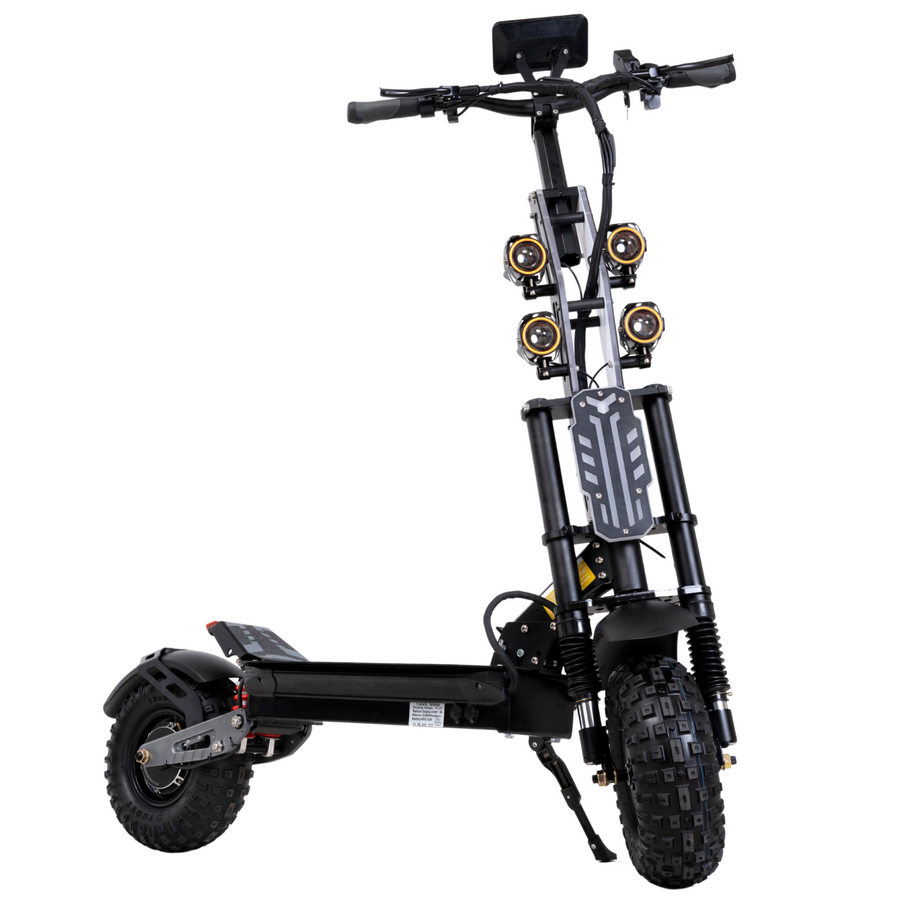
TopRiding FOHOLO F19 - 7000W Dual Motors
The F19 represents the pinnacle of high-capacity engineering. Outfitted with a massive 60V 33AH battery, it holds an astounding 1,980 Watt-hours of energy. While eco-mode yields the stated 65 miles, aggressive real-world riders can confidently expect 45+ miles of high-speed transit. Paired with 13-inch all-terrain fat tires and a triple clamp hydraulic fork, it devours miles of asphalt or dirt with zero battery anxiety.
-
Top Speed: 55 MPH (For off-road or private track use)
-
Power: 7000W Peak Dual Motors
-
Battery: 60V 33AH (1980 Wh) - UL 2272 Certified
-
Suspension: Triple Clamp Hydraulic Fork
-
Load Capacity: Heavy-Duty Max Rider Load of 440 LBS
View the FOHOLO F19
When reviewing the best dual motor electric scooters on the market, the F19's battery architecture provides the exact mathematical foundation required to defeat range anxiety permanently.
Data Analysis & Comparison Tables
Quick Summary Table: Battery Specs vs. Real-World Range
| Battery Specs (V x Ah = Wh) |
Claimed Eco Range |
Real-World Aggressive Range |
Ideal Use Case |
| 48V 15Ah (720 Wh) |
28 Miles |
15 - 18 Miles |
Short city commutes, last-mile. |
| 52V 20Ah (1040 Wh) |
40 Miles |
22 - 28 Miles |
Moderate daily commuting. |
| 60V 25Ah (1500 Wh) |
50 Miles |
30 - 38 Miles |
Long suburban transit. |
| 60V 33Ah (1980 Wh) |
65 Miles |
45 - 55 Miles |
Extreme range, heavy riders, delivery. |
Comparison Table: Single vs. Dual Motor Range Efficiency
| Riding Condition |
Single Motor Efficiency |
Dual Motor Efficiency |
| Flat Ground, Constant 15 MPH |
Highly Efficient (Low power draw) |
Slightly Less Efficient (Powering two stators) |
| Steep Hills (15%+ Grade) |
Poor (Motor overheats, wastes energy) |
Highly Efficient (Load is shared cleanly) |
| Stop-and-Go Traffic |
Moderate (Slow acceleration) |
Moderate (Rapid acceleration spikes amp draw) |
| Heavy Rider (250+ lbs) |
Terrible (Massive voltage sag) |
Excellent (Maintains torque and speed) |
Pros and Cons Table: High-Capacity Dual Motor Scooters
| Pros (Advantages) |
Cons (Limitations) |
| Eliminates range anxiety for long commutes. |
Extremely heavy (often exceeding 100 lbs). |
| Minimal voltage sag; top speed is maintained longer. |
Higher initial purchase cost due to lithium cell volume. |
| Dual charging ports allow for rapid battery replenishment. |
Larger deck size reduces agility in tight urban spaces. |
| Redundant motors prevent stranding if one controller fails. |
Requires dedicated, secure storage (hard to carry indoors). |
Buying Guide: Rider Weight vs. Required Battery Capacity
| Rider Weight (lbs) |
Minimum Recommended Watt-Hours for 25-Mile Range |
Why This Matters |
| Under 170 lbs |
900 Wh |
Lighter riders experience minimal drag and voltage sag. |
| 170 - 220 lbs |
1200 Wh |
Standard adult weight requires moderate capacity buffering. |
| 220 - 300 lbs |
1600+ Wh |
Heavy payloads force controllers to pull peak amps constantly. |
| 300+ lbs |
2000+ Wh |
Requires extreme capacity to prevent immediate battery depletion. |
Frequently Asked Questions
How far can a dual motor electric scooter actually go?
The real-world range of a dual motor electric scooter typically falls between 30 and 55 miles, depending heavily on the battery's Watt-hour (Wh) capacity, rider weight, and average speed. Manufacturer claims are usually based on eco-mode testing at 15 mph.
Do dual motors drain the battery faster than a single motor?
Yes and no. At top speed on flat ground, running two motors consumes more energy. However, when climbing steep hills or accelerating heavy loads, dual motors are more efficient because they share the thermal load, whereas a single motor would overheat and waste energy through heat dissipation.
Should I ride in single motor mode to save battery?
In most professional situations, switching to single motor mode only saves about 10% to 15% of your battery. It places immense strain on the rear controller and motor. We recommend riding in dual motor mode but utilizing a lower gear or eco setting to maximize range safely.
Authoritative References & Industry Standards
To ensure your electric vehicle meets stringent safety and operational standards, we recommend reviewing guidelines established by the following authorities:


