TopRiding electric scooters are certified to meet UL 2272 safety standards, covering critical electrical and fire safety requirements for the electrical system and battery.
This certification helps ensure safer, more reliable riding.
Over 100,000 electric scooters sold, backed by 5,000+ verified reviews and an average rating of 4.7+ stars.
Chosen by riders worldwide for reliable performance, and everyday riding confidence.
Expert support. local service.
Expert Customer Service
As a U.S.-based company, TopRiding provides 24/7 expert customer service and local after-sales support across multiple regions in North America.
Our dedicated support team is here to ensure fast responses, professional assistance, and reliable service — whenever you need it.
TEST RIDES AND SERVICE
Safety Certified
Designed to Meet UL 2272 Safety Standards
Our electric scooters are designed in accordance with UL 2272 safety requirements for electrical and battery systems, helping enhance overall safety and reliability.
Trusted by a global riding community
100,000+ Units Sold
Over 100,000 electric mobility vehicles sold, backed by 5,000+ verified reviews and an average rating of 4.7+ stars.
Chosen by riders worldwide for reliable performance, safety, and everyday riding confidence.
Expert Support. Local Service.
Expert Customer Service
As a U.S.-based company, TopRiding provides 24/7 expert customer service and local after-sales support across multiple regions in North America.
Our dedicated support team is here to ensure fast responses, professional assistance, and reliable service—whenever you need it.
Finding the best full suspension e bike under $2000 means balancing comfort, motor performance, battery capacity, braking, and the quality of the frame and suspension. A low price is not much of a bargain if the bike feels unstable on rough ground, has inadequate brakes, or cannot handle your normal riding distance. For riders who want a powerful, comfortable e-bike for commuting and recreational trails, a carefully chosen full-suspension model can be worth the investment—but the category requires realistic expectations.
Our recommendation is to prioritize usable suspension, predictable braking, a battery that fits your real route, and manufacturer support before paying extra for aggressive styling or a headline motor-power figure. TopRiding's R2 is a relevant benchmark at $1,999, with a full-CNC-machined aluminum frame, a 52V 25Ah battery, 20 × 4.0-inch tires, and front and rear suspension. However, its listed factory speed limit is 20 mph, and buyers should confirm the model's classification and local legal requirements before riding.
What Is the Best Full Suspension E Bike Under $2000?
There is no single full-suspension e-bike that is best for every rider. Under $2,000, the best choice is the model that provides dependable suspension and braking, sufficient range, a suitable frame fit, and a clear warranty without forcing you to compromise on safety-critical components.
For riders who want a moto-style design, wide tires, substantial battery capacity, and full suspension, the TopRiding R2 is worth examining at its listed $1,999 price. It meets the budget threshold before applicable taxes, shipping, accessories, or other fees. Riders who prioritize technical mountain-bike trails may be better served by a purpose-built trail e-MTB with geometry and suspension designed for that terrain.
Quick Answer
What it is
An electric bicycle with a front suspension fork and a rear shock intended to reduce impacts and improve comfort and control over uneven surfaces.
How it works
The motor assists pedaling or provides power according to the bike's control system, while front and rear suspension absorb some impacts from bumps and rough terrain.
Main benefits
Greater comfort on rough surfaces, reduced harsh impacts, and more confidence on suitable uneven routes.
Limitations
More weight, more maintenance, additional mechanical complexity, and potentially less efficient climbing or road riding than a comparable hardtail.
Who should use it?
Riders who regularly encounter broken pavement, gravel, uneven paths, or moderate off-road terrain and want motor assistance.
Who may not need it?
Riders whose journeys are almost entirely on smooth roads and who prioritize low weight, simplicity, and efficiency.
Common mistakes
Judging by peak watts alone, trusting advertised range without context, ignoring total weight, and failing to verify brakes or replacement parts.
Buying considerations
Suspension travel, motor type, battery watt-hours, brakes, tire size, payload, fit, warranty, service access, and local e-bike laws.
Expert recommendation
Choose full suspension only if the terrain justifies it. For a moto-style all-rounder near the budget ceiling, compare the TopRiding R2's full specifications against your route and local rules.
What Is a Full Suspension E-Bike?
A full suspension e-bike has suspension at both ends: a front fork and a rear shock. The front fork helps manage impacts at the front wheel, while the rear suspension allows the back wheel to move over uneven surfaces rather than transmitting every bump directly through the frame to the rider.
On a suitable route, this can improve comfort and help the tires maintain contact with the ground. That matters on rough gravel, uneven bike paths, pothole-heavy streets, and moderate off-road terrain. Suspension does not automatically make a bike safer or more capable, though. Tire choice, geometry, brakes, rider skill, and the quality of the suspension system all matter.
Full suspension versus hardtail
A hardtail typically has a suspension fork but no rear shock. It is usually simpler, lighter, and easier to maintain. A full-suspension bike adds a rear shock and associated frame linkage, which can improve comfort and control on rough ground but adds weight and mechanical complexity.
For smooth urban commuting, a good hardtail or rigid e-bike may be a more sensible purchase. For riders who regularly travel over broken surfaces or uneven paths, rear suspension can justify the additional cost. The right decision depends on the route, not the appearance of the bike.
How We Evaluate the Best Full Suspension E-Bike Under $2,000
At this price, we recommend evaluating the entire bike rather than treating one impressive specification as proof of quality. A large battery cannot compensate for poor braking, and high motor power does not guarantee comfortable handling.
Suspension design: Look for clearly stated front and rear suspension specifications. Check travel, adjustability, shock type, and whether the setup matches your intended terrain.
Motor performance: Distinguish rated power from peak power. Ask how the bike delivers assistance and whether its configuration complies with local regulations.
Battery capacity: Compare watt-hours (Wh), not voltage alone. Capacity helps you estimate available energy, but actual range depends on riding conditions.
Braking: Hydraulic disc brakes can provide useful modulation and stopping power, but rotor size, brake quality, maintenance, and rider weight remain important.
Fit and weight: Check frame geometry, standover height, riding position, and the practical difficulty of lifting or transporting the bike.
After-sales support: Confirm warranty coverage, replacement parts, battery service, and the process for resolving mechanical or electrical issues.
These criteria are a buying framework, not a claim that every model below has undergone identical hands-on testing. Product specifications and availability can change, so confirm the latest details directly with the seller before ordering.
5 Best Full Suspension E-Bike Options Under $2,000
There is an important distinction between a ranked list of verified, currently available models and a buying shortlist built around five different rider needs. The supplied product information confirms the TopRiding R2's specifications and listed price. The other entries below describe the type of bike worth comparing within this budget rather than inventing product names, prices, or test results.
1. TopRiding R2 — Best Moto-Style All-Rounder Near $1,999.00
Listed price: $1,999.00
Best for: Riders who want a moto-inspired frame, wide tires, substantial battery capacity, and front and rear suspension for commuting and recreational riding.
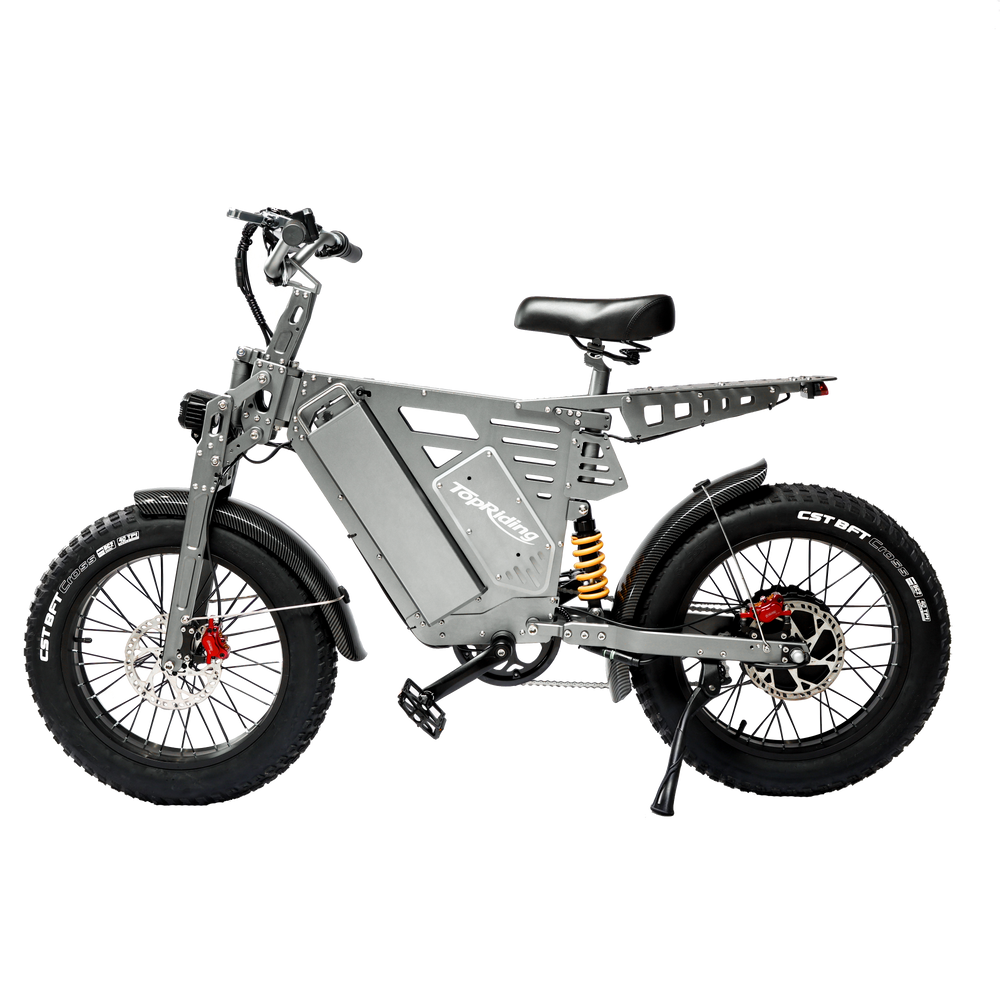
The TopRiding R2 Full CNC Moto-Style eBike has a 750W rated rear hub motor, 1,500W peak power, 100 Nm maximum torque, and a 52V 25Ah battery rated at 1,300Wh. Its listed range is up to 60 miles, while the factory speed limit is 20 mph.
The aluminum frame is described as full CNC-machined, with 100 mm front suspension travel and a rear coil shock. It uses 20 × 4.0-inch CST BFT CROSS tires and four-piston hydraulic disc brakes. Listed payload capacity is 330 lb and listed bike weight is 82 lb.
Why consider it: The large stated battery capacity and full-suspension configuration make it a strong specification-led option for riders who prefer a substantial, wide-tire design.
What to consider: At 82 lb, it is not a lightweight bicycle. Carrying it upstairs or lifting it onto a car rack can be difficult. Confirm the meaning of the 20 mph factory limit, the legal classification in your area, and the warranty and service arrangements before purchase.
2. Best Budget Full-Suspension Commuter — For Broken Pavement and Daily Travel
If your main route includes potholes, rough pavement, uneven road edges, or poorly maintained shared paths, compare full-suspension commuter models with a comfortable riding position and practical tires. The priority should be predictable handling and a suspension system designed for everyday impacts, not an extreme motor-power figure.
Check fender and lighting compatibility, battery removal, tire availability, and how easy it is to obtain replacement brake pads. A commuter bike that is convenient to maintain is usually a better long-term purchase than a heavier model with features you rarely use.
Buying recommendation: Choose this category if your rides are mostly urban and your main objective is reducing discomfort on imperfect surfaces. If your roads are smooth, a hardtail may offer better value.
3. Best Full-Suspension Fat-Tire E-Bike — For Gravel and Mixed Surfaces
Wide tires can provide a larger contact patch and a more cushioned feel at appropriate pressures. Combined with front and rear suspension, they may suit riders who alternate between pavement, compact gravel, and moderate trails. However, fat tires add rolling resistance and can increase weight, so they are not automatically the most efficient option for long road commutes.
When comparing fat-tire models, check the actual tire casing, tread, load rating, and availability of replacements. A 4-inch tire with an unsuitable tread pattern may be less useful on your route than a narrower tire chosen for the same terrain.
Buying recommendation: Select a fat-tire model if mixed surfaces and comfort are genuine priorities. Avoid paying for oversized tires simply because they look more powerful.
4. Best Entry-Level Full-Suspension Trail E-Bike — For Moderate Off-Road Riding
Riders who plan to spend time on dirt trails should prioritize geometry, suspension tuning, traction, and braking rather than motorcycle-inspired styling. A trail-oriented e-bike should feel controllable when the ground changes, and its components should be suited to the expected terrain.
Before buying, ask whether the frame and suspension are intended for the riding you plan to do. Full suspension alone does not establish that a bike is suitable for technical descents, jumps, or aggressive mountain-bike use. A model designed mainly for streets and casual trails should not be treated as a dedicated downhill or enduro bike.
Buying recommendation: If challenging singletrack is your primary goal, compare purpose-built trail e-MTBs and consider whether a reputable used model offers better suspension and braking than a new budget alternative.
5. Best Value Alternative — A Quality Hardtail or Front-Suspension E-Bike
The most cost-effective alternative may be a hardtail rather than another full-suspension model. With no rear shock or linkage to maintain, a hardtail generally has fewer suspension components and can be easier to service. It may also be lighter and more efficient on smooth roads.
That trade-off matters for commuters, students, and riders who rarely leave paved routes. Spend the savings on better brakes, a suitable battery, reliable tires, lights, a helmet, or maintenance support rather than paying for rear suspension that provides little benefit on your usual ride.
Buying recommendation: If comfort on rough surfaces is only an occasional concern, compare a hardtail before committing to full suspension. Buy the suspension you will actually use.
Comparison Table: Which Type Fits Your Riding?
Bike Type
Best Use Case
Main Advantage
Main Trade-Off
What to Verify
TopRiding R2
Moto-style commuting and recreational riding
1,300Wh listed battery, full suspension, wide tires
82 lb listed weight; near the $2,000 budget ceiling
Local classification, service, warranty, range conditions
Simplicity, lower weight potential, fewer moving parts
Less rear-impact comfort on rough terrain
Fork quality, fit, battery, total weight
Only the TopRiding R2 row uses the supplied product specifications. The other rows are category comparisons, not claims about particular models. Before treating any shortlist as a final purchase decision, verify current inventory, pricing, and specifications on each seller's official product page.
Pros and Cons of Full Suspension E-Bikes Under $2,000
Pros
Cons
Front and rear suspension can reduce harsh impacts on uneven surfaces.
Rear suspension adds weight and mechanical complexity.
Can improve comfort on rough commutes and recreational gravel routes.
Suspension components need inspection and occasional service.
May help the tires stay in contact with uneven ground when properly set up.
Low-cost suspension may offer limited adjustment or refinement.
Motor assistance can make longer or hillier rides more manageable.
Real-world range can be substantially below the advertised maximum.
Wide-tire models can suit riders who value a substantial, cushioned feel.
Wide tires and heavy frames can reduce efficiency and portability.
Some models combine substantial batteries with everyday utility.
Legal classification and allowed use vary by jurisdiction and configuration.
Benefits and Limitations: Is Full Suspension Worth It?
When full suspension is worth paying for
Full suspension is most valuable when your route regularly exposes you to bumps, uneven ground, and repeated impacts. If you ride over rough streets daily, travel on mixed gravel paths, or use suitable recreational trails, the rear shock may noticeably improve comfort. The benefit becomes more compelling when you ride for longer periods and fatigue from repeated impacts is a genuine concern.
For riders who use an e-bike as everyday transport, comfort can also affect how often the bike gets used. A bike that makes the normal route more manageable may be a better practical purchase than a lighter model that feels harsh on your local surfaces.
When full suspension is not worth the extra cost
If your commute is mostly smooth asphalt, a rear shock may add cost and weight without providing enough benefit to justify the trade-off. Hardtails generally have fewer moving parts and can be simpler to maintain. They may also offer more of the budget for a better motor system, brakes, battery, or accessories.
For heavy-duty applications or technical mountain-bike use, do not assume that any budget full-suspension bike is suitable. Confirm the manufacturer's intended use and any component limitations. A full-suspension frame is not a substitute for appropriate geometry, reliable braking, and components designed for the stresses you expect to impose.
Buying Guide: What Matters Most Under $2,000?
1. Motor power: understand rated versus peak output
Rated power and peak power describe different aspects of a motor. Peak power may be available only under specific conditions, while rated power is a more useful part of understanding the motor's sustained specification. Neither number alone tells you how the bike will feel on a hill, how efficiently it uses energy, or whether it complies with local e-bike rules.
The TopRiding R2 lists a 750W rated rear hub motor and 1,500W peak power, with a 20 mph factory speed limit. Do not assume that the speed setting automatically determines the bike's legal classification. Rules can also depend on throttle operation, motor rating, assistance behavior, and local definitions.
2. Battery capacity: compare watt-hours
Battery capacity expressed in watt-hours is more informative for comparing stored energy than voltage alone. The R2's listed 52V 25Ah battery works out to 1,300Wh, which is a substantial stated capacity for an e-bike in this price range. Actual usable energy and range still depend on operating conditions.
Higher capacity may be useful for long routes, hills, heavier riders, or frequent use of higher assistance levels. It also adds cost and can contribute to overall weight. Choose capacity according to your normal route and charging routine rather than treating the largest battery as automatically best.
3. Suspension travel and setup
Look for the front and rear suspension specifications and ask how the system is intended to be used. The R2 lists 100 mm of front travel and a rear coil spring shock absorber. Those figures help describe the hardware, but they do not independently prove how well the bike handles a particular trail.
Suspension setup matters. Rider weight, spring rate, preload where adjustable, tire pressure, and riding style can affect how the bike behaves. If the seller cannot explain basic setup or replacement support, that is a reason to ask more questions before ordering.
4. Brakes and stopping control
Brakes deserve priority because e-bikes can be heavier than conventional bicycles and may be ridden at higher average speeds. The R2 lists four-piston hydraulic disc brakes. That is a useful specification to examine, but you should also confirm the complete brake system, maintenance instructions, replacement pad availability, and recommended inspection intervals.
Do not judge brake performance by piston count alone. Rotor condition, tire grip, rider weight, brake adjustment, and riding conditions all influence stopping distance and control.
5. Frame fit, payload, and portability
Check the manufacturer's sizing information, standover height, handlebar reach, and riding posture. The R2 lists a maximum payload of 330 lb and a bike weight of 82 lb. Payload should be interpreted according to the manufacturer's definition, including any limits on rider, cargo, and accessories.
At 82 lb, the bike may be inconvenient for people who need to carry it upstairs, lift it into a vehicle, or use a conventional lightweight rack. Measure your storage space and transport setup before buying a heavy e-bike.
6. Warranty and replacement parts
A low purchase price does not guarantee low ownership cost. Ask how battery problems are handled, whether replacement tires and brake pads are readily available, how warranty claims are submitted, and whether repairs can be completed locally. For a bike you rely on for commuting, service access can be more important than a small difference in advertised motor power.
Battery Range: What Can You Realistically Expect?
Advertised range is usually a best-case or specified-condition figure, not a guarantee of what every rider will achieve. Range changes with rider and cargo weight, terrain, wind, tire pressure, temperature, stop-start riding, speed, and assistance level. Repeated climbing and frequent use of high power can consume substantially more energy than steady riding on flat ground.
The TopRiding R2 lists a range of up to 60 miles. Treat that as a manufacturer-stated maximum rather than a promise that every 60-mile trip will be possible. If your daily route is 20 miles round trip, allow a practical reserve for detours, hills, cold weather, and battery aging rather than planning to arrive at the lowest possible charge.
A sensible buying process is to estimate your typical distance, identify the steepest part of the route, and choose a battery with enough margin for less favorable conditions. Ask the seller how the advertised range was measured and what assistance level was used. If that information is unavailable, be conservative in your planning.
Brakes, Safety, and E-Bike Regulations
Before purchasing a powerful or moto-style e-bike, verify how your jurisdiction classifies it. In the United States, state and local rules can distinguish electric bicycles from other motorized vehicles based on factors such as motor rating, maximum assisted speed, and how power is delivered. Local rules may also cover helmets, age restrictions, paths, trails, and road access.
A factory speed setting alone does not guarantee that a bike qualifies as a particular legal class. Check the actual product configuration and the rules where you intend to ride. Do not modify a bike to exceed legal limits or assume that a bike permitted on a private property route can automatically be used on public roads or shared trails.
Wear a properly fitted helmet and use lights appropriate for the conditions.
Check tire pressure, brakes, wheels, and steering before riding.
Practice stopping and cornering in a controlled area before riding in traffic.
Use suspension settings and tire pressures within manufacturer recommendations.
Follow battery charging, storage, and inspection instructions.
Confirm whether the route permits your particular e-bike classification.
Maintenance and Total Cost of Ownership
A full-suspension e-bike has more components to inspect than a basic rigid bicycle. The rear shock and linkage, front fork, brakes, drivetrain, tires, battery, and electrical connections all need attention. The maintenance schedule depends on the manufacturer's instructions, riding conditions, and usage frequency.
For routine ownership, budget for brake pads, tires, drivetrain wear, suspension servicing where applicable, and eventual battery replacement. A heavier bike or one used regularly on rough surfaces may need more frequent inspection than a lightly used commuter. Do not assume that the initial price includes future repairs or wear parts.
Before purchase, ask the seller for maintenance guidance and a parts list. If you plan to ride every day, check whether a local bike shop can service the mechanical components and whether the manufacturer offers support for electrical or battery issues. A clear service path reduces the risk of a low-cost purchase becoming an expensive inconvenience.
Expert Recommendation: Which Full Suspension E-Bike Should You Buy?
For riders who want a moto-style electric bike with a large stated battery and full suspension at the top of a $2,000 budget, the TopRiding R2 deserves a close look. Its listed 1,300Wh battery, 100 mm front travel, rear coil shock, four-piston hydraulic disc brakes, and 330 lb payload capacity provide concrete specifications to evaluate against your needs.
It is not the automatic best choice for every rider. Its 82 lb listed weight is a significant consideration for stairs and vehicle transport, and its 20 mph factory speed limit should not be confused with a complete legal classification. Confirm local requirements, warranty details, and service access before placing an order.
For technical mountain-bike trails, choose a model specifically designed and approved for that use. For smooth commuting, compare a hardtail before paying for rear suspension. For mixed surfaces and comfort-focused riding, full suspension may be worth the added complexity if the bike fits you and the components suit the terrain.
Our Final Buying Checklist
Confirm the total delivered price, including taxes and shipping.
Check the frame size and whether you can handle the bike's weight.
Compare rated motor power, battery watt-hours, and stated range conditions.
Review front and rear suspension specifications and maintenance requirements.
Verify brake quality, tire replacement availability, and payload limits.
Read the warranty and battery service terms.
Check local laws for the exact bike configuration and the routes you intend to use.
Review the TopRiding R2 product details and compare them with your actual route, riding experience, and storage needs before deciding.
Frequently Asked Questions
1. Can I get a good full suspension e-bike under $2,000?
Yes, but expect trade-offs. At this price, focus on the bike's intended use, frame fit, braking, battery capacity, suspension design, and after-sales support. Do not assume that a low-cost full-suspension bike is suitable for demanding mountain-bike terrain simply because it has a rear shock.
2. Is the TopRiding R2 under $2,000?
The supplied product listing shows a price of $1,999.00. Taxes, shipping, accessories, and promotions may change the final checkout amount, so confirm the current total on the product page.
3. Is full suspension better than a hardtail e-bike?
Full suspension can improve comfort and control on rough terrain, but it adds weight, complexity, and maintenance. A hardtail is often a better value for smooth roads and routine commuting. Choose according to your route rather than assuming more suspension is always better.
4. Is a 750W e-bike powerful enough for hills?
Motor rating alone does not determine hill-climbing ability. Rider and cargo weight, gearing, motor design, battery condition, controller limits, and the steepness of the climb all matter. Compare rated and peak output and review manufacturer guidance for the terrain you expect to ride.
5. How far can a full suspension e-bike travel on one charge?
Range varies with battery capacity, assistance level, speed, terrain, temperature, wind, rider weight, and tire pressure. The TopRiding R2 lists up to 60 miles, but actual range can be lower. Use the advertised figure as a reference and plan a reserve for your normal route.
6. Is a 1,300Wh battery worth it?
A 1,300Wh battery can be useful for riders who need longer range or frequently ride hills and use higher assistance. The trade-off is additional battery weight and cost. If your daily trips are short and charging is easy, a smaller battery may be sufficient.
7. Are full suspension e-bikes good for commuting?
They can be useful on rough streets and uneven paths. However, full suspension adds weight and maintenance, so a hardtail may be more efficient for a smooth commute. Consider your road conditions, storage, carrying needs, and total daily distance.
8. What should I check before buying a full suspension e-bike online?
Verify fit, actual weight, motor and battery specifications, suspension travel, brake components, payload rating, warranty coverage, parts availability, shipping costs, and local legal classification. Ask the seller to clarify any specification that is not clearly documented.