Every urban commuter, delivery courier, campus traveler, and weekend thrill-seeker eventually realizes that personal mobility is no longer defined by sitting in bumper-to-bumper traffic or waiting for delayed subways. Standing electric scooters have completely reshaped city transit, offering an agile, cost-effective, and zero-emissions method to navigate metropolitan grids. However, walking into the modern micromobility market without a technical roadmap is an expensive gamble. The retail market is flooded with conflicting terminology, where a thirty-pound folding commuter and an eighty-pound, sixty-volt twin-motor road monster are both casually sold as "electric scooters." Buying the wrong class of machine leaves riders stranded: purchasing a fragile, low-wattage scooter for steep hills results in burnt motor windings and walking up inclines, while buying an aggressive high-performance scooter for a second-floor apartment walk-up leads to pulled back muscles and storage headaches. Selecting among the distinct types of standing scooter requires analyzing mechanical architecture, battery voltage thresholds, motor controller engineering, braking systems, and terrain requirements. As light electric vehicle (LEV) specialists who tear down motor hubs, measure battery discharge curves under real load, and test chassis geometry daily, we break down the primary types of standing scooter and their exact commercial and personal use cases, giving you the unfiltered facts to make an informed buying decision.

Quick Answer: The 5 Primary Types of Standing Scooter and Their Uses
The micromobility landscape divides into five functional types of standing scooter: (1) Ultra-Lightweight Last-Mile Scooters (weighing under 35 lbs with 250W–350W motors, built strictly for flat multi-modal transit and subway hopping); (2) Everyday Urban Commuter Scooters (48V single-motor setups with 500W–800W power, 15–25 mph top speeds, and pneumatic tires for dependable 10-mile daily work trips); (3) High-Performance Dual-Motor Scooters (52V–72V powertrains outputting 2000W–5000W+ for 35–55 mph speeds, hydraulic disc brakes, and long-range road commuting); (4) All-Terrain / Off-Road Standing Scooters (reinforced frames, high ground clearance, 11-inch knobby fat tires, and long-travel dual spring or hydraulic suspension for dirt trails and rough gravel); and (5) Heavy-Payload / Commercial Utility Scooters (structural reinforced decks supporting 330 to 400 lbs, dual-charging ports, and high-torque climbing power). For riders demanding the perfect bridge between budget, raw hill-climbing power, and rugged terrain versatility, our top commercial recommendation is the TopRiding ZSNAKE Z35, packing a 2800W motor, 60V battery architecture, and 11-inch off-road tires into an accessible package.
Under the Deck: How Standing Electric Scooters Actually Work
To evaluate the various types of standing scooter with technical competence, you must understand the mechanical and electrical ecosystem beneath the grip tape. A standing scooter is not merely a toy deck with a motor attached; it is a compact, high-energy-density power transmission system operating in demanding road environments.
Every standing electric scooter functions across four integrated subsystems:
-
The Brushless DC (BLDC) Hub Motor: Modern standing scooters integrate permanent-magnet brushless motors directly inside the wheel hubs. Single-motor scooters place the drive unit in the rear (providing superior traction and preventing front-wheel spin) or in the front (common on budget commuter models). High-performance models deploy dual hub motors—one in the front wheel and one in the rear—delivering instant all-wheel drive (AWD) torque that eliminates wheel slip on wet asphalt and powers up 30-degree inclines without losing momentum.
-
The Motor Controller & Inverter Architecture: The controller is the central brain of the scooter, converting direct current (DC) from the battery into three-phase alternating current (AC) for the motor. Cheap scooters use basic square-wave (trapezoidal) controllers, which produce a loud motor growl and jerky, on/off throttle delivery. Premium models utilize Field-Oriented Control (FOC) or sine-wave controllers, delivering whisper-quiet motor operation, silky-smooth throttle modulation, and sophisticated regenerative braking recapture.
-
The High-Voltage Lithium Battery Pack: The battery configuration dictates both speed and endurance. Entry-level units run on 36V architecture (10S lithium cells), which suffer severe voltage sag under load. Professional-grade machines utilize 48V (13S), 52V (14S), or 60V (16S) battery packs built with high-drain 18650 or 21700 cylindrical cells managed by an intelligent Battery Management System (BMS). Higher voltage allows the motor to spin faster while drawing fewer amperes for the same power output, reducing internal thermal stress.
-
Chassis Geometry & Stem Folding Mechanisms: The structural backbone consists of an extruded aviation-grade 6061-T6 aluminum or carbon steel deck. Because the rider stands upright, steering rake, trail angle, and stem rigidity are critical. The folding clamp at the base of the stem must absorb thousands of cycles of fore-and-aft rider force during hard acceleration and emergency braking. A loose or poorly engineered folding joint causes dangerous stem wobble at high speeds.
From our experience testing fleet vehicles, matching your intended use to the correct electrical voltage and structural chassis is the primary difference between a machine that lasts five years and one that ends up in a scrap yard after six months. Understanding the five primary types of standing scooter ensures you invest in the exact capabilities your terrain demands.
Quick Summary Table: The 5 Types of Standing Scooter Compared
| Scooter Classification |
Motor Power & Voltage |
Real-World Top Speed |
Realistic Range Window |
Chassis Curb Weight |
Primary Intended Use |
| 1. Ultra-Lightweight Last-Mile |
250W – 350W (36V) |
12 – 15 mph (19–24 km/h) |
8 – 12 Miles (13–19 km) |
24 – 32 lbs (11–15 kg) |
Subway connections, bus trunk stowing, short flat campus hops |
| 2. Everyday Urban Commuter |
500W – 800W (48V) |
18 – 25 mph (29–40 km/h) |
18 – 28 Miles (29–45 km) |
38 – 52 lbs (17–24 kg) |
Daily 5–10 mile city work commutes, bike lane navigation |
| 3. High-Performance Road |
2000W – 4000W+ Dual (52V–60V) |
35 – 50 mph (56–80 km/h) |
30 – 50 Miles (48–80 km) |
65 – 95 lbs (29–43 kg) |
Traffic lane merging, aggressive sport riding, suburban transit |
| 4. All-Terrain / Off-Road |
2000W – 3000W+ (60V) |
30 – 40 mph (48–64 km/h) |
25 – 40 Miles (40–64 km) |
70 – 90 lbs (32–41 kg) |
Dirt trails, gravel paths, steep rough terrain, beach access |
| 5. Heavy-Duty / Utility Fleet |
1500W – 3000W (48V–60V) |
25 – 35 mph (40–56 km/h) |
30 – 45 Miles (48–72 km) |
60 – 85 lbs (27–39 kg) |
Riders 250–400 lbs, delivery couriers, warehouse fleet logistics |
The 5 Core Types of Standing Scooter and Their Ideal Use Cases
1. Ultra-Lightweight & Last-Mile Folding Standing Scooters
The ultra-lightweight category is engineered with a single guiding metric: portability. Designed for the multi-modal commuter who combines personal riding with subways, city buses, and car trunks, these models typically weigh between 24 and 32 pounds. They feature slender aluminum decks, 250W to 350W front hub motors, and compact 36V battery packs (typically 5Ah to 7.8Ah).
In most professional situations, this class excels over flat, paved distances under three miles. You can fold the stem in three seconds, carry the scooter up three flights of apartment stairs in one hand, and slide it under an office desk or train seat without drawing attention. If you prioritize minimal carrying weight, our curated guide on the Best lightweight electric scooters for adults highlights the most reliable featherweight platforms. However, the commercial trade-off is severe: ultra-light models lack suspension, use thin 8-inch solid or pneumatic tires, struggle up any hill steeper than an 8% grade, and subject the rider to harsh road vibrations. They are transit tools, not high-speed cruisers.
2. Everyday Urban Commuter Standing Scooters
The everyday commuter is the backbone of the retail personal mobility market. Operating on a robust 48V electrical architecture with single 500W to 800W rear hub motors, these scooters hit the sweet spot of speed, range, and ride comfort. They travel at street-practical speeds between 18 and 25 mph, allowing riders to maintain pace with urban bicycle traffic while climbing standard city overpasses with ease.
Curb weights range from 38 to 52 pounds, striking a balance between road stability and portability. Commuters in this class feature 9-inch to 10-inch pneumatic tubeless tires, front and rear mechanical disc brakes or drum brakes, and integrated front and rear LED lighting. When selecting a commuter, look for models reviewed in our analysis of the Best 25 mph electric scooters. This type is ideal for riders replacing cars on daily 5-to-12-mile commutes, delivering verified weather sealing (IPX5 or better) and low maintenance overhead. Explore our full catalog of purpose-built Commuter E-Scooters to match your daily mileage requirements.
3. High-Performance Dual-Motor Standing Scooters
When daily routes demand merging into suburban traffic, conquering massive 30-degree hills, or traveling distances exceeding twenty miles, single-motor commuters fall short. High-performance standing scooters are serious transportation machines powered by 52V, 60V, or 72V electrical systems running dual brushless hub motors that deliver combined outputs from 2000W to over 5000W.
These machines reach blistering speeds of 35 to 50+ mph, demanding heavy-duty motorcycle-grade protective gear. They incorporate four-piston hydraulic disc brakes with 140mm or 160mm rotors, wide decks that accommodate an athletic, staggered riding stance, and adjustable hydraulic or PU-bushing suspension. For riders seeking raw speed and highway capability, review our field test evaluations of the Best 50 mph electric scooters 2026 and the Most powerful electric scooters in the world. While high-performance scooters deliver unmatched hill climb authority and adrenaline, they weigh between 65 and 100 pounds, making them impractical for carrying up stairs. Explore the full engineering envelope in our High Performance E-Scooters and Fast E-Scooters collections.
4. All-Terrain & Off-Road Standing Scooters
Traditional urban scooters are confined to smooth asphalt; their small wheel diameters and rigid frames cannot handle dirt ruts, gravel access roads, or roots. All-terrain standing scooters are purpose-built for trail exploration, rural properties, and rough terrain. They feature rugged 11-inch by 3.5-inch or 4-inch deep-tread pneumatic knobby fat tires that roll easily over surface obstacles without catching in crevices.
Chassis engineering is ruggedized with reinforced swingarm linkages, long-travel dual coil springs or adjustable hydraulic shock absorbers, and sealed electronics enclosures that repel mud and water splash. High-clearance decks sit 8 to 10 inches above the ground, preventing the undercarriage battery pan from scraping over boulders and logs. Sourcing a dedicated model from our Off Road E-Scooters lineup allows riders to transition seamlessly from suburban streets directly onto wilderness trails without risking frame fracture.
5. Heavy-Duty & Commercial Utility Standing Scooters
A persistent flaw across mass-market scooters is an unrealistic 220-pound (100 kg) maximum rider payload rating. When a 250-pound rider adds a heavy work backpack, budget scooters bottom out their springs, overheat their motor windings, and crawl to a halt on mild inclines. Heavy-duty utility standing scooters are engineered specifically for heavier adults, delivery gig couriers, and industrial warehouse personnel.
These machines feature reinforced forged neck stems, wide extruded aluminum decks, and heavy-gauge suspension springs rated to carry between 330 and 400 pounds without structural fatigue. Their high-torque motors are wound for low-end pulling power rather than pure top-end speed, paired with high-capacity battery packs that prevent severe voltage sag under load. Review our engineering breakdown of options in the Electric scooter for 400 lbs weight capacity guide to see how heavy-load frames withstand continuous commercial duty cycles.
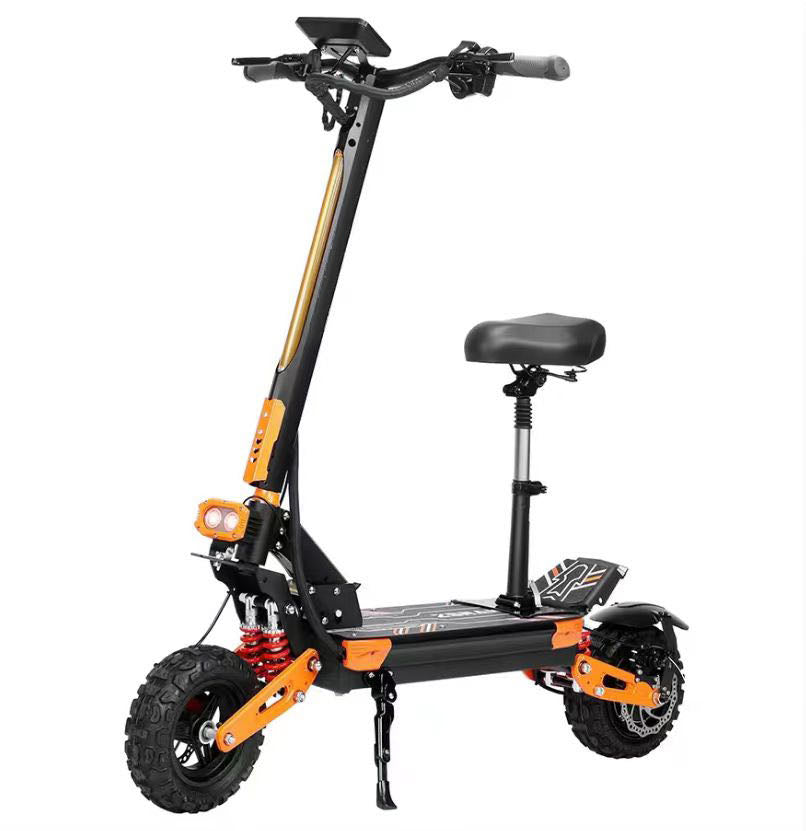
Performance Spotlight: TopRiding ZSNAKE Z35 All-Terrain Powerhouse
Bridging the gap between high-speed road commuting and rugged trail utility, the TopRiding ZSNAKE Z35 represents the pinnacle of commercial value among modern high-output standing scooters, delivering enterprise-grade power without the five-thousand-dollar price tag.
| Motor Output & Architecture |
2800W High-Torque Single Hub Motor (Exceptional incline climbing) |
| Electrical Architecture |
60V 15Ah High-Capacity Lithium-Ion Battery System with Dual-Charging Ports |
| Velocity & Range Windows |
Top Speed: 33 MPH (53 km/h) | Maximum Estimated Range: 35 Miles (56 km) |
| Wheel & Tire Specifications |
11-inch Heavy-Duty Off-Road Pneumatic Fat Tires (Superior traction) |
| Braking & Suspension |
Front & Rear Cable-Actuated Disc Brakes + Full Quad-Spring Suspension |
| Structural Payload Capacity |
Certified 330 LBS (150 kg) Maximum Rider Load with Reinforced Deck |
| Electrical Certification |
Full UL 2272 Safety Certification (Fire-safe battery management) |
Rider Procurement Advice: Eliminate range anxiety and conquer steep neighborhood inclines. Review detailed purchase specifications directly on the TopRiding ZSNAKE Z35 portal, or explore our curated innovation line via our Featured Picks collection.
Direct Technical Comparison: Voltage, Motor Wattage, Range & Weight
| Performance Parameter |
Ultra-Lightweight (Last-Mile) |
Daily Urban Commuter |
High-Performance Dual-Motor |
Heavy-Duty All-Terrain (e.g., ZSNAKE Z35) |
| Battery Nominal Voltage |
36V (10S Configuration) |
48V (13S Configuration) |
52V – 60V (14S–16S) |
60V (16S Configuration) |
| Motor Configuration |
Single 250W – 350W Hub |
Single 500W – 800W Hub |
Dual 1000W – 2000W Hubs |
Single 2800W High-Torque Hub |
| Incline Hill-Climbing Ability |
Weak (Max 8% – 10% slope) |
Moderate (15% – 18% slope) |
Extreme (30% – 45% slope) |
Aggressive (25% – 35% slope) |
| Tire Type & Diameter |
8" Solid or Honeycomb Rubber |
9" – 10" Pneumatic Tubeless |
10" – 11" Wide Road Radials |
11" All-Terrain Pneumatic Fat Tires |
| Braking Architecture |
Electronic E-Brake + Foot Fender |
Mechanical Disc or Drum Brakes |
Dual Hydraulic Disc Brakes |
Dual Front & Rear Disc Brakes |
| Portability / Carry Score |
10/10 (Effortless one-hand carry) |
7/10 (Manageable for short stairs) |
3/10 (Trunk load only; heavy) |
4/10 (Two-person lift or ground roll) |
| Typical Price Range (USD) |
$250 – $450 |
$550 – $950 |
$1,400 – $2,800 |
$800 – $1,400 |
Pros and Cons Table: Standing Scooters vs. Seated Micromobility
| Vehicle Architecture |
Operational Strengths (Pros) |
Practical Limitations & Drawbacks (Cons) |
Standing Electric Scooters
(All 5 Core Categories) |
- Compact footprint: easily stored in office cubicles, closets, and car trunks.
- Active rider engagement: standing posture allows intuitive body weight shifting.
- Rapid dismount: step off instantly in emergency low-speed situations.
- Bypasses urban traffic gridlock and eliminates parking fees completely.
- Lowest operating cost per mile of any motorized transportation tool.
|
- Requires active physical balance and core stability during acceleration.
- Physical leg fatigue during continuous rides exceeding 45 minutes.
- Smaller wheel diameter makes potholes more dangerous than on full-size bicycles.
- Limited cargo carrying capacity without a dedicated backpack.
|
Seated E-Bikes & Seated Scooters
(Traditional Seated Frames) |
- Ergonomic seated comfort for multi-hour rides and long-distance touring.
- Larger 20" to 26" wheels roll easily over massive road potholes.
- Built-in rear pannier racks support heavy grocery and cargo hauling.
|
- Massive physical footprint: cannot be brought into office elevators easily.
- Vulnerable to street bicycle theft when locked outside on public racks.
- Significantly higher purchase price and maintenance complexity.
|
Operational Realities: Real-World Efficiency vs. Physical Limitations
Before purchasing among the available types of standing scooter, riders must weigh the genuine financial and lifestyle benefits against the physical laws governing standing two-wheeled travel.
The Real Financial and Commuter Benefits:
-
Slashing Daily Transit Overhead: Operating a standing electric scooter costs mere pennies per day. Charging a 60V 15Ah battery pack from zero to full consumes roughly 0.9 kilowatt-hours (kWh) of electricity. At national average residential electricity rates ($0.16 per kWh), a full 35-mile charge costs less than fifteen cents. Compare that to public transit passes ($100+ per month) or car ownership (gas, insurance, parking, depreciating maintenance exceeding $8,000 annually), and an electric scooter pays for itself within three to six months.
-
Complete Immunity to Traffic Gridlock: Cars are bound by urban road design and congested intersections. Standing electric scooters legally leverage dedicated municipal bike lanes, multi-use paths, and greenway corridors. A commute that takes forty-five minutes in a gridlocked automobile regularly takes eighteen minutes on a dependable 25 mph commuter scooter, returning hours of productive time to your week.
-
Indoor Theft Immunity: Unlike electric bicycles that must be locked on outdoor bike racks where battery packs and components are vulnerable to angle-grinder theft, folding standing scooters roll straight into your office, apartment hallway, or college classroom, eliminating outdoor theft risks entirely. Explore our versatile folding collection through our Folding E-Scooters catalog.
The Inherent Operational Constraints:
-
Pothole Sensitivity and Wheel Geometry: A standard bicycle wheel measures 26 inches across, allowing it to roll through deep potholes without throwing the rider. A standing scooter rides on 8.5-inch to 11-inch tires. Striking a deep four-inch pothole at 25 mph can overcome the tire's roll-over angle, pitching the vehicle forward if the rider does not maintain an athletic, knees-bent stance.
-
Inclement Weather & Traction Limits: While high-grade scooters carry IPX5 or IPX6 water resistance ratings, riding a high-torque standing scooter on wet painted road lines, metal utility covers, or wet leaves requires caution. The small contact patch of scooter tires increases slip potential under hard braking, requiring progressive electronic ABS or careful mechanical brake modulation.
-
Rider Physical Fatigue on Rough Roads: Standing upright on a scooter requires continuous engagement of your calves, quadriceps, and core muscles to absorb road imperfections. If your commute spans more than 15 continuous miles of broken concrete, a rigid scooter will tire you out. For long-distance seated options, evaluate platforms in our E-Scooters with Seat division or discover our flagship TopRiding R2 - Full CNC Moto-Style eBike.
Who Needs a Heavy-Duty Scooter vs. Who Should Choose a Lightweight Model
Every dollar allocated to personal light electric vehicles should serve your specific physical profile and daily commute. Sourcing the right machine from the diverse types of standing scooter requires an honest assessment of your living situation, weight, and local geography.
Who Must Invest in a Heavy-Duty or High-Performance Scooter (60V / 2000W+):
-
Adult Riders Weighing Over 220 Pounds: Standard 36V and 48V commuter scooters are tuned for 160-pound test riders. If you weigh 240+ pounds, lighter scooters will crawl up hills at 4 mph, suffer catastrophic battery voltage sag, and overheat their controllers. You need a 60V high-torque machine like the ZSNAKE Z35 to ensure brisk acceleration and sustained hill-climbing power.
-
Riders Navigating Significant Elevation Changes: If your daily route crosses steep river valleys, mountain access roads, or severe bridge grades, single-motor 350W scooters will burn out their stator windings. High-output motors (1500W to 2800W) are non-negotiable for sustained grade climbing.
-
Suburban Road Commuters Merging with Automotive Traffic: If your route lacks protected bicycle infrastructure and forces you onto 35 mph suburban arterial roads, riding a 15 mph budget scooter in the gutter is dangerous. You need a fast, high-performance scooter capable of maintaining 30+ mph to take the lane safely and stay ahead of aggressive vehicular traffic. Review extended endurance models in our Long Range Electric Scooters portfolio.
Who Should Stick with an Everyday Lightweight Commuter (36V–48V / 350W–500W):
-
Multi-Modal Transit Riders with Stair Climbs: If your daily routine involves carrying your scooter onto a crowded metro car, lifting it onto a commuter train overhead rack, or climbing three flights of walk-up stairs, do not buy a 75-pound performance scooter. You will grow to resent its weight within a week. A 30-to-40-pound commuter is your optimal match.
-
Campus Students and Flat Urban Dwellers: If you live in a flat metropolitan grid (like downtown Chicago or Washington D.C.) and your average trip spans two to four miles, spending $1,500 on an all-terrain dual-motor monster is an unnecessary capital expense. A dependable 48V commuter scooter delivers all the speed and range you need at a fraction of the cost.
Costly Sourcing & Riding Mistakes That Destroy E-Scooters
Factory Engineering Advisory: The single most expensive mistake made by scooter buyers is purchasing an uncertified, generic machine from third-party marketplace discount sites to save a hundred dollars. Low-tier scooters cut costs by using recycled, unbranded lithium cells that lack thermal management, unsealed electronics that short-circuit in the rain, and cast pot-metal folding latches that snap under heavy braking stress.
-
Riding on Under-Inflated Pneumatic Tires: Over 70% of flat tires on standing scooters are not caused by road glass or nails; they are caused by pinch flats from low tire pressure. When a pneumatic tire drops below 40 PSI, striking a curb pinches the inner tube against the wheel rim, cutting the tube instantly. Low pressure also increases rolling resistance, slashing battery range by up to 25%. Always check tire pressure weekly and maintain 45 to 50 PSI.
-
Swapping to Solid Tires Without Suspension Upgrades: Frustrated by flat tires, many riders replace pneumatic tires with solid rubber or honeycomb tires on scooters that lack suspension. This is a severe mechanical error. Solid tires transfer 100% of high-frequency road vibrations directly into the motor axle, battery solder joints, and stem folding pin. Within three months, structural bolts rattle loose, battery cell nickel strips fracture, and the scooter's ride quality turns bone-jarring.
-
Ignoring UL 2272 Electrical Safety Certification: High-energy-density lithium-ion batteries require rigorous testing. Purchasing an unbranded scooter that lacks UL 2272 certification exposes your home to fire risks caused by battery thermal runaway during overnight charging. Insist on verified certification from established testing laboratories.
-
Over-Tightening or Neglecting Stem Folding Latches: The folding clamp at the base of the stem is under constant mechanical fatigue. Riders often fail to check the clamp bolts, allowing subtle play to develop into severe stem wobble. Check folding latch tightness every 100 miles, use blue threadlocker on critical fasteners, and never pull backward on the handlebars with your full body weight during acceleration; push through your legs and shift your center of gravity instead.
-
Charging a Cold or Wet Battery Immediately: If you ride in freezing winter weather or through a heavy rainstorm, never plug the scooter into a wall charger immediately upon arriving home. Charging frozen lithium cells causes permanent lithium plating on the anode, ruining pack capacity. Charging a wet port can arc electrical current across pins. Always let the scooter warm to room temperature and dry completely before charging.
Essential Buying Considerations: Voltage, Braking, and UL Safety Certification
Before purchasing among the many types of standing scooter on the market, audit prospective models against these four non-negotiable engineering benchmarks:
1. Electrical Safety: Verified UL 2272 Certification
Ensure the entire electrical system—including the battery pack, battery management system (BMS), motor controller, and charger—is officially certified to UL 2272 Standard for Electrical Systems for Personal E-Mobility Devices. Many municipalities and residential buildings now strictly ban uncertified electric scooters due to fire safety mandates. A certified system guarantees active protection against overcharge, short circuit, and thermal runaway.
2. Braking Architecture: Dual Mechanical vs. Full Hydraulic
Top speed is meaningless if you cannot stop predictably. For scooters operating up to 15 mph, a front electronic regenerative brake paired with a rear drum or mechanical disc brake is adequate. For any machine traveling over 20 mph, demand dual disc brakes (front and rear). For high-performance scooters exceeding 30 mph, full hydraulic disc brakes with mineral oil lines are mandatory; hydraulic systems deliver four times the clamping force of cable-actuated brakes with light one-finger lever pull, significantly shortening emergency stopping distances.
3. Real-World Battery Capacity (Watt-Hours, Not Amp-Hours)
Manufacturers often advertise range using vague Amp-hour (Ah) ratings without context. To calculate true energy storage, multiply voltage by amp-hours to find total Watt-hours (Wh = V × Ah). A 36V 10Ah battery has only 360Wh of energy, while a 60V 15Ah battery packs a massive 900Wh of energy (nearly triple the capacity). As an industry rule of thumb, expect an adult rider in real-world urban conditions to consume roughly 20 to 30 Watt-hours per mile. A 360Wh battery yields roughly 12 to 15 miles of real range; a 900Wh battery easily delivers 30 to 35 miles.
4. Regulatory Classification and Local Road Compliance
Review local municipal speed limits and vehicle classifications established by SAE International (SAE J3194 Powered Micromobility Taxonomy) and the National Highway Traffic Safety Administration (NHTSA). Ensure your scooter's display allows speed-limiting modes (e.g., locking the scooter to 15 mph or 20 mph) to maintain street-legal compliance in regulated bicycle lanes while unlocking higher speeds for private property or open suburban roads.
Expert Micromobility Verdict & Sourcing Blueprint
In our professional assessment across the light electric vehicle industry, standing electric scooters are no longer toys; they are sophisticated, reliable, and cost-effective personal transit tools that drastically reduce urban congestion and operating expenses.
Here is your clear commercial action plan when selecting among the types of standing scooter:
-
For Multi-Modal Commuters (Subways, Trains, Stairs): Choose an Ultra-Lightweight Folding Commuter under 35 pounds with a 350W motor. Prioritize folded dimensions and carrying ease over extreme speed.
-
For Standard Daily City Workers (5–12 Mile Commutes): Invest in an Everyday Urban Commuter operating on 48V architecture with a 500W to 800W rear motor and 10-inch pneumatic tubeless tires. This configuration delivers the best balance of speed, range, safety, and price.
-
For Heavy Riders (220+ lbs), Steep Hills, and Mixed Terrain: Deploy an All-Terrain Heavy-Duty Machine like the TopRiding ZSNAKE Z35. Its 2800W motor, 60V battery architecture, 11-inch off-road pneumatic fat tires, and 330-pound payload capacity provide the hill-climbing muscle, braking safety, and structural integrity required to tackle any terrain with absolute confidence.
-
For Highway Merging & Adrenaline Enthusiasts: Step up to a High-Performance Dual-Motor Scooter equipped with full hydraulic disc brakes, steering dampers, and certified high-output battery systems.
Audit your commute distance, respect your local terrain's elevation, insist on UL 2272 electrical certification, wear a certified helmet on every ride, and experience the freedom, agility, and pure thrill of standing electric mobility.
Frequently Asked Questions
What are the main types of standing scooter available on the market?
The personal electric mobility market divides into five primary types of standing scooter: (1) Ultra-Lightweight Last-Mile Scooters (under 35 lbs, 250W-350W motors for short hops and subway connections); (2) Everyday Commuter Scooters (36V-48V, 500W-800W single motors, 15-25 mph for daily urban transit); (3) High-Performance Dual-Motor Scooters (52V-60V, 2000W-4000W total power, 35-50 mph for aggressive road riding); (4) Heavy-Duty All-Terrain Off-Road Scooters (11-inch pneumatic fat tires, long-travel spring or hydraulic suspension for dirt trails); and (5) Heavy-Payload Commercial Cargo Scooters (reinforced structural decks rated for 330 to 400 lbs).
How do you match the types of standing scooter to your daily commute distance?
For commutes under 5 miles each way with public transit links, an ultra-lightweight folding model is best. For daily road commutes between 5 and 15 miles with occasional hills, an everyday commuter scooter with an 800W motor and a 48V 15Ah battery is optimal. For commutes over 15 miles or routes requiring highway-speed traffic merging, choose a 60V high-performance or long-range scooter delivering at least 35 miles of real-world range.
Why do motor wattage ratings differ between peak and nominal on standing scooters?
Nominal wattage represents the continuous power output a hub motor can sustain indefinitely without overheating. Peak wattage is the temporary maximum burst power delivered by the motor controller during hard acceleration or steep hill climbing. A scooter marketed as having a 2800W peak motor may run at 1200W to 1500W continuous nominal power to preserve battery thermals and motor windings.
Are pneumatic air-filled tires better than solid puncture-proof tires on standing scooters?
Yes, in most professional situations, pneumatic tires are vastly superior. Air-filled tires act as progressive pneumatic springs, absorbing high-frequency road vibrations, increasing the contact patch during cornering, and providing superior wet-surface traction. Solid rubber tires eliminate flats but transmit harsh impacts directly into the rider's knees and spine, increase stopping distances, and wear out stem locking folding joints prematurely.
Authoritative Standards & Industry References


