TopRiding electric scooters are certified to meet UL 2272 safety standards, covering critical electrical and fire safety requirements for the electrical system and battery.
This certification helps ensure safer, more reliable riding.
Over 100,000 electric scooters sold, backed by 5,000+ verified reviews and an average rating of 4.7+ stars.
Chosen by riders worldwide for reliable performance, and everyday riding confidence.
Expert support. local service.
Expert Customer Service
As a U.S.-based company, TopRiding provides 24/7 expert customer service and local after-sales support across multiple regions in North America.
Our dedicated support team is here to ensure fast responses, professional assistance, and reliable service — whenever you need it.
TEST RIDES AND SERVICE
Safety Certified
Designed to Meet UL 2272 Safety Standards
Our electric scooters are designed in accordance with UL 2272 safety requirements for electrical and battery systems, helping enhance overall safety and reliability.
Trusted by a global riding community
100,000+ Units Sold
Over 100,000 electric mobility vehicles sold, backed by 5,000+ verified reviews and an average rating of 4.7+ stars.
Chosen by riders worldwide for reliable performance, safety, and everyday riding confidence.
Expert Support. Local Service.
Expert Customer Service
As a U.S.-based company, TopRiding provides 24/7 expert customer service and local after-sales support across multiple regions in North America.
Our dedicated support team is here to ensure fast responses, professional assistance, and reliable service—whenever you need it.
6 Best Hunting E-Bikes Under $2,000: What to Buy for Trails, Gear and Access Roads
6 Best Hunting E-Bikes Under $2,000: What to Buy for Trails, Gear and Access Roads
senkan
The best hunting e bike under $2000 is not necessarily the fastest electric bike or the model with the biggest advertised motor. For hunting, the useful combination is dependable low-speed control, enough battery capacity for the round trip, tires suited to loose ground, a frame that can carry your equipment, and a serviceable design that will not become a problem far from your vehicle.
Our recommendation is to prioritize battery watt-hours, tire grip, braking, load capacity and practical cargo mounting before paying extra for speed. Under $2,000, you will generally be choosing among fat-tire utility e-bikes, hardtail trail bikes, value full-suspension models and moto-style e-bikes. They serve different hunters, and not every bike marketed as an off-road e-bike is appropriate for every hunting property.
Quick Answer: Which hunting e-bike should you choose under $2,000?
For long approaches with a pack, cooler or other equipment, start with a fat-tire utility e-bike with a removable battery and a sturdy rear rack. For rougher trails, prioritize suspension and hydraulic brakes. For riders who want a more motorcycle-inspired platform, consider a moto-style e-bike such as the TopRiding R2, listed at $1,999, but verify local classification, hunting-area rules, and its suitability for your specific terrain before buying.
There is no single verified winner across every brand and model at this price. The six choices below are six buying profiles to compare, not a claim that six specific models have been independently tested or that their current prices and inventory have been verified.
The 6 Best Hunting E-Bike Choices Under $2,000
These six categories reflect the trade-offs that matter most when buying an electric hunting bike. Treat them as a practical shortlist framework: confirm the exact model, current price, component specification, warranty and local riding rules before placing an order. Prices and specifications can change, and a category recommendation should not be mistaken for an independently verified model ranking.
1. Fat-Tire Utility E-Bike: Best Overall for Many Hunting Trips
A fat-tire utility e-bike is the first type we would investigate for hunters covering dirt roads, sandy access tracks, gravel, packed forest paths and mixed terrain. Its wider tires can offer a larger contact patch and additional flotation compared with narrow commuter tires, although actual traction still depends on tread design, tire pressure, ground conditions and rider technique.
Look for a removable battery, a strong rear rack or compatible cargo mounts, hydraulic or well-adjusted mechanical disc brakes, and tires with a tread pattern suited to your terrain. A rack is useful only when its rated load and mounting hardware are adequate for the cargo you plan to carry.
Best for: Hunters who need a versatile bike for access roads and moderate trails while carrying a day pack and practical equipment.
Watch out for: Very heavy fat-tire models with small batteries, weak racks or inexpensive brakes. Tire width alone does not make a bike trail-capable.
2. Long-Range E-Bike: Best for Distant Hunting Areas
For a hunting area several miles from the parking point, battery energy is more important than a marketing claim such as “long range.” Compare watt-hours (Wh), which are calculated by multiplying battery voltage by amp-hours, and then consider rider weight, cargo, elevation, temperature, tire pressure, surface and assist level.
As a simple example, a 52V, 25Ah battery contains approximately 1,300Wh of nominal energy. That is a useful capacity figure for comparing bikes, but it does not guarantee a particular number of miles. A loaded bike on steep, soft ground can consume energy much faster than a lightly loaded bike on firm paths.
Best for: Hunters who need a dependable round-trip energy reserve and can recharge the battery between outings.
Watch out for: Range estimates based on ideal conditions. Plan around a conservative return reserve rather than assuming the advertised maximum is achievable on every trip.
3. Hardtail Trail E-Bike: Best for Narrower Trails and Easier Handling
A hardtail e-bike has front suspension but no rear suspension. Compared with many full-suspension and moto-style models, a hardtail can be lighter, simpler and easier to pedal when the battery is depleted. That matters when a route includes narrow singletrack, frequent turns or a section where riding assistance is restricted.
For hunting, choose a frame size that allows confident handling at low speeds and a tire setup appropriate for roots, rocks and loose dirt. Do not assume a mountain-bike frame is designed to carry heavy cargo: check the manufacturer's payload limit and approved rack compatibility.
Best for: Riders who value maneuverability, conventional bicycle handling and a simpler mechanical setup.
Watch out for: Hardtails with limited battery capacity or low component quality. On repeated rocky descents, a suitable full-suspension bike may be more comfortable and controllable.
4. Full-Suspension E-Bike: Best for Rough, Repeated Trail Sections
Rear suspension can improve comfort and help a rider maintain control over uneven ground, especially when the route includes repeated bumps and rough descents. It is not a substitute for appropriate tires, reliable brakes or sensible speed. Suspension quality and setup matter more than the mere presence of a rear shock.
Under $2,000, compare the complete component package carefully. Some budget full-suspension bikes achieve a low headline price with compromises in fork quality, shock performance, battery capacity or braking. For hunting, the best choice is a balanced bike rather than one that spends most of its budget on appearance.
Best for: Experienced riders covering rough access trails where additional suspension control is genuinely useful.
Watch out for: Poorly specified suspension systems and frames without clear cargo or payload guidance. Do not attach heavy hunting equipment to suspension components or unapproved mounting points.
5. Cargo-Capable Hunting E-Bike: Best for Carrying Equipment
A cargo-capable e-bike is often the most practical purchase for hunters who need to carry layers, water, optics, food, recovery tools and other equipment. Instead of focusing on top speed, evaluate rack ratings, frame mounting points, wheel stability, brake performance under load and how securely the cargo can be fastened.
Keep the load balanced and low. A heavy pack attached high behind the saddle can affect steering and stability, especially on loose surfaces. If you expect to transport game, verify payload capacity, cargo dimensions, applicable wildlife rules and safe loading procedures before buying. Never assume the manufacturer's maximum payload automatically covers an accessory rack's lower limit.
Best for: Hunters who carry more than a small backpack or want a repeatable setup for regular trips.
Watch out for: Generic racks without a documented weight rating, loose straps near the wheel, and total payload calculations that ignore rider weight and accessories.
6. Moto-Style E-Bike: Best for Riders Who Prefer a Motorcycle-Inspired Platform
Moto-style e-bikes appeal to riders who prefer a compact, motorcycle-inspired frame, broad tires and a substantial riding position. They can be worth considering for suitable access roads and designated off-road areas, but their weight and geometry may make them less convenient to lift onto a vehicle or maneuver through tight trails.
Before choosing this style, check the complete specification sheet, the manufacturer's stated speed and power limits, the total weight, battery removal procedure, brake type and applicable legal classification. The label “e-bike” does not by itself establish that a high-powered or throttle-equipped model is permitted on a particular public trail.
Best for: Riders who want a sturdy moto-style design and have verified that the bike is allowed in their intended riding areas.
Watch out for: Heavy frames, hard-to-transport dimensions, and assumptions that a powerful motor or wide tire makes a bike legal or safe on every trail.
What Is a Hunting E-Bike?
A hunting e-bike is an electric bicycle selected or equipped to help a hunter reach an area, transport personal equipment and travel along permitted access routes with less physical effort than a conventional bicycle. It is not a special legal category in itself. The bike's actual motor, throttle, speed capability and local regulations determine where it may be used.
Unlike a typical city commuter, a hunting setup needs to cope with variable surfaces, low-speed maneuvering, cargo and a return trip that may occur in cold or wet conditions. That is why battery capacity, tire suitability, brakes and load management should come before cosmetic styling or maximum-speed claims.
How a Hunting E-Bike Works in the Field
The battery supplies energy to an electric motor, while the controller manages power according to the bike's system design and rider input. Some models use pedal assist, some include a throttle, and others provide both. The available modes, maximum assisted speed and throttle behavior depend on the specific bike and its configuration.
For practical hunting use, think in three stages. First, the approach: estimate the distance, elevation and surface, then choose an assist level that balances effort and energy use. Second, the stop: secure the bike, switch it off when appropriate and keep equipment organized so nothing can enter the wheels. Third, the return: preserve battery reserve and avoid relying on the highest assistance setting for the entire outbound journey.
In our buying approach, a reliable return plan matters more than a headline range figure. Carry the charging equipment recommended by the manufacturer if practical, understand how the battery is removed and charged, and do not charge a wet or damaged battery. Follow the supplied battery instructions and keep charging equipment away from moisture.
Comparison Table: Which Hunting E-Bike Type Fits Your Needs?
Bike Type
Best Use Case
Main Advantage
Main Trade-Off
What to Prioritize
Fat-tire utility
Gravel, sand, dirt roads and mixed terrain
Versatile tire footprint and utility options
Can be heavy and less nimble
Tread, battery Wh, rack rating and brakes
Long-range
Long approaches and return trips
More energy reserve when correctly sized
More battery capacity may add weight and cost
Battery Wh, realistic range and removability
Hardtail trail
Narrower trails and mixed riding
Simpler design and conventional handling
Less rear-wheel comfort on rough ground
Fit, fork quality, tires and payload limit
Full suspension
Repeated rough sections and uneven descents
Additional comfort and wheel control
Budget models may compromise on components
Suspension quality, brakes and serviceability
Cargo-capable
Equipment-heavy outings
More secure and organized load carrying
Load affects handling and range
Rack rating, mounting points and total payload
Moto-style
Suitable access roads and permitted off-road areas
Motorcycle-inspired frame and riding position
Often heavier and more difficult to transport
Legal classification, weight, brakes and battery
Benefits and Limitations of Hunting E-Bikes
Benefits
Less effort on the approach: Electric assistance can reduce the physical demand of covering long access roads, particularly with a loaded bike.
More equipment flexibility: Suitable racks and cargo mounts can help keep supplies organized, provided they are rated for the load.
Useful low-speed travel: A well-chosen bike can be easier to control along appropriate paths than a vehicle, depending on the terrain and the rider.
Rechargeable operation: A removable battery can make charging and storage more convenient where the manufacturer permits removal.
Multiple applications: The same bike may be useful for ordinary trail riding, property access and general recreation outside hunting season.
Limitations
Range varies substantially: Soft ground, hills, cold temperatures, low tire pressure, heavy cargo and high assist levels can reduce usable distance.
Weight is a real drawback: Some powerful or moto-style e-bikes are difficult to lift, carry over obstacles or transport without a suitable rack.
Access is not guaranteed: Public land, wildlife areas, parks and private properties may restrict e-bikes or particular classes of motorized bicycle.
Maintenance still matters: Tires, brakes, suspension, drivetrain and battery condition need regular attention.
Noise and visibility require judgment: An electric motor may be relatively quiet, but tires, chains, brakes and cargo can still make noise. Riders must also avoid creating hazards for other trail users and wildlife.
Pros and Cons Table
Pros
Cons
Reduces effort on suitable access routes
Real-world range may be much lower than advertised
Can carry equipment with compatible, rated accessories
Additional cargo reduces range and changes handling
Can serve as a general-purpose recreational bike
Heavy models may require a dedicated vehicle rack
Removable batteries can simplify charging
Battery replacement can be a significant future expense
Several frame and tire styles fit different terrain
Not every e-bike is allowed on every hunting trail or public land
Buying Considerations Before Spending $2,000
1. Compare Battery Watt-Hours, Not Just Voltage
Voltage is only one part of battery capacity. Multiply volts by amp-hours to estimate nominal watt-hours. A 52V, 25Ah battery is rated at approximately 1,300Wh. That figure is useful for comparing energy capacity, but it does not reveal battery quality, usable capacity, cell configuration or expected longevity on its own.
Ask the seller for the battery's exact specification, replacement cost, warranty, charging instructions and whether replacement batteries are actually available. A removable battery is useful only if you can safely remove it and obtain a compatible replacement.
2. Choose Tires for the Ground You Actually Ride
Wide tires may help on sand, loose soil and uneven access roads, but tread pattern and pressure matter. Aggressive tread can improve grip on some surfaces while increasing rolling resistance on firm roads. Narrower trail tires may be easier to steer on technical paths. Choose for your normal terrain, not for appearance alone.
For beginners, learn how the bike behaves when braking and turning on loose ground before carrying a full hunting load. Test the tire pressure range recommended by the manufacturer rather than assuming lower pressure is always better.
3. Treat Brakes as a Safety-Critical Component
A loaded e-bike needs brakes that can reliably manage the combined weight of rider, bike and cargo on the intended descents. Hydraulic disc brakes can offer useful modulation and reduced hand effort, but quality, rotor size, pad condition and maintenance all matter. A premium-sounding brake specification does not remove the need to inspect and maintain the system.
Ask whether replacement pads and rotors are standard sizes and easy to obtain. If you regularly ride steep terrain, have a qualified technician inspect the bike and make sure the braking system is appropriate for the total load.
4. Calculate Total Payload Correctly
Do not confuse maximum payload with the load rating of a rear rack. A bike may have a stated total payload limit, while a rack or front basket has a separate, lower limit. Include the rider, clothing, backpack, accessories and cargo in your calculation, and follow the lowest applicable component limit.
For commercial users or hunters making repeated equipment-heavy trips, secure cargo is not optional. Loose straps, dangling bags and overloaded racks can interfere with the wheels, chain or steering.
5. Check Weight and Transport Before Ordering
Weight becomes important when loading the bike into a truck, carrying it up steps or lifting it onto a vehicle rack. An 80-pound-plus e-bike is not a minor handling issue. Check the complete bike weight, the rack's per-bike rating and the vehicle's tongue-weight or hitch limits where applicable.
If you hunt alone and cannot comfortably lift the bike, prioritize a manageable frame and a practical loading method over a larger motor or oversized battery.
6. Verify Legal Classification and Land Access
E-bike rules vary by state, land manager and trail. Motor power, throttle operation and maximum assisted speed may affect classification. Hunting regulations can separately govern where a bicycle or motorized vehicle may be used, whether game may be transported, and how access is handled during particular seasons.
Before buying, consult the relevant land agency and current state rules. Do not assume that a bike marketed for hunting is automatically legal on a public trail or permitted for use in a wildlife management area. A high-powered model may be treated differently from a conventional pedal-assist bicycle.
7. Look Beyond the Sale Price
A $1,700 bike with weak brakes, a proprietary battery that is hard to replace and no clear warranty may cost more over time than a $1,900 bike with serviceable components. Include delivery, tax, a helmet, lights where appropriate, cargo equipment, maintenance and possible battery replacement in the total budget.
Before checkout, ask about warranty coverage for the frame, motor, battery and controller; the process for diagnosing faults; shipping costs for replacement parts; and who pays return freight if a large bike arrives damaged. Clear answers are part of the product's value.
Common Mistakes When Choosing a Hunting E-Bike
Buying on motor wattage alone: A larger peak-power number does not guarantee better traction, battery life, braking or reliability.
Trusting the maximum range without context: Ask what rider weight, speed, terrain, temperature and assist setting were used for the estimate.
Assuming fat tires equal all-terrain capability: Frame geometry, tire tread, suspension, brakes and ground clearance still matter.
Ignoring total weight: A bike that performs well on a trail can still be a poor choice if you cannot load or unload it safely.
Adding cargo without checking ratings: Confirm both the total payload limit and the individual rack or accessory limit.
Overlooking battery support: Confirm replacement availability and warranty terms before purchasing an unfamiliar system.
Assuming access is legal: Check trail and hunting-area rules before planning a trip.
Skipping a loaded test ride: Test braking, low-speed turns and stability with a representative load on permitted terrain before relying on the bike for a remote outing.
Who Should Use a Hunting E-Bike—and Who Does Not Need One?
Who Should Use One
A hunting e-bike is worth considering if you regularly travel along permitted access roads, cover distances that would be tiring on a conventional bicycle, or need to carry equipment without using a motor vehicle for the entire route. It can be especially practical for hunters who can plan a safe return route and recharge between trips.
For beginners, the best choice is usually a manageable bike with predictable handling, reliable brakes and enough battery capacity for the route—not the fastest or heaviest model. For experienced riders on rough ground, suspension and component serviceability may justify a different setup.
Who Does Not Need One
You may not need an e-bike if your hunting area is a short walk from parking, the route is too narrow or technical for safe bike use, or the land manager prohibits e-bikes. A conventional bicycle may be lighter and less expensive for short, firm routes. Walking may be the more sensible option where riding would create a safety, access or wildlife disturbance concern.
If your plan requires carrying a load beyond the bike's rated capacity, crossing terrain unsuitable for bicycles or accessing land where motorized travel is prohibited, do not try to solve that problem by buying a more powerful model.
Where the TopRiding R2 Fits Under $2,000
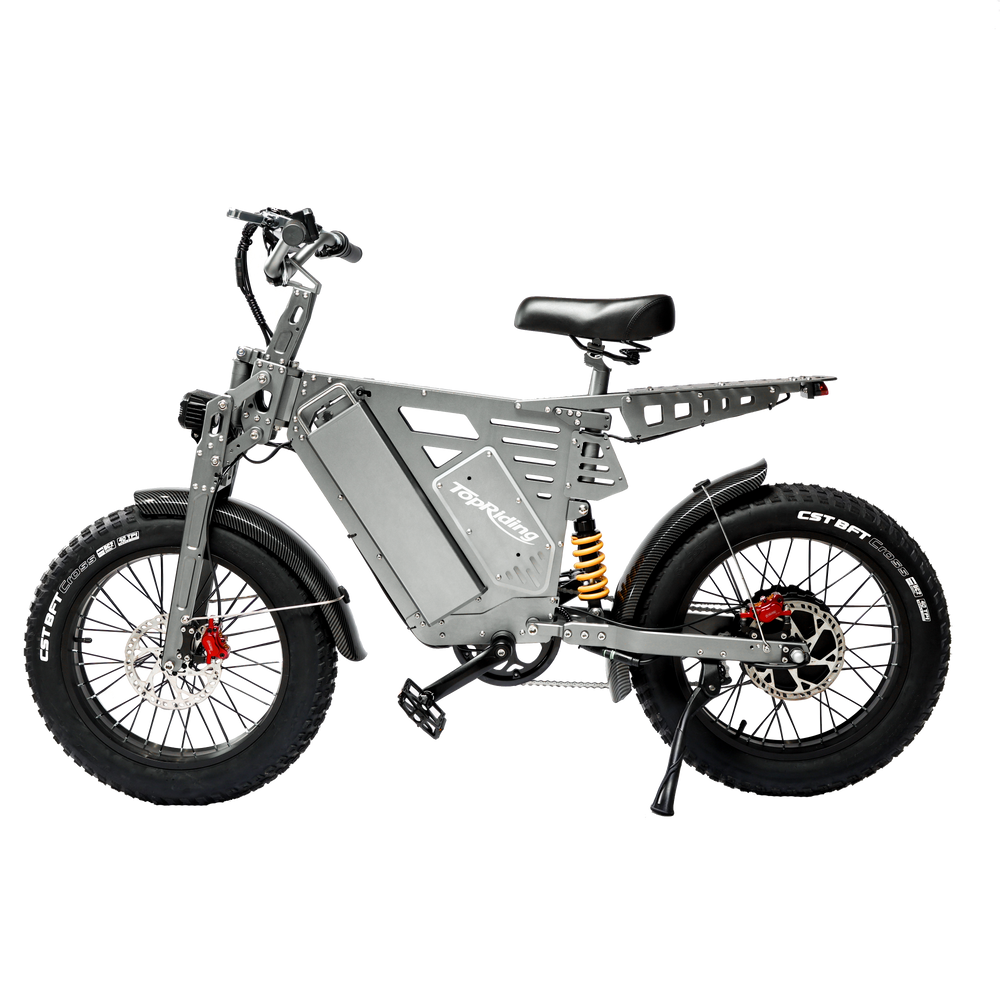
The TopRiding R2 Full CNC Moto-Style eBike is a relevant option for buyers drawn to a motorcycle-inspired frame and a large removable battery. The listed price is $1,999, which places it at the upper edge of this budget. Its supplied specifications provide a useful example of how to evaluate a moto-style e-bike against the demands of hunting access.
TopRiding R2 - Full CNC Moto-Style eBike
$1,999.00
Key listed specifications include a 52V, 25Ah removable lithium-ion battery rated at 1,300Wh; a 750W rated rear hub motor with 1,500W peak power; 20 mph factory speed limit; 20 × 4.0-inch tires; full suspension with 100mm front and rear travel; four-piston hydraulic disc brakes; and a stated maximum payload of 330 pounds.
Large stated battery capacity: The 1,300Wh rating is a useful comparison point for buyers who need an energy reserve for longer trips. Actual range will depend on conditions and riding style.
Removable battery: This can make charging and storage easier when the bike is parked away from a suitable charging outlet.
Full suspension: The listed 100mm front and rear travel may be useful on compatible uneven routes, subject to suspension setup and rider weight.
Hydraulic disc brakes: Four-piston brakes are a promising specification for controlling a heavy bike, but setup, rotor details, maintenance and the loaded stopping test remain important.
Stated payload: The 330-pound maximum payload gives buyers a figure to investigate, but it should not be treated as a rack rating or permission to overload any individual component.
What to Consider Before Buying It for Hunting
The R2 is listed at 82 pounds. That is substantial for a bike that may need to be lifted into a vehicle or maneuvered over obstacles. Measure your available vehicle rack and loading space, and check the rack's capacity before ordering.
Its 20 mph factory speed limit is a listed specification, not proof of legal classification on every trail. Confirm the exact model configuration, applicable state law and land-manager rules. A motorcycle-inspired appearance does not automatically make it a legal e-bike for public land.
The R2's supplied specification does not by itself confirm the rear rack's load rating, a hunting-specific accessory package, independent real-world range testing or replacement-battery lead times. Ask TopRiding for those details if they are essential to your use case. We would not buy any hunting e-bike on the assumption that unlisted accessories or performance results are included.
For a rider who values a moto-style platform and has verified trail access, the R2 deserves consideration at its listed $1,999 price. For someone who must frequently lift the bike, ride narrow technical singletrack or carry heavy cargo on a rack, a lighter trail model or a purpose-built utility bike may be the more practical purchase.
Cost-Benefit Analysis: Is a Hunting E-Bike Under $2,000 Worth It?
The purchase makes the most sense when it solves a recurring access problem. If you make many trips along long, permitted access roads, electric assistance can reduce effort and make it easier to carry a moderate amount of equipment. If you only use the bike once or twice a year on short routes, the cost may be difficult to justify compared with walking or using a bicycle you already own.
Calculate value based on frequency, not excitement about the specification sheet. Add the bike price to essential accessories, maintenance, charging and likely battery replacement over the period you expect to own it. Then compare that total with the time and effort it saves on your actual trips.
For riders also shopping for general outdoor transport, TopRiding's off-road electric scooters and long-range electric scooters offer other electric-vehicle categories to compare, but scooters are not direct substitutes for a bicycle where pedaling, bike geometry or cargo mounting is important. Use the product category that suits the route and local access rules.
Expert Recommendation: What We Would Buy
From our experience evaluating e-bike specifications for practical use, we would make the decision in this order: first confirm that e-bikes are permitted on the intended route; then calculate the required round-trip distance and reserve; next check brakes, tires, payload and battery support; and only then compare motor output, styling and additional features.
For most hunters under $2,000, we would begin with a fat-tire utility e-bike if the route includes mixed dirt roads and the rider needs to carry equipment. Choose a long-range model when the route is the main challenge, a hardtail when maneuverability matters, or a properly equipped full-suspension bike when rough trails justify the added complexity. A moto-style bike such as the TopRiding R2 is a reasonable alternative if its weight and legal classification fit the plan.
We would not pay extra for speed that the route does not require. We would pay attention to a documented battery specification, accessible replacement parts, clear warranty terms, dependable brakes and a bike that can be loaded safely. Those features have more day-to-day value than a dramatic peak-power figure.
Our final buying rule: Do not choose a hunting e-bike until you can answer three questions: Is it legal where I plan to ride? Can it complete my round trip with a reserve under realistic conditions? Can it safely carry my total load and be transported when I am done? If any answer is unclear, ask the seller or land manager before spending your budget.
Frequently Asked Questions
1. What is the best hunting e-bike under $2,000?
For many hunters, a fat-tire utility e-bike with a removable battery, suitable tread, reliable disc brakes and rated cargo mounts is the best starting point. The right model depends on route length, terrain, total load, bike weight and whether e-bikes are allowed where you hunt. There is no universally best model for every hunting situation.
2. Is a 750W e-bike powerful enough for hunting?
A 750W rated motor may be sufficient for many access-road trips, but performance also depends on torque, gearing or controller behavior, rider and cargo weight, grade, tires and battery output. Compare the complete specification and verify that the model is permitted in the area where you intend to ride.
3. How much battery capacity do I need for a hunting e-bike?
Start with the round-trip distance, elevation, surface and expected cargo, then compare battery capacity in watt-hours. A larger battery can provide more energy reserve, but no capacity guarantees a particular range in every condition. Use conservative estimates and plan a return reserve rather than relying on the manufacturer's maximum advertised distance.
4. Are fat tires better for hunting?
They can be helpful on sand, loose dirt and mixed access roads because the wider tire footprint may improve flotation and stability. They are not automatically better on every trail. Tread, tire pressure, frame geometry and handling all matter, and very wide tires can add rolling resistance and weight.
5. Can I carry hunting gear on an e-bike?
Yes, if the bike and its accessories are designed and rated for the load. Check the total payload limit and separate rack or basket limits, secure all straps, keep the load balanced and low, and test handling and braking with a representative load before a remote trip.
6. Is the TopRiding R2 suitable for hunting?
The listed R2 specifications include a 1,300Wh removable battery, full suspension, 20 × 4.0-inch tires, hydraulic disc brakes and a 330-pound maximum payload. Those features may suit some access-road and permitted off-road use cases. However, the bike's 82-pound weight, actual cargo-mount options, real-world range and legal classification should be checked against your needs before buying.
7. Can I ride a hunting e-bike on public hunting land?
Not automatically. Rules vary by land manager, trail, state and e-bike classification. Check current regulations for the specific property and route before riding. Also review any separate restrictions on motorized travel, wildlife disturbance and transporting harvested game.
8. Is a hunting e-bike better than an electric scooter?
It depends on the task. A bicycle may be preferable where pedaling, bicycle handling and compatible cargo mounts matter. A scooter may fit some paved or permitted access routes, but its design may be less suitable for carrying hunting equipment or negotiating uneven ground. Compare the actual terrain, cargo needs, transport requirements and legal access rather than assuming one category is universally better.
9. What should I check before buying a used hunting e-bike?
Inspect battery condition and charging behavior, frame and suspension, brakes, tires, drivetrain, display and controller. Ask for service records, original purchase information, charger compatibility and battery replacement availability. If possible, have a qualified technician inspect the bike and test it before payment.
10. Should I buy the highest-powered e-bike I can afford?
No. More power is not automatically better for hunting access. It can increase cost, weight and legal complexity without solving your main problem. Choose enough power for the terrain and load, then prioritize control, battery reserve, serviceability and legal access.
Specifications and listed prices in this guide reflect the product information supplied for the article and may change. Confirm the current listing, warranty, accessory ratings and applicable local regulations before purchase or use.
Al seleccionar una opción se actualiza toda la página.