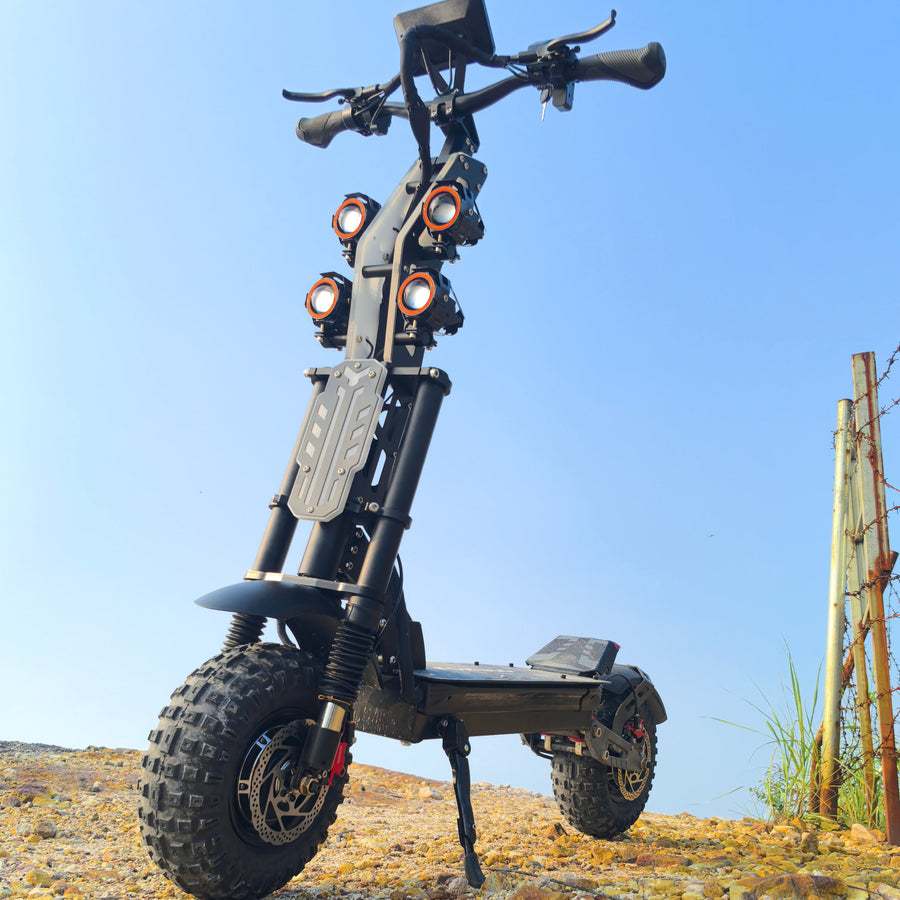
The electric scooter industry has evolved massively over the past few years. What started as a low-speed, pavement-only commuting solution has transformed into a high-performance powersport. Today, riders are increasingly looking beyond the bike lane and pointing their handlebars toward dirt trails, gravel paths, and rugged outdoor terrain. But this raises a critical question for consumers planning to invest their hard-earned money: are e-scooters good off-road?
From our experience as industry practitioners at TopRiding, the answer is not a simple yes or no. The reality is that taking an electric vehicle onto a dirt trail requires specific engineering, advanced suspension geometry, and substantial motor torque. Taking a standard commuter scooter off-road is a fast track to broken components, voided warranties, and potential injury. However, if you select a purpose-built model designed for heavy-duty applications, the off-road riding experience is nothing short of extraordinary.
The Quick Answer
Are e-scooters good off-road? Yes, e-scooters are exceptionally good off-road, but only if you purchase a dedicated off-road model. A capable off-road e-scooter must feature dual motors (minimum 2000W combined), deeply treaded pneumatic tires (10 to 13 inches), and a high-travel hydraulic or heavy-duty spring suspension system. Standard commuter scooters will instantly fail on dirt trails due to low torque, rigid frames, and slick tires.
What Makes an E-Scooter Off-Road Capable?
To understand what makes e-scooters good off-road machines, you must look directly at the hardware. You cannot simply put knobby tires on a lightweight city scooter and expect it to conquer a mountain trail. In most professional situations, true off-road capability is determined by a combination of four critical components working together: dual motors, high-clearance suspension, specialized tires, and structural frame integrity.
First and foremost, off-road environments demand raw torque. A single rear-wheel motor will immediately bog down in mud, loose gravel, or steep inclines. Therefore, dual motor configurations are an absolute necessity. When both wheels are actively pulling and pushing the frame, the vehicle can claw its way out of ruts and power up hills that would stall a standard scooter. If you are serious about trail riding, we strongly suggest reviewing our guide on the Best dual motor electric scooters to understand the power dynamics required.
Secondly, the suspension system dictates your control and safety. When you hit a tree root at 20 mph, that kinetic energy must be absorbed. Cheap spring suspensions will bottom out, transferring the impact directly into your wrists and knees. For commercial users and extreme enthusiasts, we recommend hydraulic triple-clamp suspension systems, which provide the dampening and rebound control necessary to keep the tires planted firmly on the ground.
The Reality of Off-Roading: Benefits and Limitations
Before you invest in a high-performance machine, it is vital to weigh the commercial and practical realities. While e-scooters good off-road performance is thrilling, these vehicles come with specific ownership trade-offs that you must consider.
| The Pros (Benefits) |
The Cons (Limitations) |
|
Unmatched Terrain Versatility: You are no longer restricted to paved roads. You can cut through parks, tackle forest trails, and navigate deeply rutted gravel driveways with ease. |
Considerable Weight: Purpose-built off-road scooters easily weigh between 80 to 150 lbs. They are incredibly difficult to carry up stairs or load into small car trunks. |
|
Superior Ride Quality: The massive hydraulic suspensions and large tires mean that even when you ride them on city streets, potholes and speed bumps are completely absorbed. |
Higher Initial Cost: The technology required to build a durable off-road scooter (dual controllers, large batteries, hydraulic shocks) requires a premium financial investment. |
|
High Weight Capacity: The reinforced tubular frames are excellent for heavier riders. These scooters rarely suffer from stem wobble or frame flex under pressure. |
Increased Maintenance: Riding in mud, dust, and water requires diligent maintenance. You must regularly clean the suspension stanchions and check brake pad wear. |
Who Should Use an Off-Road E-Scooter? (And Who Does Not Need It)
We believe in helping our readers make smart buying decisions. An off-road e-scooter is a major purchase, and it is not the right tool for everyone.
You should buy an off-road e-scooter if:
- You live in a rural area, on a farm, or frequently navigate poorly maintained, unpaved roads.
- You are a larger rider who needs maximum structural stability. In this scenario, we highly recommend reading our breakdown of the Best electric scooters for heavy adults, as the crossover between heavy-duty frames and off-road capability is significant.
- You want a recreational vehicle for weekend trail riding that is quieter and more environmentally friendly than a gas-powered dirt bike.
You do not need an off-road e-scooter if:
- You live in a dense urban environment, only ride on smooth bike lanes, and need to carry your scooter onto public transit.
- You live in a walk-up apartment building without an elevator. For this demographic, we recommend exploring the Best lightweight electric scooters for adults instead.
Comparison Table: Commuter vs. Off-Road E-Scooters
To clearly illustrate the engineering differences that make e-scooters good off-road vehicles, we have compiled a direct comparison matrix. This table highlights why attempting to use a commuter model on a trail is a critical mistake.
| Feature |
Standard Commuter Scooter |
Purpose-Built Off-Road Scooter |
| Motors |
Single Rear Motor (300W - 500W) |
Dual Motors (2000W - 7000W Combined) |
| Tires |
8.5 to 10-inch slick or solid tires |
11 to 13-inch deeply treaded pneumatic tires |
| Suspension |
None, or basic front spring |
Dual hydraulic shocks / Triple clamp front fork |
| Braking System |
Mechanical disc or drum brakes |
Full hydraulic disc brakes with regenerative braking |
| Frame Design |
Lightweight aluminum, folding stem |
Aviation-grade aluminum alloy, reinforced neck |
Buying Considerations for Heavy-Duty Applications
When you are ready to make a purchase, navigating the specification sheets can be overwhelming. To ensure you are getting a machine that proves e-scooters good off-road capabilities, you must evaluate several specific metrics.
Battery Voltage and Capacity: Off-roading drains batteries significantly faster than cruising on flat asphalt. Pushing through dirt and climbing steep grades requires massive energy. We recommend looking for scooters with at least a 60V system. A 60V or 72V battery minimizes voltage sag under heavy load, ensuring you have consistent torque when climbing hills. Ensure the battery capacity is high enough to offer at least 40 miles of stated range, as real-world off-road range is typically 30% to 40% less than the manufacturer's maximum claim.
Tire Size and Type: In our testing, tire diameter is one of the most critical factors for trail safety. Small 8-inch tires will get stuck in minor ruts and throw the rider over the handlebars. You must demand 11-inch to 13-inch pneumatic tires. Pneumatic (air-filled) tires allow you to adjust the tire pressure. Dropping the PSI slightly when you enter a dirt trail widens the contact patch, providing superior traction and acting as a secondary suspension system.
Seated Options: Navigating bumpy terrain for extended periods can cause severe leg fatigue. For longer excursions, many riders prefer installing a dedicated seat to lower their center of gravity and improve comfort. If this interests you, check our analysis on the Electric scooter with seat for adults 30 mph configurations.
Common Mistakes Buyers Make
Even experienced riders can make costly errors when transitioning to off-road micromobility. From our experience, these are the most frequent mistakes we see consumers make:
Mistake 1: Ignoring the IP Rating. Off-roading inherently involves mud, puddles, and dust. If you purchase a scooter with an IPX4 rating (only resistant to light splashes), driving it through a muddy trail will likely short-circuit the motor controllers or ruin the display. You must look for an IP54 or IPX5 rating minimum for true off-road reliability.
Mistake 2: Buying Solid Tires for the Trail. Because riders fear flat tires in the wilderness, they often install solid rubber tires. This is a massive mistake. Solid tires offer zero shock absorption and have terrible traction on loose dirt and wet rocks. Stick to pneumatic tires and carry a tire sealant (like Slime) and a portable air pump in your backpack.
Mistake 3: Underestimating the Need for Quality Suspension. A scooter with massive motors but poor suspension is incredibly dangerous off-road. If the wheels are bouncing off the ground rather than tracking the terrain, you have zero braking power and zero steering control. Always prioritize a quality suspension setup. You can learn more about premium shock setups in our guide to the Electric scooters with suspension for adults.
Expert Recommendation: The TopRiding FOHOLO F19
If you are looking for the definitive answer to making e-scooters good off-road, we highly recommend examining the engineering behind the TopRiding FOHOLO F19. We have analyzed countless models on the market, and this specific build represents the pinnacle of modern off-road capabilities without requiring custom modifications.
TopRiding FOHOLO F19 - Fast Electric Scooter for Adult
This heavy-duty machine is purpose-built to conquer the most unforgiving terrain while providing an incredibly stable and comfortable ride. It eliminates the guesswork of off-road upgrades by including premium components straight from the factory.
-
7000W Dual Motors (3500W × 2): Delivers massive hill-climbing torque, ensuring you never stall on steep dirt inclines.
-
13-inch Explosion-Proof Off-Road Tires: The oversized diameter rolls effortlessly over tree roots and rocks, while the deep treads guarantee traction in loose gravel and mud.
-
Triple Clamp Hydraulic Suspension: Motorcycle-grade front suspension absorbs catastrophic impacts, keeping your hands steady and the tires planted.
-
60-65 Miles Ultra-Long Range: A massive battery pack ensures you have enough power for deep-woods exploration without range anxiety.
-
Top Speed: 20 mph (Factory Limited): Keeps you within safe operational limits while delivering maximum torque to the ground.
-
Dual Charging Ports: Cuts down charging time significantly, getting you back on the trail faster.
-
Advanced Lighting: 4 angel-eye front headlights and contour lighting provide maximum visibility during dusk and night riding.
View the TopRiding FOHOLO F19 Here
For those looking for a broader view of the premium market landscape, we also recommend checking out the Top 5 electric scooters of 2026 to see how the F19 stacks up against other industry leaders.
The Bottom Line
Are e-scooters good off-road? Absolutely, provided you respect the physics of the trail and purchase the correct hardware. An off-road environment demands respect, high torque, and superior shock absorption. If you attempt to take a lightweight, single-motor city scooter into the woods, you will be disappointed and likely walking it back home.
However, by investing in a robust, dual-motor machine with a proper hydraulic suspension and large pneumatic tires—like the FOHOLO F19—you unlock a completely new world of adventure. You gain the ability to explore nature trails, cut across rough terrain, and experience the outdoors with the silent, thrilling power of modern electric mobility.
Frequently Asked Questions
Are e-scooters good off-road for absolute beginners?
While off-road scooters are highly capable, riding off-road requires a different skill set than riding on pavement. Beginners should start on flat, packed gravel or dry dirt paths to learn how the scooter handles traction loss before attempting steep inclines or muddy, root-filled trails. Always wear full protective gear, including a full-face helmet.
Can I use an off-road e-scooter for my daily city commute?
Yes, many riders use off-road scooters for urban commuting because the heavy-duty suspension and large tires easily absorb massive potholes, curbs, and uneven pavement. However, keep in mind that the aggressive tire treads may be slightly noisier on smooth asphalt, and the scooter will be significantly heavier to maneuver indoors.
How do I clean an e-scooter after an off-road ride?
Never use a high-pressure power washer on an electric scooter, as it can force water past the IP seals and ruin the electronics. Instead, wait for the mud to dry, brush off the heavy debris with a soft bristle brush, and wipe down the frame and suspension components with a damp cloth. Ensure the charging port covers are securely closed before cleaning.
Expert References and Industry Standards
To ensure the highest level of accuracy and safety advice in this guide, TopRiding consults documentation from leading transportation and safety authorities:
-
Federal Highway Administration (FHWA): Guidelines on micromobility integration, trail safety, and unpaved surface navigation for electric vehicles. Visit FHWA
-
Society of Automotive Engineers (SAE): Standards regarding the structural testing, battery safety, and suspension requirements for powered micromobility vehicles (SAE J3194). Visit SAE International
-
Consumer Reports: Independent testing methodologies concerning the durability, braking performance, and real-world range of consumer electric scooters. Visit Consumer Reports