The electric mobility landscape has exploded in recent years, leaving many consumers overwhelmed by the sheer volume of choices. If you find yourself repeatedly searching for answers on what scooter to buy, you are certainly not alone. The market is saturated with everything from low-powered last-mile commuters to extreme off-road behemoths. Choosing the wrong model can lead to buyer's remorse, frequent mechanical failures, or a machine that simply cannot handle your daily terrain.

At TopRiding, we have engineered and rigorously tested electric mobility solutions for years. From our experience, the process of determining what scooter to buy should never be based solely on aesthetics or basic price points. Instead, it must be an analytical decision based on motor wattage, battery chemistry, suspension geometry, and structural integrity. We recommend approaching this investment exactly as you would when purchasing a motor vehicle. You must assess your specific use case, environmental demands, and safety requirements before committing to a specific model.
In this comprehensive industry guide, we will break down the core engineering metrics that matter most. We will provide you with the professional knowledge necessary to evaluate specifications, understand safety certifications, and ultimately definitively answer the question of what scooter to buy for your unique lifestyle.
1. Defining Your Needs: The First Step in Knowing What Scooter To Buy
Before looking at technical specification sheets, you must conduct a thorough audit of your intended riding environment. When clients ask us what scooter to buy, our first question is always regarding their route topography and distance. A rider navigating flat, paved urban streets for three miles a day requires a drastically different machine than a rider tackling steep suburban hills, gravel paths, and twenty-mile round trips.
If your commute involves carrying the device up multiple flights of stairs or loading it onto crowded public transit, weight and portability must take precedence over dual-motor power. Conversely, if you are a heavier rider, or if your route includes aggressive inclines, a lightweight commuter model will burn out its controller or overheat its single motor within months. From our experience, under-buying is the most common mistake consumers make. Choosing a model with power and range slightly above your minimum requirements ensures the components are never operating at their absolute thermal limits, thereby extending the lifespan of the machine.
Therefore, knowing what scooter to buy begins with classifying yourself into one of three categories: the short-distance urban commuter, the mid-range versatile rider, or the high-performance enthusiast seeking maximum torque, speed, and all-terrain capabilities.
2. Summary Table: Scooter Categories and Specifications
To assist you in determining what scooter to buy, we have compiled a summary table outlining the baseline specifications you should demand based on your specific rider profile.
| Rider Profile |
Recommended Motor |
Ideal Battery Capacity |
Required Braking System |
Expected Top Speed |
| Urban Commuter |
350W - 500W (Single) |
36V 10AH - 15AH |
Mechanical Disc or Drum |
15 - 20 MPH |
| Mid-Range Versatile |
800W - 1000W (Single/Dual) |
48V 15AH - 20AH |
Semi-Hydraulic Disc |
25 - 35 MPH |
| High-Performance Enthusiast |
3000W+ (Dual Motor) |
60V+ 25AH+ |
Full Hydraulic Disc |
45+ MPH |
3. Deep Dive: Evaluating Core Components
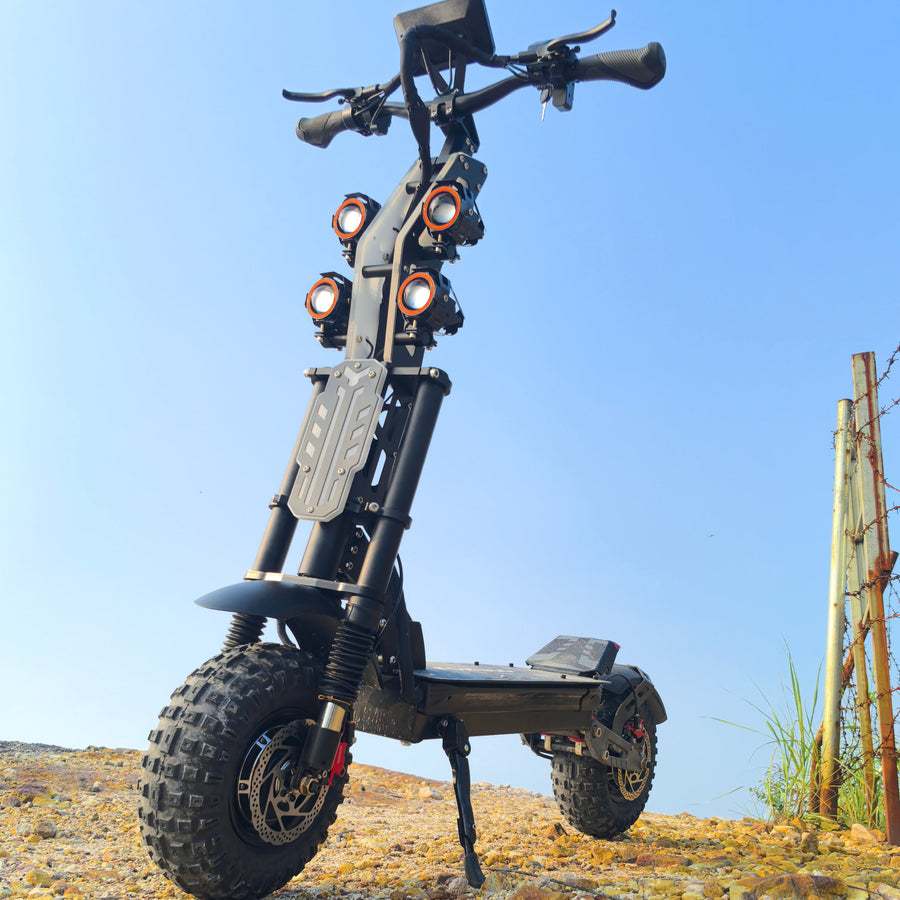
Once you have identified your rider profile, the next phase of deciding what scooter to buy is understanding the engineering behind the specifications. The difference between premium manufacturing and budget assembly lies entirely within the core components.
Motor Power and Top Speed
The heartbeat of any electric mobility device is its motor. Manufacturers list motor power in watts (W). A higher wattage translates directly to higher torque, which is the twisting force required to accelerate rapidly and conquer steep inclines. When evaluating what scooter to buy for hilly areas, we recommend avoiding single motors entirely. Dual brushless motors distribute the workload, preventing overheating and controller failure.
For example, high-end machines engineered for extreme performance, such as those featuring a 7000W dual brushless motor setup (combining two 3500W motors), deliver unparalleled climbing ability. From our experience, a true 7000W output can push a heavy rider up to a 45-degree incline without stalling. If you demand a top speed of 55 MPH and instantaneous acceleration, choosing a dual-motor architecture is a non-negotiable requirement.
Battery Architecture and Maximum Range
Understanding battery metrics is crucial when figuring out what scooter to buy. Batteries are measured in Volts (V) and Amp-Hours (AH). Voltage dictates the maximum speed and power delivery efficiency, while Amp-Hours determine the capacity, or the "size of the gas tank." A 60V system is considered the threshold for high-performance riding, providing the voltage necessary to prevent voltage sag under heavy acceleration.
We recommend looking for a high-capacity lithium battery, such as a 60V 33AH pack, if you intend to undertake long journeys. This capacity typically yields a max range of 65+ miles under optimal conditions. Furthermore, you must verify the presence of an Intelligent BMS (Battery Management System). The BMS protects the volatile lithium cells from overcharging, deep discharging, short circuits, and thermal runaway. When assessing what scooter to buy, ensure the model supports dual chargers; utilizing 2 chargers across 2 charging ports can reduce a massive 33AH battery's charging time down to a manageable 5 to 8 hours.
Suspension Systems and Tire Dynamics
At speeds exceeding 25 MPH, the quality of the pavement becomes largely irrelevant; every minor crack and pebble will transmit shock through the chassis directly to your joints. Therefore, when researching what scooter to buy, the suspension geometry is just as important as the motor. Standard spring suspensions are prone to rebounding violently. We recommend advanced hydraulic dampening systems.
A Triple Clamp Hydraulic Fork on the front, paired with a Dual Spring Rear suspension, offers motorcycle-grade stability, preventing speed wobbles and absorbing massive impacts. This must be paired with appropriate rubber. Solid tires are puncture-proof but offer zero shock absorption and terrible wet traction. Knowing what scooter to buy means insisting on pneumatic (air-filled) tires. Specifically, 13-inch All-Terrain Explosion-Proof Fat Tires provide a massive contact patch with the ground, ensuring maximum grip on dirt, gravel, and wet asphalt while drastically reducing the risk of pinch flats.
Braking Technology and Certifications
It is a fundamental rule of mechanical engineering that your stopping power must exceed your acceleration power. If you are debating what scooter to buy in the high-performance bracket, cable-actuated mechanical brakes are entirely insufficient. The friction and heat generated at high speeds will stretch cables and glaze brake pads rapidly.
You must select a model equipped with full Hydraulic disc brakes. Hydraulic systems use fluid dynamics to apply massive, immediate clamping force to the rotors with minimal finger pressure, ensuring safe, controlled deceleration from 55 MPH. Furthermore, safety extends beyond the brakes to the electrical systems. Always check for compliance with UL2272 certification, which is the gold standard for electrical and fire safety in personal e-mobility devices. Regarding visibility, look for comprehensive lighting systems. A setup featuring 4 front LED headlights (like Angel-Eye designs) and 360-degree LED ambient lighting ensures you are highly visible to vehicular traffic during night rides.
4. Payload Capacity and Structural Portability
A frequently overlooked metric when consumers ask what scooter to buy is the maximum rider load. Budget models often cap out at 220 LBS, which leaves no margin for riders carrying heavy backpacks or groceries. Pushing a frame beyond its payload limit causes micro-fractures in the aluminum, bending of the folding stem, and rapid battery depletion.
For heavier adults or those who demand a rigid, flex-free chassis, we recommend seeking a max rider load of at least 440 LBS. Achieving this payload requires thick, aerospace-grade aluminum alloys. However, this robust construction increases the net weight of the device. High-performance models frequently weigh over 100 LBS (e.g., 105 LBS). Despite this heft, top-tier engineering incorporates quick folding mechanisms and a removable seat to ensure the dimensions (such as 53.5 inches L x 10.6 inches W x 49-57 inches H) can be collapsed for storage in a garage or the trunk of a large SUV. Ensure the handlebar height is adjustable to accommodate your specific stature, promoting proper riding posture and reducing lower back fatigue.
5. Our Professional Recommendation: The TopRiding FOHOLO F19
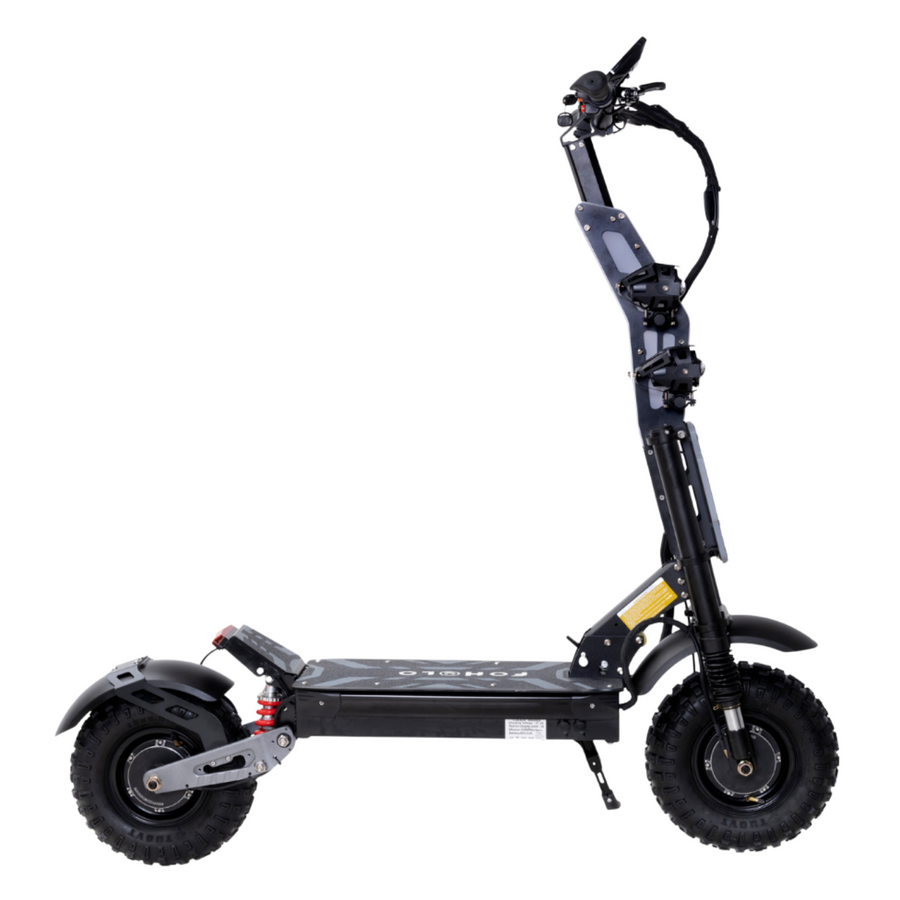
If you are an enthusiast who has carefully evaluated all the criteria above and you are still wondering exactly what scooter to buy for uncompromising speed, range, and durability, we proudly present our flagship model. From our experience, the TopRiding FOHOLO F19 represents the pinnacle of high-performance electric mobility.
We engineered the TopRiding FOHOLO F19 to be a super-fast, long-range electric machine that leaves nothing to chance. Featuring a 7000W dual brushless motor and a 60V 33AH lithium battery managed by an Intelligent BMS, it delivers a top speed of 55 MPH and a max range of 65+ miles. The triple clamp hydraulic fork and 13-inch all-terrain explosion-proof fat tires provide absolute dominance over up to 45-degree inclines. Furthermore, it boasts uncompromising safety with hydraulic disc brakes, UL2272 compliance, and a massive 440 LBS max rider load.
| Specification Category |
TopRiding FOHOLO F19 Capabilities |
| Motor & Speed |
7000W dual brushless motor (3500W x 2) | Top Speed: 55 MPH |
| Battery & Range |
60V 33AH lithium battery | Max Range: 65+ miles | Dual charging ports |
| Terrain & Ride |
13-inch All-Terrain Fat Tires | 6 + 1 Riding Modes | Up to 45 degree incline |
| Suspension & Brakes |
Triple Clamp Hydraulic Fork + Dual Spring Rear | Hydraulic disc brakes |
| Safety & Visibility |
UL2272 Compliance | 4 Angel-Eye Front Headlights | 360 degree LED lighting |
| Body & Dimensions |
Net Weight: 105 LBS | Max Load: 440 LBS | Adjustable Handlebars: 49-57 inches |
6. Frequently Asked Questions (FAQs)
How do I know what scooter to buy if I live in a highly mountainous area?
For mountainous terrains, you must prioritize torque over everything else. We recommend avoiding single-motor scooters entirely. You will need a dual-motor setup with at least 2000W of combined power. A model like the TopRiding FOHOLO F19, with its 7000W dual motor system, is explicitly designed to conquer inclines up to 45 degrees without suffering from controller thermal throttling.
What does UL2272 compliance mean, and why is it important?
UL2272 is an extremely rigorous electrical and fire-safety standard established by Underwriters Laboratories specifically for personal e-mobility devices. It involves aggressive testing of the battery, charger, and electrical drive train to prevent thermal runaway and fires. When deciding what scooter to buy, UL2272 compliance is a non-negotiable metric for the safety of your home and person.
Are solid tires better than pneumatic tires?
From our professional experience, pneumatic (air-filled) tires are vastly superior to solid tires. While solid tires prevent flats, they offer zero shock absorption, terrible traction in wet conditions, and vibrate violently at high speeds. For a premium ride, we recommend heavy-duty pneumatic options like the 13-inch explosion-proof fat tires found on high-end models.
How can I reduce the charging time of a massive 60V 33AH battery?
Large capacity batteries inherently take longer to charge. However, premium manufacturers design their scooters with dual charging ports. By utilizing two chargers simultaneously, as seen on the FOHOLO F19, you can effectively cut the charging time in half, achieving a full charge in just 5 to 8 hours.
7. Industry References


