The secondary market for personal electric vehicles has exploded, leaving consumers with a critical purchasing dilemma. When looking at premium models that usually retail for thousands of dollars, buying a refurbished electric scooter seems like the ultimate financial loophole. But behind the aggressive markdowns and promises of factory-certified performance lies a highly variable industry where cosmetic cleaning is often passed off as mechanical restoration. From our experience inspecting, repairing, and selling thousands of electric mobility devices at TopRiding, we know exactly what fails first and what factory resets cannot fix.

Navigating the refurbished market requires strict commercial and practical judgment. You are not just buying a metal frame; you are investing in a complex system of lithium-ion cells, phase wires, motor controllers, and hydraulic suspension components. In most professional situations, a poorly refurbished unit will cost you more in downtime and replacement parts than purchasing a brand-new budget performance model outright. This guide will dissect the reality of buying a refurbished electric scooter, helping you decide whether the upfront savings are worth the hidden mechanical liabilities.
Quick Answer: Should You Buy Refurbished?
Whether buying a refurbished electric scooter is worth it depends entirely on the seller's transparency regarding battery cycles and motor health. We recommend it only if the unit comes with a certified diagnostic report proving the battery retains at least 90% of its original capacity and includes a minimum 6-month comprehensive warranty. If these elements are missing, the risk of a dead battery—which often costs 60% of the scooter's total value to replace—makes it a terrible investment.
Instead of gambling on a used premium model with an unknown history, modern manufacturing advancements mean you can secure brand-new, high-wattage performance for the same price as a refurbished unit.
Quick Summary Table
| Purchasing Path |
Best For |
Primary Risk |
Our Verdict |
| Certified Refurbished (Factory) |
Bargain hunters wanting flagship models. |
Shortened battery lifespan. |
Acceptable if warranty exceeds 6 months. |
| Third-Party Refurbished |
Mechanically inclined riders who can DIY repairs. |
Hidden water damage; aftermarket parts used. |
Avoid unless deeply discounted. |
| New High-Performance Budget |
Riders needing reliability and full warranty. |
Lacks prestige brand naming. |
Highest ROI. Best practical choice. |
What It Is and How It Works
To make an informed decision, you must understand the stark difference between "used" and "refurbished." Buying a refurbished electric scooter means purchasing a unit that has theoretically undergone a standardized inspection, repair, and testing process. How it works in a legitimate refurbishment facility involves reading the Battery Management System (BMS) data to check cell voltage balance, testing the motor hall sensors for accurate wheel positioning, bleeding hydraulic brake lines, and replacing worn pneumatic tires. A true refurbished unit is restored to a functional state that mimics a new out-of-the-box experience, albeit with some cosmetic blemishes.
However, the term "refurbished" is legally ambiguous in the personal mobility space. Many unauthorized third-party sellers simply wipe down the deck grip tape, tighten the folding mechanism stem, and reset the LCD odometer to zero. They do not load-test the battery. Lithium-ion batteries have a finite cycle life—typically 500 to 800 full charge cycles before they experience significant voltage sag. If you are buying a refurbished electric scooter from a vendor who cannot provide a voltage discharge graph, you are essentially buying a used scooter blindfolded. Understanding factors like how cold weather affects scooter battery performance will quickly reveal the weaknesses in an aging, improperly refurbished battery pack.
Benefits and Limitations
The primary benefit of buying a refurbished electric scooter is avoiding the steep initial depreciation curve. Much like driving a new car off the lot, a premium electric scooter loses 20% to 30% of its retail value the moment it is unboxed and ridden for 50 miles. By purchasing refurbished, you let the original owner absorb this financial hit. This strategy allows budget-conscious riders to access high-end suspension systems, larger deck spaces, and dual-motor configurations that would otherwise be out of reach.
The limitations, however, are severe and often hidden. The most critical limitation is battery degradation. A battery that has been left fully charged in a hot garage for a year will suffer permanent capacity loss, significantly reducing your real-world range. Furthermore, refurbished units rarely qualify for comprehensive manufacturer warranties. If the motor controller burns out on month three, you are paying out of pocket for parts and labor. For riders planning to navigate steep inclines, you must consider can a 500W scooter go uphill with an older battery? The answer is usually no; voltage sag on aging cells will cause the scooter to shut down under heavy load.
Pros vs Cons Table: Refurbished Electric Scooters
| Advantages (Pros) |
Disadvantages (Cons) |
| Substantial upfront cost savings (typically 20% to 40% off retail). |
Unknown battery history and reduced overall range capacity. |
| Access to premium brand names and advanced suspension designs on a budget. |
Limited or non-existent warranties (often only 30 to 90 days). |
| Eco-friendly choice that keeps electronic waste out of landfills. |
High risk of underlying water damage to the motor controller or display. |
| Usually comes fully assembled, skipping the unboxing setup process. |
Stem folding mechanisms may have micro-fractures from previous abuse. |
Who Should Use It and Who Does Not Need It
Who should use it: For beginners exploring micromobility for the first time, buying a refurbished electric scooter from a reputable, certified dealer is a low-risk entry point. It is also an excellent route for college students looking for cheap campus transport where the risk of theft is high, making a lower-value unit preferable. In these scenarios, you can find some of the best scooters for college commuting on the refurbished market, provided your daily commute is under three miles and battery degradation will not leave you stranded.
Who does not need it: For commercial users, gig economy workers, and heavy-duty riders, we explicitly advise against refurbished models. If your income relies on your vehicle, you cannot afford sudden BMS shutoffs or controller failures. Those looking for the best electric scooters for delivery business must prioritize absolute reliability, zero-cycle batteries, and full warranty support. Similarly, for heavy-duty applications where riders weigh over 250 lbs, a used frame and aging suspension present safety hazards. If you are wondering can a 300 lb person ride an electric scooter safely, the answer requires a brand-new, structurally uncompromised frame, not a refurbished unit with unknown metal fatigue.
Product Comparison: Refurbished Premium vs. New High-Performance
The most compelling argument against buying a refurbished electric scooter in 2026 is the incredible advancement in budget-friendly, high-performance new models. Previously, you had to buy used to get dual suspension and large batteries. Today, TopRiding offers models that completely outclass refurbished legacy units.
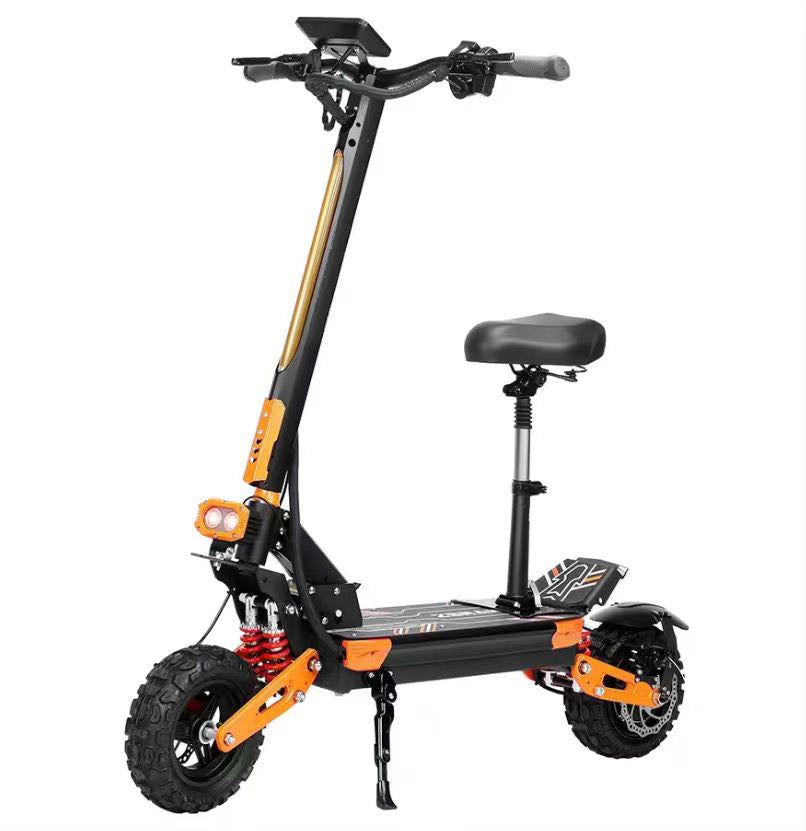
Consider the alternative: instead of spending $800 on a three-year-old refurbished model with a 500W motor and a degraded battery, you can invest in the TopRiding ZSNAKE Z35. This provides a massive 2800W single motor setup, a pristine 60V 15AH battery, and UL 2272 safety certification out of the box.
In our testing, this unit consistently outperforms premium refurbished models that cost significantly more, primarily because every component operates at 100% factory efficiency.
-
Top Speed: 33 MPH (Vastly superior to 15mph refurbished commuter models)
-
Power: 2800W Single Motor for extreme torque.
-
Battery: Brand new 60V 15AH Battery (Max Range 35 Miles).
-
Safety: Strict UL 2272 Certification against fire hazards.
-
Terrain: 11” Off-road Fat Tires with Full Spring Suspension.
-
Stopping Power: Front & Rear Disc Brakes.
-
Capacity: Max Rider Load 330 LBS.
Comparison Table: ZSNAKE Z35 vs Typical Refurbished Flagship
| Feature |
TopRiding ZSNAKE Z35 (New) |
Typical $800 Refurbished Unit |
| Motor Power |
2800W Peak (Zero wear) |
800W - 1000W (Magnets may be degraded) |
| Battery Health |
100% Capacity / 0 Cycles |
70% - 85% Capacity / 200+ Cycles |
| Warranty Support |
Full Manufacturer Warranty |
30 to 90 Days Limited |
| Suspension |
Pristine Full Spring Setup |
Likely squeaking, requiring lubrication/rebuild |
| Tires |
New 11" Off-road Fat Tires |
Worn tread, potential internal tube patching |
Common Mistakes and Buying Considerations
If you absolutely insist on buying a refurbished electric scooter, you must act as your own quality control inspector. The most common mistake buyers make is trusting the dashboard odometer. It takes less than five minutes for an unscrupulous seller to access the P-settings on a generic throttle display and reset the total mileage to zero. You should never evaluate a scooter based on its stated mileage alone.
Another catastrophic mistake is ignoring signs of water ingress. Electric scooters are generally water-resistant, not waterproof. Over time, riding through heavy rain allows moisture to seep into the deck compartment where the battery and controller sit. When inspecting a refurbished unit, look closely at the deck screws. Are they rusted? Does the charging port cover sit flush, or is it torn? Water damage is a ticking time bomb that will short out the controller entirely. Ensure you also think about security; are electric scooters easily stolen? Yes, and refurbished models sold without their original NFC keys or paired app access might actually be stolen goods fenced through secondary markets.
Your primary buying consideration must be the cost-benefit analysis of replacement parts. If you are buying a refurbished scooter for $400, but a replacement battery pack costs $350 and a new set of tires costs $80, you have zero financial margin for error. We highly suggest reading up on best long range electric scooters under 1000 to see what the new market offers before locking yourself into a used ecosystem.
Expert Recommendation
We recommend entirely avoiding the refurbished market unless you are purchasing directly from the original manufacturer's certified program and receiving at least a one-year warranty. The mechanics of high-powered electric scooters undergo massive torque and vibrational stress. A refurbished frame has absorbed every pothole and curb drop of its previous owner.
In most professional situations, the math simply does not favor buying used. The smart money in 2026 is directed toward high-spec, competitively priced new models. If your budget is tight, upgrading to a model like the TopRiding ZSNAKE Z35 guarantees you 2800W of reliable power, a pristine 60V battery, and the structural integrity required to handle speeds up to 33 MPH safely. Stop risking your safety and wallet on someone else's discarded battery cycles.
Frequently Asked Questions
How much range is lost on a refurbished electric scooter battery?
It depends on the charging habits of the previous owner. Generally, a lithium-ion scooter battery loses about 15% to 20% of its total capacity after 300 to 500 charge cycles. A poorly maintained refurbished scooter might only deliver 60% of its original advertised range, meaning a 40-mile scooter might only achieve 24 miles.
Is it safe to ride a refurbished scooter at high speeds?
Only if the folding mechanism, stem bolts, and hydraulic brakes have been thoroughly inspected and torque-tested by a certified technician. Micro-fractures in the aluminum stem from previous crashes can lead to catastrophic failure at high speeds.
Can I replace the battery on a refurbished scooter myself?
Yes, but the cost-benefit ratio is usually poor. High-quality replacement battery packs often cost between $250 and $600 depending on the voltage and amp-hour rating. When you add this cost to the purchase price of the refurbished scooter, it is almost always more economical to buy a brand-new high-performance model outright.
Authoritative References & Industry Standards
To ensure our readers make safe and technically sound purchasing decisions, our evaluations are backed by the following industry and safety standards:
-
Consumer Product Safety Commission (CPSC) - Federal micromobility safety guidelines detailing the risks associated with structural fatigue and improper electrical maintenance in used electric scooters.
-
Underwriters Laboratories (UL 2272) - The definitive global safety standard for electrical systems in personal e-mobility devices, emphasizing the hazards of uncertified aftermarket batteries commonly found in third-party refurbished units.
-
Environmental Protection Agency (EPA) - Government documentation on the lifecycle, degradation rates, and proper disposal protocols for lithium-ion battery cells used in electric vehicles.


)