TopRiding electric scooters are certified to meet UL 2272 safety standards, covering critical electrical and fire safety requirements for the electrical system and battery.
This certification helps ensure safer, more reliable riding.
Over 100,000 electric scooters sold, backed by 5,000+ verified reviews and an average rating of 4.7+ stars.
Chosen by riders worldwide for reliable performance, and everyday riding confidence.
Expert support. local service.
Expert Customer Service
As a U.S.-based company, TopRiding provides 24/7 expert customer service and local after-sales support across multiple regions in North America.
Our dedicated support team is here to ensure fast responses, professional assistance, and reliable service — whenever you need it.
TEST RIDES AND SERVICE
Safety Certified
Designed to Meet UL 2272 Safety Standards
Our electric scooters are designed in accordance with UL 2272 safety requirements for electrical and battery systems, helping enhance overall safety and reliability.
Trusted by a global riding community
100,000+ Units Sold
Over 100,000 electric mobility vehicles sold, backed by 5,000+ verified reviews and an average rating of 4.7+ stars.
Chosen by riders worldwide for reliable performance, safety, and everyday riding confidence.
Expert Support. Local Service.
Expert Customer Service
As a U.S.-based company, TopRiding provides 24/7 expert customer service and local after-sales support across multiple regions in North America.
Our dedicated support team is here to ensure fast responses, professional assistance, and reliable service—whenever you need it.
5 Key Advantages of Fat Tire E-Bikes: Are They Worth Buying?
5 Key Advantages of Fat Tire E-Bikes: Are They Worth Buying?
senkan
A fat tire e-bike is worth considering if your rides involve loose gravel, sandy paths, uneven ground, wet trails, or a mix of pavement and off-road routes. Its wider tires can improve traction, add cushioning, and make the bike feel more composed over rough surfaces. But bigger tires are not automatically better. They add weight and can increase rolling resistance, so the right choice depends on where and how you ride.
Quick Answer: What Are the Main Advantages of a Fat Tire E-Bike?
The five main advantages of a fat tire e-bike are better traction on loose surfaces, more tire-based cushioning, improved stability at low speeds, greater versatility across different riding environments, and increased confidence when carrying everyday gear or navigating uneven routes.
We recommend a fat tire e-bike for riders who regularly encounter mixed terrain or prioritize comfort and control over minimum weight and maximum pedaling efficiency. If your daily route is smooth pavement and you need a lightweight bike for easy storage, a standard-tire commuter e-bike may be the smarter purchase.
Advantage
Practical benefit
Best use case
1. Better traction
A wider contact patch can help the tire grip loose or soft surfaces.
Gravel, packed dirt, sand, and some trail conditions.
2. More cushioning
Lower-pressure tires can absorb some small bumps and vibration.
Uneven roads, rough paths, and comfort-focused rides.
3. Greater stability
The broad tire profile can create a planted, confidence-inspiring feel.
Low-speed riding and changing surface conditions.
4. More terrain versatility
One bike can handle a wider variety of surfaces.
Riders who combine streets, trails, and unpaved paths.
5. More confident utility riding
Grip and cushioning can make loaded rides feel more manageable.
Recreational trips, errands, and carrying approved gear.
What Is a Fat Tire E-Bike?
A fat tire e-bike is an electric bicycle equipped with unusually wide tires, commonly around 3.8 to 5 inches across. Many models use 4-inch tires, such as the 20 × 4.0-inch setup found on the TopRiding R2. These tires have a larger volume of air than typical city-bike tires and are designed to provide a broad, supportive contact area.
The electric assistance comes from a motor powered by a rechargeable battery. Depending on the model, the motor may be mounted in the rear hub or integrated into the frame near the pedals. The rider still steers, brakes, and controls the bicycle, while the motor provides assistance according to the bike's control system and applicable regulations.
It is important to separate tire width from overall bike capability. A fat tire does not automatically make an e-bike a mountain bike, a snow bike, or a high-performance off-road machine. Frame geometry, suspension, brakes, motor control, battery capacity, tire tread, and component quality all influence how the bike performs.
How Do Fat Tire E-Bikes Work?
The basic electric system works much like that of other e-bikes: a battery supplies energy to a motor, and the control system manages power delivery. A pedal-assist system responds to the rider's pedaling, while a throttle-equipped model may provide motor power through a hand control where local rules permit it.
The tires contribute a separate performance advantage. Their larger air volume allows many fat tire models to run at lower pressures than narrow-tire bikes. When correctly adjusted for the rider's weight, tire construction, terrain, and load, this can help the tire deform around small irregularities and maintain contact with the ground.
That does not mean the lowest possible tire pressure is best. Excessively low pressure can cause rim strikes, unstable cornering, tire damage, or increased rolling resistance. Follow the tire manufacturer's pressure range and adjust carefully for the conditions.
Practical point: A fat tire is a system component, not a substitute for good suspension, quality brakes, suitable tread, or correct riding technique. Evaluate the whole e-bike rather than buying based on tire width alone.
5 Key Advantages of Fat Tire E-Bikes
1. Better Traction on Loose and Unpredictable Surfaces
Traction is one of the strongest reasons to choose a fat tire e-bike. A wide tire can create a broad contact patch, depending on tire pressure, rider weight, tread pattern, and surface conditions. This can help the bike feel more controlled on packed dirt, gravel, sandy paths, and other loose surfaces.
For example, imagine a rider taking a route that begins on pavement, crosses a gravel access road, and ends on a dirt trail. A narrow commuter tire may be optimized for smooth surfaces, while a suitable fat tire can offer a more forgiving setup for the mixed route. The advantage is not that the bike becomes immune to slipping. Wet roots, mud, steep loose climbs, and sharp turns can still challenge any tire.
From our experience evaluating e-bike configurations, tread design matters just as much as width. A wide tire with an unsuitable tread pattern may not deliver the grip a rider expects. Look for a tire designed for the surfaces you actually ride, not simply the widest tire available.
Best for: Riders who regularly use gravel roads, dirt paths, firm sand, or mixed-surface routes.
2. More Cushioning and a More Comfortable Ride
Fat tires can add a useful layer of comfort because their larger air volume can absorb some road vibration and small impacts. This is especially noticeable on uneven pavement, patched roads, gravel, and rough access paths. For riders who find narrow tires harsh, the extra tire volume can make longer recreational rides more pleasant.
However, tire cushioning and suspension are not the same thing. Tires can smooth out smaller surface irregularities, but they cannot replace a properly designed suspension fork or rear shock when the bike is regularly exposed to larger bumps, potholes, or trail obstacles.
That distinction matters when comparing two e-bikes. A rigid fat tire model may feel comfortable on ordinary rough roads, but a full-suspension design can provide additional control and impact absorption on more demanding terrain. If your riding includes repeated larger bumps, compare suspension travel, adjustment options, and component quality instead of assuming fat tires alone will solve the problem.
Best for: Comfort-focused riders, people using uneven paths, and recreational cyclists who want less vibration on mixed surfaces.
3. A More Stable, Confidence-Inspiring Feel
Many riders appreciate the planted feel of a fat tire e-bike. The broad tire profile can make the bike feel composed at low speeds and over irregular surfaces, especially when the tire pressure and geometry are properly matched to the rider. That can be reassuring for people who are returning to cycling or who frequently move between pavement and unpaved ground.
Still, tire width is only one part of stability. Wheelbase, frame geometry, handlebar position, center of gravity, suspension setup, and weight distribution all affect handling. A poorly balanced heavy e-bike can feel awkward even with wide tires.
We recommend taking a test ride before purchasing whenever possible. Try a slow turn, a controlled stop, and a short ride over the type of surface you expect to use. Pay attention to how the bike responds when you change direction and how easy it is to put a foot down. A bike that feels stable to one rider may feel cumbersome to another.
Best for: Riders who value a planted ride feel and want additional confidence on mixed or uneven surfaces.
4. Greater Versatility Across Different Riding Environments
A fat tire e-bike can be a practical choice when one bicycle needs to handle several types of riding. A suitable model may work for neighborhood trips, recreational trail rides, gravel access roads, and occasional unpaved routes. This flexibility can be valuable for riders who do not want to maintain separate bikes for every activity.
But versatility depends on the complete specification. A fat tire e-bike intended mainly for relaxed recreational use may not be ideal for technical mountain-bike trails. A heavy model may also be inconvenient if you need to carry it upstairs, load it onto a vehicle, or store it in a small apartment.
Best for: Riders whose routes change with the season, destination, or weekend plans.
5. More Confidence for Utility and Gear-Carrying Rides
Fat tires can be useful for everyday utility riding because the added grip and cushioning may make a loaded ride feel more manageable on uneven surfaces. That can help when carrying a backpack, commuting with work equipment, or taking recreational gear along for the ride.
However, a wide tire does not increase the bike's rated payload. The frame, wheels, tires, brakes, rack, and manufacturer's weight limit determine how much the bicycle can safely carry. Exceeding the stated maximum payload can affect braking, handling, component life, and safety.
For commercial users or riders who regularly carry heavier equipment, we recommend checking the complete load rating and confirming whether the bike has a suitable rack and mounting points. A model with strong brakes and a stable frame is more important than tire width alone.
Best for: Riders carrying ordinary personal gear or using an e-bike for errands, provided the load remains within the manufacturer's limits.
Limitations of Fat Tire E-Bikes: What They Do Not Do
Fat tire e-bikes have real advantages, but they are not the right answer for every rider. Buyers should understand the compromises before spending more on a wide-tire model.
Higher Weight and More Difficult Handling When Moving the Bike
Wide tires, larger wheels, reinforced frames, and full-suspension components can contribute to a heavier overall bicycle. This matters when lifting the bike onto a car rack, carrying it upstairs, maneuvering it in a tight storage area, or transporting it without motor assistance.
Potentially More Rolling Resistance
Fat tires can create more rolling resistance than narrower tires, particularly on smooth pavement when the tread is aggressive or pressure is poorly adjusted. The motor can help offset the extra effort, but it cannot eliminate the energy cost. Riders focused on efficient road commuting may prefer a narrower tire designed for pavement.
Range Is Not Guaranteed by Tire Size
Battery range depends on battery capacity, rider and cargo weight, speed, terrain, temperature, tire pressure, assist level, and riding style. A fat tire e-bike with a large battery may travel farther than a smaller-battery commuter bike, but that is a battery and system advantage, not an automatic benefit of fat tires.
More Tire Is Not a Replacement for Proper Equipment
Fat tires do not make an e-bike waterproof, puncture-proof, or suitable for every trail. They cannot compensate for weak brakes, poor suspension, an unsuitable frame, or a lack of maintenance. For steep descents and technical routes, braking performance and handling geometry deserve particular attention.
Pros
Cons
Good traction potential on loose surfaces.
Can be heavier and harder to transport.
More air volume can improve comfort on rough roads.
May roll less efficiently on smooth pavement.
Can feel planted and confidence-inspiring.
Wide tires do not guarantee stability in every situation.
Useful for mixed-surface riding.
May be unnecessary for strictly urban commuting.
Can support comfortable recreational and utility rides.
Does not increase the manufacturer's payload rating.
Fat Tire vs. Standard Tire E-Bikes: Which Is Better?
The better option depends on your route and priorities. Fat tire e-bikes generally make more sense when traction, comfort, and mixed-terrain capability matter. Standard tire e-bikes are often more practical for riders who spend most of their time on smooth roads and want a lighter, more efficient commuter setup.
Buying factor
Fat tire e-bike
Standard tire e-bike
Our recommendation
Loose gravel and dirt
Often a better fit with suitable tread.
Depends heavily on tire design and route.
Choose fat tires for frequent loose-surface riding.
Smooth pavement
Can work, but may have extra rolling resistance.
Often more efficient.
Choose standard tires for mostly paved commutes.
Ride comfort
Higher air volume can improve small-bump comfort.
Depends on tire width, pressure, and suspension.
Compare the whole setup, not tire width alone.
Weight and portability
Often heavier.
Often easier to lift and store.
Choose standard tires if carrying the bike is common.
Mixed-terrain versatility
Strong option for varied recreational routes.
Can work with appropriate tires and components.
Choose based on the roughest surface you ride regularly.
Battery range
Depends on battery, motor, pressure, and conditions.
May benefit from lower rolling resistance.
Compare watt-hours and realistic range claims.
Maintenance
Wide tires and specific components may cost more to replace.
Parts may be easier to source in common sizes.
Check local parts and service availability.
There is no universal winner. A fat tire model is a sensible upgrade when your current bike struggles with loose surfaces or comfort. It is less compelling if your only goal is to ride faster on smooth asphalt. For riders comparing other off-road configurations, TopRiding also covers full-suspension e-bikes under $2,000.
Who Should Use a Fat Tire E-Bike?
Good Match: Mixed-Terrain and Recreational Riders
If your regular rides include pavement, gravel, packed dirt, and uneven paths, a fat tire e-bike may be a practical all-rounder. The wider tires can provide a useful balance of traction and comfort without requiring a dedicated bike for every surface.
Good Match: Riders Who Prioritize Comfort and Confidence
Some cyclists simply prefer the feel of a wider tire. If you regularly encounter rough pavement or want a more cushioned ride, the added air volume may be worthwhile. Test the bike first, because frame fit and suspension design also influence comfort.
Good Match: Outdoor Enthusiasts Carrying Recreational Gear
People riding to campsites, trail access points, or outdoor recreation areas may benefit from the combination of electric assistance and wide tires. For hunting or other outdoor trips, make sure the bike's payload, braking system, tires, and legal use match the intended conditions. See TopRiding's guide to hunting e-bikes under $2,000 for more buying considerations.
Who Does Not Need a Fat Tire E-Bike?
Riders who commute exclusively on smooth, well-maintained roads and prioritize efficiency.
People who frequently carry their bike upstairs or need a lightweight folding design.
Buyers with limited storage space who cannot comfortably accommodate a wide, heavy bike.
Riders who want a technical mountain bike but have not checked suspension, geometry, brakes, and trail suitability.
Anyone choosing fat tires solely because they assume wider tires guarantee more speed, range, or safety.
If portability is more important than off-road traction, compare a folding electric scooter or a compact personal transport option before committing to a large e-bike. The right vehicle is the one that fits your actual route and storage situation.
What to Consider Before Buying a Fat Tire E-Bike
Do not choose a fat tire e-bike by appearance or motor wattage alone. A reliable purchase should be based on fit, component quality, intended terrain, battery capacity, braking performance, and after-sales support.
1. Tire Width, Tread, and Pressure Range
Many fat tire e-bikes use tires around 4 inches wide. That is a common format, not a guarantee of better performance. Check the tread pattern for your intended surface and confirm that replacement tires are available. Learn the manufacturer's recommended pressure range and adjust it according to rider weight and riding conditions without going below safe limits.
2. Motor Output and Power Delivery
Motor wattage is only one part of the experience. Rated power, peak power, torque, controller tuning, and legal classification all matter. A high peak-power figure does not necessarily mean a bike will climb smoothly or provide a predictable ride. Look for clear specifications and understand the local rules for e-bike motor power, throttle use, and maximum assisted speed.
3. Battery Capacity and Realistic Range
Battery capacity is commonly expressed in watt-hours (Wh). As a general comparison, a 52V, 25Ah battery has a nominal energy capacity of 1,300Wh. That is a substantial capacity, but actual range will still vary with terrain, speed, temperature, load, and assist level. Treat advertised maximum range as a best-case estimate rather than a guaranteed daily distance.
4. Brakes and Suspension
Heavy e-bikes need dependable stopping power. Hydraulic disc brakes can offer strong braking performance and modulation, but the exact brake components, rotor size, setup, and maintenance condition matter. If you ride rough terrain, compare front and rear suspension design, travel, adjustability, and serviceability. A wide tire is not a replacement for good brakes or suspension.
5. Frame, Payload, and Overall Weight
Check frame material, weld or machining quality, maximum payload, and the bike's own weight. A high payload figure should be supported by appropriate wheels, tires, brakes, and frame construction. If you plan to transport the bike on a rack, check the rack's weight rating and compatibility before buying.
6. Warranty, Replacement Parts, and Support
Ask what the warranty covers, how battery claims are handled, whether replacement tires and brake components are available, and how technical support works. For commercial users or frequent riders, access to service parts can matter more over the life of the bike than a small difference in purchase price.
7. Local E-Bike Rules
Electric bicycle definitions and restrictions vary by location. Check local requirements for motor output, assisted speed, throttle operation, age restrictions, helmet use, and where e-bikes may be ridden. Do not assume that a bike's marketing label determines its legal classification. Confirm the exact configuration and local rules before riding on public roads or trails.
A TopRiding Fat Tire E-Bike to Consider: TopRiding R2
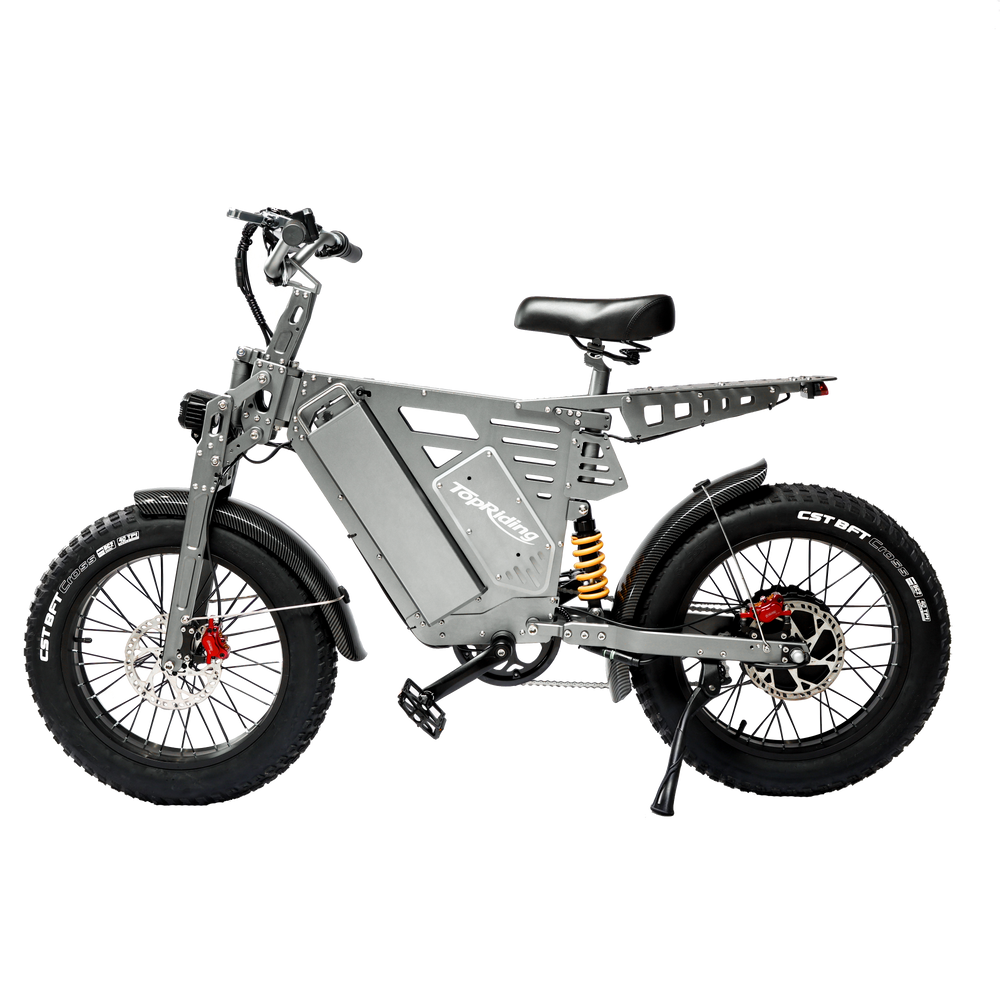
For riders who want a fat tire setup with a distinctive moto-style frame and substantial battery capacity, the TopRiding R2 Full CNC Moto-Style eBike is one model worth examining. Its specifications combine 20 × 4.0-inch tires, full suspension, a 52V 25Ah battery, and a rear hub motor. That combination is more relevant to buyers seeking comfort and mixed-terrain capability than to someone looking for the lightest possible city commuter.
TopRiding R2 - Full CNC Moto-Style eBike
$1,999.00
The R2 pairs a 750W rated rear hub motor with a 52V 25Ah removable lithium-ion battery and 20 × 4.0-inch CST BFT CROSS tires. Its full-suspension design is intended to add comfort and control over uneven surfaces.
Dual charging ports; one charger included, second charger available
Advertised charging time
6.5 hours from 0–100% with two chargers
Frame
Aluminum, full CNC-machined, anodized finish
Bike weight
82 lbs
Maximum payload
330 lbs
Water and dust resistance
IP65
Suspension
Full suspension
Front suspension
Custom 4-link fork, 100mm travel
Rear suspension
Coil spring shock absorber, 100mm travel
Tires
CST BFT CROSS, 20 × 4.0 inches, 40 TPI
Brakes
4-piston hydraulic disc brakes
Throttle
Twist throttle
Smart access
NFC and app
Why the R2 May Suit Fat Tire E-Bike Buyers
Wide tire configuration: The 20 × 4.0-inch CST BFT CROSS tires fit the fat tire format and are relevant for riders who want a broad tire footprint.
Large battery capacity: The 1,300Wh battery provides substantial nominal energy capacity. Actual range depends on riding conditions and power use.
Full suspension: The listed 100mm front and rear travel adds another layer of impact management beyond tire cushioning.
Hydraulic braking: Four-piston hydraulic disc brakes are a useful feature to evaluate on an 82 lb e-bike.
Removable battery: Removability can make charging more convenient when the bike is stored away from a suitable power outlet.
What Buyers Should Think About Before Choosing the R2
The R2 weighs 82 lbs, so it is not a lightweight commuter bike. Buyers should plan for storage, lifting, transport, and compatible bike-rack capacity. Its advertised range of up to 60 miles should also be treated as a best-case figure rather than a promise for every rider or route. If your daily ride includes steep climbs, high speeds, heavy cargo, or cold weather, expect range to vary.
At $1,999, the R2 is best evaluated as a complete package: battery capacity, full suspension, hydraulic brakes, tire configuration, frame construction, and support. Do not pay extra for a fat tire model if you will never use the traction or comfort advantages. But if those features match your riding conditions, the combination may be worth considering.
Common Fat Tire E-Bike Buying and Riding Mistakes
Assuming wider always means safer. Grip depends on tire compound, tread, pressure, terrain, and riding technique. Wide tires do not prevent every skid or fall.
Ignoring the bike's total weight. An 80 lb e-bike may ride comfortably with motor assistance but can be difficult to lift, store, or transport.
Believing the advertised range without checking the conditions. Ask what assist level, rider weight, terrain, and speed were used to calculate the stated range.
Choosing motor power without checking local regulations. Verify the bike's classification and whether its motor and throttle configuration are legal where you plan to ride.
Running tire pressure too low. Incorrect pressure can cause handling problems and tire or rim damage. Follow the tire maker's guidance.
Overlooking brake quality. A heavy electric bike needs a suitable braking system and regular inspection.
Buying without checking parts and service. Confirm that replacement tires, brake pads, batteries, and other essential parts can be obtained.
Expert Recommendation: Are Fat Tire E-Bikes Worth It?
Our recommendation is straightforward: buy a fat tire e-bike because your riding conditions justify it, not because the tires look more powerful. If you regularly ride on gravel, packed dirt, rough roads, or mixed surfaces, the combination of traction potential and tire cushioning can make a meaningful difference. If your rides are almost entirely on smooth pavement, a lighter standard-tire e-bike is often a more efficient and practical choice.
For beginners, the most important priorities are a comfortable frame fit, predictable handling, dependable brakes, and a manageable bike weight. Do not let a large motor or impressive range claim distract you from those basics.
For experienced recreational riders, compare the full setup: tire model, suspension travel, battery watt-hours, motor torque, brake specification, payload, and replacement-part availability. For heavy-duty applications, check the manufacturer's payload limit and service support before considering the bike suitable for regular loaded use.
TopRiding's R2 is worth a closer look if you want a moto-style fat tire e-bike with a large battery, full suspension, and hydraulic disc brakes. Its 82 lb weight makes it less suitable for buyers who need a portable everyday commuter, but the specification may appeal to riders who value a substantial frame and equipment package. The right decision comes down to whether those features solve a real problem in your riding routine.
Frequently Asked Questions About Fat Tire E-Bikes
1. What are the main advantages of a fat tire e-bike?
The main advantages are better traction potential on loose surfaces, more tire-based cushioning, a stable ride feel, greater mixed-terrain versatility, and added confidence for recreational or utility riding. The actual benefit depends on tire tread, pressure, bike geometry, and the terrain.
2. Are fat tire e-bikes better than regular e-bikes?
Not in every situation. Fat tire e-bikes are often better suited to loose or uneven surfaces and comfort-focused riding. Standard tire e-bikes are often lighter and more efficient on smooth pavement. Choose according to your most common routes.
3. Are fat tire e-bikes good for commuting?
They can be, especially when a commute includes rough pavement, gravel paths, or changing surface conditions. However, their added weight and potential rolling resistance may make them less practical for long, smooth-road commutes where efficiency and portability are priorities.
4. Do fat tires make an e-bike more comfortable?
They can. Their larger air volume can help absorb small bumps and road vibration when pressure is set correctly. For larger impacts and rough trails, suspension design remains important.
5. Do fat tire e-bikes have a longer battery range?
No. Tire width does not automatically increase range. Battery capacity, motor efficiency, rider weight, terrain, speed, tire pressure, temperature, and assist level all affect distance. Wider tires may increase rolling resistance on some surfaces.
6. Are fat tire e-bikes suitable for off-road riding?
Some are suitable for gravel, dirt roads, and moderate trails, but not every fat tire e-bike is designed for technical off-road use. Check the frame, suspension, brakes, tires, and manufacturer guidance. Do not assume wide tires alone make a bike trail-ready.
7. What tire size is common on fat tire e-bikes?
Many models use tires approximately 4 inches wide, although sizes vary. The TopRiding R2, for example, uses 20 × 4.0-inch CST BFT CROSS tires. Always check the exact tire dimensions and replacement availability before purchasing.
8. Are fat tire e-bikes harder to pedal without motor assistance?
They can be, depending on their weight, tire tread, tire pressure, gearing, and terrain. A heavy fat tire e-bike with aggressive tread may require more effort to pedal without assistance than a lightweight road-oriented e-bike.
9. Are fat tire e-bikes suitable for beginners?
They can suit beginners who want a comfortable, confidence-inspiring bike for suitable routes. New riders should still learn safe braking, cornering, speed control, and local e-bike rules. Test the bike's weight and handling before buying.
10. Is a full-suspension fat tire e-bike worth the extra cost?
It may be worthwhile if you regularly ride on rough paths or encounter larger bumps. Full suspension adds complexity, weight, and maintenance needs, so it may not be worth paying for if most of your riding is on smooth roads. Compare the suspension components and service requirements, not just the label.
References
Use authoritative safety and technical guidance when comparing e-bike specifications and planning where to ride. The following sources provide useful background on bicycle safety, electric bicycle standards, and lithium-ion battery precautions.