The micromobility market is absolutely saturated with white-labeled, underpowered garbage disguised as reliable transportation. If you are browsing generic marketplaces looking for a cheap e scooter for adults, you are stepping into a minefield of fire hazards, snapped steering columns, and batteries that die after three months of use. From our experience at TopRiding, testing and engineering personal electric vehicles, the word "cheap" should mean "high-value budget," not "dangerous plastic toy."

In most professional situations, we see first-time buyers making catastrophic purchasing decisions because they solely look at the price tag and the wildly inflated manufacturer range claims. Buying a cheap e scooter for adults requires commercial and practical judgment. You must understand the baseline specifications required to move a full-grown human safely through urban traffic. You cannot compromise on battery chemistry or braking infrastructure. In this definitive guide, we take a clear, opinionated position on what specs you must demand, what features are pure marketing fluff, and how to secure the best electric scooter for the money 2026.
Quick Answer: 6 Tips to Buying a Cheap E Scooter for Adults
If you want a reliable cheap e scooter for adults without wasting your money on a defective unit, follow these six non-negotiable rules:
-
Reject 24V Systems: Never buy a scooter with a 24-volt battery. Demand 36V minimum for flat terrain, and 48V+ if you face any hills.
-
Demand 350W Minimum Motor Power: A 250W motor will stall under the weight of an average adult. Look for 350W to 500W nominal power.
-
Insist on Mechanical Brakes: Electronic brakes fail. Your scooter must have at least one mechanical disc or drum brake.
-
Check True Weight Limits: Ignore generic "220 lbs" ratings. Verify the structural payload capacity before buying.
-
Prioritize Pneumatic Tires: Solid tires on a budget scooter without suspension will vibrate your teeth loose. Choose air-filled 8.5-inch or 10-inch tires.
-
Verify UL 2272 Certification: This is a mandatory safety standard that prevents catastrophic lithium-ion battery fires.
We recommend entirely bypassing ultra-budget models under $250. True value and safety for an adult rider begin in the $400 to $600 range.
What It Is: The Reality of Budget Scooters
A cheap e scooter for adults is generally defined as a personal electric vehicle priced between $300 and $600. It is a strictly utilitarian device engineered for last-mile commuting, college campus navigation, and short inner-city trips. It is not a performance vehicle, and it is not designed to withstand off-road abuse or competitive speeds. When you search for the top 10 electric scooters 2026, you will notice a massive divide between high-end dual-motor beasts and single-motor budget commuters.
For commercial users or daily commuters, a budget scooter must strip away luxury features—like customizable RGB lighting, hydraulic brakes, and full-color TFT displays—in favor of structural integrity. A legitimate cheap e scooter for adults invests its limited manufacturing budget into a safe battery, a welded aluminum frame, and a functional motor controller.
How It Works: Budget Powertrains Explained
How it works under the deck dictates the lifespan of your purchase. In a cheap e scooter for adults, the powertrain consists of a single brushless DC hub motor (usually mounted in the front or rear wheel), a lithium-ion battery pack, and a motor controller. Because cost is restricted, budget scooters rely on 36V electrical systems. The controller acts as the brain; when you push the throttle, it regulates the amperage sent from the battery to the motor.
In our testing, the primary failure point in ultra-cheap models is the controller overheating. If you buy a 250W scooter and attempt to force it up a 15-degree incline, the motor demands more amps than the controller can safely deliver. The internal components melt, and the scooter dies. This is why understanding the mechanics is crucial before making a buying decision.
The 6 Tips to Buying Safely
To avoid throwing your money away, you must adhere strictly to these six procurement tips.
1. Reject 24V Systems Entirely
The voltage of the battery acts like water pressure in a hose. A 24V system simply does not have the "pressure" to move a 180 lb adult efficiently. It will suffer from severe voltage sag, meaning the scooter will slow to a crawl the moment the battery drops below 50%. Demand a 36V system for flat commutes, or a 48V system if you expect performance.
2. Demand 350W Minimum Motor Power
A 250W motor is suitable for a child's toy. For an adult, a 250W motor will stall on the slightest incline. You must look for a nominal wattage of 350W to 500W. If you want to conquer steep hills, you need to abandon the budget category entirely and look at the best dual motor electric scooters.
3. Insist on Mechanical Brakes
Many ultra-budget manufacturers use solely "electronic braking" to save money. This is a fatal flaw. Electronic brakes simply resist the motor's forward momentum, and they fail instantly if the scooter loses power or encounters a wet surface. You must buy a scooter that features at least one mechanical disc brake or an enclosed drum brake.
4. Check True Weight Limits
Manufacturers notoriously overestimate structural load. If a budget scooter claims a 220 lb limit, its performance will severely degrade at 190 lbs. If you are a heavier rider, a cheap standard scooter will snap at the folding mechanism. You must upgrade to one of the best electric scooters for heavy adults to ensure structural safety.
5. Prioritize Pneumatic (Air-Filled) Tires
Solid honeycomb tires will never go flat, which sounds appealing for beginners. However, solid tires have zero shock absorption. If you buy a cheap scooter with solid tires and no suspension, every crack in the pavement will transfer directly to your spine, and the intense vibrations will eventually rattle the internal battery spot-welds to pieces. Choose 8.5-inch to 10-inch pneumatic tires for necessary ride compliance.
6. Verify UL 2272 Certification
This is non-negotiable. UL 2272 is the safety standard that tests the electrical drive train and battery system for fire and explosion risks. If a cheap e scooter for adults does not carry a verifiable UL 2272 certification, you are essentially storing an unexploded incendiary device in your living room.
Benefits of Budget Commuters
The primary benefit of a cheap e scooter for adults is the immediate return on investment (ROI). If you replace a daily $10 rideshare or public transit commute with a $400 scooter, the device pays for itself in less than two months. Furthermore, budget scooters excel at portability. They usually weigh under 35 lbs, making them the best lightweight electric scooters for adults who need to carry their ride up three flights of apartment stairs.
Limitations and Sacrifices
We must apply practical judgment: you cannot buy a Ferrari for the price of a bicycle. The limitations of a cheap e scooter for adults are severe. You will sacrifice range—most budget scooters claim 15 miles, but deliver a real-world range of 8 to 10 miles. You will sacrifice ride comfort, as cheap scooters rarely feature dual-spring suspension setups. Finally, you sacrifice top speed, generally maxing out at 15.5 mph (25 km/h).
Who Should Use It
For Beginners and Last-Mile Commuters: If your commute is under 3 miles each way on relatively flat, paved surfaces, a high-quality budget scooter is the perfect tool. College students, urban professionals navigating dense traffic, and RV owners looking for local campground transport are the ideal demographic.
Who Does Not Need It
For Heavy-Duty Applications and Speed Enthusiasts: If your commute involves 15 miles of poorly maintained roads, or you weigh over 250 lbs, a budget scooter will break down rapidly. Similarly, if you require speeds to keep up with suburban car traffic, you do not need a cheap commuter. You need to explore the best 25 mph electric scooters or higher-tier performance models.
Common Mistakes Buyers Make
In our testing, the most catastrophic mistake consumers make is believing the manufacturer's range claims. A scooter advertised with a "20-mile range" was tested using a 150 lb rider, riding in Eco mode (9 mph), on a perfectly flat indoor track, with zero wind resistance. In the real world, a 190 lb adult riding at top speed with frequent stops and starts will achieve roughly 50% to 60% of that claimed range. Always cut the advertised range in half to find your realistic commuting distance.
Expert Buying Considerations
When conducting a cost-benefit analysis, look closely at the folding mechanism and the stem wobble. A cheap e scooter for adults with a poorly designed latch will develop dangerous stem wobble over time. Also, evaluate the availability of spare parts. If you buy a nameless brand from a generic marketplace, you will not be able to find replacement brake pads or inner tubes. Always buy from a dedicated mobility brand that offers domestic customer support.
Comparison Table: Budget vs Mid-Tier Scooters
| Feature |
Cheap E Scooter ($300-$500) |
Mid-Tier E Scooter ($800-$1200) |
| Motor Power |
350W - 500W (Single Hub) |
800W - 1200W (Often Dual Motor) |
| Battery Voltage |
36V |
48V to 52V |
| Top Speed |
15.5 mph (25 km/h) |
25 mph to 35 mph |
| Suspension |
None (relies on tires) |
Front & Rear Spring/Hydraulic |
| Brakes |
Single Mechanical Disc or Drum |
Dual Disc (Often Hydraulic) |
Pros and Cons of Buying a Cheap E Scooter
| Pros |
Cons |
| Extremely high ROI for daily short-distance commuters. |
Real-world range is often limited to less than 10 miles. |
| Lightweight (under 35 lbs), easy to carry on public transit. |
Struggles significantly on inclines over 10 degrees. |
| Low barrier to entry for beginners testing micromobility. |
Poor shock absorption on rough city asphalt. |
| Easy to store under an office desk or in a small car trunk. |
Susceptible to stem wobble and generic component failure if abused. |
Expert Recommendation & Product Spotlight
Is it actually worth buying a cheap e scooter for adults? Yes, provided you keep your expectations realistic and refuse to compromise on baseline safety specs like UL 2272 certification and mechanical brakes. However, if your budget allows you to stretch slightly out of the entry-level tier, you enter a realm of exponential value. Upgrading to a performance-budget model guarantees you will not outgrow the scooter in three months.
We recommend looking closely at the TopRiding lineup. If you want the ultimate intersection of budget pricing and aggressive performance—especially if you require best off-road electric scooters under 1000 capabilities—the TopRiding ZSNAKE Z35 obliterates standard budget limitations.
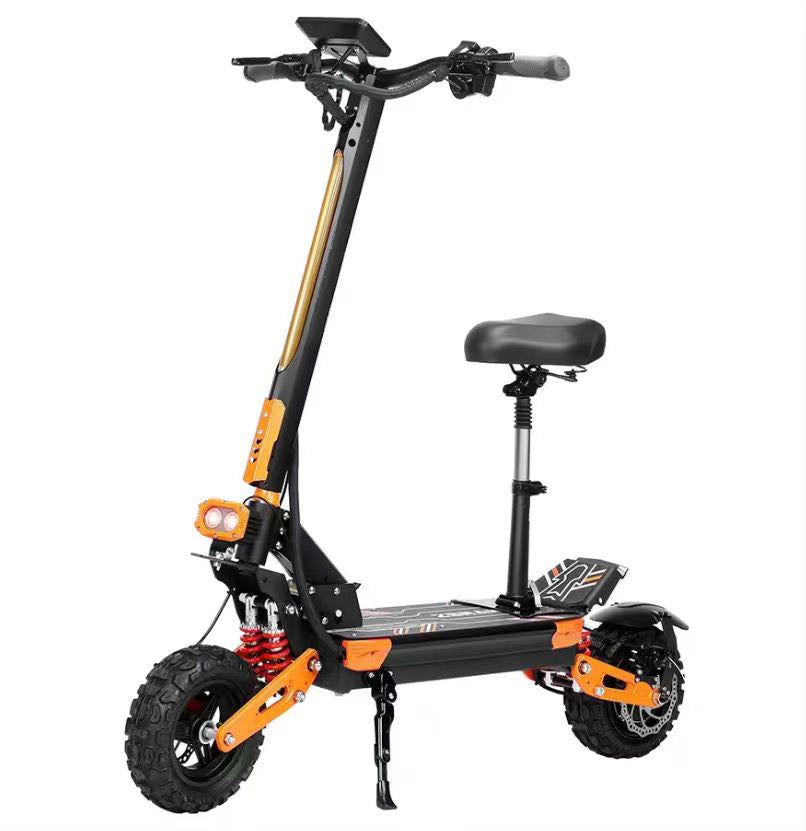
TopRiding ZSNAKE Z35 - High Performance Budget Scooter
The ZSNAKE Z35 redefines what is possible in the affordable performance category. Unlike flimsy 36V commuters, this machine boasts a 60V architecture and a massive 2800W single motor, providing enough torque to conquer steep urban hills and light off-road trails with ease.
-
Top Speed & Range: Up to 33 MPH with a max range of 35 miles.
-
Power Architecture: 2800W Single Motor paired with a robust 60V 15AH Battery.
-
Safety & Control: Front & Rear Disc Brakes, Full Spring Suspension, and UL 2272 Certification.
-
Durability: 11” Off-road Fat Tires and a massive 330 LBS Max Rider Load.
Upgrade Your Commute Today
Frequently Asked Questions
Are cheap electric scooters safe for adults?
In most professional situations, yes, provided you verify two things: the scooter must have UL 2272 certification to prevent battery fires, and it must have a mechanical brake (disc or drum). Avoid ultra-cheap, unbranded imports that lack these safety standards.
How long does the battery last on a budget e-scooter?
A standard 36V lithium-ion battery in a budget scooter will typically last for 300 to 500 charge cycles before you notice a significant degradation in total range. For a daily commuter, this equates to roughly 1.5 to 2 years of reliable lifespan.
Can a cheap e-scooter go up hills?
Barely. A cheap e scooter for adults with a 350W motor and a 36V battery will struggle on inclines greater than 10 to 12 degrees, often slowing down to a walking pace. If you live in a hilly city like San Francisco, you must upgrade to a scooter with a minimum of 800W or dual motors.
Are solid tires better than air-filled tires?
From our experience, no. While solid tires prevent flat tire maintenance, they offer zero shock absorption and terrible traction on wet pavement. Unless the scooter features an advanced dual-suspension system, you should always choose pneumatic (air-filled) tires for safety and ride comfort.
Industry References & Authoritative Guidelines
To ensure our electrical safety and mechanical recommendations meet the highest standards, TopRiding aligns with the following authoritative organizations:
-
UL Solutions (Underwriters Laboratories): The definitive authority on electrical safety, specifically the UL 2272 standard which tests the electrical drive train system for e-scooters to prevent thermal runaway and fire hazards. Review UL Micromobility Standards
-
Consumer Product Safety Commission (CPSC): Federal guidelines and safety alerts regarding the proper usage, maintenance, and structural requirements for personal micromobility devices. Review CPSC Micromobility Safety
-
National Association of City Transportation Officials (NACTO): Design guidelines and best practices for the safe integration and operational speeds of electric scooters within urban infrastructure. Review NACTO Urban Guidelines


