If your priority is covering more ground between charges, do not choose an electric bike by its advertised mileage alone. Battery energy capacity, motor efficiency, rider weight, terrain, speed and assist level all affect real-world range. A bike advertised for 80 miles may deliver substantially less when ridden fast, loaded with cargo or taken onto steep trails.
Our position is straightforward: buy the largest practical battery capacity you can afford, but do not sacrifice braking, frame quality, tire suitability or service support just to get a bigger range number. For riders who want a powerful moto-style fat-tire bike with a substantial battery, the TopRiding R2 deserves a close look. For commuters, touring riders and lighter recreational users, a different frame and riding setup may make more sense.

Quick Answer: What is the best long range electric bike?
The best long range electric bike is the one that can reliably complete your usual route with a meaningful battery reserve. For a high-capacity moto-style option, the TopRiding R2 combines a 52V 25Ah battery rated at 1,300Wh with a 750W rated rear hub motor, full suspension and 20 × 4.0-inch tires. Its stated range is up to 60 miles, not a guaranteed distance in every riding condition. Touring and commuting riders should also compare lighter, more efficient designs with large batteries before choosing a heavy fat-tire model.
The Shortlist: Eight Long Range Electric Bikes to Consider
This guide separates bikes by their intended use rather than pretending that eight different designs can be ranked fairly using one advertised range figure. The TopRiding R2 is the featured model because its battery capacity and complete specifications are supplied for evaluation. The remaining entries below identify the types of established long-range platforms worth comparing; verify the exact model year, battery configuration, regional specification and current manufacturer range claim before purchase.
| Bike or platform |
Best suited to |
What to compare |
Buying priority |
| TopRiding R2 |
Moto-style riding, mixed terrain and riders wanting a large battery |
52V 25Ah / 1,300Wh; stated up to 60 miles |
High-capacity battery and full suspension |
| Specialized Turbo Tero X |
Mixed-surface touring and utility riding |
Battery size, motor system and range extender compatibility by version |
Ride versatility and dealer support |
| Trek Allant+ long-range configurations |
Commuting and paved-distance riding |
Exact battery configuration and compatible range extender |
Efficient commuter setup |
| Gazelle Ultimate / Medeo long-range configurations |
Comfortable daily riding and recreational distance |
Battery capacity, motor assistance and frame fit |
Comfort and practical ownership |
| Riese & Müller touring configurations |
Long-distance touring and cargo use |
Dual-battery options, total system weight and service access |
Extended energy capacity |
| Fuell Flluid long-range models |
Urban riders prioritizing battery capacity |
Current model availability, battery specification and support |
Range-oriented urban design |
| Juiced Bikes long-range models |
Value-focused utility and recreational riding |
Current stock, battery replacement and warranty support |
Battery value and parts availability |
| Specialized Turbo Vado configurations |
Fast, efficient urban and fitness commuting |
Battery size, motor generation and range extender options |
Efficient assistance and dealer network |
Important model-selection note: product families often include several generations and battery options. A family name is not a complete specification. Before treating any alternative as a direct competitor, confirm the exact model's battery watt-hours, motor system, included equipment, warranty and availability in your market. The comparison below explains how to evaluate those choices without relying on unverified range figures.
What Is a Long Range Electric Bike?
A long range electric bike is an e-bike configured to cover longer distances per charge than a typical short-trip setup. There is no single universal mileage threshold that makes a bike officially long range. In practical buying decisions, battery energy capacity is a more useful starting point than a marketing label.
Battery capacity is commonly expressed in watt-hours (Wh). It represents the amount of energy stored in the battery. Voltage multiplied by amp-hours gives nominal watt-hours:
Battery energy calculation
52V × 25Ah = 1,300Wh
A 1,300Wh battery stores substantially more energy than a 500Wh battery, although the bike's actual distance per charge still depends on energy consumption while riding.
That distinction is important. A heavy bike with wide tires, high speed and aggressive acceleration can consume energy faster than a lighter commuter bike. A smaller battery on an efficient bike can sometimes deliver more distance than expected, while a large battery on a high-power bike can be depleted quickly under demanding conditions.
How Electric Bike Range Works
Range is the distance a bike travels before its battery reaches the point where it can no longer provide useful assistance. A simple planning estimate is:
Estimated range = usable battery energy (Wh) ÷ average energy consumption (Wh per mile).
For example, a 1,000Wh battery used at an average consumption of 20Wh per mile would theoretically provide 50 miles. If consumption rises to 30Wh per mile, the same battery would provide about 33 miles. These are illustrative calculations, not predictions for a particular bike.
Six factors that change real-world range
-
Assist level and speed: Higher assistance and sustained high speeds usually increase energy use.
-
Rider and cargo weight: More total mass requires more energy, especially during acceleration and climbing.
-
Terrain: Repeated climbs, soft trails and frequent stops can reduce distance per charge.
-
Tire type and pressure: Wide, knobby tires can increase rolling resistance on pavement. Pressure must remain within the manufacturer's safe range.
-
Temperature: Cold conditions can temporarily reduce battery performance and available capacity.
-
Battery condition: Age, charging habits, storage and cell condition affect how much energy the battery can deliver.
For a deeper look at terrain, tire choice and frame design, see our guide to what makes an e-bike all-terrain. A long-range bike that is poorly matched to the route is not a good purchase, even if its battery is large.
8 Best Long Range Electric Bike Choices
1. TopRiding R2 – Best High-Capacity Moto-Style Option
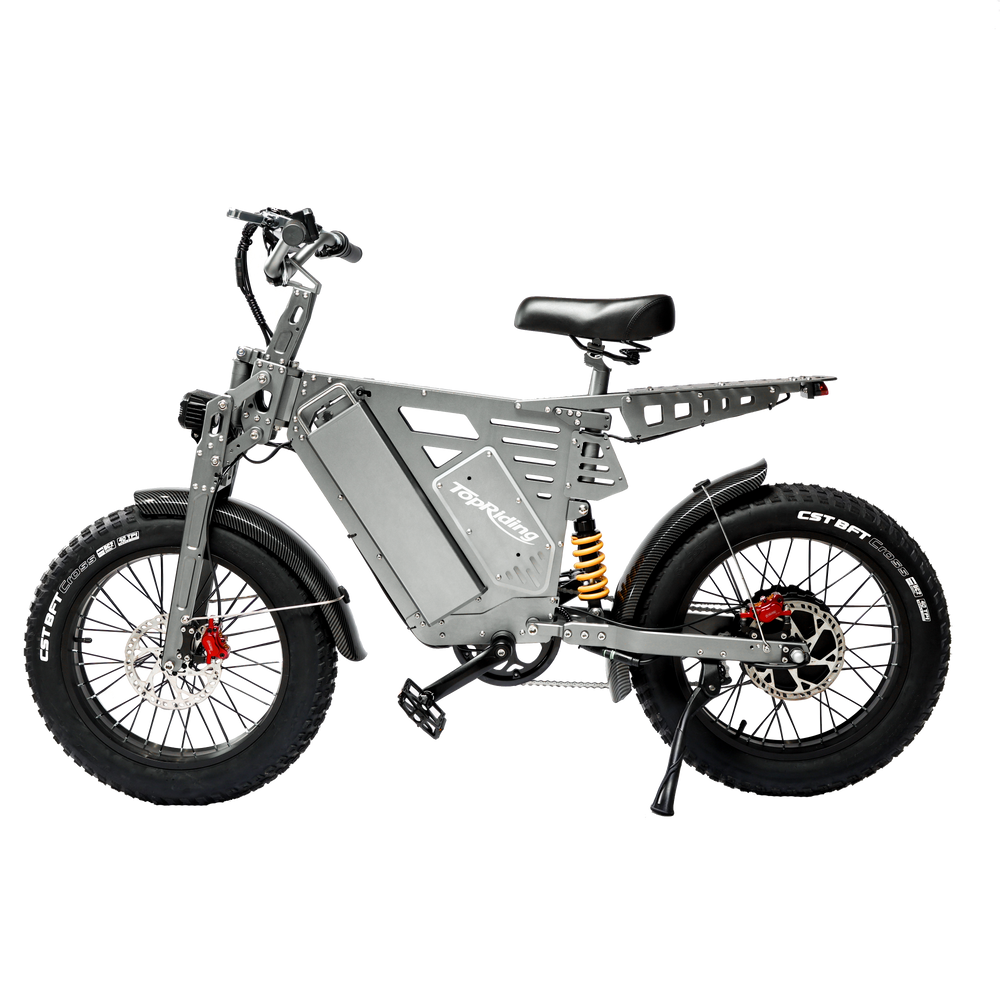
The TopRiding R2 is the most directly specified option in this guide. Its 52V 25Ah lithium-ion battery stores 1,300Wh, and TopRiding lists a range of up to 60 miles. That battery capacity is the central reason to consider it for riders who want a powerful, substantial e-bike rather than a lightweight city commuter.
Battery52V 25Ah
Energy1,300Wh
Stated rangeUp to 60 miles
Motor750W rated / 1,500W peak
Torque100Nm maximum
Price$1,999
The R2 also includes a removable 21700-cell lithium-ion battery, dual charging ports, full suspension with 100mm front and rear travel, 20 × 4.0-inch CST BFT Cross tires and four-piston hydraulic disc brakes. Its aluminum frame is full CNC-machined, and the listed maximum payload is 330 lbs. The bike weighs 82 lbs, which is a meaningful consideration for storage, transport and lifting.
Why it makes the shortlist: 1,300Wh is a substantial battery capacity for this style of e-bike. The combination of full suspension, wide tires and hydraulic brakes is relevant to riders who split their time between paved roads, rough paths and recreational off-road routes. NFC and app-based smart access add convenience, although they should not be treated as substitutes for mechanical security.
What to consider: the 82 lb weight is not commuter-light. Wide tires and a moto-style frame may be less efficient for riders whose daily route is mostly smooth pavement. The listed 60-mile figure is an upper claim, not a guaranteed range. Ask the seller for test conditions and confirm the local legal classification before riding on public roads or trails.
Our verdict: At the supplied $1,999 price, the R2 is worth considering if you want a large battery, a full-suspension moto-style layout and a high payload rating. It is not the right upgrade for someone whose main priority is a lightweight bike that is easy to carry upstairs.
View TopRiding R2 specifications and availability
2. Specialized Turbo Tero X – Best for Mixed-Surface Utility
The Turbo Tero X family is worth comparing if your routes combine pavement, gravel and maintained trails. Its appeal is versatility: rather than buying a purely road-oriented commuter or a very heavy moto-style bike, riders can look for a setup intended to handle mixed surfaces and practical everyday use.
When comparing a specific Tero X model, check the battery capacity in watt-hours, motor generation, suspension configuration and whether a range extender is supported in your market. Do not assume every model year has the same battery or equipment.
Best for: riders who want one bike for commuting, recreational rides and mixed terrain. Not ideal for: buyers who want the largest possible battery capacity at the lowest purchase price.
3. Trek Allant+ – Best for Long-Distance Commuting
Trek's Allant+ family is a useful comparison for riders who spend most of their time on paved roads. A commuter-focused geometry, integrated equipment and established dealer network can be more valuable than a high peak motor rating when the objective is to cover a repeatable daily route.
Battery configuration differs by model and generation. Compare the exact watt-hour rating, compatible range extender, rack capacity, lighting and local service options. If your commute includes long climbs, evaluate the motor's sustained assistance and gearing rather than choosing by battery size alone.
Best for: daily commuters and practical urban riders. Not ideal for: riders who specifically want fat tires, a motorcycle-inspired frame or aggressive off-road handling.
4. Gazelle Ultimate or Medeo – Best for Comfortable Everyday Distance
Gazelle's commuter and trekking-oriented e-bike families are worth a look if comfort, upright riding position and predictable everyday handling matter more than a high-speed appearance. A comfortable bike encourages consistent use, and that can be more valuable than buying a powerful model that feels excessive for ordinary errands.
Compare the exact battery option, motor system, frame size and carrying equipment. A larger battery may be available on one trim but not another. Also consider whether the bike can be serviced locally and whether replacement batteries are readily available.
Best for: riders who want a comfortable daily bike with touring potential. Not ideal for: buyers seeking a moto-style fat-tire platform.
5. Riese & Müller Touring Configurations – Best for Extended Touring
Riese & Müller is worth researching when your definition of long range includes loaded touring, frequent long rides or the possibility of a dual-battery configuration. Additional battery capacity can be valuable when a route has limited charging opportunities, but it also increases purchase price and total weight.
Do not compare a dual-battery touring build with a single-battery commuter as if they were equivalent products. Check the total energy capacity, charging arrangement, payload limits, luggage compatibility and service requirements. For touring, braking performance and a stable loaded ride deserve as much attention as battery size.
Best for: riders with demanding touring requirements and a higher budget. Not ideal for: cost-sensitive shoppers who only need a modest daily commute.
6. Fuell Flluid Long-Range Models – Best for Range-Focused Urban Riding
Fuell's Flluid line has been associated with urban e-bike designs that emphasize substantial battery capacity. It is a useful name to investigate if you want a city-oriented platform rather than a wide-tire recreational bike.
Because model availability and product support can change, confirm that the exact model is currently sold in your region. Verify battery watt-hours, replacement battery access, warranty coverage and the availability of authorized service before placing an order.
Best for: urban riders researching high-capacity battery designs. Not ideal for: buyers who cannot confirm local parts and service support.
7. Juiced Bikes Long-Range Models – Best for Value-Oriented Utility Riding
Juiced Bikes models have attracted riders interested in powerful utility-oriented e-bikes and larger battery configurations. They can be relevant in a value comparison, but buyers should pay particular attention to current stock, warranty terms and replacement battery availability.
A discounted bike is not necessarily a bargain if it becomes difficult to obtain a compatible battery, controller or display. Before purchasing, confirm the exact model specification and the support arrangements that apply to your order.
Best for: shoppers comparing utility features and battery capacity against price. Not ideal for: buyers who cannot establish reliable after-sales support.
8. Specialized Turbo Vado – Best for Efficient Urban and Fitness Commuting
The Turbo Vado family is a strong comparison for riders who want a more conventional urban e-bike experience. A commuter-oriented setup can be a better match for paved routes, regular errands and fitness riding than a heavy, wide-tire model.
Check the battery capacity and range-extender compatibility for the exact trim. Also consider fit, gearing, integrated lighting, rack options and the quality of local dealer support. The best long-distance commuter is one you can ride comfortably every day, not simply the one with the biggest battery.
Best for: commuters and fitness-oriented riders who value efficient road handling. Not ideal for: riders who prioritize a rugged moto-style appearance or wide tires.
Real-World Buying Checks: Four Useful Specification Benchmarks
Before paying for a long-range e-bike, compare the published battery capacity with the manufacturer's range claim. The following examples show why two bikes with similar marketing language can be very different purchases.
| Model |
Published battery |
Manufacturer range claim |
What the specification tells you |
| TopRiding R2 |
1,300Wh |
Up to 60 miles |
Large battery paired with a heavy moto-style full-suspension platform |
| Lectric XPedition2 Dual Long-Range |
1,680Wh |
Up to 170 miles |
Dual-battery cargo configuration; designed around utility and carrying capacity |
| Segway Xafari |
936Wh |
Up to 88 miles |
Comfort-oriented all-terrain design; manufacturer describes a low-assist test condition |
| Heybike Ranger 3.0 Pro |
720Wh |
Up to 90 miles |
Folding fat-tire platform; advertised maximum should not be treated as typical mixed-use range |
| Aventon Current ADV |
800Wh |
Up to 105 miles |
Full-suspension mountain-bike configuration with a high-torque motor system |
| FUELL Flluid-2 / 2S |
2,000Wh |
Up to 225 miles |
Dual removable batteries and an automatic mid-drive system; premium price positioning |
These are manufacturer-published figures, not results from a single controlled comparison test. Test conditions, rider weight, assist level, speed and terrain differ between brands. For example, Segway publishes an 88-mile maximum range for the Xafari and describes a low-assistance test condition. FUELL publishes separate maximum-range figures for low and maximum assist. Those numbers should not be compared as if they were measured on the same route with the same rider.
There is also a practical distinction between an advertised maximum and a useful daily range. A cargo bike with a 1,680Wh battery may be a better choice for carrying equipment over long distances, while a 936Wh comfort bike may be easier to live with for ordinary mixed-surface riding. The right answer depends on the job.
Benefits of Buying a Long Range Electric Bike
Fewer charging stops
A larger battery can reduce the number of charging stops on a long ride. That matters when your route passes through rural areas, parks or industrial districts where convenient outlets are limited. It is also useful for delivery riders who cannot afford to interrupt a working shift for frequent charging.
More flexibility in assist level
Extra capacity gives you more flexibility to use higher assistance when you need it, such as on a steep climb or when carrying cargo. It does not mean you should ride in maximum assist all day, but it can reduce the pressure to conserve every percentage point of battery.
Better suitability for loaded trips
Riders carrying groceries, work equipment, camping supplies or panniers need to consider both energy and payload. A long-range cargo bike can be a better fit than a conventional commuter model if the load is a regular part of the trip. Check the manufacturer's total payload rating, rack rating and handling guidance rather than assuming a large battery means the frame can carry more.
More room for route planning
A battery reserve gives you more options when a route changes unexpectedly. A detour, headwind or missed turn is less stressful when the battery is not already close to empty. We recommend planning to arrive with a reserve instead of treating the manufacturer's maximum range as the distance you should attempt.
Limitations: When a Bigger Battery Is Not Worth It
More battery capacity has real trade-offs. Larger packs add cost, weight and charging time. A heavy bike can be difficult to lift into a vehicle, carry up stairs or maneuver through a crowded storage area. If you ride a short, flat commute and can recharge at home, a very large battery may be unnecessary.
There is also a difference between battery capacity and overall bike quality. A large battery does not compensate for poor brakes, weak wheels, uncomfortable geometry or an unreliable drivetrain. For off-road use, suspension quality and tire suitability matter. For commuting, fenders, lights, rack mounts and service access can be more valuable than another few hundred watt-hours.
| Advantages |
Limitations |
| Longer potential distance between charges |
Higher purchase price in many configurations |
| More reserve for hills, cargo and detours |
Additional battery weight can affect handling |
| Useful for touring and delivery applications |
Longer charging time if charger output is unchanged |
| Can reduce charging frequency for multi-trip days |
Battery replacement can be expensive |
| More flexibility in assist-level selection |
Does not guarantee the advertised maximum range |
Who Should Buy a Long Range Electric Bike?
Commuters with longer daily routes
If your round trip is long, includes hills or leaves little time for charging during the day, a larger battery can make ownership more convenient. Calculate your round-trip distance first, then choose a battery with enough capacity for the journey plus a sensible reserve.
Touring and recreational riders
For riders planning long weekend routes, battery capacity is only one part of the decision. You also need a comfortable saddle, stable handling, suitable gearing, dependable brakes and a practical way to carry repair tools and supplies. A touring-focused bike with a range extender or dual-battery setup may be a better fit than a high-powered fat-tire bike.
Hunters and outdoor users
Hunters and outdoor users may value a robust frame, wide tires, quiet operation and the ability to carry equipment. But range claims can fall sharply on soft ground, steep access roads and trails with frequent elevation changes. Compare the bike's payload rating and tire design with the terrain you actually ride. Our guide to hunting e-bikes under $2,000 covers the trade-offs between equipment capacity, trail access and price.
Commercial users and delivery riders
For commercial users, downtime has a direct cost. A larger battery can support longer shifts, but the purchase decision should include replacement battery cost, charging logistics, service turnaround, brake wear and the availability of consumable parts. If a bike is used every day, dependable support is more important than a headline range claim.
Who Does Not Need an Extra-Large Battery?
You may not need a long-range model if your daily ride is short, your route is mostly flat and you can charge conveniently at home or work. A lighter bike with a moderate battery may be easier to store, more comfortable to pedal without assistance and less expensive to maintain.
Likewise, do not buy a heavy moto-style bike simply because its battery looks impressive if you need to carry it upstairs or lift it onto a vehicle rack. In that situation, a lighter commuter e-bike with a smaller battery—or a removable battery that can be charged indoors—may be the better long-term purchase.
Common Mistakes When Choosing a Long Range E-Bike
1. Comparing maximum range claims without comparing test conditions
One brand may quote an ideal low-assist figure while another provides a more conservative estimate. Compare watt-hours and the stated test conditions before drawing conclusions. Treat an unqualified maximum as a best-case marketing figure, not a promise.
2. Looking at amp-hours but ignoring voltage
Amp-hours alone do not tell you how much energy a battery stores. A 25Ah battery at 52V stores approximately 1,300Wh; a 25Ah battery at 48V stores approximately 1,200Wh. Compare watt-hours when evaluating energy capacity.
3. Assuming peak motor power determines range
Peak power describes short-term motor output, not how efficiently a bike uses energy over an entire ride. A higher-power motor can use more energy when ridden aggressively. Consider motor control, gearing, assist behavior and the way you intend to ride.
4. Ignoring bike weight
Battery capacity is only useful if the bike suits your daily routine. An 82 lb e-bike may be perfectly reasonable for a rider who stores it at ground level, but inconvenient for someone who must carry it up several flights of stairs. Include the weight of accessories and cargo in your decision.
5. Forgetting replacement battery availability
A proprietary battery can become a costly ownership problem if replacement packs are unavailable. Before buying, ask whether the manufacturer sells replacement batteries, how long parts are expected to remain available and whether the battery can be removed for charging or storage.
6. Treating water resistance as permission to ignore care
An IP rating is useful, but it does not mean every electrical connection can be submerged or that the bike should be pressure-washed. Follow the owner's manual for cleaning, charging and storage. Check the exact rating and which components it covers.
Buying Considerations: What Professionals Check Before Recommending a Bike
Battery capacity and cell information
Start with watt-hours, then ask about the battery manufacturer, cell specification, battery management system, warranty and replacement options. A specification such as 21700 cells tells you the cell format, but it does not independently prove pack quality or safety. Pack construction, protection circuitry and system integration matter.
Battery and electrical safety certification
For a lithium-ion e-bike, electrical safety deserves serious attention. UL 2849 addresses the electrical system of e-bikes, including the battery, drive unit, battery management system, wiring and charger. Ask for documentation that applies to the exact model and electrical configuration. Do not assume that a component-level claim means the complete bike has been certified.
Motor system and legal classification
Check rated motor power, peak output, torque, speed settings and the bike's classification in the area where you intend to ride. A model's advertised peak power does not establish that it is legal on every public road, shared-use path or trail. Local rules can distinguish between pedal-assist and throttle operation, maximum assisted speed and motor output.
Brakes, tires and suspension
A long-range bike may spend more time on the road and accumulate more miles between services. Hydraulic disc brakes can offer useful stopping power, but rotor size, pad quality, setup and maintenance matter too. Wide tires can improve comfort and traction on loose surfaces, but they may create additional rolling resistance on pavement. Full suspension can improve control on rough terrain but adds weight and complexity.
Charging time and charging options
Ask how long the battery takes to charge with the included charger. If the bike has dual charging ports, confirm whether a second charger is included or sold separately and whether the manufacturer specifies a safe dual-charging procedure. Do not connect improvised chargers or use a charger with an incompatible voltage or charging profile.
Warranty and after-sales support
For a high-capacity e-bike, after-sales support is part of the purchase price. Check the warranty period for the battery, motor, frame and other electrical components. Ask who handles warranty claims, where replacement parts ship from and whether local bike shops can service the system. A slightly more expensive model with reliable parts support may cost less over several years.
Cost-Benefit Analysis: Is a Long Range E-Bike Worth the Upgrade?
The financial case depends on how often you ride and what transport costs you replace. A long-range e-bike can reduce car trips, parking expenses and some commuting costs, but it still has purchase, maintenance, insurance (where applicable), charging and battery-replacement costs.
For a rider who travels a few miles on weekends, upgrading from a 500Wh battery to a 1,300Wh battery may deliver little practical benefit. For a delivery rider covering a long route every day, the extra capacity may reduce charging interruptions and make a second battery or mid-shift charging stop unnecessary. The value is operational, not just numerical.
| Riding pattern |
Battery approach |
Upgrade advice |
| Short urban trips, mostly flat |
Moderate battery |
Prioritize lower weight, comfort and serviceability |
| Daily 20–40 mile commute |
Medium-to-large battery |
Choose enough capacity for the round trip plus reserve |
| Frequent 40–60 mile recreational rides |
Large battery or range extender |
Compare efficiency and charging access as well as capacity |
| Loaded touring or commercial shifts |
Large or dual battery |
Evaluate payload, replacement cost and charging logistics |
| Rough trails and steep terrain |
Large battery with suitable drivetrain |
Do not sacrifice brakes, tires or suspension for capacity alone |
If you are choosing a bike for rough terrain rather than distance alone, read our comparison of full-suspension e-bikes under $2,000 and our assessment of whether e-bikes are good for off-road riding. Those factors can change which bike is worth buying.
Our Expert Recommendation
For a rider who wants a substantial battery in a moto-style package, the TopRiding R2 is a compelling option to evaluate. Its 1,300Wh battery, 100Nm maximum torque, full suspension and 330 lb maximum payload make it more than a basic short-range commuter. The 82 lb weight, however, means buyers should be comfortable with a heavy bike and its storage requirements.
If maximum stated range is the overriding priority, a dual-battery cargo bike such as the Lectric XPedition2 Long-Range configuration offers a larger published battery capacity. If you want an all-terrain comfort bike, the Segway Xafari is worth comparing. If you want a high-performance mountain-bike platform, compare the Aventon Current ADV. Those are different tools for different jobs, not interchangeable alternatives.
We recommend making the final decision in this order: calculate your real round-trip distance, choose a battery with reserve, confirm the bike's weight and payload, check braking and tire suitability, verify electrical safety documentation, and confirm parts and warranty support. A long-range electric bike is worth buying when it solves a real distance problem. It is not worth paying extra for mileage you will never use.
TopRiding's range includes electric bikes and other personal electric mobility options. If your daily route is better suited to a seated scooter or a compact commuting vehicle, compare the long-range electric scooter collection rather than assuming an e-bike is automatically the best format.
Frequently Asked Questions About the Best Long Range Electric Bike
1. What is the best long range electric bike?
The best choice depends on your route and riding style. The TopRiding R2 is worth considering for a moto-style full-suspension bike with a 1,300Wh battery and a stated range of up to 60 miles. Riders prioritizing maximum battery capacity should also compare dual-battery cargo bikes, while commuters may prefer lighter and more efficient designs.
2. How many miles can a long range electric bike travel?
Some long-range models advertise 60, 100 or more miles per charge. Actual distance depends on battery watt-hours, rider and cargo weight, speed, assist level, terrain, tire pressure, temperature and battery condition. Use the manufacturer's range as a best-case reference unless test conditions closely match your ride.
3. Is a 1,000Wh e-bike battery enough for long rides?
A 1,000Wh battery can support substantial riding distance, but there is no universal mileage guarantee. A relatively efficient bike on flat roads may travel much farther than a heavy bike ridden quickly over steep or soft terrain. Calculate your expected energy use and leave a reserve.
4. Is a 1,300Wh battery better than a 750Wh battery?
In terms of stored energy, a 1,300Wh battery has greater capacity than a 750Wh battery. It can support more distance under comparable conditions, but it may add weight and cost. A lighter, more efficient bike with a 750Wh battery may still be the better choice for a commuter.
5. Are fat-tire electric bikes good for long distances?
They can be, especially on sand, loose gravel, snow or rough access roads where wider tires provide useful flotation and traction. On smooth pavement, wide tires may increase rolling resistance and weight. Choose fat tires when the terrain justifies them, not simply because they look rugged.
6. Does a more powerful motor reduce e-bike range?
Not automatically. Range depends on how much energy the bike uses, not just the motor's maximum rating. However, aggressive acceleration, high speeds and sustained high assistance can increase consumption. Riding style and terrain have a major influence.
7. How long does it take to charge a long-range electric bike?
Charging time depends on battery capacity, charger output, battery condition and the charging system. Larger batteries generally take longer to charge with the same charger. Check the manufacturer's stated charging time and use only the approved charger or an explicitly compatible replacement.
8. Is the TopRiding R2 suitable for long-distance riding?
The R2 has a 52V 25Ah battery with 1,300Wh of energy and a manufacturer-stated range of up to 60 miles. It also has full suspension and wide tires. Its 82 lb weight makes it less convenient to carry or transport than a lighter commuter bike, so it is best suited to riders who want its moto-style format and can accommodate its size.
9. Should I buy a dual-battery electric bike?
A dual-battery bike can be worthwhile for touring, cargo use or long daily shifts where charging access is limited. It adds cost and weight, so it is unnecessary for many ordinary commutes. Confirm whether both batteries are included in the advertised price and whether the bike manages them as one system.
10. What safety certification should I look for?
Ask whether the complete e-bike electrical system has been evaluated to UL 2849 or another applicable recognized safety standard. Confirm the documentation applies to the exact model and battery configuration. A seller's general statement about safe cells is not the same as certification of the complete electrical system.
References
-
UL Standards & Engagement – UL 2849: Electrical Systems for eBikes. Scope of the electrical-system standard, including battery, drive unit, battery management system, wiring and charger.
-
Gazelle Bikes – E-Bike Battery and Range. Manufacturer explanation of how assist mode, battery capacity and riding conditions affect range.
-
National Renewable Energy Laboratory – Standards Guidance for Electric Bicycles. Technical overview of relevant electric bicycle standards, including UL 2849 and EN 15194.


