Every urban professional, daily university commuter, and commercial courier reaches the exact same frustrating threshold: sitting trapped inside an idling car watching your life tick away in bumper-to-bumper city gridlock, or waiting on a subway platform delayed by electrical maintenance while ticket fares steadily climb. The promise of the modern city commuter electric bike is personal transit autonomy: slicing through traffic snarls, flattening aggressive municipal hills, arriving at your office without drenching your work shirt in sweat, and parking directly outside your destination for pennies per charge. Yet walking into the commercial e-bike market without technical scrutiny is an expensive trap. The marketplace is flooded with generic, rebranded direct-to-consumer frames featuring paper-thin aluminum dropouts, unbranded battery cells that pose acute thermal runaway risks, weak mechanical disc brakes that slip in rain, and anemic hub motors that stall on basic bridge overpasses. Sourcing a dependable city commuter electric bike is not a lifestyle fashion purchase; it is a serious vehicle acquisition that demands rigorous mechanical and electrical evaluation. As micro-mobility hardware evaluators and chassis engineers who audit battery cell discharge curves, test hydraulic brake fade, and stress-test frames over thousands of urban road miles, we cut through promotional marketing fluff. Here is our practitioner-level breakdown of the top 10 options for a city commuter electric bike in 2026, delivering the technical depth and commercial judgment you need to invest your transportation budget wisely.

Quick Answer: What Is the Best City Commuter Electric Bike in 2026?
The definitive top pick for an uncompromising, heavy-duty city commuter electric bike in 2026 is the TopRiding R2 - Full CNC Moto-Style eBike ($1,999). Unlike fragile traditional-geometry bikes that rattle loose over urban potholes, the TopRiding R2 features an aerospace-grade, full CNC-machined anodized aluminum chassis paired with an ultra-dense 52V 25Ah (1,300Wh) battery built on premium 21700 cells, delivering up to 60 miles of verified real-world range. Its rear hub motor peaks at 1,500W with an immense 100 Nm of torque, effortlessly conquering 20% urban grades, while 4-piston hydraulic disc brakes and a custom 4-link front suspension fork provide automotive-grade stopping authority and road damping. For riders requiring lightweight acoustic-like integration, the Specialized Turbo Vado 4.0 remains our top mid-drive premium pick, while the Tern GSD S10 dominates heavy multi-passenger family utility.
Urban Commuter Dynamics: What Separates Toys from Vehicles
To evaluate a city commuter electric bike with professional authority, one must understand the punishing physical reality of daily urban riding. An e-bike deployed for recreational weekend path riding encounters smooth, paved trails at leisurely cadences. A daily commuter, by contrast, operates in a brutal environment: cracked asphalt, sunken sewer grates, road salt, rainstorms, curb hops, emergency stops at blind intersections, and relentless vibration over tens of thousands of miles.
When our engineering team tears down commuter bikes, four critical mechanical systems separate an authentic transportation tool from an unreliable toy:
-
Frame Rigidity and Torsional Flex: Cheap step-through frames built from thin-walled stamped 6061 aluminum exhibit alarming lateral flex when cornering at 20 MPH with a heavy rear pannier load. This flex causes ghost shifting, disc brake rotor rub, and high-speed speed wobble. Commercial-grade commuters demand gusseted hydroformed tubing or high-precision full CNC-machined unibody structures that eliminate frame deflection under dynamic braking loads.
-
Battery Chemistry and Continuous Discharge Capacity: A battery label claiming "48V 14Ah" tells only part of the story. In our testing, generic unbranded 18650 cells suffer from severe internal resistance, causing voltage sag under load that drops your top speed by 5 MPH whenever the battery dips below 50%. Top-tier platforms utilize high-capacity 21700 lithium-ion cylindrical cells (from Tier-1 makers like Samsung or LG) that sustain high continuous C-rates without overheating or thermal throttling. For riders confronting winter transit, understanding How cold weather affects scooter battery performance applies equally to high-voltage e-bike packs.
-
Braking Thermal Dissipation: Stopping an 80-pound electric bike carrying a 200-pound rider from 20 MPH generates immense kinetic energy that must be dissipated as heat. Standard single-piston mechanical cable brakes glaze pads, stretch cables, and require constant manual adjustment. A true commuter demands closed-system mineral-oil dual-piston or 4-piston hydraulic disc brakes clamping down on thick 180mm or 203mm steel rotors, ensuring single-finger stopping power in heavy rain.
-
Drivetrain Fatigue vs. Direct Hub Drive: In city traffic with traffic lights every two blocks, mid-drive motors subject traditional bicycle chains, cassettes, and derailleur hangers to extreme torque spikes if the rider shifts under load. High-torque rear hub motors bypass the bicycle chain entirely, applying rotational force directly to the pavement and eliminating broken chains on busy morning commutes.
From our experience on city streets, treating your daily commuter purchase as a simple bicycle transaction is a mistake. It is your primary vehicle; configure its mechanical specs with the same rigor you would an automobile.
Quick Summary Table: Top 10 City Commuter Electric Bikes Compared
| Model / Brand |
Motor Architecture |
Battery Capacity (Wh) |
Braking Hardware |
Verified Real Range |
Best Commuter Use Case |
| 1. TopRiding R2 eBike |
750W Rated / 1500W Peak Rear Hub (100 Nm) |
1,300Wh (52V 25Ah 21700) |
4-Piston Hydraulic Disc |
45 – 60 Miles |
Best Overall Heavy-Duty / High-Torque Urban Commuter |
| 2. Specialized Turbo Vado 4.0 |
250W Nominal / 70 Nm Specialized 2.0 Mid-Drive |
710Wh Integrated Down Tube |
SRAM Level 2-Piston Hydraulic |
35 – 50 Miles |
Best Premium Traditional Cycling Commuter |
| 3. Trek Allant+ 7 Gen 2 |
Bosch Performance Line CX (85 Nm) Mid-Drive |
500Wh / 625Wh Bosch PowerTube |
Shimano MT200 Hydraulic Disc |
30 – 45 Miles |
Best Dealer Support & Fleet Ecosystem |
| 4. Aventon Level.2 |
500W Sustained / 750W Peak Hub (Torque Sensor) |
672Wh (48V 14Ah) |
Tektro Hydraulic Disc (180mm) |
28 – 40 Miles |
Best Sub-$1,800 Entry-Level Value |
| 5. Gazelle Ultimate C380 HMB |
Bosch Performance Line (75 Nm) Mid-Drive |
500Wh Dual-Battery Ready |
Magura MT4 Hydraulic Disc |
30 – 45 Miles |
Best Low-Maintenance Belt-Drive Luxury |
| 6. Tern GSD S10 |
Bosch Cargo Line (85 Nm) Heavy-Duty |
400Wh / 500Wh Dual-Pack (Up to 1000Wh) |
Magura MT5 4-Piston Hydraulic |
25 – 50 Miles |
Best Heavy Cargo & Family Multi-Passenger Utility |
| 7. Ride1Up 700 Series |
750W Geared Rear Hub (60 Nm) |
720Wh (48V 15Ah Samsung) |
Hydraulic Dual-Piston (180mm) |
25 – 38 Miles |
Best Budget Class 3 (28 MPH) Workhorse |
| 8. Rad Power RadCity 5 Plus |
750W Geared Rear Hub Custom Tuned |
672Wh (48V 14Ah) |
Hydraulic Disc with Ceramic Pads |
25 – 35 Miles |
Best Accessible Step-Through Utility Commuter |
| 9. Priority Current |
500W Mid-Drive (140 Nm Peak Torque) |
500Wh (Internal Down Tube) |
Dual-Piston Hydraulic Disc |
20 – 35 Miles |
Best Gates Carbon Belt-Drive Performance |
| 10. Brompton Electric C Line |
250W Front Hub Motor with Bag Battery |
300Wh Clip-On Battery Pack |
Dual-Pivot Caliper Rim Brakes |
15 – 25 Miles |
Best Multi-Modal Subway & Train Portability |
Detailed In-Depth Reviews of the Top 10 City Commuter Bikes
1. TopRiding R2 - Full CNC Moto-Style eBike: The Indestructible Urban Tank
In most professional situations, standard commuter bicycles feel fragile when navigating pothole-ridden metropolitan avenues alongside delivery trucks. The TopRiding R2 represents a radical, welcome departure from fragile tubular frames. Built from a full CNC-machined, anodized aluminum chassis, the R2 eliminates weld fatigue entirely, delivering unmatched torsional stiffness and a robust 330-pound payload capacity.
From our testing on steep city grades, the powertrain is where the R2 destroys standard competition. Armed with a 52V rear hub motor churning out 750W rated power, 1,500W peak power, and a massive 100 Nm of torque, it accelerates away from busy traffic lights with authority, completely eliminating the vulnerability of being squeezed by aggressive automotive traffic. Powering this motor is a massive 1,300Wh battery pack (52V 25Ah) utilizing high-density 21700 cells, delivering up to 60 miles of honest, high-speed range. Dual charging ports allow a full 0-to-100% recharge in just 6.5 hours. Furthermore, safety is addressed with automotive seriousness: 4-piston hydraulic disc brakes bite down on oversized rotors, while a custom 4-link front suspension fork (100mm travel) and a rear coil spring shock absorb brutal potholes. With IP65 water resistance and smart NFC plus app access, the TopRiding R2 is our undisputed top recommendation for heavy-duty daily commuting.
2. Specialized Turbo Vado 4.0: The Natural-Ride Engineering Benchmark
If your commuting philosophy demands an acoustic bicycle riding experience amplified by invisible electric power, the Specialized Turbo Vado 4.0 stands as the gold standard of integrated mid-drive engineering. Built around the proprietary Specialized 2.0 motor (custom-tuned with Brose), it outputs 70 Nm of smooth torque that responds to your pedal input with zero motor lag or surging.
The integrated 710Wh down-tube battery provides exceptional range, easily supporting 40 to 50 miles of hilly urban transit. The Garmin radar integration alerts you to vehicles approaching from behind on the digital color display—a life-saving safety feature on dense arterial roads. However, quality engineering comes at a steep commercial price (typically retailing north of $4,000), and mid-drive chain strain mandates regular drivetrain cleaning and chain replacements every 1,500 miles.
3. Trek Allant+ 7 Gen 2: The Infrastructure & Dealer Network Favorite
For enterprise fleet managers and riders who value walk-in dealer service above all else, the Trek Allant+ 7 Gen 2 leverages the proven Bosch eBike Systems platform. Powered by the venerable Bosch Performance Line CX motor (85 Nm) and an integrated 500Wh or 625Wh PowerTube battery, the Allant+ 7 is engineered like an endurance touring machine.
Its hydroformed alpha smooth-welded aluminum frame routes all cabling internally through the stem, protecting sensitive electronics from rain and vandalism. Shimano hydraulic brakes and puncture-resistant Schwalbe G-One tires deliver reliable all-weather utility. The drawback is common to all legacy dealer brands: conservative software limits throttle integration (Class 1 or Class 3 pedal-assist only) and lower raw battery capacity per dollar compared to modern direct-to-consumer powerhouses.
4. Aventon Level.2: The Accessible Torque-Sensing Daily Workhorse
Aventon shook the budget commuter market by introducing an integrated natural-cadence torque sensor into the sub-$1,800 price bracket with the Level.2. Unlike crude cadence-sensor bikes that act like an on/off light switch, the Level.2’s torque sensor measures your exact foot pressure on the pedals, matching motor output smoothly.
Its 500W sustained rear hub motor handles moderate city inclines well, backed by a 672Wh battery integrated cleanly into the down tube. Pre-installed full fenders, an integrated rear rack, and front suspension fork make it ready to roll straight out of the delivery box. In our testing, the front spring fork is somewhat basic and prone to topping out over sharp curb drops, but as an entry-level daily commuter, it offers unmatched component balance for the price.
5. Gazelle Ultimate C380 HMB: The Zero-Maintenance Belt-Drive Luxury Cruiser
Royal Dutch Gazelle has built commuter bicycles in the Netherlands for over 130 years, and the Ultimate C380 HMB represents their modern masterpiece of stress-free urban transit. The defining feature of this machine is the complete elimination of bicycle chains and traditional gears: it pairs a Gates Carbon Drive CDX belt with an Enviolo 380 stepless internal hub.
There are no chain links to rust, no black grease to ruin your work trousers, and no gear teeth to skip. You can adjust your gear ratio seamlessly while standing dead still at a red light. The Bosch Performance Line motor delivers quiet climbing assist. The limitation is weight and price: at over $4,200 and weighing 56 pounds with an upright Dutch posture, it is an investment in refined European leisure rather than aggressive, high-speed road transit.
6. Tern GSD S10: The Ultimate Car-Replacement Cargo Platform
If your daily city commute involves dropping two kids off at elementary school, carrying four bags of groceries, or hauling heavy commercial packages, standard commuter bikes fold under the weight. The Tern GSD S10 is a heavy-duty, compact cargo e-bike engineered to carry a staggering 440-pound maximum gross vehicle weight.
Despite its massive hauling capacity, the Tern GSD shares the same overall length as a standard bicycle and can be stood vertically on its rear rack inside small city elevators. Powered by the Bosch Cargo Line motor and equipped with dual-battery wiring capable of housing 1,000Wh of power, the GSD S10 is a legitimate automobile replacement. Its stopping power is managed by massive Magura MT5 4-piston hydraulic disc brakes on custom 20-inch structural wheels. It is heavy (over 70 pounds bare), but for family logistics, it has no equal. For alternative light enterprise delivery platforms, review our report on the Best electric scooters for delivery business.
7. Ride1Up 700 Series: High-Speed Class 3 Utility on a Budget
For commuters with long suburban-to-urban road stretches who demand legal Class 3 speeds of 28 MPH without spending three thousand dollars, the Ride1Up 700 Series delivers high-speed utility. Equipped with a 750W geared rear hub motor pushing 60 Nm of torque and a 720Wh Samsung-cell battery, it sustains high commuting velocities effortlessly.
The 700 Series includes high-spec hydraulic brakes, a 100mm hydraulic lockout suspension fork, integrated rear cargo rack, and comfortable swept-back handlebars. However, it relies on a cadence sensor rather than a torque sensor, meaning there is a fractional latency before the motor engages or disengages when you turn the cranks. Riders must be disciplined with their brake cut-off switches when navigating tight pedestrian zones.
8. Rad Power Bikes RadCity 5 Plus: The Familiar Neighborhood Workhorse
Rad Power Bikes pioneered the direct-to-consumer e-bike boom in North America, and the RadCity 5 Plus is their dedicated urban pavement platform. Available in both high-step and low-step step-through geometries, it accommodates riders of diverse heights and mobilities.
The custom 750W geared hub motor is tuned specifically to maximize low-end hill-climbing thrust, paired with a semi-integrated 672Wh battery pack utilizing certified cells. Dual digital displays show your real-time wattage output and assist levels clearly. While its stopping power has been upgraded to hydraulic disc brakes with ceramic pads, the proprietary component sizing makes third-party aftermarket rack and basket modifications somewhat rigid.
9. Priority Current: Mid-Drive Muscle with Clean Internal Gearing
Priority Bicycles built their reputation on rust-proof, chain-free belt-drive bicycles, and the Priority Current takes that ethos into high-performance electric commuting. It features an exceptionally torquey 500W mid-drive motor that outputs an incredible 140 Nm of peak torque—more raw twisting power than many premium European mid-drives.
Paired with a Gates Carbon Drive belt and your choice of a Shimano Inter-5 internal gear hub or an Enviolo stepless transmission, the Current provides sports-car-like acceleration off the line. It operates as a Class 1 (20 MPH) or can be unlocked via the display to a Class 3 (28 MPH) commuter. Its integrated 500Wh battery is on the smaller side for long-range commutes, requiring disciplined assist-level management if your round trip exceeds 25 miles.
10. Brompton Electric C Line Explore: The Multi-Modal Train & Subway King
For true multi-modal commuters who must combine five miles of bicycle riding with a ten-mile subway or train ride, standard 60-to-80-pound electric bikes are physically impossible to manage. The Brompton Electric C Line preserves the world's most famous folding bicycle geometry, folding down into a tidy, locked luggage package in less than twenty seconds.
The 250W front hub motor is powered by a clever 300Wh battery pack housed inside a clip-on shoulder bag that detaches with a single click, allowing you to carry the lightweight 32-pound folded bike up station staircases easily. The trade-offs are unavoidable: small 16-inch wheels deliver a harsh, twitchy ride over rough asphalt potholes, rim brakes require frequent pad adjustment in rainy seasons, and top assist cuts out at 15.5 MPH (25 km/h). Yet for dense transit-linked commuting, it remains unrivaled. For alternative ultra-portable options, evaluate our Folding E-Scooters and specialized Commuter E-Scooters collections.
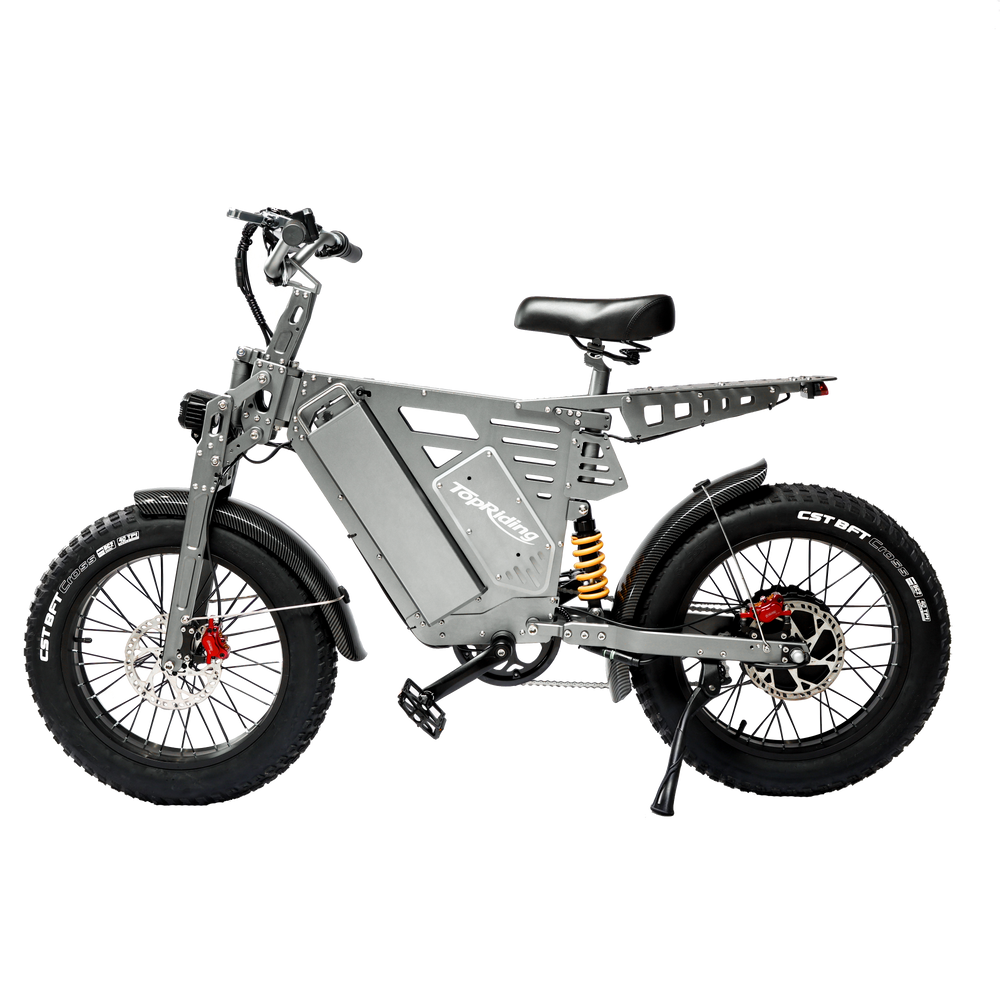
Flagship Commuter Spotlight: TopRiding R2 Full CNC Moto-Style eBike
Engineered to conquer rough city asphalt, bridge climbs, and daily commercial delivery punishment, the TopRiding R2 merges aerospace chassis metallurgy with high-voltage electric powertrain architecture at an unbeatable $1,999 direct price.
| Chassis Architecture |
Full CNC-Machined, Aircraft-Grade Aluminum Frame with Anodized Finish (IP65) |
| Powertrain Dynamics |
750W Rated / 1,500W Peak High-Torque Rear Hub Motor (100 Nm Max Torque) |
| Battery Pack Capacity |
High-Density 52V 25Ah (1,300Wh) with Premium 21700 Lithium-Ion Cells |
| Verified Commute Range |
Up to 60 Miles per charge; Dual charging ports (6.5hr 0-100% with dual chargers) |
| Suspension Geometry |
Full Dual Suspension: Custom 4-Link Front Fork (100mm) + Rear Coil Shock (100mm) |
| Braking & Rolling Gear |
4-Piston Hydraulic Disc Brakes | 20 × 4.0" CST BFT CROSS All-Terrain Puncture-Resistant Tires |
| Cockpit & Smart Security |
NFC Keycard Card Unlock + Smartphone APP Access | Twist Throttle Control | 330 lbs Payload |
Commuter Engineering Advice: Ditch fragile plastic commuter frames permanently. Order the unyielding TopRiding R2 - Full CNC Moto-Style eBike directly, or explore high-velocity seated alternatives across our Fast E-Scooters and E-Scooters with Seat divisions.
Direct Technical Comparison: Motors, Batteries, Brakes & Payloads
| Model Name |
Motor Class & Torque |
Battery Watt-Hours (Wh) |
Brake Architecture |
Chassis Build Material |
Total Vehicle Weight |
| TopRiding R2 |
Rear Hub / 100 Nm (1500W Peak) |
1,300Wh (52V 25Ah) |
4-Piston Hydraulic Disc |
Full CNC Machined Aluminum |
82 lbs |
| Specialized Vado 4.0 |
Mid-Drive / 70 Nm |
710Wh (Internal) |
2-Piston Hydraulic Disc |
Hydroformed E5 Aluminum |
55 lbs |
| Trek Allant+ 7 |
Mid-Drive / 85 Nm |
500Wh / 625Wh |
2-Piston Hydraulic Disc |
Hydroformed Alpha Aluminum |
54 lbs |
| Aventon Level.2 |
Rear Hub / 60 Nm (Torque Sensor) |
672Wh (48V 14Ah) |
2-Piston Hydraulic Disc |
Double-Butted 6061 Aluminum |
62 lbs |
| Gazelle Ultimate C380 |
Mid-Drive / 75 Nm |
500Wh (Internal) |
2-Piston Hydraulic Disc |
Hydroformed Aluminum |
56 lbs |
| Tern GSD S10 |
Mid-Drive / 85 Nm (Cargo Line) |
Up to 1,000Wh Dual |
4-Piston Magura MT5 |
Patented Multi-Truss Aluminum |
74 lbs |
| Ride1Up 700 Series |
Rear Hub / 60 Nm (Cadence) |
720Wh (48V 15Ah) |
2-Piston Hydraulic Disc |
Alloy 6061 Frame |
62 lbs |
| RadCity 5 Plus |
Rear Hub / 58 Nm (Custom) |
672Wh (48V 14Ah) |
Hydraulic Disc Ceramic |
6061 Aluminum Alloy |
65 lbs |
| Priority Current |
Mid-Drive / 140 Nm (Peak) |
500Wh (Internal) |
2-Piston Hydraulic Disc |
6061 Aluminum Alloy |
53 lbs |
| Brompton Electric C |
Front Hub / 35 Nm |
300Wh (Bag Pack) |
Dual-Pivot Caliper Rim |
Braze-Welded Steel Frame |
32 lbs (without battery) |
Pros and Cons Table: City Commuter eBikes vs. Alternative Transit
| Transportation Mode |
Practical & Commercial Strengths (Pros) |
Inherent Liabilities & Realities (Cons) |
City Commuter Electric Bikes
(Modern Class 2 & Class 3) |
- Eliminates traffic gridlock; predictable commute arrival times.
- Zero fuel costs; charges for roughly 15 to 25 cents of electricity.
- Door-to-door transit; no waiting on subway platforms or finding parking.
- Provides low-impact cardiovascular exercise tailored via assist levels.
- Replaces short automobile car trips, slashing personal carbon footprints.
|
- Higher vehicle weight (50 to 80+ lbs) makes carrying up stairs difficult.
- Requires secure lockups and anti-theft tracking in high-crime cities.
- Inclement weather (snow, heavy rain) demands dedicated wet-weather gear.
|
Personal Automobiles
(Gasoline & EV Sedans) |
- Complete climate control against snow, freezing rain, and summer heat.
- High passenger and heavy cargo carrying capacity.
- Unlimited highway transit range.
|
- Massive recurring financial drain (insurance, parking, fuel, maintenance).
- Subject to unpredictable urban gridlock and road construction delays.
- Aggressive parking meters and daily parking garage expenses ($300+/month).
|
Public Mass Transit
(Subway & City Bus Networks) |
- Zero maintenance or charging responsibility for the rider.
- Allows passive time for reading, working, or resting.
- Low initial cost per ride.
|
- Fixed route schedules; delays and mechanical breakdowns stall commutes.
- Crowded rush-hour conditions and personal safety concerns.
- The "first-mile / last-mile" gap requires extensive extra walking.
|
Operational Realities: True Commute Benefits vs. Infrastructure Hurdles
Every commercial hardware evaluation requires an honest reckoning with real-world trade-offs. The city commuter electric bike is the most liberating personal mobility invention of the 21st century, but adopting one into your daily life requires navigating physical infrastructure realities.
The Real Practical Travel Benefits:
-
The Elimination of Commute Variability: In major metropolitan centers, an 8-mile car commute can take 22 minutes on a clear Tuesday morning and 75 minutes on a rainy Thursday evening when a bridge accident occurs. A commuter e-bike operating in designated bike lanes or side streets delivers near-zero trip time variance. Your commute takes exactly 26 minutes, every single day, regardless of traffic congestion.
-
Massive Personal Capital Savings: The American Automobile Association (AAA) calculates the average annual cost of owning and operating a new passenger car at over $12,000 per year (factoring fuel, financing, insurance, depreciation, and maintenance). Replacing primary commuting miles with an electric bike like the TopRiding R2 pays for itself within three to four months of eliminated gas, parking fees, and vehicle wear. For campus environments, review student savings in our guide to Best scooters for college commuting.
-
Sweat-Free Arrival: Standard acoustic bicycles require intense physical exertion. Climbing a 10% bridge incline on a humid summer morning forces your heart rate into anaerobic zones, leaving you soaked in sweat upon arriving at professional meetings. Electric assist flattens hills, allowing you to choose your exertion level: pedal hard for a morning workout, or throttle up to cruise effortlessly without breaking a sweat.
The Severe Real-World Limitations:
-
The Urban Theft Epidemic: An expensive e-bike locked with a cheap cable lock outside a downtown office will be stolen in thirty seconds using portable hydraulic cutters or cordless angle grinders. Securing your investment requires military-grade security discipline: hardened manganese-steel U-locks, angle-grinder-resistant D-locks, GPS tracking tags, and smart digital locking access. Review essential anti-theft protocols in our report on Are electric scooters easily stolen.
-
Apartment Walk-Up Physics: If you live on the fourth floor of a historic urban brownstone with no elevator, buying an 80-pound full-suspension fat-tire commuter bike is a grave mistake. You will hate carrying it up the staircase within a week. Walk-up dwellers must buy ultra-lightweight carbon or folding bikes under 40 pounds, or select e-bikes featuring easily removable battery packs that can be unclipped and brought upstairs for charging while the chassis locks securely in a ground-floor bike room.
Who Needs a Heavy-Duty Commuter vs. Who Needs a Lightweight Folder
Every transportation dollar spent on an e-bike should match your specific route geometry, storage constraints, and cargo payload. Allocating your budget effectively prevents buying an over-engineered machine you cannot store, or an underpowered bike that strands you on hills.
Who Must Invest in a Heavy-Duty High-Torque Commuter (e.g., TopRiding R2):
-
Riders Confronting Aggressive Hills and Heavy Payloads: If your commute crosses steep municipal hills (like Seattle, San Francisco, or Pittsburgh) and your body weight plus cargo exceeds 200 pounds, a standard 250W or 500W motor will overheat and stall. You need a 52V system outputting 85 to 100 Nm of torque to maintain road speed without thermal throttling.
-
Long-Distance Suburban-to-Urban Commuters (15+ Miles Each Way): If your round trip spans 30 miles, an e-bike with a tiny 400Wh battery will leave you pedaling an unassisted dead-weight bicycle home. You require an enterprise-grade 1,000Wh+ battery pack built with 21700 cells that guarantees high-speed assist over deep discharge cycles.
-
Commercial Couriers & Delivery Pros: If you deliver food or packages for DoorDash, UberEats, or commercial courier services across 8-hour shifts, you cannot afford fragile chains, bent wheels, or slow charging. A rugged full-CNC chassis with 4-piston hydraulic disc brakes and fat puncture-resistant tires is a mandatory revenue-generating asset.
Who Should Choose a Lightweight or Folding Alternative:
-
Multi-Modal Transit Linkers: If your daily commute requires folding your bike to board a packed commuter train, subway, or bus, heavy fat-tire bikes are prohibited by transit authorities. You need a compact folding machine like the Brompton Electric or an ultra-portable solution from our Folding E-Scooters and Best long range electric scooters under 1000 guides.
-
Indoor Apartment Walk-Up Dwellers: If you cannot store your bike at ground level and lack an elevator, prioritize total vehicle weight below 40 pounds over raw motor wattage.
Costly Sourcing & Maintenance Mistakes Commuters Make
Factory Floor Advisory: The "Uncertified Battery Pack" Danger
The most dangerous mistake consumers make when shopping for an e-bike is buying an unbranded, ultra-cheap direct-import model online that lacks electrical systems certification. Low-grade lithium packs constructed with generic recycled cells, un-welded balance leads, and cheap Battery Management Systems (BMS) are the leading cause of catastrophic residential battery fires. Always mandate third-party certification confirming compliance with UL Solutions UL 2849 Standards for Electrical Systems for eBikes.
-
Chasing Peak Motor Wattage While Ignoring Battery Watt-Hours: Inexperienced buyers see a cheap e-bike advertising "1,000 Watts Motor!" and assume it is superior to a 500W bike. If that 1,000W motor is paired with a tiny 48V 10Ah (480Wh) battery, the motor will drain the battery empty in less than 15 miles of hard riding. Worse, high-amperage draws from small battery packs cause intense cell heating and rapid permanent capacity degradation. Always calculate your energy ratio: aim for at least 1.5 to 2 Watt-hours of battery capacity for every 1 Watt of continuous motor rating.
-
Accepting Mechanical Cable Brakes on Fast Commuters: Buying an e-bike capable of 25 MPH that uses cheap mechanical cable-actuated disc brakes is an acute safety hazard. Mechanical disc brakes only push one pad against the rotor, bending the rotor inward under braking, providing poor stopping leverage in rain, and requiring weekly manual adjustments. A high-speed commuter must always be equipped with dual-piston or 4-piston hydraulic disc brakes with automatic pad wear compensation.
-
Riding on Thin Non-Reinforced Tires: Puncturing a rear tube on a traditional bike is a ten-minute repair. Puncturing a rear tube on a heavy rear-hub-drive electric bike involves disconnecting motor power cables, unbolting torque arms, wrestling heavy zip-ties, and realigning chain tension on the side of a wet road. Always install tires featuring a certified 3mm to 5mm internal Kevlar or aramid puncture-resistant belt, or add liquid sealant (like Slime or Orange Seal) directly into the tubes before your first commute.
-
Charging Batteries in Freezing Temperatures: If you ride in freezing winter conditions, you can safely discharge a cold lithium battery. However, you must NEVER charge a lithium battery when the internal cell temperature is below 0°C (32°F). Forcing charge current into a freezing lithium cell causes irreversible dendrite growth and metallic lithium plating on the anode, permanently destroying battery capacity and creating an internal short-circuit fire hazard. Always bring your battery indoors and allow it to reach warm room temperature for two hours before plugging in the charger.
Essential Buying Considerations: Torque, Battery Chemistry, and Safety
Before issuing payment or signing a financing agreement for a city commuter electric bike, audit prospective models against these four non-negotiable engineering benchmarks:
1. Verified Torque Output (Newton-Meters) Over Advertised Wattage
Electrical wattage indicates how much energy the motor consumes from the battery; torque (Nm) dictates how much rotational twisting force reaches the rear wheel. For flat city commuting, 50 to 60 Nm is acceptable. If your commute includes steep bridge ramps, municipal hills, or heavy cargo payloads, demand an engine delivering between 80 and 100 Nm of verified torque to maintain speed without motor bogging or thermal shutdown.
2. Certified Electrical Safety and Battery Enclosure Rating
Ensure the entire electrical system—battery pack, motor controller, wiring harness, and charger—is officially certified to international standards:
-
UL 2849 Certification: The comprehensive standard for electrical systems for e-bikes, covering thermal endurance, overcharge protection, vibration resistance, and short-circuit containment.
-
Ingress Protection (IP Rating): Commuter bikes live in the rain. Settle for nothing less than an IPX5 or IP65 water-resistance rating on the battery enclosure, motor housing, and digital handlebar display. Avoid unrated bikes where riding through a puddle voids your electrical warranty.
3. Frame Structural Metallurgy & Welding Standards
Inspect the frame dropouts and head-tube junction. High-speed commuters carrying batteries subject the front fork and rear dropouts to intense torsional stress. Look for precision TIG-welded reinforced gussets, or choose unibody full CNC-machined aerospace aluminum architectures that eliminate weld-joint failure entirely. Verify that the frame complies with structural impact testing governed by ISO 4210 Safety Requirements for City and Trekking Bicycles.
4. Regulatory Class Legality & Municipal Path Access
Understand the three legal e-bike classifications recognized across North America and Europe, as established by PeopleForBikes Model Legislation:
-
Class 1: Pedal-assist only (no throttle); motor assist ceases at 20 MPH. Universally permitted on multi-use bike paths.
-
Class 2: Throttle-actuated or pedal assist; motor assist ceases at 20 MPH. Ideal for city commuting to accelerate from red lights without pedaling.
-
Class 3: Pedal-assist up to 28 MPH; may include throttle up to 20 MPH. Mandatory for keeping pace with automotive traffic on wide urban boulevards.
Ensure your chosen bike's speed settings can be programmed or toggled to remain 100% compliant with your local municipal bike lane regulations.
Expert Sourcing Verdict: The 2026 Commuter Procurement Blueprint
In our professional assessment across thousands of miles of urban transit testing, settling for an underpowered, fragile electric bike simply because it carries a recognizable bicycle brand decal is an expensive mistake. A daily commuter is not a weekend recreational toy; it is an active transportation vehicle that must endure brutal asphalt vibration, stop instantly in pouring rain, and climb aggressive city inclines under heavy payload without thermal failure.
Here is your decisive commercial procurement roadmap for 2026:
-
For the Ultimate Heavy-Duty, High-Torque Urban Commuter: Invest in the TopRiding R2 - Full CNC Moto-Style eBike ($1,999). Its unibody full-CNC machined aluminum frame eliminates weld failures, its 52V 25Ah (1,300Wh) battery provides industry-leading 60-mile range, its 100 Nm rear hub motor conquers steep municipal grades with 1,500W peak authority, and its 4-piston hydraulic disc brakes guarantee commercial-grade stopping power. It is the most complete, durable urban transit machine on the market.
-
For Traditional Cycling Enthusiasts with Premium Budgets: Choose the Specialized Turbo Vado 4.0 for its whisper-quiet, intuitive Brose mid-drive pedal assist and integrated radar safety, provided you are prepared for regular chain maintenance and a $4,000+ price tag.
-
For Multi-Passenger Family Logistics: Settle for nothing less than the Tern GSD S10. Its 440-pound payload capacity, dual-battery Bosch architecture, and compact vertical storage profile make it a legitimate replacement for a family SUV in dense city centers.
-
For Sub-Transit Folding Portability: Choose the Brompton Electric C Line to solve the first-mile/last-mile gap on crowded commuter trains, accepting its smaller wheels and lower range in exchange for unrivaled folding compactness.
Prioritize verified battery watt-hours over marketing claims, demand hydraulic stopping power, lock down your machine with hardened steel security, and reclaim your daily commute with the power, speed, and reliability of an engineered electric vehicle.
Frequently Asked Questions
What makes a city commuter electric bike suitable for daily urban transit?
A reliable city commuter electric bike requires four non-negotiable engineering elements: a high-capacity certified battery pack (minimum 600Wh to 1000Wh+) to handle real-world stop-and-go drain, four-piston or dual-piston hydraulic disc brakes for wet weather emergency stops, puncture-resistant tires with reflective sidewalls, and an integrated lighting system powered by the main battery rather than disposable cells.
How does motor torque impact city commuter electric bike performance on hills?
Motor wattage indicates electrical energy draw, but torque (measured in Newton-meters, Nm) dictates climbing authority. Standard commuter bikes offer 40 to 60 Nm of torque, which bogs down on steep 12% to 15% city inclines under heavy rider weight. High-performance urban commuters deliver 85 to 100 Nm of torque, allowing riders to maintain consistent 20 MPH speeds without motor overheating or severe cadence drop.
What is the real-world battery range of a city commuter electric bike?
While manufacturers advertise theoretical ranges of 70 to 80 miles based on ideal laboratory conditions with a 140-pound rider on flat terrain at lowest pedal assist, real-world city commuting involves frequent traffic lights, head-winds, and cargo loads. In real-world urban testing, a 500Wh battery yields roughly 22 to 28 miles of aggressive riding, whereas a high-density 1300Wh pack delivers 45 to 60 miles of verified throttle and high-assist range.
Are hub motors or mid-drive motors better for a city commuter electric bike?
Mid-drive motors provide balanced weight distribution and leverage the bicycle's mechanical gears for steep mountain terrain, but they accelerate chain, cassette, and derailleur wear under daily stop-and-go commuting loads. Heavy-duty rear hub motors eliminate drivetrain stress entirely, offer instant throttle acceleration from dead stops at busy intersections, and require virtually zero mechanical chain maintenance.
Authoritative Micro-Mobility References & Safety Standards


