Medicare Part B covers power mobility devices, but it almost never covers a folding mobility scooter because folding models are classified as travel or convenience items designed for outdoor use, rather than medical necessities required to navigate inside your home. The internet is flooded with aggressive advertisements suggesting that seniors can easily get lightweight, portable, folding scooters paid for by the government. This is a profound misrepresentation of federal healthcare policy. As an industry solution provider at TopRiding, we constantly field inquiries from consumers who are confused by the intersection of medical mobility devices, recreational electric scooters, and insurance bureaucracy. We are here to cut through the noise, eliminate the marketing spin, and deliver the unvarnished facts regarding what is actually covered and what you will have to pay for out of pocket.

From our experience, the distinction between a medical mobility device and a consumer recreational vehicle is where most buyers make costly errors. If you are looking for an electric vehicle to commute to work, ride trails, or keep in the trunk of your car for weekend trips, you are stepping entirely outside the bounds of Medicare. We will explain exactly what the government requires, why folding scooters fail the test, and how to make a practical buying decision based on your actual lifestyle needs rather than false hopes of insurance reimbursement.
Quick Answer: Does Medicare cover a folding scooter in USA?
No, in almost all circumstances, Medicare does not cover folding mobility scooters. Medicare Part B only covers Durable Medical Equipment (DME) that is deemed medically necessary for performing "Activities of Daily Living" (ADLs) specifically inside the four walls of your home. Because folding scooters are explicitly marketed and designed for portability, travel, and outdoor convenience, Medicare automatically disqualifies them. If you need a scooter for shopping, traveling, or commuting, you must purchase it out of pocket.
What It Is: The Definition of Durable Medical Equipment (DME)
To understand why a folding scooter is denied, you must understand what Medicare actually considers a mobility device. Under Medicare Part B, a power scooter is classified as Durable Medical Equipment (DME) under the specific sub-category of Power Mobility Devices (PMD). A device only qualifies as DME if it withstands repeated use, is used for a medical reason, is not useful to someone who is not sick or injured, and is used within the home.
A folding scooter, by its very engineering, violates the spirit of this definition in the eyes of federal auditors. Folding mechanisms, lightweight lithium batteries, and collapsible tillers are features designed so the user can put the device in the trunk of a car and go to the grocery store or a park. The moment a device is engineered primarily for outdoor portability, it transitions from a medical necessity to a lifestyle convenience. Therefore, when answering the question does Medicare cover a folding scooter in USA, the structural design of the scooter itself is the disqualifying factor.
How It Works: The Medicare Approval Process
If you abandon the idea of a folding scooter and decide to pursue a standard, heavy-duty medical scooter through Medicare, the bureaucratic process is rigorous and unforgiving. It does not work by simply getting a doctor's note and walking into a medical supply store.
First, you must have a face-to-face examination with your doctor specifically addressing your mobility limitations. The doctor must document that you have a severe mobility condition that prevents you from completing Activities of Daily Living (ADLs)—such as bathing, dressing, getting to the bathroom, or moving across a room—even with the use of a cane, walker, or manual wheelchair. Secondly, the doctor must certify that you are physically and mentally capable of operating a power scooter safely. Finally, the scooter must be able to maneuver through the specific hallways and doorways of your personal residence. If your home has narrow doors that a standard medical scooter cannot fit through, Medicare will deny the claim, stating the device is useless in your home environment. You must then purchase the equipment from a Medicare-approved supplier. If the supplier is not approved, Medicare will pay nothing.
The Benefits of the Medicare Route
When you navigate the red tape successfully and are approved for a standard (non-folding) indoor medical scooter, the financial benefits are substantial. Medicare Part B typically covers 80% of the Medicare-approved amount for the device, after you have met your Part B deductible. You are responsible for the remaining 20%. For seniors living on a fixed income with severe, debilitating medical conditions, this coverage is life-changing, providing a vital tool for independence inside their residence.
The Limitations: The Infamous "In-The-Home" Rule
The most restrictive and universally despised regulation within Medicare's DME policy is the "in-the-home" restriction. Medicare explicitly states that it does not cover power mobility devices that are needed solely for use outside the home. If you can walk from your bedroom to your kitchen, but you cannot walk around the block to get your mail, Medicare will deny your scooter claim.
This rule is precisely why folding scooters are rejected. A Medicare auditor will look at a prescription for a lightweight, folding travel scooter and immediately conclude that the patient intends to use it to go to the mall, visit family, or travel on airplanes. Because Medicare does not consider outdoor socialization or travel to be a medical necessity, the claim is instantly denied. You cannot game this system; the billing codes for folding travel scooters are red-flagged for rejection.
Who Should Use Medicare for a Scooter
You should pursue Medicare coverage only if you suffer from a severe cardiopulmonary condition, advanced neuropathy, or a musculoskeletal disease that makes it impossible to move from your bed to your bathroom. Furthermore, you should only apply if you are willing to accept a large, heavy, non-folding medical scooter that is permanently stationed inside your house. If your primary goal is to regain the ability to navigate your own living room and kitchen, you are the exact candidate the Medicare system was designed to assist.
Who Does Not Need Medicare (The Recreational Buyer)
If you are an active adult, a commuter, or someone who simply wants electric mobility for recreation, travel, or outdoor exploration, you do not need Medicare, and you should not waste your time trying to fit your lifestyle into a medical billing code. In most professional situations, individuals looking for outdoor freedom require an entirely different class of vehicle: the recreational electric scooter.
Recreational stand-up or sit-down electric scooters are designed for speed, range, and portability. Unlike medical devices, these scooters are built for the real world. Whether you are looking for electric scooters for commuting daily use to avoid urban traffic, or you want to know can electric scooters go off road to explore dirt trails, out-of-pocket consumer models offer the suspension, battery capacity, and portability that medical devices lack. Furthermore, if you are a larger rider, consumer models are robustly engineered; you can easily find models that answer the question can a 300 lb person ride an electric scooter affirmatively, offering massive payload capacities without requiring a doctor's permission.
Common Mistakes in the Procurement Process
The most common mistake consumers make is purchasing a folding scooter online with their credit card, assuming they can simply mail the receipt to Medicare for reimbursement. Medicare strictly prohibits this. You must obtain approval and a prescription before the purchase, and the purchase must be executed through an officially enrolled Medicare supplier.
Another profound mistake is ignoring local legislation when buying recreational scooters out of pocket. Medical mobility devices are treated like pedestrians under the law, but high-powered consumer electric scooters are subject to specific vehicle codes. For example, before buying a high-speed commuter model, you must research electric scooter laws in California or electric scooter laws in New York to understand helmet requirements, speed limits, and whether you need to understand where electric scooters are not allowed in your municipality.
Buying Considerations: When to Buy Out of Pocket
When you realize that Medicare will not cover your folding scooter, you must transition to commercial and practical judgment. Buying out of pocket liberates you from bureaucratic restrictions. You can choose the exact weight, battery range, and design that fits your lifestyle. For commercial users or gig-economy workers, out-of-pocket purchases are tax-deductible business expenses.
When evaluating consumer models, consider your terrain. If you live in a hilly area, you might wonder, can a 500W scooter go uphill? The answer depends heavily on the rider's weight and the incline grade, which is why dual-motor setups are often preferred for challenging topographies. You must also consider battery chemistry, especially if you live in a northern climate, as you need to understand how cold weather affects scooter battery performance to ensure you aren't left stranded on your commute. Finally, security is paramount. Since you are paying cash, you must invest in heavy-duty U-locks, as buyers frequently ask are electric scooters easily stolen—and the answer is yes, if improperly secured.
Quick Summary Table: Medicare vs. Out-of-Pocket Scooter Acquisition
| Factor |
Medicare Funded (Standard Medical Scooter) |
Out-of-Pocket (Folding / Recreational Scooter) |
| Coverage Criteria |
Strictly for indoor home use; requires doctor prescription. |
No criteria; buy whatever fits your needs and budget. |
| Folding Models |
Almost universally denied (viewed as travel/convenience). |
Widely available, highly portable, easy to store. |
| Process Time |
Weeks to months of evaluations and approvals. |
Immediate purchase and delivery. |
| Use Case |
Navigating from bed to bathroom; severe disability. |
Commuting, travel, outdoor recreation, running errands. |
Comparison Table: Medical PMDs vs. TopRiding Electric Scooters
| Feature |
Standard Medical Mobility Scooter |
TopRiding Commuter/Off-Road Scooter |
| Top Speed |
Usually capped at 4 to 5 MPH. |
Can exceed 30 MPH depending on the model. |
| Terrain Capability |
Flat, smooth indoor surfaces and paved sidewalks. |
Off-road trails, steep inclines, and rough urban streets. |
| Portability |
Heavy, requires a specialized vehicle lift or van. |
Often foldable, fits in standard car trunks. |
| Legal Status |
Treated as a pedestrian device everywhere. |
Regulated by local traffic and license laws. |
Pros and Cons Table: Attempting to Use Medicare for a Scooter
| Pros |
Cons |
| Saves significant money (80% coverage) if approved. |
The "In-The-Home" rule severely limits usability. |
| Provides essential indoor mobility for severe disabilities. |
Folding and travel models are explicitly excluded. |
| Equipment is sourced from vetted, approved medical suppliers. |
Process requires multiple doctor visits and home inspections. |
| Includes maintenance and repair coverage under Medicare rules. |
Zero flexibility in choosing the specific make, model, or features. |
Expert Recommendation
We recommend abandoning the pursuit of Medicare funding if your goal is to acquire a portable, folding scooter for outdoor travel, commuting, or recreational freedom. The bureaucratic wall of the "in-the-home" rule is impenetrable for these types of devices. If you are physically capable of standing or utilizing a high-performance seated commuter scooter, purchasing a device out of pocket is the only logical, frustration-free path forward.
For heavy-duty applications, whether you are commuting long distances or tackling rough terrain, you need a machine engineered for the real world, not a restricted medical device. If you are looking for the best long range electric scooters under 1000 or high-performance off-road models, TopRiding provides the exact architectural solutions required for modern urban and off-road mobility.
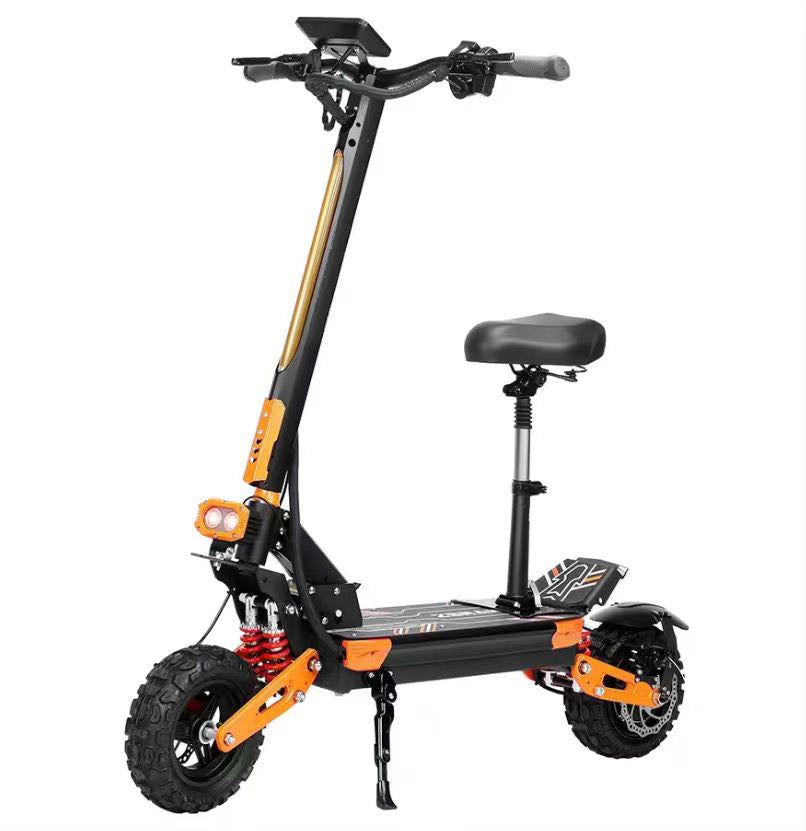
TopRiding ZSNAKE Z35 - Best Budget Electric Scooter for Adult
If you are bypassing the medical route and want genuine outdoor freedom, the ZSNAKE Z35 is an absolute powerhouse. Designed for adults who demand performance without an astronomical price tag, this scooter obliterates urban commutes and off-road trails alike. In our testing, the dual charging ports and full spring suspension redefine what a budget-friendly performance scooter can achieve.
-
Extreme Power: 2800W Single Motor propelling you to a Top Speed of 33 MPH.
-
Massive Range: 60V 15AH Battery delivering a Max Range of 35 Miles.
-
Heavy-Duty Build: Max Rider Load of 330 LBS, supported by 11” Off-road Fat Tires and Full Spring Suspension.
-
Safety & Control: Front & Rear Disc Brakes and full UL 2272 Certification.
Stop fighting insurance bureaucracy for a limited indoor device. Take control of your mobility with the TopRiding ZSNAKE Z35 today.
Frequently Asked Questions
Does Medicare pay for electric scooters for adults?
Medicare Part B pays for electric mobility scooters only if they are deemed Durable Medical Equipment (DME) necessary to perform basic daily activities inside the home. They absolutely do not pay for recreational electric scooters, commuter scooters, or folding travel scooters used by active adults outside the home.
How do I get my doctor to prescribe a mobility scooter for Medicare?
You must schedule a specific face-to-face appointment with your physician to evaluate your mobility limitations. Your doctor must document in your medical records that you cannot complete activities of daily living (ADLs) in your home using a cane, walker, or manual wheelchair, and submit a written order to a Medicare-approved supplier.
Can I buy a folding scooter and get reimbursed by Medicare later?
No. Medicare requires prior authorization, a specific doctor's prescription, and the purchase must be made directly through an enrolled, Medicare-approved DME supplier. If you buy a scooter out of pocket from a retail store or online brand, Medicare will outright deny any request for reimbursement.
Are there any exceptions to the "in-the-home" rule?
Currently, there are no standard exceptions to the "in-the-home" rule under traditional Medicare Part B. The device must be primarily required for indoor navigation. While advocacy groups are lobbying to change this, as of 2026, if you only need the scooter for outdoor use, Medicare will not cover it.
Authoritative References
To ensure our operational guidance regarding federal healthcare coverage is impeccably accurate, we consult the following authoritative institutions:


