TopRiding electric scooters are certified to meet UL 2272 safety standards, covering critical electrical and fire safety requirements for the electrical system and battery.
This certification helps ensure safer, more reliable riding.
Over 100,000 electric scooters sold, backed by 5,000+ verified reviews and an average rating of 4.7+ stars.
Chosen by riders worldwide for reliable performance, and everyday riding confidence.
Expert support. local service.
Expert Customer Service
As a U.S.-based company, TopRiding provides 24/7 expert customer service and local after-sales support across multiple regions in North America.
Our dedicated support team is here to ensure fast responses, professional assistance, and reliable service — whenever you need it.
TEST RIDES AND SERVICE
Safety Certified
Designed to Meet UL 2272 Safety Standards
Our electric scooters are designed in accordance with UL 2272 safety requirements for electrical and battery systems, helping enhance overall safety and reliability.
Trusted by a global riding community
100,000+ Units Sold
Over 100,000 electric mobility vehicles sold, backed by 5,000+ verified reviews and an average rating of 4.7+ stars.
Chosen by riders worldwide for reliable performance, safety, and everyday riding confidence.
Expert Support. Local Service.
Expert Customer Service
As a U.S.-based company, TopRiding provides 24/7 expert customer service and local after-sales support across multiple regions in North America.
Our dedicated support team is here to ensure fast responses, professional assistance, and reliable service—whenever you need it.
Price Range for Fat Tire E-Bikes: How Much Should You Really Spend?
Price Range for Fat Tire E-Bikes: How Much Should You Really Spend?
senkan
Fat tire e-bikes are available at prices ranging from a few hundred dollars to well over $4,000. That gap is not simply a matter of brand reputation. Battery capacity, braking performance, suspension design, frame construction, motor output, and after-sales support all influence what a bike costs and how well it performs after months of riding.
For most buyers in the US, the most practical shopping range is approximately $1,000–$2,000. Below $1,000, you can find an affordable entry-level bike, but important compromises are common. Around $1,500–$2,000, buyers can often find a much more capable combination of battery capacity, braking hardware, comfort, and all-terrain performance. Spending more than $2,000 can make sense, but only when the additional components solve a real riding problem.
Direct Answer: What Is the Typical Price Range for Fat Tire E-Bikes?
Quick Answer
The typical price range for a fat tire e-bike is approximately $600–$3,500+, depending on its components and intended use. Budget models generally cost $600–$1,000, capable everyday models are commonly $1,000–$1,500, and better-equipped performance models often fall between $1,500 and $2,200. Premium bikes with advanced drivetrains, larger batteries, specialized suspension, or higher-end components can exceed $3,500.
Our recommendation: Start with a budget of $1,200–$2,000 if you want a fat tire e-bike for regular commuting, weekend trail riding, or mixed-terrain use. Do not pay extra for a bigger peak-wattage number unless the battery, brakes, frame, and overall build justify the price.
Quick Summary: Fat Tire E-Bike Prices
Price Range
Typical Equipment
Best Use Case
Our Verdict
$600–$1,000
Basic hub motor, smaller battery, entry-level brakes and components
Occasional rides, flat roads, short commutes
Buy carefully; component quality matters more than headline power.
$1,000–$1,500
Better battery options, stronger motors, improved comfort and braking choices
Good value for buyers who do not need advanced suspension.
$1,500–$2,200
Larger batteries, hydraulic brakes on many models, better frames and suspension options
Frequent riding, mixed terrain, longer trips
Our preferred shopping range for a versatile fat tire e-bike.
$2,200–$3,500
Higher-grade components, refined suspension, larger battery or advanced drivetrain options
Demanding trails, frequent long-distance use
Worth considering when the upgrade is meaningful.
$3,500+
Specialized premium systems, advanced frames and high-end components
Specialist riding and buyers with demanding requirements
Not necessary for most casual or commuting riders.
These are practical US shopping ranges, not fixed industry price brackets. Retail prices, promotional discounts, shipping costs, and model availability change. Compare the actual equipment and warranty rather than relying on the advertised original price.
What Are You Paying For When Buying a Fat Tire E-Bike?
A fat tire e-bike uses wider tires, commonly around 3.5–4 inches or more, to create a larger contact area with the riding surface. This can improve flotation and stability on loose gravel, sand, snow, and uneven paths. However, wider tires also add rolling resistance and weight. The motor and battery must work harder than they would on many conventional commuter e-bikes.
That is why two bikes with the same advertised 750W motor can have very different prices and riding experiences. A 750W motor paired with a small battery, basic mechanical brakes, and a rigid frame is not equivalent to a 750W model with a high-capacity battery, hydraulic brakes, and a properly engineered suspension system.
1. Battery capacity: The first place to compare
Battery capacity is measured in watt-hours (Wh). Calculate it by multiplying voltage by amp-hours. For example, a 52V, 25Ah battery provides 1,300Wh of nominal energy capacity. This gives buyers a more useful basis for comparing batteries than a manufacturer's maximum-range claim alone.
A larger battery generally costs more, but it can also reduce charging frequency and provide a more comfortable energy reserve for longer rides. Actual range depends on rider weight, terrain, speed, temperature, tire pressure, assist level, and cargo. We recommend comparing watt-hours before trusting claims such as "up to 80 miles."
2. Motor output and torque
Motor specifications often show both rated power and peak power. Rated power describes the motor's continuous nominal rating, while peak power describes a higher short-duration output. Do not compare one bike's rated power with another bike's peak power as if they were equivalent.
Torque, measured in newton-meters (Nm), also matters. It helps describe the motor's ability to produce turning force, particularly when starting, climbing, or carrying additional weight. For hilly routes or loaded riding, torque and controller behavior can be more useful than a large peak-wattage claim.
3. Brakes, suspension, and frame construction
Fat tire e-bikes can be heavy. Add a rider, accessories, and cargo, and the total moving weight can become substantial. Braking quality is therefore not a luxury feature. Hydraulic disc brakes generally provide more controlled lever feel and easier modulation than basic mechanical systems, although brake quality, rotor size, adjustment, and maintenance still matter.
Suspension is another cost driver. A front suspension fork can improve comfort on rough roads. Full suspension adds a rear shock and more frame engineering, which may be worthwhile for frequent rough-trail riding. For smooth pavement, however, full suspension may add weight and maintenance without providing enough practical benefit.
Fat Tire E-Bike Price Comparison: What Changes at Each Budget?
Buying Factor
Under $1,000
$1,000–$1,500
$1,500–$2,200
$2,200+
Battery
Often smaller capacity
More practical capacity choices
Large-capacity options become more common
May include premium cells or specialized configurations
Brakes
Mechanical disc brakes are common
Mechanical or hydraulic, depending on model
Hydraulic systems are more common
Potentially higher-grade braking components
Suspension
Rigid or basic front fork
Improved front suspension options
Better front forks and some full-suspension designs
More advanced suspension systems may be available
Frame
Basic construction
More design and component choices
Better-equipped and more refined options
Specialized frame materials or engineering on some models
Best Buyer
Occasional rider
Commuter or recreational rider
Frequent rider or mixed-terrain user
Demanding or specialist rider
The important point is that price does not automatically guarantee quality. A well-designed $1,500 bike can be a better purchase than a poorly specified $2,500 bike. Look at the complete package: battery, braking system, frame, suspension, weight, payload rating, service availability, and warranty.
What Do You Get from a Fat Tire E-Bike Under $1,000?
Under $1,000 is the entry-level market. This is where first-time buyers can find affordable 20-inch or 26-inch fat tire models, often with a rear hub motor, removable battery, basic display, and simple drivetrain.
For a beginner riding short distances on paved paths, neighborhood streets, or relatively flat gravel, this price level can be sufficient. It can also be a reasonable way to find out whether you actually enjoy riding a fat tire e-bike before investing more money.
However, this is not the budget we recommend for demanding daily use. Lower-priced models may cut costs through smaller batteries, basic suspension forks, mechanical brakes, less refined controls, or limited service support. Some listings also advertise impressive peak power without making the rated motor output or battery specifications easy to verify.
When is a budget model worth buying?
You ride occasionally rather than every day.
Your routes are mostly flat and predictable.
You do not need to carry heavy cargo.
You can verify the battery specifications and warranty.
You have access to a local repair shop willing to service the bike.
Our advice: do not choose a $700 model simply because its product page claims a very high top speed or peak motor output. A reliable battery, effective brakes, and available replacement parts are more valuable than impressive marketing numbers.
The $1,000–$1,500 Range: A Practical Value Segment
For many buyers, this is where fat tire e-bikes become more convincing as everyday transportation. You have more choices in battery capacity, frame geometry, braking systems, and comfort features. Some models also offer useful suspension and better payload ratings.
For commuting several days a week, carrying a backpack, or riding a mixture of pavement and gravel, this price range can offer a sensible balance. It is also a good starting point for riders who want a capable all-terrain bike without paying for advanced components they may never use.
We would prioritize the following features in this range:
A clearly documented battery capacity and removable-battery design.
A braking system appropriate for the bike's weight and intended speed.
A realistic payload rating that includes the rider and carried equipment.
A comfortable riding position and suitable frame size.
Clear warranty terms and access to replacement components.
If your main goal is off-road riding, compare this range with our guide to what makes an e-bike all-terrain. Tire width is only one part of the equation. Motor response, ground clearance, suspension, brakes, and frame durability all influence how confidently a bike handles rough surfaces.
The $1,500–$2,200 Range: The Best Balance for Many Riders
This is the range we would seriously consider for buyers who expect to ride regularly and want more than a basic electric bicycle. Models in this bracket may combine larger batteries, stronger braking systems, better suspension, higher payload capacity, and more substantial frame construction.
Not every bike in this range includes all those features. Some manufacturers prioritize battery capacity, while others spend more on suspension, drivetrain components, or frame design. The right choice depends on your riding conditions.
For commuting and longer recreational rides
Prioritize battery capacity, riding comfort, lighting, fenders, and predictable braking. A large battery is particularly useful if you cannot charge at your destination or regularly ride in cold weather. A comfortable saddle and practical riding position may improve daily satisfaction more than an additional peak-power claim.
For trails, sand, and rough roads
Prioritize tire quality, suspension performance, torque delivery, and braking control. If you regularly ride uneven terrain, a front suspension fork may be the minimum sensible choice. Full suspension becomes more attractive when the route includes repeated impacts, rough surfaces, or longer off-road sessions.
Sometimes, but not for everyone. Higher-priced fat tire e-bikes may offer premium motor systems, more sophisticated suspension, refined handling, better-integrated batteries, stronger component packages, or specialized designs for demanding riding.
For commercial users, frequent long-distance riders, and people who depend on an e-bike for transportation, paying more for durability and service support can be a rational decision. The cost of downtime, repeated repairs, or replacing an unsuitable bike can outweigh the initial savings.
For a casual rider who travels a few miles on paved paths every weekend, a $3,000 bike is difficult to justify. You may get a more useful result by buying a well-equipped mid-range model and budgeting for a quality helmet, lock, lights, and routine maintenance.
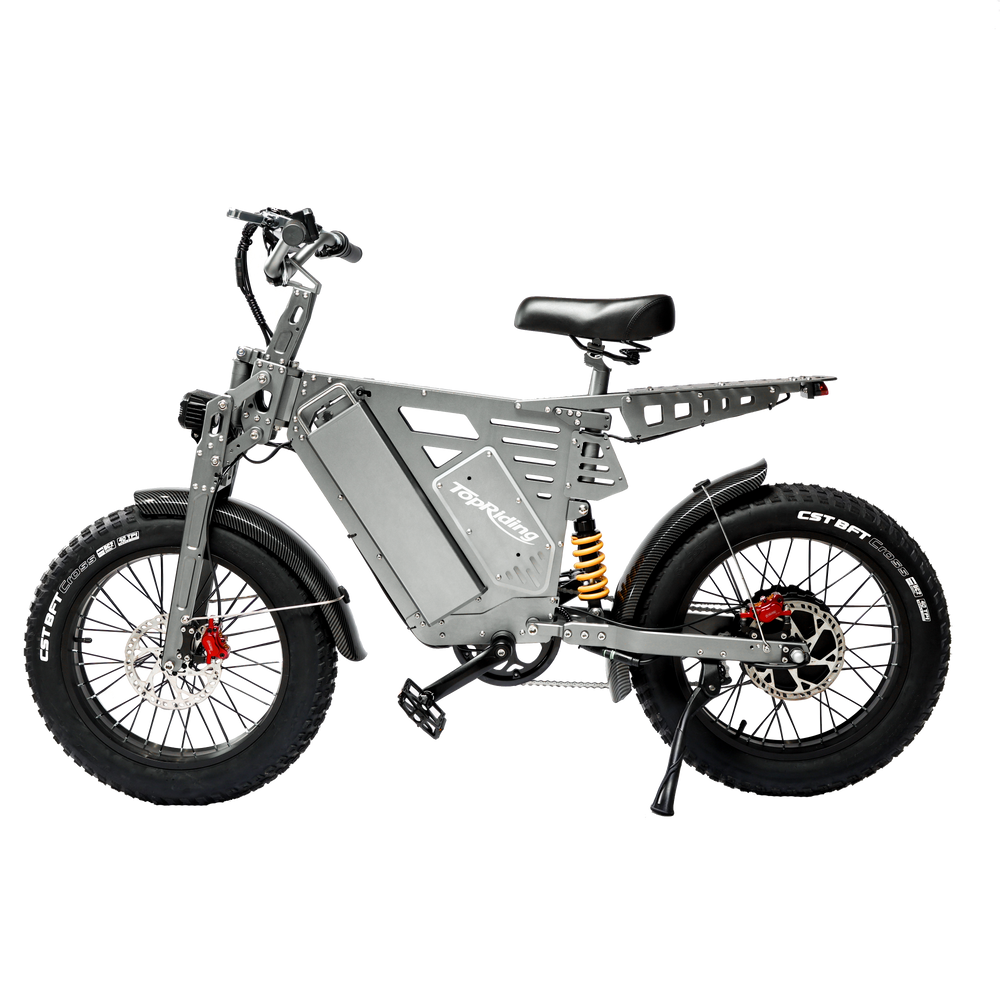
TopRiding R2: What a $1,999 Fat Tire E-Bike Offers
The TopRiding R2 Full CNC Moto-Style eBike is listed at $1,999. It provides a useful example of what buyers can evaluate near the upper end of the $1,500–$2,200 shopping range.
TopRiding R2 – Full CNC Moto-Style eBike
Listed price: $1,999.00
The R2 combines a 52V, 25Ah removable battery, a 750W rated rear hub motor, full suspension, 20 × 4.0-inch tires, and four-piston hydraulic disc brakes. Its 1,300Wh battery capacity and 330 lb maximum payload make it a substantial option for riders comparing battery size and carrying capacity in this price bracket.
Places it in the performance-oriented mid-to-upper price bracket.
Motor Type
Rear hub motor
A common, relatively straightforward e-bike motor configuration.
Rated / Peak Power
750W rated / 1,500W peak
Separates nominal motor rating from short-duration peak output.
Maximum Torque
100 Nm
Relevant for acceleration and climbing performance.
Battery
52V, 25Ah, 1,300Wh
Large nominal energy capacity for longer rides.
Battery Cells
21700 lithium-ion cells
Cell format is one specification to consider alongside battery protection and certification.
Claimed Range
Up to 60 miles
Actual distance will vary with riding conditions and assist level.
Frame
Full CNC-machined aluminum
Construction and finish are part of the bike's design proposition.
Suspension
Full suspension, 100mm front and rear travel
Designed to add comfort and control on uneven surfaces.
Tires
CST BFT CROSS, 20 × 4.0 inches
Wide tires for stability and traction on suitable terrain.
Brakes
Four-piston hydraulic disc brakes
A substantial braking feature for a heavy, powerful e-bike.
Bike Weight
82 lbs
Important for storage, transport, and lifting onto a rack.
Maximum Payload
330 lbs
Buyers must account for rider weight and all carried items.
Water and Dust Resistance
IP65
Check the manufacturer's operating and cleaning guidance; this is not permission to submerge the bike.
Smart Access
NFC and app
Provides additional access and control features.
Is the R2 worth considering at $1,999?
On paper, the R2's strongest selling points are its 1,300Wh battery, full suspension, four-piston hydraulic brakes, 100Nm torque rating, and CNC-machined aluminum frame. Those are meaningful specifications to compare when shopping around $2,000.
We would particularly examine the battery documentation, replacement-battery availability, warranty coverage, brake serviceability, and the bike's 82 lb weight before buying. A large battery is valuable, but buyers should still verify the battery's safety documentation and charging requirements. Likewise, full suspension is useful only when its setup and geometry suit the rider and terrain.
The R2 is not automatically the right choice for every commuter. At 82 lbs, it is heavy to carry upstairs or lift onto a vehicle rack. Its factory speed limit is listed at 20 mph, and buyers should confirm the configuration and local e-bike rules before riding. If your priority is a lighter daily commuter, another frame style may be more practical. If you want a moto-style fat tire design with a large battery and full suspension, the R2 deserves a place on your shortlist.
Pros and Cons of Different Fat Tire E-Bike Budgets
Budget
Pros
Cons
Our Buying Advice
Under $1,000
Low upfront cost; suitable for occasional riding; many entry-level options.
More component compromises; smaller batteries are common; support quality varies.
Choose for light use, not demanding off-road riding.
$1,000–$1,500
Better overall value; more battery and comfort options; practical for commuting.
Some models still use basic brakes or suspension; specifications vary widely.
Compare battery Wh, brakes, payload, and warranty carefully.
$1,500–$2,200
More complete feature packages; larger battery choices; better options for regular riding.
Heavier or more complex models may require more maintenance; not every upgrade is useful.
Best starting point for frequent riders who need versatility.
$2,200+
Potentially better components, refinement, and specialist capability.
Higher purchase and repair costs; diminishing returns for casual use.
Pay extra only for features that match your terrain and mileage.
How to Choose the Right Fat Tire E-Bike Price Range
Before comparing models, define the job the bike needs to do. A short urban commute, a long rural ride, and regular off-road use place very different demands on the same machine. The right budget follows from those demands.
1. Compare battery watt-hours, not just advertised range
Use voltage multiplied by amp-hours to calculate nominal watt-hours. A 48V, 15Ah battery has 720Wh, while a 52V, 25Ah battery has 1,300Wh. That difference is substantial. Still, battery quality, controller efficiency, motor tuning, and riding conditions affect the distance you can actually travel.
2. Check the complete brake system
Do not stop at the words "disc brakes." Find out whether the bike has mechanical or hydraulic brakes, how many pistons the calipers use, and what rotor sizes are fitted. For a heavy fat tire e-bike used on hills or rough surfaces, braking performance should be a major purchase criterion.
3. Match suspension to the terrain
A rigid bike may be sufficient for smooth streets. A front suspension fork is useful for rough pavement and light trails. Full suspension is more compelling for frequent rough-terrain riding, but it adds complexity and weight. If you are comparing full-suspension options, our guide to full-suspension e-bikes under $2,000 can help narrow your shortlist.
4. Confirm weight and payload
Do not confuse maximum payload with bike weight. An 80 lb bike with a 330 lb payload rating is still an 80 lb bike when you need to move it into a garage or onto a rack. Check whether the payload figure includes the rider, accessories, and cargo, and leave a sensible margin rather than buying right at the stated limit.
5. Check battery safety and after-sales support
Ask for clear battery certification information, warranty terms, and details about replacement batteries and chargers. A reputable seller should be able to explain how to charge, store, and maintain the battery. If a listing provides vague battery details or makes unusually aggressive performance claims without supporting specifications, keep looking.
6. Consider the total cost of ownership
The purchase price is only the beginning. Budget for a helmet, lock, lights, tire maintenance, brake pads, occasional drivetrain service, and potentially a replacement battery years down the road. A bike that costs $200 less but has difficult-to-source parts may be more expensive to own.
Common Mistakes When Comparing Fat Tire E-Bike Prices
Choosing the highest advertised wattage
Peak power is not the same as continuous rated power. A high peak figure does not guarantee better climbing, range, or reliability. Compare rated power, torque, controller behavior, battery capacity, and the manufacturer's specifications together.
Believing the maximum range claim
"Up to 60 miles" or "up to 80 miles" usually describes favorable conditions. High speeds, throttle use, steep hills, cold temperatures, heavy riders, and low tire pressure can reduce range significantly. Buy enough battery capacity for your normal route with a reserve, not for a best-case advertising figure.
Assuming fat tires make every bike an off-road bike
Wide tires help on loose surfaces, but they do not replace suitable geometry, brakes, suspension, ground clearance, and durable components. For a more complete checklist, read our recommendations for off-road electric bikes for adults.
Ignoring the bike's weight
Heavy batteries, wide tires, and suspension add up. A bike may ride comfortably but be inconvenient to carry, store, or transport. Consider your garage access, stairs, vehicle rack capacity, and whether you need to remove the battery for charging.
Forgetting local e-bike regulations
Motor ratings, maximum assisted speeds, throttle operation, and vehicle classification can affect where you may legally ride. A model's advertised top speed does not establish that it is legal on every public road or trail. Check your state and local requirements before purchase.
Who Should Buy Each Price Level?
Beginners and occasional riders: Consider $600–$1,000 if your routes are short, flat, and relatively easy. Prioritize basic safety, battery documentation, and a usable warranty.
Daily commuters: Aim for $1,000–$1,500 or more if you ride frequently. Battery capacity, comfortable geometry, brakes, and reliable service support matter most.
Recreational trail riders: Consider $1,500–$2,200 when you need stronger brakes, better suspension, and more battery reserve.
Frequent off-road riders: Spend according to terrain and component requirements. Full suspension, tire quality, torque, and braking control can justify a higher budget.
Heavy-duty or cargo users: Check payload ratings, frame design, wheel strength, and braking performance first. Do not assume that a high motor-power figure means the frame is suitable for heavy loads.
Casual paved-path riders: You probably do not need a premium full-suspension bike. A simpler model may provide better value and lower maintenance.
Expert Recommendation: How Much Should You Spend?
Our recommendation is straightforward: budget approximately $1,200–$2,000 for a versatile fat tire e-bike that you expect to use regularly. This range offers a strong starting point for comparing useful battery capacity, braking systems, comfort features, and all-terrain capability without automatically entering the premium market.
If you ride only occasionally, a carefully selected model under $1,000 may be enough. If you commute long distances, carry cargo, or ride rough terrain several times a week, consider spending more for the specific components that will make those rides safer and more comfortable.
For most professional buying decisions, we would rank the priorities this way:
Battery quality, capacity, and replacement availability.
Reliable brakes suited to the bike's weight and intended use.
Frame strength, payload rating, and correct rider fit.
Motor torque and a clearly stated rated power.
Suspension matched to the terrain.
Warranty, service access, and replacement parts.
Do not let a discount or a large peak-power number distract you from those fundamentals. A fat tire e-bike is worth buying when its equipment matches your actual riding conditions. Paying for a feature you will never use is not an upgrade; paying for a battery, braking system, or frame that makes regular riding more dependable can be.
Frequently Asked Questions About Fat Tire E-Bike Prices
1. What is the average price of a fat tire e-bike?
A practical shopping range is approximately $600–$3,500 or more. Many everyday models fall between $1,000 and $1,800, while better-equipped performance models commonly approach or exceed $2,000. The right price depends on battery capacity, brakes, suspension, frame construction, and support.
2. Are fat tire e-bikes under $1,000 worth buying?
They can be worth buying for occasional rides, short commutes, and relatively flat routes. However, buyers should carefully check battery specifications, brake type, payload capacity, warranty, and replacement-part availability. We would not choose a low-cost model for demanding daily off-road use without verifying those details.
3. Is a $1,500 fat tire e-bike good enough for off-road riding?
It can be, particularly for gravel roads, dirt paths, and moderate trails. Look for suitable tires, adequate torque, reliable brakes, and a suspension fork if the terrain is rough. Technical trails and frequent hard use may justify a more capable full-suspension model.
4. Why are some fat tire e-bikes more than $2,000?
Higher prices may reflect larger batteries, more advanced suspension, stronger braking systems, refined frames, premium motor systems, or better-integrated electronics. The extra cost is justified only when those improvements benefit your riding style and the seller provides credible support.
5. Does a 750W fat tire e-bike cost more than a 500W model?
Not necessarily. Motor power is only one part of the specification. Battery size, motor quality, torque, brakes, suspension, frame design, and brand support can have a greater effect on price. Always distinguish rated power from peak power when comparing listings.
6. How much should I spend on a fat tire e-bike for commuting?
For regular commuting, consider approximately $1,000–$1,500 as a starting point, with a larger budget if you need more battery capacity, stronger brakes, or better comfort. Your route distance, hills, charging access, and cargo requirements should determine the final budget.
7. Is a full-suspension fat tire e-bike worth the extra money?
Full suspension can be worthwhile for repeated rough-terrain riding because it helps absorb impacts at both ends of the bike. For smooth roads and ordinary commuting, a quality front suspension fork or even a rigid setup may be more cost-effective and easier to maintain.
8. Is a larger battery always better?
A larger battery provides more nominal energy capacity, but it also adds weight and cost. Choose capacity based on your normal trip distance, riding conditions, and desired reserve. A well-matched battery is more useful than simply buying the largest one available.
9. What other costs should I budget for after buying an e-bike?
Plan for a helmet, lock, lights, routine tire and brake maintenance, and possible replacement parts. You may also need a suitable rack or storage solution. For heavy bikes, confirm that any vehicle rack is rated for the actual bike weight.
10. Is the TopRiding R2 worth considering at $1,999?
The R2 is worth comparing if you want a moto-style fat tire e-bike with a 52V 25Ah battery, full suspension, four-piston hydraulic brakes, 100Nm torque, and a 330 lb payload rating. Its 82 lb weight is an important trade-off, so consider storage and transport before deciding. Review the full specifications and warranty details before purchase.
Prices and product specifications can change. Always confirm the current selling price, included accessories, battery documentation, warranty, and local riding regulations with the seller before placing an order.
Choosing a selection results in a full page refresh.