TopRiding electric scooters are certified to meet UL 2272 safety standards, covering critical electrical and fire safety requirements for the electrical system and battery.
This certification helps ensure safer, more reliable riding.
Over 100,000 electric scooters sold, backed by 5,000+ verified reviews and an average rating of 4.7+ stars.
Chosen by riders worldwide for reliable performance, and everyday riding confidence.
Expert support. local service.
Expert Customer Service
As a U.S.-based company, TopRiding provides 24/7 expert customer service and local after-sales support across multiple regions in North America.
Our dedicated support team is here to ensure fast responses, professional assistance, and reliable service — whenever you need it.
TEST RIDES AND SERVICE
Safety Certified
Designed to Meet UL 2272 Safety Standards
Our electric scooters are designed in accordance with UL 2272 safety requirements for electrical and battery systems, helping enhance overall safety and reliability.
Trusted by a global riding community
100,000+ Units Sold
Over 100,000 electric mobility vehicles sold, backed by 5,000+ verified reviews and an average rating of 4.7+ stars.
Chosen by riders worldwide for reliable performance, safety, and everyday riding confidence.
Expert Support. Local Service.
Expert Customer Service
As a U.S.-based company, TopRiding provides 24/7 expert customer service and local after-sales support across multiple regions in North America.
Our dedicated support team is here to ensure fast responses, professional assistance, and reliable service—whenever you need it.
6 Best 1000 Watt Electric Bike Options: What to Buy for Power, Range, and Off-Road Riding
6 Best 1000 Watt Electric Bike Options: What to Buy for Power, Range, and Off-Road Riding
senkan
A 1000 watt electric bike is attractive for one reason: riders want more assistance when climbing hills, carrying extra weight, riding over loose surfaces, or covering demanding routes. But choosing the right high-power e-bike is not as simple as buying the model with the biggest motor number. Motor rating, peak output, battery capacity, torque, gearing, suspension, brakes, and local riding laws all affect whether a bike is actually worth the money.
Our position is straightforward: buy a 1000W-class electric bike only when your terrain and riding needs justify the additional power. For mixed commuting and recreational riding, a well-designed 750W rated bike with a strong battery and good torque can be a better purchase than a poorly balanced bike marketed with a larger peak-wattage figure. For serious off-road use, prioritize the complete drivetrain and chassis rather than motor power alone.
Quick Answer: Which Is the Best 1000 Watt Electric Bike?
The best 1000 watt electric bike depends on the job. For steep technical climbs, look for a high-torque mid-drive motor. For loose trails and sand, a fat-tire hub-drive or dual-motor configuration may be more suitable. For rough terrain, full suspension and powerful hydraulic brakes matter as much as motor output. For long-distance riding, prioritize battery watt-hours over advertised maximum range.
One important specification distinction: the TopRiding R2 featured in this guide is rated at 750W with 1500W peak output. It is not a 1000W continuous-rated motor. We include it as a premium moto-style alternative for riders who value its 52V 25Ah battery, full CNC-machined frame, full suspension, and 100Nm torque specification.
Important buying and legal note: A bike advertised as 1000W is not automatically a legally classified e-bike in every US state. Federal low-speed electric bicycle rules use a motor rating below 750W, and California's electric bicycle definition also has a 750W limit. A vehicle exceeding those limits may fall under a different vehicle category, depending on its design and use. Check the rules where you intend to ride before purchasing or modifying a high-power model.
What Is a 1000 Watt Electric Bike?
A 1000 watt electric bike uses an electric motor with a stated power rating of 1000 watts. In the market, this specification is commonly associated with fat-tire e-bikes, hunting bikes, high-power commuter models, full-suspension off-road bikes, and utility-oriented electric bicycles.
However, the phrase "1000W e-bike" is not always used consistently. Some brands advertise continuous rated motor power, while others emphasize peak output. A bike with a 750W rated motor and 1500W peak output is not the same thing as a bike with a 1000W continuous-rated motor. Buyers should compare the actual motor label and manufacturer's technical documentation rather than relying on the headline number.
High-power models are generally designed for riders who need stronger acceleration, more assistance under load, or improved climbing capability. They can be useful on private land, designated off-road areas, and certain permitted routes. They are not automatically faster, safer, or better for everyday commuting.
Rated Power vs. Peak Power: What Matters More?
This is the first specification we recommend checking. Rated power describes the motor's stated continuous operating output under the manufacturer's rating method. Peak power refers to a higher output that may be available for a limited period, depending on the controller, battery, temperature, and operating conditions.
For example, the TopRiding R2 lists a 750W rated rear hub motor and 1500W peak power. That makes it a 750W rated motor with a higher peak output, not a 1000W rated motor. The distinction matters for comparing performance and determining whether a vehicle fits the legal definition of an electric bicycle in a particular jurisdiction.
Why wattage alone does not tell you how powerful a bike feels
Torque: Measured in newton-meters (Nm), torque helps describe the motor's ability to deliver turning force. It is particularly relevant when starting on a hill or moving a heavy load.
Controller current: The controller manages electrical power delivered to the motor. A motor's advertised peak output depends partly on the controller and battery configuration.
Battery voltage: Voltage is one part of the electrical system. A higher-voltage battery can support a different performance configuration, but voltage alone does not prove greater real-world range or climbing ability.
Gearing and motor type: Mid-drive motors use the bicycle's gearing, while hub motors drive the wheel directly. Their strengths differ depending on terrain and riding style.
Heat management: Sustained high loads can heat a motor and controller. A headline peak figure does not tell you how long that output can be maintained.
From our experience reviewing e-bike specifications, the strongest purchase is rarely the bike with the highest wattage printed on the product page. It is the bike whose motor, battery, tires, brakes, and frame are designed to work together.
6 Best 1000 Watt Electric Bike Options for Different Riding Needs
The six options below are buying categories rather than six independently tested product rankings. This distinction is important: motor configurations and product specifications vary between model years, and we will not label a bike as a verified 1000W model without a matching manufacturer specification. Use these recommendations to identify the configuration that suits your route, then verify the exact model's rated motor power, battery, and legal classification before ordering.
1. 1000W Fat-Tire Hub-Drive E-Bike: Best for Mixed Terrain
Best for: Riders who use dirt roads, gravel, beach access routes where permitted, and mixed recreational terrain.
A fat-tire hub-drive e-bike is one of the most recognizable high-power configurations. Wide tires provide a larger contact patch and can be run at pressures suited to the surface and tire manufacturer's recommendations. A rear hub motor keeps the drivetrain mechanically straightforward and can deliver strong assistance without relying on the bicycle's gear selection.
For beginners moving from a regular bicycle to a powerful e-bike, a fat-tire model can feel stable at low speeds, but its weight and wide tires can make it less agile than a conventional mountain bike. It is also important to distinguish traction from suspension: wide tires can help absorb small surface irregularities, but they do not replace a proper suspension system on rough trails.
Our recommendation: Choose this configuration for mixed-surface recreational riding. Check tire quality, puncture protection, hydraulic brakes, and battery capacity before paying extra for a larger motor rating. For more detail, read our analysis of whether fat-tire e-bikes are better.
2. 1000W Mid-Drive E-Bike: Best for Steep Climbs
Best for: Riders who regularly climb steep trails, ride technical terrain, or carry loads over changing gradients.
A mid-drive motor is mounted near the crankset and drives the rear wheel through the bicycle's chain and gearing. This allows the motor to benefit from gear selection. On a steep climb, a suitable low gear can help keep the motor operating in a more useful range.
For heavy-duty applications, we generally prefer evaluating torque, gearing, thermal management, and serviceability before choosing a mid-drive bike. A powerful mid-drive system can place additional stress on the chain, cassette, and drivetrain, so replacement-part availability matters.
The trade-off is cost and maintenance. Mid-drive systems can be more mechanically demanding than hub-drive designs, and drivetrain wear can become a real ownership expense for riders who frequently use high assistance. If your riding is mostly flat roads and paved paths, you may not benefit enough to justify the premium.
3. Dual-Motor 1000W-Class E-Bike: Best for Loose Surfaces and Traction
Best for: Experienced riders who need additional traction on loose surfaces or private off-road routes.
Dual-motor electric bikes use a motor at each wheel, often with independent front and rear drive. Depending on the design, this can improve traction when one wheel loses grip. It can be useful in certain off-road conditions, but it also increases system complexity and electrical demand.
Do not assume that two motors automatically make a bike safer or better at climbing. Weight distribution, tire compound, controller programming, battery capacity, and braking performance all influence the result. A dual-motor bike can consume battery energy quickly when both motors are under heavy load.
Our recommendation: Consider dual-motor drive only when the terrain justifies it. For ordinary commuting, it is usually unnecessary weight and complexity. Verify whether the advertised wattage is per motor or combined output; a "1000W" label can describe very different configurations.
4. Full-Suspension High-Power E-Bike: Best for Rough Trails
Best for: Riders who encounter rocks, roots, uneven access roads, and rough off-road surfaces.
Full suspension means the bike has front and rear suspension. On rough terrain, this can improve comfort, help the tires maintain contact with the ground, and reduce the amount of impact transferred to the rider. It is particularly relevant when a heavier e-bike is used on uneven trails.
For off-road riding, we recommend looking beyond the presence of a rear shock. Check suspension travel, fork construction, shock adjustability, frame design, and whether replacement components are available. A low-quality suspension system can add weight without delivering the control expected from a genuine trail-oriented setup.
Full suspension also increases purchase price and maintenance requirements. If you ride mainly on paved roads or smooth gravel, a hardtail may provide better value. Compare the options in our full-suspension e-bike buying guide.
5. Long-Range 1000W-Class E-Bike: Best for Extended Rides
Best for: Riders who travel longer distances, explore remote routes, or want fewer charging stops.
For long-distance use, battery capacity is more important than the motor's headline wattage. Battery energy is measured in watt-hours (Wh), calculated by multiplying voltage by amp-hours. A 52V 20Ah battery, for example, has a nominal energy capacity of 1040Wh.
Real-world range depends on rider weight, cargo, speed, terrain, tire pressure, temperature, wind, assist level, and battery condition. A manufacturer may publish an "up to" range measured under favorable conditions. Treat that as a best-case reference, not a daily planning guarantee.
For practical buying decisions, compare watt-hours, battery cell information, removability, charger specifications, and replacement availability. If you regularly ride far from charging access, plan your route around a conservative range estimate rather than the maximum advertised figure.
6. Utility or Hunting-Style High-Power E-Bike: Best for Gear and Equipment
Best for: Riders who carry outdoor equipment, work supplies, or hunting gear on permitted roads and private land.
Utility and hunting-style e-bikes often emphasize payload capacity, wide tires, frame strength, accessory mounting, and battery capacity. Some include racks, cargo attachments, or a frame geometry intended for equipment transport. These features may be more valuable than a small increase in motor output.
Before buying, calculate the total load: rider, clothing, backpack, tools, cargo, and accessories. Check the manufacturer's maximum payload rating and understand whether it includes the rider. A high payload figure does not mean the bike will perform well at maximum load on every gradient.
For outdoor use, also check tire puncture resistance, brake performance, lighting, water resistance, and how easily the battery can be removed and charged. Our guide to hunting e-bikes under $2,000 covers practical considerations for this category.
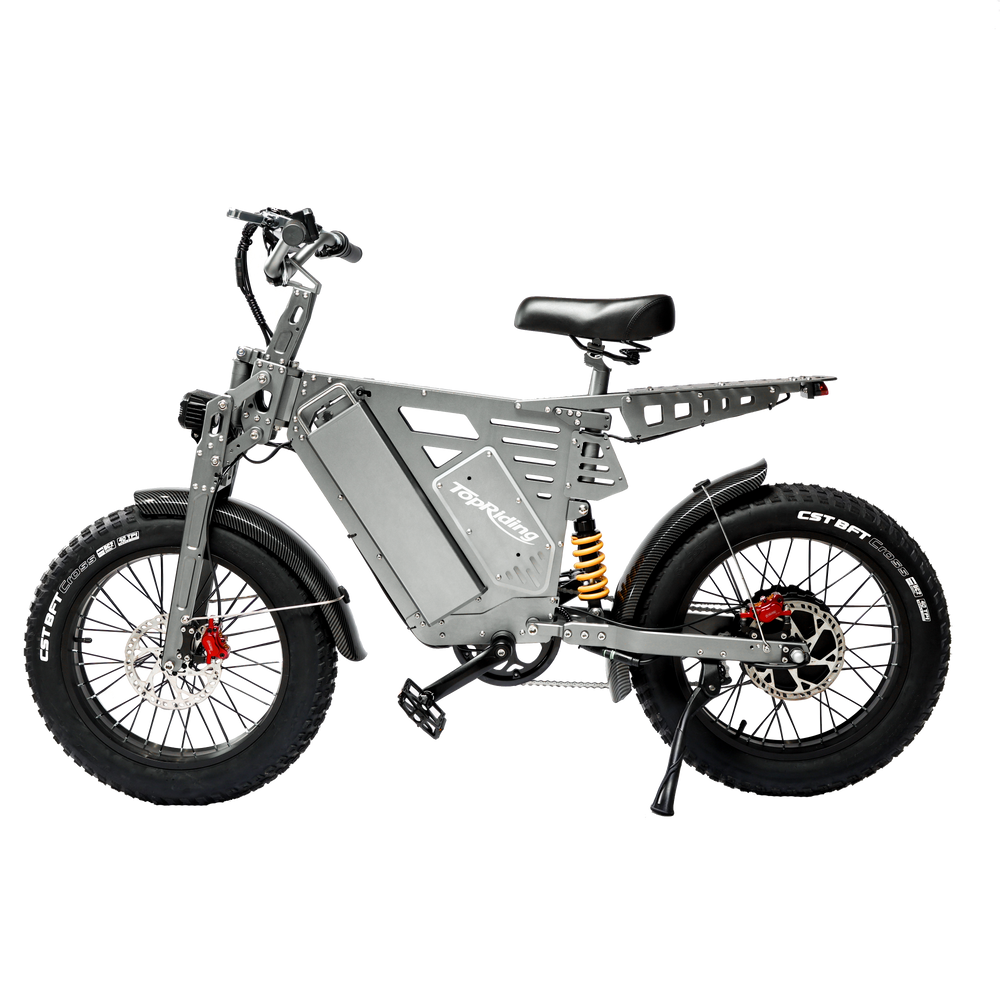
TopRiding R2: A High-Spec Moto-Style Alternative to a 1000W Rated E-Bike
The TopRiding R2 deserves consideration for riders who want a powerful moto-style platform with a substantial battery, full suspension, and a precision-machined frame. However, we need to be precise about its motor specification: the R2 is listed with a 750W rated rear hub motor and 1500W peak power. It should not be described as a 1000W continuous-rated e-bike.
TopRiding R2 – Full CNC Moto-Style eBike
$1,999.00
The R2 combines a 52V 25Ah lithium-ion battery with a 750W rated rear hub motor, 1500W peak output, and listed maximum torque of 100Nm. Its 1300Wh battery capacity and removable battery design make it an interesting option for riders who prioritize stored energy and practical charging flexibility.
The frame is full CNC-machined aluminum with an anodized finish. The bike also features full suspension, a custom four-link front fork with 100mm travel, a rear coil spring shock with 100mm travel, 20 × 4.0-inch CST BFT CROSS tires, and four-piston hydraulic disc brakes.
Key specifications:
Motor: 750W rated rear hub motor, 1500W peak
Maximum listed torque: 100Nm
Battery: 52V 25Ah, 1300Wh, removable lithium-ion
Listed range: up to 60 miles
Factory speed limit: 20 MPH
Suspension: full suspension, 100mm front and rear travel
Brakes: four-piston hydraulic disc brakes
Tires: 20 × 4.0 inches
Bike weight: 82 lbs
Maximum payload: 330 lbs
Water and dust resistance: IP65
Smart access: NFC and app
Who should consider it? Riders who want a distinctive moto-style design, a large 1300Wh battery, full suspension, and strong listed torque. Its 82 lb weight means it is not an ideal choice if you frequently need to carry the bike upstairs or lift it onto a vehicle rack.
Our buying judgment: The R2 is worth comparing if you value its battery, frame construction, and suspension package more than having a 1000W rated motor. If a true 1000W continuous rating is a non-negotiable requirement, ask the seller for the motor nameplate and technical documentation before treating it as a match.
Comparison Table: Which 1000W-Class E-Bike Configuration Is Best?
This comparison focuses on the intended riding application. It does not imply that every bike in each category has exactly 1000W of rated motor power. Confirm the exact model specifications before purchasing.
Configuration
Best Use
Main Advantage
Main Trade-Off
What to Prioritize
Fat-tire hub drive
Mixed terrain and recreational riding
Simple drive layout and wide tire options
Can be heavy and less agile
Tires, torque, battery, brakes
Mid-drive
Steep climbs and technical trails
Uses bicycle gearing
Higher drivetrain wear and cost
Torque, gearing, service support
Dual motor
Loose surfaces and demanding private routes
Potentially improved traction
Higher energy use and complexity
Combined vs. per-motor rating, controller, battery
Full suspension
Rough trails and uneven access roads
More control and comfort over impacts
More weight and maintenance
Suspension quality, frame, brakes
Long-range setup
Extended rides and remote routes
More stored battery energy
Large batteries add cost and weight
Wh capacity, cells, charging, replacement
Utility or hunting style
Carrying gear and outdoor equipment
Payload and accessory flexibility
Load reduces range and handling
Payload rating, racks, tire durability
Quick Summary: Our Recommended Buying Priorities
Your Riding Need
Best Option to Investigate
Our Advice
Daily mixed-surface riding
Fat-tire hub-drive e-bike
Choose balanced handling and reliable brakes over maximum peak wattage.
Steep and technical climbs
Mid-drive e-bike
Compare torque, gearing, and motor thermal performance.
Loose terrain and traction
Dual-motor model
Verify the combined power rating and check battery capacity carefully.
Rough off-road trails
Full-suspension model
Inspect suspension quality and braking components.
Long-distance rides
Large-battery configuration
Compare Wh capacity, not just advertised maximum range.
Outdoor gear and cargo
Utility or hunting-style model
Calculate total payload and consider loaded handling.
Moto-style design and large battery
TopRiding R2
Consider its 750W rated / 1500W peak configuration as an alternative, not a 1000W rated bike.
Benefits and Limitations of a 1000 Watt Electric Bike
Benefits
More assistance potential: A properly configured high-power motor can provide stronger assistance under demanding conditions than a lower-output system.
Useful for hills and heavy loads: High torque and a suitable drivetrain can make climbing and carrying equipment more manageable.
More configuration choices: Buyers can choose from fat-tire, mid-drive, dual-motor, full-suspension, and utility designs.
Suitable for demanding private-property riding: Where permitted, high-output systems can be useful for recreational and work-related riding away from public roads.
Limitations
Legal restrictions: A 1000W rated motor may not qualify as a conventional electric bicycle in jurisdictions with 750W limits.
Higher battery demand: Using more power can reduce range, particularly during sustained climbs or high-speed riding.
More weight: Large motors, batteries, frames, and suspension components can make these bikes difficult to transport or store.
Greater braking demands: A heavier, faster bike needs a braking system appropriate for its total mass and intended use.
Potentially higher maintenance costs: Tires, brakes, drivetrain components, and battery replacements can cost more than on a basic commuter e-bike.
Pros and Cons: Is a 1000W Electric Bike Worth Buying?
Pros
Cons
Strong assistance potential for demanding terrain.
May exceed local e-bike power limits or require another vehicle classification.
Useful for steep routes and carrying equipment when properly configured.
High power can consume battery energy quickly.
Wide selection of fat-tire, dual-motor, and full-suspension designs.
Many models are heavy and less convenient to transport.
Can be a practical option for experienced off-road riders.
More powerful systems require careful braking and handling.
Potentially better suited to demanding applications than basic commuter models.
Higher purchase and maintenance costs are common.
Our verdict: A 1000W electric bike is worth considering when you genuinely need its performance and have a legal place to ride it. For ordinary commuting, a compliant lower-power model is usually the more sensible purchase. Do not pay a premium for power that you cannot legally or practically use.
How to Choose the Best 1000 Watt Electric Bike
1. Confirm the Actual Motor Rating
Ask whether the advertised figure is rated continuous power or peak output. Check the motor label, user manual, and technical specification sheet. If the listing says "1000W peak" but the rated motor is 500W or 750W, compare it as a lower-rated model with a higher temporary output. Do not assume that the biggest number in the product title is the legal or continuous rating.
2. Compare Battery Capacity in Watt-Hours
Battery capacity is a major factor in range and sustained performance. Compare voltage and amp-hours, then calculate watt-hours where possible. A higher Wh figure generally means more stored energy, but it does not guarantee a particular riding distance. Battery chemistry, cell quality, BMS protection, temperature, load, and riding style all matter.
3. Check Torque and Motor Type
For steep climbs, torque and gearing deserve more attention than peak wattage alone. A mid-drive motor can use the bike's gears, while a hub motor offers a simpler drive arrangement. Neither design wins every application. Choose based on terrain, maintenance expectations, and the manufacturer's support for the motor system.
4. Do Not Compromise on Brakes
High-power e-bikes can be heavy and may travel at speeds that place greater demands on the braking system. Check brake type, rotor size, caliper configuration, replacement-part availability, and the manufacturer's recommended inspection schedule. Hydraulic disc brakes can offer useful modulation and braking force, but the entire system must be properly matched to the bike's weight and intended use.
5. Match Suspension to the Terrain
For smooth roads and light gravel, a rigid or front-suspension design may be enough. For rough trails, full suspension can be worth the additional expense. Look for meaningful suspension travel, a quality fork and shock, and a frame designed to handle the forces involved. A rear shock fitted mainly for appearance is not a substitute for a well-engineered suspension platform.
For a closer look at the features that separate genuine all-terrain bikes from ordinary fat-tire commuters, read what makes an e-bike all-terrain.
6. Check Payload and Realistic Range
Payload capacity should include the rider, clothing, backpack, tools, and accessories. Riding near the maximum payload can affect acceleration, braking, handling, and range. If you plan to carry hunting gear or work equipment, choose a model with a suitable payload margin rather than operating at its limit every day.
For range, use a conservative estimate. Hills, cold weather, high assist levels, low tire pressure, and frequent acceleration can all reduce distance. Ask the manufacturer how its range figure was measured and whether the test used pedal assist, throttle, a specific rider weight, or a flat route.
7. Check Battery Safety and Replacement Support
The battery is one of the most important and expensive components on an electric bike. Look for clear battery specifications, documented electrical safety testing, a defined warranty, and a replacement path. Ask whether the battery is removable and whether the manufacturer can supply an approved replacement pack and charger.
8. Confirm Where You Can Legally Ride It
Before purchasing, check state and local laws, trail rules, and land-manager restrictions. A model that is suitable for private property may not be permitted on a public bike path. Do not assume that installing pedals or changing a speed setting makes a high-power vehicle legally equivalent to a low-speed electric bicycle.
Common Mistakes When Buying a 1000W E-Bike
Confusing Peak Power with Rated Power
This is one of the most common specification mistakes. A 750W rated motor with 1500W peak output is not a 1000W rated motor. Always compare like with like.
Buying the Highest Wattage Instead of the Right Motor
A high-wattage hub motor may not be the best choice for steep technical climbs. A well-matched mid-drive system with appropriate gearing may perform better for that specific job. Buy for your terrain rather than the largest marketing number.
Ignoring Battery Capacity
A powerful motor paired with a small battery can produce disappointing range. Compare watt-hours, not just voltage or amp-hours in isolation. Consider how much energy your route will require and leave a reserve for unexpected conditions.
Underestimating Weight
High-power e-bikes can weigh substantially more than conventional bicycles. If you need to carry the bike upstairs, load it into a small vehicle, or use a rear-mounted rack, check the actual bike weight and rack capacity first.
Assuming Fat Tires Make Every Bike an Off-Road Bike
Wide tires do not automatically make a bike suitable for demanding trails. Frame strength, suspension, brakes, tire construction, geometry, and component quality all matter. Read our guide to e-bikes for off-road riding before choosing a model for regular trail use.
Overlooking Local Regulations
A high-power electric bicycle may be treated differently from a Class 1, Class 2, or Class 3 e-bike. This can affect registration, licensing, insurance, helmet requirements, and where the vehicle can be used. Confirm the rules before spending money.
Who Should Buy a 1000W-Class Electric Bike?
Good Candidates
Experienced off-road riders: Riders who need additional assistance on demanding private trails or permitted off-road routes.
Riders carrying equipment: People who need a suitable payload rating and enough battery capacity for loaded rides.
Riders in hilly areas: Those who regularly face steep gradients and have chosen a motor system suited to climbing.
Private-property users: Owners who need a powerful electric vehicle for land where its use is permitted.
Who May Not Need One?
Daily urban commuters: A compliant lower-power e-bike may be lighter, easier to park, and more practical.
New riders unfamiliar with e-bike handling: Starting with a manageable power level can make it easier to learn braking, cornering, and throttle control.
Apartment residents with limited storage: A heavy full-suspension bike may be difficult to carry or store.
Riders limited to public bike paths: A high-power model may not be permitted on the routes they use.
Budget-focused buyers: A lower-powered bike with better brakes, battery quality, and support may offer better total value.
Expert Recommendation: Which High-Power E-Bike Should You Choose?
We recommend choosing in this order: intended riding location, legal classification, terrain, battery capacity, motor type, brakes, and then price. That order prevents a common mistake: buying an impressive-looking high-power bike and discovering that it is too heavy, has insufficient range, or cannot be used on the routes you planned.
For mixed terrain, a quality fat-tire hub-drive model is a sensible starting point. For sustained steep climbs, investigate mid-drive options and compare torque and gearing. For rough trails, prioritize a well-designed full-suspension chassis and hydraulic brakes. For longer rides, select the battery with enough watt-hours for your actual route rather than trusting the maximum range printed in an advertisement.
TopRiding's R2 is a strong alternative for riders who want a moto-style design, full CNC-machined aluminum frame, 52V 25Ah battery, full suspension, and a listed 100Nm of torque. Its 750W rated motor and 1500W peak output should be understood accurately: it is not a 1000W rated model. Its factory speed limit is listed at 20 MPH, but buyers should still verify the vehicle's classification and permitted use in their location.
Our final buying advice: Do not buy a 1000 watt electric bike just because 1000W sounds more powerful. Buy it when the motor configuration, battery, brakes, frame, and legal riding environment all match your needs. A balanced 750W rated bike can be a smarter purchase than an oversized high-power model that is difficult to control, maintain, or use legally.
Frequently Asked Questions About 1000 Watt Electric Bikes
1. Is a 1000 watt electric bike more powerful than a 750W e-bike?
A 1000W rated motor has a higher stated continuous power rating than a 750W rated motor. However, actual performance also depends on torque, controller output, battery voltage, gearing, motor design, and thermal management. Compare complete specifications rather than wattage alone.
2. Is a 1000W electric bike legal in the United States?
It depends on the vehicle design and the state or local rules. Federal low-speed electric bicycle rules define the relevant category around a motor below 750W. States may have their own classification and operating requirements. A 1000W model may not qualify as a conventional low-speed e-bike, so verify its legal category before riding.
3. Is a 1000W e-bike legal in California?
California's electric bicycle definition uses a motor limit of 750W and requires fully operable pedals. A vehicle exceeding the applicable definition may be treated as another type of motorized vehicle, depending on its design. Check current California requirements and local restrictions before buying or riding a high-power model.
4. What is the difference between 1000W rated power and 1000W peak power?
Rated power is the stated continuous motor output under the manufacturer's rating method. Peak power is a higher output that may be available temporarily. A bike advertised as 1000W peak may have a much lower rated motor, so check the motor label and technical documentation.
5. Is a 1000W hub motor or mid-drive motor better?
A hub motor is often simpler and can be a good fit for mixed terrain and recreational riding. A mid-drive motor uses the bicycle's gearing and can be advantageous on steep climbs. Choose according to terrain, drivetrain maintenance, service availability, and riding style.
6. How fast can a 1000W electric bike go?
There is no universal speed based on wattage alone. Speed depends on motor design, controller settings, gearing, wheel size, rider weight, battery condition, and applicable speed limits. Advertised top speed should not be treated as permission to ride at that speed on public roads or trails.
7. How far can a 1000W electric bike travel on one charge?
Range depends on battery watt-hours, terrain, rider and cargo weight, speed, assist level, temperature, and tire pressure. A large battery generally provides more stored energy, but actual distance can be substantially lower than a manufacturer's maximum range claim.
8. Is a 1000W fat-tire e-bike good for off-road riding?
It can be suitable for some off-road conditions, but motor power and tire width are not enough to establish trail capability. Check suspension, frame construction, tire durability, braking performance, and whether the trail permits that vehicle type.
9. Is the TopRiding R2 a 1000W electric bike?
No. The listed R2 specification is a 750W rated rear hub motor with 1500W peak output. It should be described as a 750W rated model with 1500W peak power, not as a 1000W rated motor. It also has a 52V 25Ah, 1300Wh removable battery and full suspension.
10. Is full suspension worth the extra cost on a high-power e-bike?
It can be worth the extra cost for rough trails, uneven access roads, and frequent off-road riding. For smooth pavement and light gravel, a hardtail or rigid design may be more cost-effective and easier to maintain.
11. What battery capacity should I look for in a 1000W-class e-bike?
Choose based on your route and expected energy use. Compare watt-hours rather than voltage alone. Riders covering long distances, climbing hills, or carrying equipment should generally prioritize a larger battery and confirm replacement availability.
12. What should I check before buying a high-power electric bike?
Verify rated and peak motor power, battery watt-hours, torque, brakes, suspension, payload, bike weight, warranty, replacement parts, and legal classification. Ask for the manufacturer's technical documentation if a specification is unclear.