The micromobility revolution has fundamentally changed how we navigate urban environments. As riders transition away from traditional pedal bicycles and public transit, the electric scooter has emerged as the dominant force in last-mile transportation. Yet, a persistent debate continues to echo through the commuting community: is a scooter harder to ride than a bike? From our experience at TopRiding, engineering and testing high-performance electric vehicles, the answer requires a complete deconstruction of physics, ergonomics, and rider psychology. Riding a stand-up scooter and riding a seated bicycle demand entirely different skill sets, and treating one like the other is the fastest route to an emergency room.

In most professional situations, we observe that the learning curve for a scooter is deceptively shallow, which creates a false sense of absolute security. A novice can step onto a scooter and confidently travel at 15 miles per hour within sixty seconds. You cannot do that on a bicycle. However, when road conditions deteriorate or emergency braking is required, the scooter's structural geometry makes it significantly harder to control than a bicycle. You must use commercial and practical judgment before committing to a transit method. In this definitive guide, we take a clear, uncompromising position on the scooter versus bike debate. We will break down the mechanical realities, expose common riding mistakes, and provide you with the exact technical criteria to decide which platform is genuinely right for your daily commute.
Quick Answer: Is a scooter harder to ride than a bike?
No, a scooter is not harder to learn to ride than a bike, but it is harder to master and stabilize at high speeds. Here is the operational reality:
-
The Learning Curve: Scooters are vastly easier for beginners. If you lose your balance, you simply step off the deck. A bicycle requires mastering complex seated balance and pedaling momentum simultaneously.
-
High-Speed Stability: Bicycles are inherently more stable due to their massive 26-inch to 29-inch wheels, which create a strong gyroscopic effect. Scooters utilize 8-inch to 11-inch tires, making their steering highly "twitchy" and sensitive to small handlebar inputs.
-
Physical Effort: Scooters require zero cardiovascular effort, making them superior for sweat-free commuting, but they demand significantly more core and lower-back engagement to absorb road vibrations while standing.
We recommend electric scooters for riders prioritizing ultimate portability and effortless acceleration, provided they are willing to proactively bend their knees and respect the limitations of smaller tires.
What It Is: The Structural Differences
To determine if a scooter harder to ride than a bike, you must first understand the structural geometry of both machines. A bicycle is a triangulated frame designed around a seated rider. The rider's mass is distributed across three contact points: the saddle, the pedals, and the handlebars. This spreads the center of gravity and heavily stabilizes the chassis.
An electric scooter is a linear deck with a vertical steering column (stem). The rider stands upright, placing 100% of their lower body mass on a narrow platform. This creates a high center of gravity. When utilizing electric scooters for commuting daily use, you are essentially piloting a motorized skateboard with a handle. The structural design explicitly trades the inherent stability of a bicycle for unmatched agility, portability, and footprint reduction.
How It Works: Physics and Gyroscopic Forces
How it works mechanically dictates the difficulty of the ride. Bicycles rely on large diameter wheels. As a 27-inch wheel spins, it generates a massive gyroscopic force that actively wants to keep the bike upright. You can take your hands off the handlebars of a moving bicycle, and it will track straight.
Scooters operate on 8-inch, 10-inch, or 11-inch tires. These tiny wheels generate very little gyroscopic stability. Consequently, the steering is incredibly responsive—often described as "twitchy." If you hit a pothole or jerk the handlebars on a scooter at 25 MPH, the vehicle will not auto-correct; it will aggressively dive into the turn, potentially causing a crash. This is why we explicitly state that while scooters are easier to start riding, they require significantly more active mental engagement to ride safely at velocity. If you are wondering can electric scooters go off road, the answer is yes, but only if they are equipped with heavy-duty 11-inch pneumatic tires and dual suspension to compensate for this lack of gyroscopic stability.
Benefits: Why the Scooter Wins the Commute
The commercial and practical benefits of electric scooters over bicycles are profound. First is the sweat factor. Arriving at a corporate office drenched in sweat from pedaling a bicycle is unacceptable in most professional situations. A scooter requires zero cardiovascular exertion. Second is absolute portability. You cannot fold a standard bicycle and slide it under a lecture hall desk, which is why we highly recommend them as the best scooters for college commuting.
Furthermore, acceleration on a high-wattage scooter is instantaneous. When navigating hostile urban traffic, the ability to punch the throttle and clear an intersection ahead of moving cars is a massive safety advantage that traditional bicycles simply cannot match without extreme physical effort.
Limitations: Where the Bicycle Dominates
We must use commercial and practical judgment: scooters have definitive physical limitations. The primary limitation is obstacle clearance. A bicycle will roll smoothly over a 3-inch curb or a deep pothole. If you hit that same 3-inch curb on a scooter with solid 8-inch tires, you will be violently ejected over the handlebars.
Secondly, scooters are highly susceptible to climate variables. If you live in a region with severe winters, you must understand how cold weather affects scooter battery performance. Lithium-ion voltage drops significantly in freezing temperatures, slashing your range and acceleration. Finally, cargo capacity on a scooter is limited to what you can carry in a backpack, whereas bicycles can easily be fitted with heavy panniers and cargo racks.
Who Should Ride an E-Scooter
For Commercial Users and Urban Professionals: If your commute involves mixed-mode transit (riding to a train station, taking the train, then riding to the office), a folding electric scooter is the undisputed champion. Furthermore, gig-economy workers utilizing the best electric scooters for delivery business benefit from the rapid stop-and-go capabilities and the fact that they do not have to leave their vehicle locked outside—they simply carry it into the restaurant.
Who Should Stick to a Bicycle
For Fitness Enthusiasts and Rural Riders: If your primary goal is cardiovascular health, or if your commute involves miles of poorly maintained, deeply rutted rural roads, an electric scooter is the wrong tool. The sustained vibration of standing on a deck over bad pavement will cause lower back fatigue, making a seated, large-wheeled bicycle the superior choice.
Common Scooter Riding Mistakes
From our experience auditing rider telemetry, beginners consistently make three dangerous errors that make the scooter feel artificially hard to ride:
-
The Death Grip: Beginners stand completely rigid with their arms locked straight, putting all their weight on the handlebars. When they brake, their momentum throws them forward over the stem. You must bend your knees and shift your weight back over the rear tire when braking.
-
Stance Geometry: Standing with your feet side-by-side (like you are on a ski lift) is entirely wrong. You must ride in a "skate stance"—one foot forward, one foot back. This creates a wide base of stabilization to absorb acceleration and braking forces.
-
Premature Upgrades: Novices often search for how to make electric scooter faster before they have mastered basic emergency braking. Never bypass factory speed limiters until you have mastered weight distribution.
Expert Buying Considerations
When purchasing an electric scooter, you cannot afford to buy blind. First, evaluate your payload. If you are a larger rider, do not buy a cheap 250W commuter. You must verify can a 300 lb person ride an electric scooter by checking the structural payload limits and opting for dual-motor systems. If your route features steep gradients, single motors will burn out; you must ensure can a 500W scooter go uphill by demanding a peak output of at least 800W for consistent climbing.
Furthermore, you must navigate the legal landscape. Ignorance is not a defense. Before buying, review where electric scooters are not allowed, and investigate specific state mandates, such as electric scooter laws in California or electric scooter laws in New York. Depending on your top speed, you must clearly ascertain do you need a license for an electric scooter in your specific municipality.
Lastly, consider security. Thieves target micro-mobility devices relentlessly. Are electric scooters easily stolen? Yes, if locked with cheap cable locks. Invest in heavy-duty U-locks and models with integrated NFC keycard immobilizers.
Summary and Comparison Tables
Comparison Table: Electric Scooter vs. Bicycle
| Metric |
Electric Scooter |
Standard Bicycle |
| Initial Learning Curve |
Very Easy (Just stand and press throttle) |
Moderate (Requires learning to pedal and balance) |
| High-Speed Stability |
Low (Twitchy steering, small wheels) |
High (Gyroscopic stability, large wheels) |
| Physical Exertion |
Zero to Minimal (Core engagement only) |
High (Cardiovascular effort) |
| Portability & Storage |
Excellent (Folds under desks/in trunks) |
Poor (Requires racks or large storage space) |
| Vulnerability to Potholes |
High Risk (10-inch tires can get swallowed) |
Low Risk (26+ inch tires roll over easily) |
Pros and Cons of E-Scooter Commuting
| Pros (Why you must upgrade) |
Cons (The operational reality) |
| Arrive at your destination completely sweat-free. |
Requires proactive knee-bending to absorb road shocks. |
| Unmatched acceleration allows you to escape heavy traffic quickly. |
Heavily impacted by wet weather and icy conditions. |
| Can be carried indoors, virtually eliminating theft risk. |
Cannot carry large cargo or weekly groceries effectively. |
| Operating costs are pennies on the dollar compared to cars. |
Strict regulatory environments in certain city centers. |
Expert Recommendation & Hardware Spotlight
Is an electric scooter actually worth buying if it demands more high-speed focus than a bicycle? Emphatically, yes. The sheer convenience, financial savings, and transit flexibility obliterate the learning curve. If you want to bypass the limitations of cheap entry-level models and secure the best long range electric scooters under 1000, you must demand heavy-duty suspension and massive battery capacity. We recommend that commercial users and daily commuters invest in a machine that refuses to compromise on structural integrity.
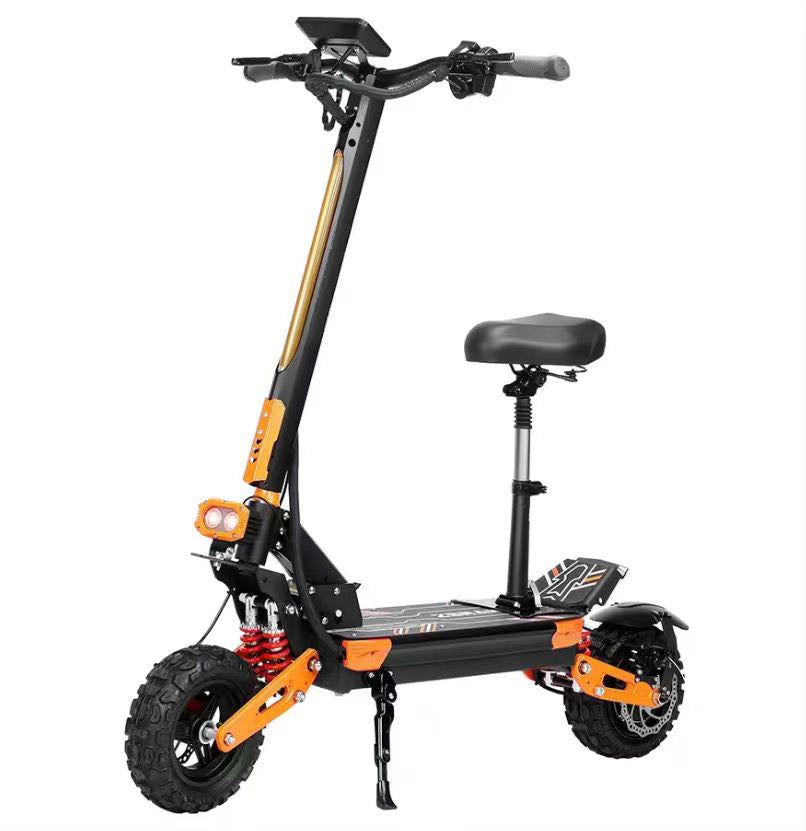
TopRiding ZSNAKE Z35 - Best Budget Electric Scooter
Do not gamble your safety on rigid commuter scooters that shatter your knees over every crack in the pavement. The ZSNAKE Z35 is engineered for absolute domination of the urban and off-road environment. Featuring massive 11-inch off-road fat tires and full spring suspension, this machine provides the high-speed stability that cheap scooters lack.
-
Performance: Top Speed of 33 MPH powered by a relentless 2800W Single Motor.
-
Endurance: 60V 15AH Battery delivering a Max Range of 35 Miles with DUAL Charging capabilities.
-
Safety: Front & Rear Disc Brakes for absolute stopping power, backed by UL 2272 Certification.
-
Capacity: Heavy-duty chassis supporting a Max Rider Load of 330 LBS.
Explore the ZSNAKE Z35 Today
Frequently Asked Questions
Is a scooter harder to ride than a bike?
A scooter is significantly easier to learn initially because you can step off instantly at low speeds without untangling yourself from a frame. However, at high speeds, a scooter is mechanically harder to stabilize than a bicycle due to its smaller wheels and vertical standing position, requiring more core engagement and proactive knee bending to absorb shocks.
Do you need a license to ride an electric scooter?
It depends entirely on your local jurisdiction and the speed capabilities of your vehicle. In many US states, scooters capped at 15-20 mph do not require a license, but high-performance scooters that exceed 30 mph often blur the legal line into moped territory, requiring registration and a valid driver's license.
Can an electric scooter go uphill easily?
Yes, provided it has sufficient wattage. A cheap, single 250W motor will struggle and stall on a 10-degree incline, but a 500W or dual-motor setup (like the 2800W ZSNAKE Z35) will effortlessly pull an adult rider up a 20-degree grade without losing momentum.
Is it bad to ride an electric scooter in the rain?
In most professional situations, yes. Unless the scooter explicitly boasts an IPX5 or IPX6 water resistance rating, driving an electronic device through deep puddles will short out the controller or battery matrix. Furthermore, small polyurethane or street tires lose severe traction on wet painted lines and manhole covers.
Industry References & Authoritative Safety Guidelines
To ensure our safety guidance and legal interpretations meet rigorous federal standards, TopRiding aligns its operational data with the following authoritative organizations:
-
National Highway Traffic Safety Administration (NHTSA): The federal authority defining the strict safety, crash statistics, and equipment requirements for micromobility vehicles operating on public roads. Review NHTSA Micromobility Data
-
Insurance Institute for Highway Safety (IIHS): Providing peer-reviewed research and crash-test data comparing the fatality and injury rates of electric scooters versus traditional bicycles in urban transit environments. Review IIHS Scooter Safety Research
-
Consumer Reports: The premier independent nonprofit organization executing rigorous physical testing on electric scooter braking distances, battery safety (UL certification), and structural reliability. Review Consumer Reports E-Scooter Testing


