When you are upgrading from a basic rental scooter to a premium personal electric vehicle, speed is usually the first metric you look at. In the micromobility industry, Apollo has established itself as a reputable brand, but potential buyers constantly ask us exactly how fast does an Apollo scooter go in real-world conditions. From our experience at TopRiding, manufacturer-stated top speeds often reflect perfect laboratory conditions—a 150-pound rider on a flat, smooth track with a 100% battery charge. The reality on the asphalt is often quite different.

In most professional situations, we advise riders not to simply buy a scooter based on a singular top speed number, but rather to examine the continuous motor wattage, the voltage of the battery, and the specific model's engineering. Apollo offers a tiered lineup ranging from entry-level commuters to high-speed enthusiast machines. We are going to break down exactly what speeds you can expect, the limitations of these machines, and whether Apollo's top-end models are actually worth buying compared to ultra-performance alternatives.
Quick Answer: Apollo Top Speeds
Depending on the specific model you choose, an Apollo scooter can go anywhere from 21 MPH to 44 MPH (34 km/h to 70 km/h).
-
Apollo Air: Tops out at 21 MPH (34 km/h). Ideal for beginners.
-
Apollo City (Single Motor): Reaches 27 MPH (43 km/h).
-
Apollo City Pro (Dual Motor): Hits 32 MPH (51 km/h).
-
Apollo Phantom: Reaches 41 MPH (66 km/h). A solid entry into high-performance riding.
-
Apollo Pro: The flagship model, maxing out around 44 MPH (70 km/h).
Professional Insight: If you are looking to push past the 50 MPH barrier for extreme performance and off-road capability, you will need to look outside the Apollo ecosystem at heavier 60V systems.
Breaking Down Apollo Speeds by Model
To understand what you are buying, you must look at the specific tiers of the Apollo lineup. We recommend categorizing these scooters based on their intended use case rather than just their raw speed numbers.
| Apollo Model |
Advertised Top Speed |
Motor Configuration |
Best Use Case |
| Apollo Air |
21 MPH (34 km/h) |
500W Single Motor |
Last-mile commuting, flat terrain. |
| Apollo City |
27 MPH (43 km/h) |
500W Single Motor |
Urban commuting with mild hills. |
| Apollo City Pro |
32 MPH (51 km/h) |
2 x 500W Dual Motor |
Daily commuting, keeping up with local traffic. |
| Apollo Phantom |
41 MPH (66 km/h) |
2 x 1200W Dual Motor |
Enthusiast riding, aggressive acceleration. |
| Apollo Pro |
44 MPH (70 km/h) |
2 x 1200W Dual Motor (Peak) |
Premium luxury riding, heavy riders. |
If you are entirely new to this space and find a 21 MPH limit acceptable, you might be interested in our guide on the electric scooters for commuting daily use. However, if you are looking at the Phantom or Pro, you are stepping into a territory where specialized knowledge is required to ride safely.
How Speed Works: Motors, Voltage, and Controllers

Speed does not just magically happen. In our testing, the speed of an electric scooter is dictated by a strict mathematical relationship between the battery voltage and the motor controller's amperage output. Apollo's faster scooters (the Phantom and Pro) utilize 52V systems. The voltage acts as the "water pressure" pushing electricity into the motors. Higher voltage equates to a higher top speed ceiling.
However, the motor controller is the true brain of the operation. Apollo uses proprietary MACH controllers designed for smooth, predictable acceleration. While this is fantastic for ride comfort, it inherently limits the aggressive torque that speed junkies crave. If you ever find yourself wondering how to make an electric scooter faster, you will quickly learn that software locks and controller limits are the main bottlenecks preventing a 52V scooter from exceeding 45 MPH.
Real-World Factors That Kill Your Top Speed
We absolutely must address the discrepancy between a brochure and the street. When you ask how fast does an Apollo scooter go, you must factor in your personal physical metrics.
-
Rider Weight: The heavier the payload, the harder the motors must work. A 250-pound rider on an Apollo Phantom will likely max out around 36 MPH, not the advertised 41 MPH. If you are a larger rider, this is a critical buying factor; read our detailed breakdown on can a 300 lb person ride an electric scooter to understand weight capacities.
-
Voltage Sag: As your battery depletes, its voltage output drops. You will only hit peak speeds when the scooter is between 80% and 100% charge. By the time you hit 40% battery, your top speed will be noticeably throttled by the system to protect the cells.
-
Aerodynamic Drag: At speeds exceeding 30 MPH, wind resistance becomes the primary enemy of acceleration. Standing upright creates a massive sail effect, drastically reducing top-end speed.
The Benefits and Limitations of 40+ MPH Scooters
Is a scooter that goes 40+ MPH actually worth buying? Yes, but it comes with severe responsibilities and mechanical limitations.
| Pros (Benefits) |
Cons (Limitations) |
| Ability to safely take the lane in 30-35 MPH traffic zones, avoiding the dangerous "door zone" on the shoulder. |
Dramatically increased braking distance. Standard brakes fade quickly at these speeds. |
| Massive torque reserves make climbing steep urban hills effortless. |
High-speed riding drains the battery exponentially faster, severely cutting maximum range. |
| Shorter commute times across long, straight suburban stretches. |
Requires motorcycle-grade safety gear (full-face helmet, armored jacket). |
| Suspension systems on these models offer unparalleled comfort over potholes. |
Heavier weight (often 75+ lbs) makes them impossible to carry up multiple flights of stairs. |
Who Actually Needs High-Speed Scooters?
For beginners: You absolutely do not need an Apollo Phantom or Pro. Sticking to a 20 MPH scooter is the smartest and safest choice while you learn throttle control and balance.
For commercial users and extreme commuters: If your daily route involves roads where the speed limit is 35 MPH, having a scooter that tops out at 40+ MPH is a defensive driving tactic. It prevents aggressive drivers from attempting to dangerously pass you in the same lane.
For heavy-duty applications: If you plan on riding dirt trails, grass, or gravel, top speed on pavement is less important than raw torque. However, many riders ask us can electric scooters go off road. While Apollo offers street dominance, true off-road capability often requires heavier frames, C-type suspensions, and massive 11-inch knobby tires that go beyond the typical Apollo build.
Common Mistakes When Chasing Scooter Speed
From our experience, consumers make fatal errors when they become obsessed with top speed metrics.
The most common mistake is ignoring the brakes. Riding an electric scooter past 35 MPH without full hydraulic brakes is essentially a death wish. Cable-actuated disc brakes will snap or fade when trying to halt 250 pounds of mass moving at 40 MPH. Secondly, buyers ignore local legislation. Before dropping thousands of dollars on a high-speed machine, you must understand your local laws. For instance, you should review the electric scooter laws in California or check if do you need a license for an electric scooter in your specific municipality, as many areas strictly cap legal scooter speeds at 15 to 20 MPH.
Apollo vs. Ultra-Performance Alternatives
While the Apollo Phantom and Pro are excellent machines, their 41-44 MPH top speeds are not the absolute ceiling of the scooter world. If you are an adrenaline seeker or require extreme power, you must step up to a 60V, dual 2800W motor system.
| Feature |
Apollo Phantom (V3/V4) |
TopRiding ZSNAKE Z36 |
| Top Speed |
41 MPH (66 km/h) |
52 MPH (83 km/h) |
| Motor Power |
Dual 1200W (2400W Total) |
Dual 2800W (5600W Total) |
| Battery System |
52V 23Ah |
60V 30Ah |
| Tire Size |
10-inch street/hybrid |
11-inch off-road fat tires |
| Target Rider |
Urban high-speed commuter |
Off-road enthusiasts, heavy riders, extreme speed seekers |
If you are looking for vehicles that dominate dirt paths and extreme inclines, you should explore our curated list of the best off-road electric scooters under 1000 to see what the market offers beyond standard commuter brands.
Product Spotlight: TopRiding ZSNAKE Z36
For those who find a 44 MPH top speed insufficient for their private property or off-road trail riding, we engineer solutions that shatter standard limits. If you want uncompromising power, we recommend the ZSNAKE Z36.
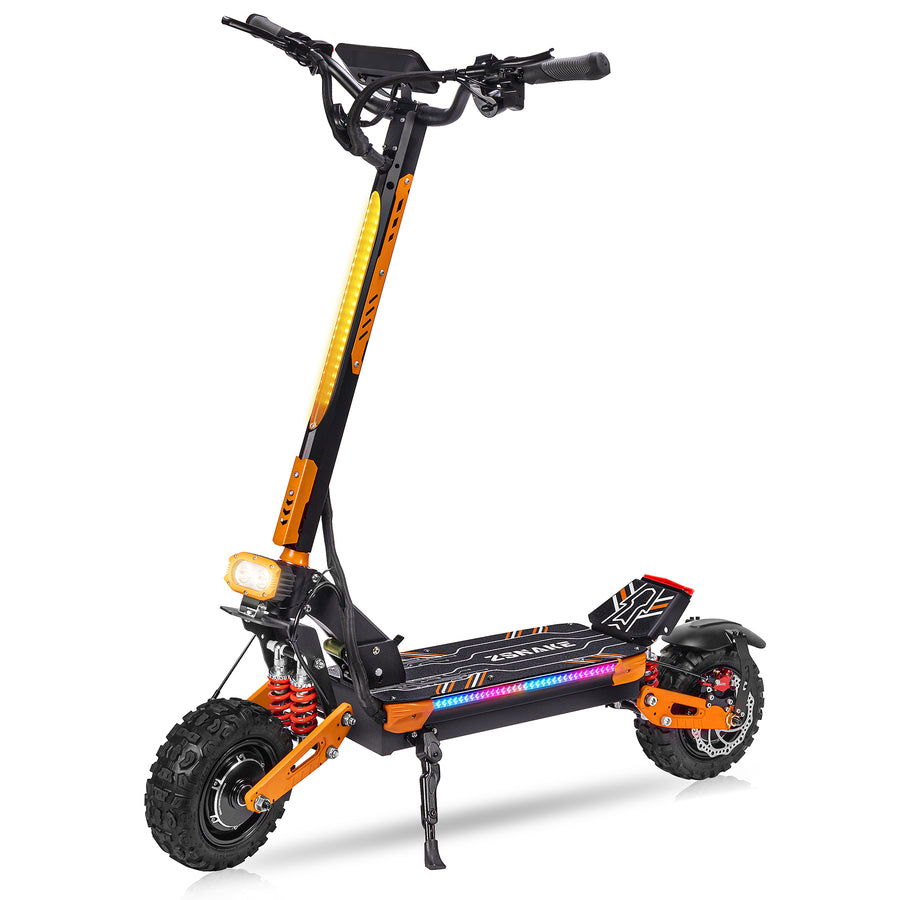
TopRiding ZSNAKE Z36 - Adult Electric Scooter
Engineered for extreme performance, this beast leaves standard 52V commuter scooters in the dust. With dual 2800W motors pumping out a combined 5600W of peak power, it delivers the raw torque needed to conquer 45-degree inclines and hit thrilling straightaway speeds.
-
Top Speed: 52 MPH (For experienced riders only)
-
Max Range: Up to 55 miles per charge (60V 30AH Battery)
-
Safety First: Hydraulic Disk Brakes & UL 2272 Certification
-
Terrain Dominance: 11” Off-road Fat Tires with Full Spring Suspension
-
Payload: Supports a Max Rider Load of 330 LBS
View the ZSNAKE Z36
Buying Considerations for Fast Scooters
Before you swipe your credit card for an Apollo, a TopRiding model, or any other fast electric scooter, apply this commercial judgment matrix to your decision. Do not buy a scooter based purely on marketing numbers; if you are still researching, you can view the fast electric scooters for adults to broaden your horizons.
| Consideration |
What You Must Demand |
Why It Matters |
| Braking System |
Full Hydraulic Disc Brakes (NUTT or ZOOM). |
Mechanical brakes stretch and require constant tuning. At 40+ MPH, hydraulic brakes are non-negotiable for immediate stopping power. |
| Steering Stability |
Steering Damper compatibility. |
At high speeds, small tire scooters suffer from "speed wobble" which can violently throw a rider. A damper eliminates this. |
| Battery Quality |
UL 2272 Certification. |
High-speed riding draws massive amperage. Uncertified batteries pose severe thermal runaway (fire) risks. |
| Suspension |
Adjustable coil or hydraulic shocks. |
Hitting a 2-inch pothole at 40 MPH on a rigid scooter will shatter the rim and cause a crash. Deep travel suspension is required. |
Expert Recommendation & Final Verdict
So, is an Apollo scooter actually worth buying? Yes, Apollo produces some of the most refined, aesthetically pleasing, and technologically advanced commuter scooters on the market today. If you are a standard urban commuter looking for a reliable, smooth ride that tops out around 30 to 40 MPH, the Apollo City Pro and Apollo Phantom are exceptional investments.
However, we must take a clear position: if you are looking for extreme, adrenaline-pumping speed that crosses the 50 MPH threshold, Apollo's 52V systems will ultimately leave you wanting more. For commercial users, heavy riders over 250 pounds, or off-road thrill-seekers, we strongly recommend stepping up to a 60V, 5600W machine like the TopRiding ZSNAKE Z36. The upgrade in raw voltage, tire size, and torque provides a heavy-duty platform that simply cannot be matched by standard commuter-focused brands.
Frequently Asked Questions
Are 40 MPH electric scooters street legal?
In most US states, electric scooters are legally capped at 15 to 20 MPH on public bike lanes and roads. Scooters capable of 40+ MPH are generally classified as off-road or private-property vehicles unless you register them as mopeds (which requires turn signals, mirrors, and a valid driver's license). Always check your local municipal codes before riding.
Why doesn't my Apollo scooter reach the advertised top speed?
Advertised top speeds are calculated using a 150-pound rider on perfectly flat terrain with a 100% charged battery. If you weigh more than 170 pounds, are riding up a slight incline, facing a headwind, or have a battery charge below 70%, the motor controller will naturally throttle your top speed output due to voltage sag.
Is it safe to ride an electric scooter at 40 MPH?
It is only safe if you treat the scooter like a motorcycle. You must wear a DOT-certified full-face helmet, armored jacket, gloves, and knee/shin guards. The small 10-inch tires on most scooters are highly susceptible to potholes, making high-speed riding inherently dangerous without proper protective gear and a steering damper.
Authoritative Safety & Industry References


