TopRiding electric scooters are certified to meet UL 2272 safety standards, covering critical electrical and fire safety requirements for the electrical system and battery.
This certification helps ensure safer, more reliable riding.
Over 100,000 electric scooters sold, backed by 5,000+ verified reviews and an average rating of 4.7+ stars.
Chosen by riders worldwide for reliable performance, and everyday riding confidence.
Expert support. local service.
Expert Customer Service
As a U.S.-based company, TopRiding provides 24/7 expert customer service and local after-sales support across multiple regions in North America.
Our dedicated support team is here to ensure fast responses, professional assistance, and reliable service — whenever you need it.
TEST RIDES AND SERVICE
Safety Certified
Designed to Meet UL 2272 Safety Standards
Our electric scooters are designed in accordance with UL 2272 safety requirements for electrical and battery systems, helping enhance overall safety and reliability.
Trusted by a global riding community
100,000+ Units Sold
Over 100,000 electric mobility vehicles sold, backed by 5,000+ verified reviews and an average rating of 4.7+ stars.
Chosen by riders worldwide for reliable performance, safety, and everyday riding confidence.
Expert Support. Local Service.
Expert Customer Service
As a U.S.-based company, TopRiding provides 24/7 expert customer service and local after-sales support across multiple regions in North America.
Our dedicated support team is here to ensure fast responses, professional assistance, and reliable service—whenever you need it.
How Fast Will a 1500 Watt E-Bike Go? Realistic Speeds, Limits and What to Expect
How Fast Will a 1500 Watt E-Bike Go? Realistic Speeds, Limits and What to Expect
senkan
A 1500 watt e-bike can sound like a 30–40 mph machine, but the number printed on a motor label does not tell you its actual road speed. A bike’s top speed depends on whether 1,500W is its continuous or peak rating, its battery voltage, controller current, wheel and tire size, rider weight, terrain, and—critically—the factory speed limit and local e-bike laws.
Quick Answer: How Fast Will a 1500 Watt E-Bike Go?
A 1500W-rated e-bike may reach roughly 28–35 mph in some configurations, while higher-speed setups can exceed that range. However, there is no guaranteed speed based on wattage alone. A model with a 750W rated motor and 1,500W peak output may be factory-limited to 20 mph, even though its electrical system can briefly deliver more power.
For a dependable estimate, check the manufacturer's stated top speed, motor rated and peak power, battery voltage, controller specifications, and factory speed setting. Do not treat an advertised peak-watt figure as a promise of road speed.
The Direct Answer: What Speed Can You Expect?
When people search for how fast a 1500 watt ebike go, they usually want a simple number. The honest answer is a range, not a fixed speed. Depending on the system design, a 1,500W e-bike might be configured for approximately 28 mph, 30–35 mph, or a higher speed. Some bikes with a 1,500W peak rating are deliberately limited to 20 mph.
That distinction matters because motor power and vehicle speed are different measurements. Wattage describes electrical power output. Speed is the result of how the motor, controller, battery, gearing or hub design, wheel size, load, and resistance work together.
From our experience evaluating e-bike specifications, the most common buyer mistake is comparing two bikes by peak watts alone. A bike with a higher peak figure is not automatically faster, more efficient, or better suited to daily riding. A well-matched battery and controller, sensible gearing, and stable chassis can matter more to the actual riding experience.
Our recommendation: If you need a bike for public-road commuting, start with the legal speed class in your area. If you need off-road performance, compare torque, sustained power, brakes, suspension, battery capacity, and thermal management—not just the highest speed claim.
What Does 1500W Mean on an E-Bike?
In an electric bicycle specification, watts indicate the rate at which electrical power is delivered to the motor. But manufacturers may list rated power, nominal power, or peak power. These terms should not be treated as interchangeable.
Rated power vs peak power
Rated power is the motor's specified continuous output under defined operating conditions. It is a more useful starting point for judging sustained performance. Peak power is a higher short-duration output that may be available during acceleration or demanding riding, depending on the controller, battery, and thermal limits.
For example, a bike advertised as 750W rated / 1,500W peak is not necessarily a 1,500W continuous e-bike. The peak figure describes a temporary capability, not what the motor should deliver indefinitely.
Why battery voltage and controller current matter
Battery voltage and controller current influence the electrical power available to the motor. In simplified terms, electrical input power is related to voltage multiplied by current. Actual mechanical output is lower because the system has losses, and the controller may limit current to protect components.
A 52V battery system with a controller configured for a relatively high current can behave differently from a lower-current system, even if both bikes carry similar wattage labels. However, increasing current without checking motor temperature, wiring, battery discharge capability, and controller ratings can create reliability and safety problems.
Seven Factors That Determine How Fast a 1500 Watt E-Bike Goes
1. Factory speed limit
The programmed speed limit may be the single biggest reason a powerful e-bike does not reach the speed buyers expect. Manufacturers may limit speed to meet the intended market's regulations, preserve range, or keep the bike within its approved configuration. A 1,500W peak system can therefore be delivered with a 20 mph factory limit.
2. Battery voltage and discharge capability
Voltage affects the motor system's operating range, while the battery's discharge capability affects how much current can be supplied safely. A battery with a high capacity rating in amp-hours does not automatically deliver more speed. Capacity is primarily about stored energy and potential range; discharge capability and controller limits influence power delivery.
3. Controller configuration
The controller manages power sent to the motor. Its current limit, thermal protection, and speed settings influence acceleration and top speed. A controller that is underspecified for the motor or battery can restrict performance. An improperly upgraded controller can cause overheating, premature component failure, or unsafe operation.
4. Motor design and torque
Hub motors and mid-drive motors deliver power differently. Hub motors are mechanically straightforward and common on fat-tire e-bikes. Mid-drive motors use the bicycle's drivetrain and can take advantage of gear ratios, which can be useful on steep terrain. Neither design is automatically faster in every situation.
Torque is particularly important when starting from a stop, climbing a hill, or carrying a heavy load. A bike that accelerates confidently may still have a modest top speed if its controller or factory settings impose a limit.
5. Wheel and tire size
Wheel diameter affects how far the bike travels per wheel revolution. Tire width, tread pattern, pressure, and rolling resistance also influence the power required to maintain speed. Fat tires provide useful flotation and traction on loose surfaces, but they can create more rolling resistance than narrower tires on smooth pavement.
A heavier rider or loaded rack increases the work required to accelerate and climb. Wind resistance also rises sharply as speed increases. At higher speeds, an upright riding position can require substantially more power than a tucked position. This is one reason a bike's maximum speed on a flat test route may not match the speed a rider sees during everyday use.
7. Terrain, wind, and temperature
Headwinds, steep grades, soft ground, low tire pressure, and cold battery conditions can all reduce performance. A speed figure recorded on a flat road with a light rider and a full battery should not be treated as a guaranteed speed on a trail or long climb.
1500W vs 750W vs 1000W E-Bikes: Which Is Better?
More power can be useful, but it is not automatically the best purchase. The right choice depends on where you ride and whether you need stronger acceleration, climbing ability, or a higher permitted speed. The following table is a practical comparison, not a promise of specific performance from every model.
Specification / Use
750W class
1000W class
1500W class or peak
Typical positioning
Commuting and recreational riding
More demanding recreational and mixed-terrain use
Performance-oriented or off-road-focused configurations
Acceleration potential
Generally adequate for ordinary riding
Can offer stronger acceleration when properly matched
Can deliver strong acceleration with a suitable battery and controller
Hill performance
Depends heavily on torque, gearing, and rider load
Often better suited to sustained demanding climbs
Potentially strong, but thermal management becomes important
Top speed
May be limited by law or factory settings
Depends on system design and speed configuration
May be higher, but peak watts alone do not determine speed
Battery demand
Often lower under comparable riding conditions
Can consume more energy under hard acceleration
High-power use can drain the battery quickly
Best buyer
Commuter prioritizing simplicity and efficiency
Rider wanting a balance of power and versatility
Rider who genuinely needs stronger performance and has suitable riding access
For most daily commuters, a well-built 750W or 1000W bike may be more sensible than a high-output model. For trail riders who regularly face steep climbs, loose surfaces, or heavier loads, a higher-output system can be worth considering—but only when the frame, brakes, tires, and battery are designed to handle it.
A high-output e-bike can be a strong choice for a specific rider. It is not automatically a better all-round bicycle. Consider the trade-offs before paying extra for power you may rarely use.
Pros
Cons
Potentially stronger acceleration, especially when the battery and controller are matched correctly.
Higher power demand can reduce range when riding aggressively.
Can provide useful assistance on demanding climbs and loose terrain.
More electrical and thermal load can increase component stress.
May suit heavier riders or riders carrying equipment, depending on the bike's payload rating.
Higher power does not guarantee a higher legal speed or a better riding experience.
Can offer more performance headroom for off-road applications.
May be heavier, more expensive, or subject to stricter local rules.
Can reduce the effort required in challenging riding conditions.
Requires appropriate brakes, tires, suspension, and rider control.
Expert view: We would rather recommend a balanced e-bike with dependable brakes and a properly rated battery than a cheaper model that advertises impressive peak watts but provides little information about its controller, thermal protection, or component quality.
How Fast Does a 1500W E-Bike Go in Real Riding Conditions?
Real-world speed depends on the route and the bike's configuration. These scenarios are more useful than a single headline speed.
Flat paved roads
On a smooth, flat road, a properly configured high-output e-bike may maintain a higher speed than a lower-powered model, provided its speed setting and local rules allow it. Wind resistance becomes a major factor as speed rises. Do not assume that a bike capable of a brief high-speed run can maintain that speed for an entire commute.
Steep hills and access roads
On hills, torque and sustained power matter more than the top-speed figure printed on a product page. A 1500W peak system may climb more confidently than a modest system, but only if it can maintain output without overheating. For hunting access roads and mixed terrain, compare motor torque, low-speed control, tire grip, and payload. Our guide to hunting e-bikes under $2,000 explains which features deserve attention.
Loose trails, sand, and gravel
Loose surfaces reduce traction and make high speed less useful. Fat tires and suitable tread can help with flotation and grip, but they do not eliminate the risk of sliding or losing control. A rider should choose a speed that matches visibility, braking distance, and surface conditions—not the motor's maximum capability.
Long rides with cargo
Carrying tools, camping equipment, or groceries increases total system weight. This affects acceleration, climbing, braking, and range. If you regularly ride with cargo, check the manufacturer's maximum payload rating and consider battery capacity before focusing on peak power.
Motor wattage and maximum assisted speed can affect how an e-bike is classified. Rules differ by country, state, and sometimes local riding area. In the United States, many jurisdictions use a three-class framework based on motor assistance and speed, but definitions and access rules are not identical everywhere. A 1,500W system may fall outside the definition of a conventional low-speed electric bicycle in some jurisdictions.
Before buying, check the rules where you will actually ride. Confirm whether the bike is permitted on public roads, shared-use paths, bike lanes, and off-road trails. Also check whether registration, insurance, a license, age restrictions, or additional equipment requirements apply.
Why braking and stability matter as much as speed
Higher speed increases stopping distance and leaves less time to respond to hazards. A powerful motor is not a substitute for hydraulic disc brakes, suitable tires, a stable frame, and correctly adjusted suspension. Inspect brake rotor size and caliper quality, tire load ratings, wheel construction, and the manufacturer's payload limit.
Wear a properly fitted helmet and use lights and reflective equipment where appropriate. Keep a safe following distance, reduce speed on wet or loose surfaces, and avoid carrying loads beyond the rated limit. Never assume that a throttle or display setting makes a bike legal for public-road use.
Do not buy on a motor headline alone. A useful product listing should provide enough detail to judge whether the complete bike is suitable for your weight, terrain, riding distance, and local rules.
Buying factor
What to check
Why it matters
Motor rating
Rated power and peak power shown separately
Prevents confusing short-duration output with continuous capability.
Battery
Voltage, amp-hours, watt-hours, cell information, and discharge rating
Helps assess usable energy and power delivery.
Controller
Current rating, thermal protection, and factory speed setting
Determines how power is managed and whether performance is restricted.
Brakes
Hydraulic or mechanical design, rotor dimensions, and replacement availability
Reliable stopping is essential when the bike is heavy or powerful.
Suspension
Front and rear travel, adjustment, and serviceability
Important for rough terrain and rider control.
Frame and payload
Frame construction, total bike weight, and maximum payload
Confirms whether the bike suits the rider and carried equipment.
Warranty and support
Battery, motor, frame, and electrical-system coverage
High-power components are expensive to replace without support.
Legal configuration
Factory speed limit and compliance documentation for your region
Helps avoid buying a bike that cannot be used where you intend to ride.
Do not overlook battery energy capacity
Watt-hours (Wh) provide a more useful comparison of stored battery energy than amp-hours alone because Wh accounts for voltage. For example, a 52V, 25Ah battery has a nominal energy capacity of approximately 1,300Wh. Actual riding range will be lower or higher depending on rider input, speed, terrain, temperature, tire pressure, and assist settings.
When is upgrading worth the money?
Upgrade only when you can identify a real limitation. If your current bike struggles on hills, first check tire pressure, brake drag, battery health, and whether the motor is overheating. If the system is already operating within its intended limits, fitting a more powerful controller may create reliability and legal problems rather than solving the underlying issue.
For most riders, moving to a better battery, stronger brakes, more capable suspension, or a bike designed for the intended terrain is a more sensible investment than chasing a larger wattage number.
TopRiding R2: Why a 1500W Peak E-Bike May Still Be Limited to 20 MPH
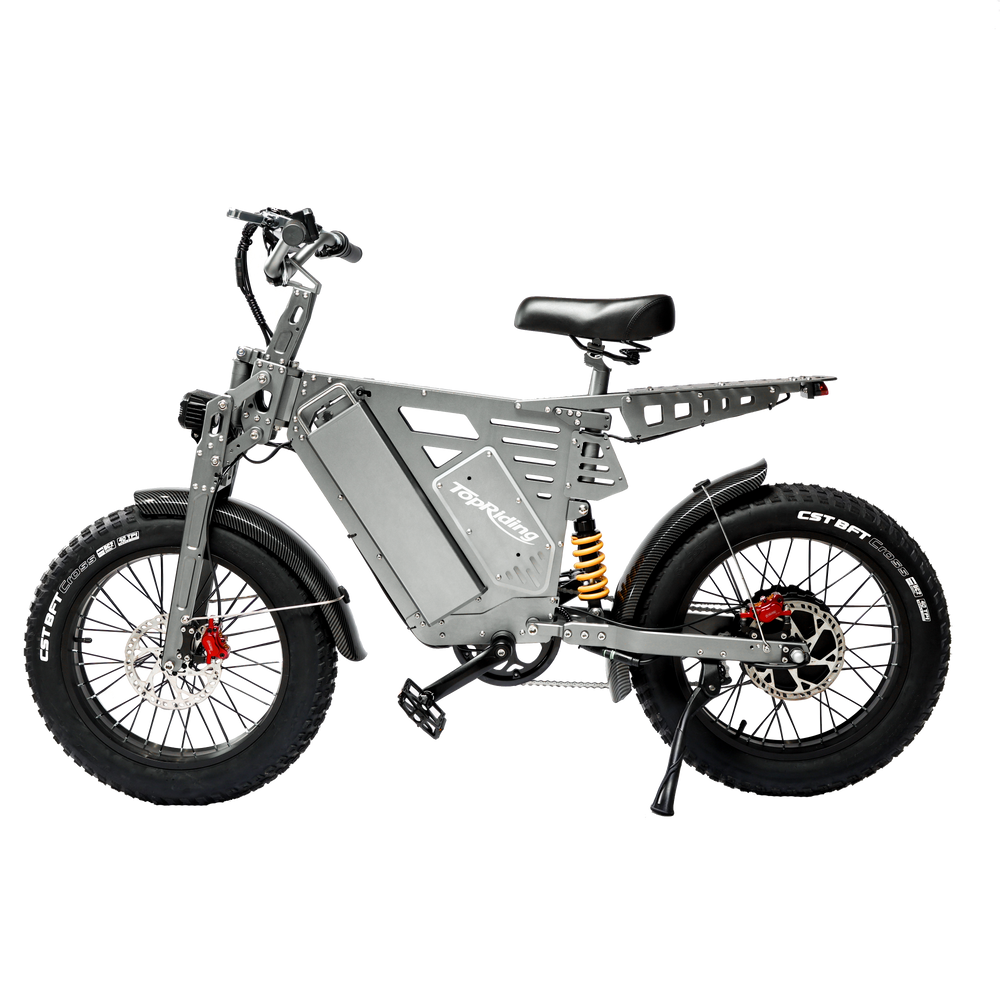
The TopRiding R2 is a useful example of why buyers should read the complete specification instead of judging a bike by its peak power figure. It lists a 750W rear hub motor with 1,500W peak power and a factory speed limit of 20 mph. That means it should not be described as a 1,500W continuous motor or assumed to reach 30–35 mph in its standard configuration.
The R2 combines a 750W rated rear hub motor with 1,500W peak output, a 52V 25Ah removable lithium-ion battery, full suspension, and 20 × 4.0-inch fat tires. Its listed factory speed limit is 20 mph.
For a rider who wants a substantial, moto-style e-bike with strong peak output, 100 Nm of listed torque, full suspension, and a large battery, the R2 has a specification worth considering. Its 20 mph factory speed limit is also an important part of the buying decision. It is not the right model for someone whose primary requirement is a standard factory top speed above 30 mph.
The 1,300Wh battery is a meaningful feature for riders who value energy capacity, although the advertised range of up to 60 miles should be treated as a best-case claim rather than a guaranteed distance. High speeds, frequent acceleration, hills, cold weather, and heavy loads can reduce range substantially.
We recommend evaluating the R2 as a complete bike, not as a shortcut to a 1,500W continuous setup. If your priority is a factory-limited 20 mph ride with a powerful peak-output system and substantial equipment, it may be a better fit than an unverified high-speed conversion.
Who Should Choose a 1500W E-Bike—and Who Should Not?
Good candidates
Experienced riders who regularly travel on demanding private or permitted off-road routes.
Riders who need stronger acceleration or climbing assistance and have confirmed the bike's payload and thermal limits.
People carrying equipment who need a robust frame, suitable tires, and adequate battery energy.
Buyers who understand the local rules and have a legal place to use the bike's intended configuration.
Who may not need one
Urban commuters who mainly ride on flat roads and prioritize a light, efficient bicycle.
Beginners who are not yet comfortable controlling a heavy e-bike.
Riders who need access to paths or facilities that restrict higher-powered e-bikes.
Buyers who assume a bigger wattage number guarantees longer range or higher quality.
Frequently Asked Questions About 1500 Watt E-Bike Speed
1. Can a 1500W e-bike go 40 mph?
Some high-performance electric bikes may reach 40 mph, but 1,500W alone does not guarantee that speed. Battery voltage, controller settings, motor design, wheel size, rider weight, terrain, and factory restrictions all matter. A bike rated at 1,500W peak may be limited to 20 mph.
2. Is a 1500W e-bike faster than a 1000W e-bike?
It can be, but not always. A 1,500W system may provide more acceleration or climbing capability when the components are matched correctly. However, a factory speed limit can make it no faster at top speed than a lower-powered bike.
3. Is 1500W enough for steep hills?
A well-designed 1,500W peak system can provide useful hill-climbing assistance, but performance depends on torque, controller current, battery condition, gearing, rider weight, and how long the climb lasts. Sustained climbs can cause heat buildup, so thermal protection and motor design matter.
4. Does a 1500W e-bike have a longer range?
No. Motor wattage does not determine range by itself. Battery energy capacity in watt-hours is a more useful starting point. A high-power bike can have a long range if it carries a large battery and is ridden efficiently, but aggressive acceleration and high speeds can drain it quickly.
5. Is a 1500W e-bike legal in the United States?
It depends on the state, local rules, vehicle classification, and where the bike is ridden. Many low-speed e-bike definitions use lower motor-power limits than 1,500W. Check your state and local requirements before buying or using a high-powered model on public roads or shared paths.
6. Is 1500W peak power the same as 1500W rated power?
No. Peak power is a short-duration maximum, while rated power refers to the motor's specified continuous output under defined conditions. Always check both figures in the manufacturer's documentation.
7. Can I increase the speed of my 1500W e-bike?
Do not assume that changing a display setting or controller will be safe or legal. A speed modification can affect motor temperature, battery current, braking demands, warranty coverage, and vehicle classification. Ask the manufacturer or a qualified e-bike technician before making changes, and only use the bike in a legally permitted setting.
8. Is a 1500W e-bike suitable for beginners?
It can be suitable if the bike has predictable controls and the rider uses a conservative assist setting, but a heavy, powerful model is not the easiest way to learn. Beginners should prioritize manageable weight, reliable brakes, stable handling, and a gradual introduction to motor assistance.
Final Recommendation: Buy the Complete System, Not the Wattage Label
So, how fast will a 1500 watt ebike go? A realistic answer is that some configurations can reach around 28–35 mph or more, while others are deliberately limited to 20 mph. The motor's peak rating is only one part of the system, and it should never be treated as a guaranteed top-speed specification.
For beginners and everyday commuters, a legally compliant, well-built bike with dependable brakes and a suitable battery is usually the smarter purchase. For experienced off-road riders, a higher-output system can be worth the investment when its torque, cooling, frame, suspension, and braking equipment are designed for demanding use.
TopRiding's R2 illustrates the point: it lists 750W rated power, 1,500W peak power, and a 20 mph factory speed limit. That is a specific performance configuration—not a promise of 35 or 40 mph. Buyers who understand that distinction are far more likely to choose a bike that meets their real needs.
Product specifications in the TopRiding R2 section are based on the manufacturer-provided information supplied for this article. Speed and range vary with configuration, rider, route, weather, and operating conditions. Always verify current product specifications and local regulations before purchase or use.
Al seleccionar una opción se actualiza toda la página.