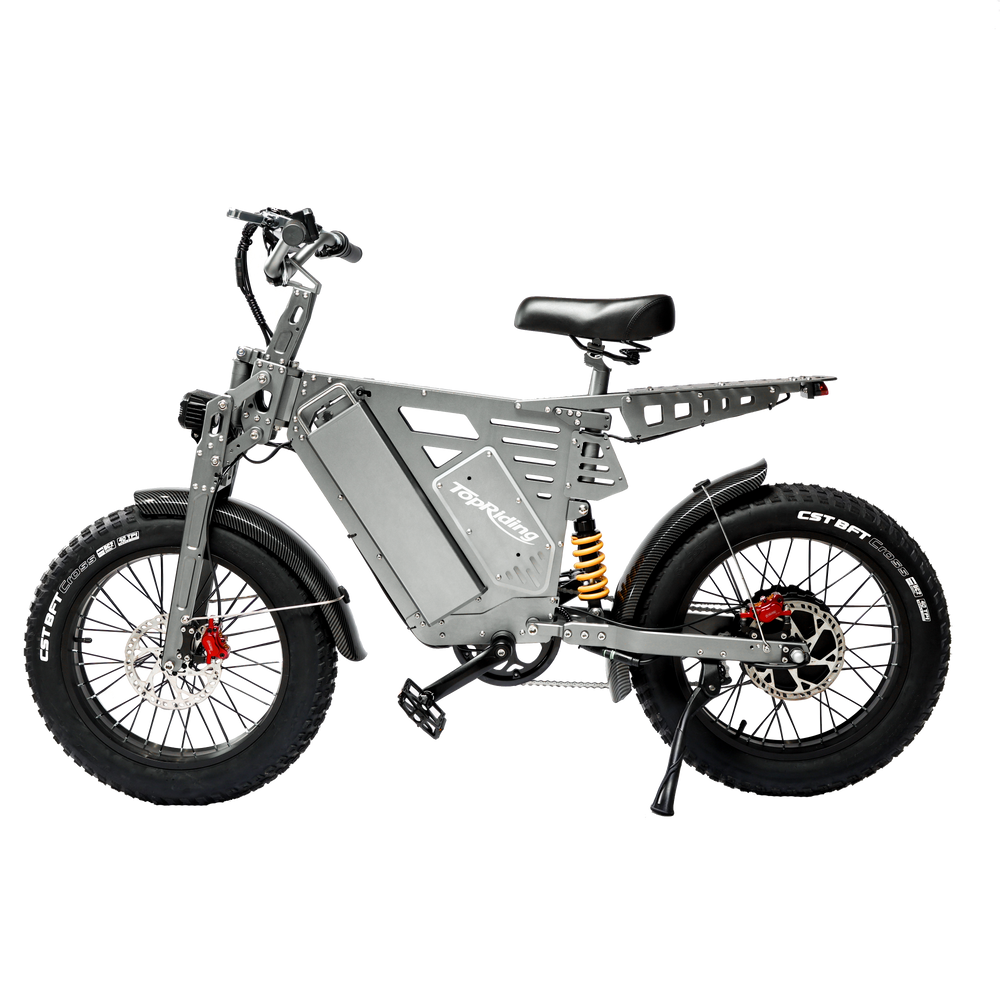
Yes, e-bikes can be excellent for off-road riding, provided you choose a model designed for the terrain. A properly equipped electric mountain bike can make steep climbs more manageable, help riders cover longer trails, and deliver a more enjoyable experience on gravel, dirt roads, and many rough paths. But an electric motor cannot compensate for poor tires, inadequate brakes, unsuitable geometry, or a frame that is not designed for the forces of trail riding.

The most important buying decision is not simply whether an e-bike has enough power. It is whether the complete bike can handle your intended surface, elevation, rider weight, and riding style. TopRiding's R2 Full CNC Moto-Style eBike, for example, combines full suspension, wide tires, a removable high-capacity battery, and hydraulic disc brakes. Those features make it worth evaluating for suitable recreational off-road routes, although its 82-pound weight is a serious consideration.
Quick Answer: Are E-Bikes Good for Off-Road?
Yes. An e-bike is a good off-road choice when its tires, suspension, brakes, frame, and motor system match the terrain. Full-suspension electric mountain bikes are usually the stronger option for rough trails. Hardtails offer better value for gravel and moderate dirt paths, while fat-tire e-bikes can suit loose surfaces such as sand and packed snow.
How they work: An electric motor adds assistance through a pedal-assist system, a throttle, or both, depending on the model and its legal classification. The motor helps with acceleration and climbing, while the tires, suspension, brakes, and rider still determine control.
Our recommendation: Buy for handling and braking first, then compare motor output and battery capacity. Do not choose an off-road e-bike solely because it advertises high wattage, a large battery, or motorcycle-inspired styling.
1. Quick Summary Table
If you are deciding whether an electric bike is suitable for off-road use, start with the terrain you will ride most often. This summary helps match the bike type to the job.
| Riding Condition |
Recommended E-Bike Type |
Main Benefit |
Important Limitation |
| Gravel roads and maintained dirt paths |
Hardtail electric mountain bike |
Good value and relatively simple maintenance |
Less rear-wheel cushioning on rough sections |
| Rocky trails, roots, uneven descents |
Full-suspension electric mountain bike |
Improved control and comfort when properly tuned |
Higher purchase price and maintenance costs |
| Sand, loose dirt, some snow conditions |
Fat-tire electric bike |
Wide tires can improve flotation and surface adaptation |
Can be heavy and less agile |
| Long recreational rides with substantial elevation |
E-bike with suitable motor output and a large battery |
More assistance and potentially greater range |
Actual range varies with terrain, load, and assistance level |
| Rural access roads and mixed everyday use |
Utility-oriented e-bike |
Practical for commuting and recreational trips |
May not be designed for technical trails |
| Moto-style riding preference |
Moto-style e-bike with appropriate components |
Substantial frame and often a high-capacity battery |
Weight, handling, and trail-access rules need careful checking |
2. What Does Off-Road E-Bike Riding Involve?
Off-road riding covers a wide range of conditions. A compact gravel road is very different from a steep, rocky mountain trail. A bike that performs well on one surface may feel unstable, uncomfortable, or mechanically unsuitable on another.
How an electric bike helps off-road
An electric bike uses a battery, motor, controller, and rider controls to provide assistance. Depending on the model, assistance may be activated by pedaling, a throttle, or both. On a climb, the motor can reduce the effort needed to maintain progress. On a long route, assistance can help a rider conserve energy for the more demanding sections.
However, the motor is only one part of the system. Tires create traction, suspension helps manage impacts, brakes control speed, and the frame geometry affects steering and stability. On loose ground, sudden power delivery can cause wheel spin. On a steep descent, a powerful motor does little to compensate for weak brakes or poor tire grip.
What makes an e-bike suitable for off-road use?
-
Appropriate tires: Tread, casing, width, and pressure must suit the surface.
-
Suitable suspension: A quality fork may be sufficient for moderate terrain, while rough trails often justify full suspension.
-
Reliable brakes: Braking performance must match the bike's total weight and expected descents.
-
Predictable power delivery: Smooth assistance helps riders maintain traction on climbs and loose corners.
-
Strong, serviceable components: Wheels, drivetrain, suspension, and electrical parts need to withstand the intended use.
-
Correct fit: Frame size, reach, handlebar position, and riding posture affect control and comfort.
For beginners, a manageable bike with predictable assistance is usually a better choice than the most powerful model available. Experienced riders tackling technical trails should prioritize geometry, suspension performance, tire grip, and brake quality before comparing headline motor figures.
3. Benefits of Off-Road E-Bikes
Benefit 1: Climbing becomes more manageable
Motor assistance can make steep climbs and long inclines less physically demanding. This is particularly useful on routes where repeated elevation changes would otherwise shorten the ride or exhaust the rider before reaching the most enjoyable sections.
That advantage does not mean every motor is equally effective. Rated power, peak power, torque, controller tuning, gearing, rider weight, and tire traction all affect climbing performance. On loose soil, smooth power delivery may be more useful than aggressive acceleration because it helps the rider avoid spinning the rear wheel.
Benefit 2: Riders can cover longer routes
An e-bike can help riders extend a recreational trip without relying entirely on leg power. A suitable battery is especially valuable when a route combines distance with elevation gain. Riders who want to explore rural roads, forest tracks, or large outdoor areas may appreciate the additional flexibility.
Battery capacity should be compared in watt-hours (Wh), not voltage alone. A 52V battery rated at 25Ah has approximately 1,300Wh of nominal energy. That is a substantial capacity, but real-world range still depends on terrain, speed, assistance level, weather, rider and cargo weight, and tire resistance.
Benefit 3: More riders can enjoy outdoor routes
Electric assistance can make mixed-ability group rides easier to plan. Riders with different fitness levels may be able to stay together on routes with significant climbs. It can also help people return to recreational riding after a long break, provided they choose a bike they can control safely.
Assistance does not eliminate the need for balance, technique, or fitness. Riders still need to manage corners, braking distances, obstacles, and changing traction. Beginners should practice in an open area before attempting steep or technical terrain.
Benefit 4: Full suspension and suitable tires can improve comfort
On rough trails, suspension helps absorb impacts and can keep the tires in better contact with the ground. Wide tires may provide useful cushioning and flotation when pressure is correctly adjusted. These features can reduce fatigue over repeated bumps, although neither suspension nor tire width guarantees better handling in every condition.
From a practical buying perspective, suspension quality matters more than the mere presence of a rear shock. Damping, adjustability, frame geometry, and the rider's weight all influence how the bike behaves. A poorly tuned full-suspension model may perform worse than a well-designed hardtail on moderate terrain.
Benefit 5: One bike can serve several purposes
Some adults need a bike for recreational trails, rural access roads, and occasional everyday trips. A suitable mixed-use e-bike can cover those needs without requiring separate vehicles. If daily utility is a priority, consider payload, lights, fenders, rack compatibility, weather protection, and ease of charging.
For commercial users who move around a large property or worksite, durability, service access, and battery logistics may be more important than technical trail performance. Always check whether the selected bike is approved for the intended load and surface.
4. Limitations and Risks of Off-Road E-Bikes
Extra weight affects handling and transport
Electric motors, batteries, reinforced frames, and suspension can make e-bikes substantially heavier than conventional bicycles. Weight may help a bike feel planted in some situations, but it also makes the bike harder to lift, carry, load onto a vehicle, or recover after a fall.
This is a particularly important consideration for compact moto-style bikes. Before purchasing, think about storage stairs, vehicle racks, garage space, and whether you can move the bike safely when the battery is depleted.
Battery range can fall sharply on difficult terrain
Advertised maximum range is not a guarantee. Steep climbs, soft ground, low temperatures, high assistance settings, and heavy loads can all increase energy consumption. A rider who expects a published maximum distance on a demanding trail may end up with insufficient reserve for the return trip.
We recommend planning routes conservatively, charging before departure, and keeping enough battery capacity for unexpected detours. If range is critical, choose a bike with sufficient watt-hours and ask the manufacturer how its range figure was measured.
Maintenance costs can be higher than expected
Off-road riding accelerates wear on tires, brake pads, chains, cassettes, bearings, suspension components, and sometimes wheels. Mud, grit, and water can make routine cleaning and inspection more important. Electric components add another layer of maintenance and replacement cost.
Before buying, check the availability of batteries, chargers, brake parts, tires, controllers, and replacement suspension components. A lower upfront price is not necessarily better value if replacement parts are difficult to obtain.
Not every e-bike is suitable for technical trails
A bike may have wide tires and a powerful motor yet still lack the geometry, suspension design, braking system, or frame rating required for technical riding. Do not assume that the words “off-road” or “all-terrain” mean the bike is suitable for jumps, severe impacts, or every public mountain-bike trail.
Legal access is not universal
Rules can vary by jurisdiction, vehicle classification, motor rating, throttle behavior, speed capability, and trail manager. A model that is legal on one road may be prohibited on a particular park trail. Check the specific rules before riding rather than assuming that an e-bike is allowed wherever conventional bicycles are permitted.
Pros and cons of using an e-bike off-road
| Pros |
Cons |
| Motor assistance can reduce the effort required on climbs. |
Power delivery can cause wheel spin if traction is poor or assistance is too aggressive. |
| Battery capacity can support longer recreational routes. |
Range depends heavily on terrain, load, temperature, and riding style. |
| Suspension and suitable tires can improve comfort on uneven surfaces. |
Suspension adds cost, weight, and maintenance requirements. |
| Electric assistance can make group rides more accessible to riders with different fitness levels. |
Riders still need appropriate handling skills and protective equipment. |
| A mixed-use model can serve recreational and practical transport needs. |
Some models are too heavy or poorly suited for technical trails and frequent carrying. |
5. Which E-Bike Works Best on Different Terrain?
Gravel roads and maintained dirt paths
A hardtail electric mountain bike is often the best starting point for this terrain. Front suspension helps with bumps, while a simpler rear frame can reduce cost and maintenance. If the route is relatively smooth, a full-suspension bike may offer little practical benefit for the additional price.
Rocky trails and technical singletrack
Choose a purpose-built electric mountain bike with suitable geometry, quality suspension, dependable brakes, and tires intended for the surface. Technical trails require more than motor power. The rider must be able to steer accurately, modulate braking, and maintain traction through obstacles and descents.
Sand and loose surfaces
Fat tires can be useful because they allow a larger contact patch and can be run at pressure appropriate to the surface and load. The correct tire pressure is a compromise: too much pressure can reduce grip on loose ground, while too little can increase the risk of tire damage or rim impacts.
Wet trails and muddy conditions
Wet soil changes traction and braking behavior. Tires with suitable tread and a rider who can adjust speed smoothly are essential. Avoid assuming that a waterproofing rating means the bike can be submerged or cleaned with a high-pressure washer. Follow the manufacturer's instructions for cleaning, charging, and storage.
Rural access roads and mixed everyday use
A utility-oriented e-bike may be more practical than a specialized mountain model if your riding includes unpaved driveways, campground roads, rural properties, and regular errands. Look for dependable brakes, a suitable payload rating, durable tires, lighting, and available service parts.
6. TopRiding R2: An Example of a Moto-Style E-Bike
The TopRiding R2 is a useful example of a high-capacity, moto-style electric bike. Its published specifications combine a removable battery, full suspension, wide tires, and hydraulic disc brakes. That package may appeal to riders who want a substantial-feeling bike for suitable recreational routes, but it should not automatically be treated as a replacement for a lighter, purpose-built mountain e-bike.
TopRiding R2 – Full CNC Moto-Style eBike
A moto-style e-bike featuring a removable 52V battery, full suspension, 20 × 4.0-inch tires, and 4-piston hydraulic disc brakes.
$1,999.00
Consider it for: Riders who prefer a compact moto-inspired design and want substantial battery capacity for compatible recreational routes.
View the TopRiding R2 product details
TopRiding R2 specifications
| Motor type |
Rear hub motor |
| Rated / peak power |
750W rated; 1,500W peak |
| Listed maximum torque |
100Nm |
| Factory speed limit |
20 mph, according to the supplied specifications |
| Battery |
52V, 25Ah lithium-ion; 1,300Wh nominal capacity; removable |
| Published range |
Up to 60 miles, depending on riding conditions |
| Charging |
One charger included; second charger available; listed 6.5-hour 0–100% charging time with two chargers |
| Frame |
Aluminum, full CNC-machined, anodized finish |
| Bike weight |
82 lbs |
| Maximum payload |
330 lbs |
| Suspension |
Full suspension; 100mm front travel and 100mm rear travel |
| Tires |
CST BFT CROSS, 20 × 4.0 inches, 40 TPI |
| Brakes |
4-piston hydraulic disc brakes |
| Additional features |
Twist throttle, NFC and app-based access, IP65 water and dust resistance as listed by the manufacturer |
Is the R2 worth considering for off-road use?
Battery capacity is a clear advantage on paper. Its nominal 1,300Wh battery offers substantial energy storage for a recreational e-bike. That can be useful for longer rides, but the published “up to 60 miles” figure should not be treated as a guaranteed range on steep, muddy, or soft terrain.
Suspension and brakes are important strengths. The listed 100mm of front and rear suspension travel can help manage uneven surfaces, while 4-piston hydraulic brakes are a useful feature on a heavy bike. Still, buyers should confirm brake rotor dimensions, suspension adjustability, service instructions, and parts availability before committing.
Weight is the major compromise. At 82 lbs, the R2 is not a lightweight trail bike. It may be difficult to lift into a vehicle or carry up stairs, and it requires more effort to recover if it falls on a steep section. The 330 lb payload rating should be treated as a limit, not as a recommendation to ride at maximum load on every surface.
Verify legal classification and intended use. A factory speed limit alone does not establish the vehicle's legal status in every jurisdiction. Motor rating, throttle operation, local e-bike definitions, and trail rules can all affect where it may be ridden.
Practical verdict: The R2 is worth a closer look if you specifically want a moto-style design, a removable high-capacity battery, and full suspension. If your main goal is agile handling on technical mountain-bike trails, compare it with purpose-built e-MTBs and evaluate weight, geometry, and intended-use guidance before making a decision.
7. Off-Road E-Bike Comparison Table
The following comparison focuses on practical ownership decisions. These are general category characteristics, not results from a controlled head-to-head test of individual bikes.
| Bike Type |
Best Use |
Comfort on Rough Ground |
Weight Consideration |
Value Recommendation |
| Full-suspension e-MTB |
Technical trails and repeated rough sections |
High when well designed and tuned |
Varies by frame and battery |
Worth the extra cost for frequent rough-trail use |
| Hardtail e-MTB |
Gravel and moderate dirt trails |
Good on moderate terrain |
Often simpler than comparable full-suspension models |
Strong value for recreational riders |
| Fat-tire e-bike |
Loose ground and mixed surfaces |
Can be good with correct tire pressure |
Often relatively heavy |
Best when the surface justifies wide tires |
| Moto-style e-bike |
Riders who prefer a substantial, motorcycle-inspired format |
Depends on suspension and geometry |
Can be difficult to carry or transport |
Buy for the complete package, not appearance alone |
| Lightweight trail e-bike |
Agile riding and frequent direction changes |
Depends on its trail components |
Designed around easier handling |
Good for riders who value control over maximum battery size |
| Utility e-bike |
Rural access roads and everyday mixed use |
Usually adequate for moderate surfaces |
Depends on cargo equipment and frame |
Best when practical features matter more than technical trail capability |
8. Buying Considerations: What Matters Most?
1. Choose the terrain before choosing the motor
List your most common riding conditions before comparing products. If you ride gravel and smooth dirt roads, a hardtail may be the sensible choice. If you ride rocky descents and uneven singletrack every weekend, prioritize suspension, geometry, tires, and brakes. A large motor cannot turn an unsuitable frame into a capable trail bike.
2. Compare battery capacity in watt-hours
Watt-hours provide a practical comparison of nominal stored energy. Multiply voltage by amp-hours to calculate nominal capacity, but remember that usable energy and actual range depend on the battery management system, efficiency, terrain, and riding style.
For long routes, choose a battery with enough capacity to complete the ride while retaining a reserve. Ask how the manufacturer's range estimate was obtained and whether it reflects realistic hills, rider weight, and assistance settings.
3. Evaluate brakes and suspension as a system
Brake performance depends on more than piston count. Rotor size, pad material, adjustment, heat management, and maintenance all matter. Similarly, suspension travel alone does not establish quality. Ask about tuning, service intervals, replacement parts, and the intended terrain.
4. Check rider fit, weight, and payload
Review frame size, reach, seat height, standover clearance, and handlebar position. If possible, test ride the bike on a similar surface to your usual route. A bike that feels too large or heavy in a parking lot is unlikely to become easier to manage on a steep trail.
Add the rider, clothing, backpack, accessories, and cargo when checking payload. Leave a margin rather than assuming the maximum rating is appropriate for rough impacts. For heavy-duty applications, confirm that the manufacturer explicitly permits the intended load and use.
5. Confirm weather resistance and maintenance requirements
Water and dust resistance ratings can help buyers understand a product's stated protection, but they do not mean a bike is suitable for immersion or high-pressure washing. Follow the manual for cleaning and charging, especially after wet or muddy rides.
Before purchase, confirm the availability of tires, brake pads, batteries, chargers, controllers, and suspension parts. This is particularly important for less common designs that may use proprietary components.
6. Calculate total ownership cost
The real cost includes the bike, protective gear, routine service, wear parts, and potential battery replacement. Full suspension may justify its cost for frequent rough-trail riding, but it can be an unnecessary expense for someone who mainly rides smooth gravel. Likewise, a large battery is worth paying for only if your routes require the capacity.
Ask about warranty coverage for the battery, motor, controller, frame, and suspension. Clarify who handles repairs and how replacement parts are supplied. A small saving at checkout is not useful if the bike becomes difficult to maintain later.
7. Check local laws and trail access
Do not assume that every electric bike can use every bicycle trail. Local rules may distinguish between pedal-assist and throttle-operated models or impose motor-power and speed limits. Individual land managers may apply additional restrictions.
TopRiding also offers off-road electric scooters, but scooter rules and e-bike rules should not be treated as interchangeable. Check the applicable local transportation regulations and specific trail-access requirements for the vehicle you intend to ride.
9. Common Mistakes When Riding or Buying an Off-Road E-Bike
Mistake 1: Assuming more watts always means better trail performance
High peak output can help under some conditions, but traction and controllability matter more when the surface is loose. Look at rated output, torque, controller tuning, and how smoothly the motor responds. Beginners often benefit from predictable assistance rather than abrupt acceleration.
Mistake 2: Trusting the maximum advertised range
Maximum-range figures may reflect favorable test conditions. Steep climbs, heavy loads, high assistance, and low temperatures can reduce distance substantially. Plan the route conservatively and keep enough battery reserve to return safely.
Mistake 3: Treating wide tires as a replacement for suspension
Wide tires can improve flotation and cushion some vibration, but they do not provide the same control as suitable suspension over repeated large impacts. Tire pressure must also match rider weight and terrain. Neither maximum width nor minimum pressure is automatically best.
Mistake 4: Ignoring braking demands on descents
A heavy e-bike descending a long hill places substantial demands on its brakes. Check the braking system, keep components maintained, and control speed before entering steep sections. Do not wait until a corner or obstacle to make a sudden stop.
Mistake 5: Buying a heavy bike without planning transport
An 82 lb e-bike may be manageable on a ride but awkward to lift into a car or carry up stairs. Consider storage, vehicle rack capacity, and whether you can move the bike safely without assistance. Weight is a day-to-day ownership issue, not just a number on a specification sheet.
Mistake 6: Skipping protective equipment and routine inspections
Wear a properly fitted helmet and use additional protective equipment appropriate to the speed and terrain. Before riding, inspect tire pressure, brakes, wheels, frame, and battery condition. After a muddy ride, clean the bike according to the manufacturer's instructions and check for damage or loose components.
10. Expert Recommendation: Are E-Bikes Worth It for Off-Road Riding?
For many adults, an e-bike is absolutely worth considering for off-road riding. It can make climbing easier, extend recreational routes, and help riders enjoy mixed terrain with less fatigue. The purchase makes the most sense when the bike's design matches the surfaces you ride regularly.
Choose a full-suspension e-MTB if you ride technical trails
If you frequently encounter rocks, roots, steep descents, and rough singletrack, prioritize a purpose-built electric mountain bike with suitable geometry, suspension, brakes, and tires. This is the category where spending more on trail-specific components can provide a meaningful benefit.
Choose a hardtail if you mainly ride gravel and moderate dirt
For recreational riders on maintained paths, a hardtail often offers a better balance of cost, weight, and maintenance. Use the budget you save to secure reliable brakes, suitable tires, a good fork, and a battery that meets your actual range needs.
Choose a fat-tire bike if your surfaces justify it
If you regularly ride sand or loose ground, a fat-tire model can be a sensible choice. Do not buy one simply because the tires look more rugged. Consider the bike's weight, steering behavior, tire quality, and whether the surface benefits from a wider contact patch.
Consider the TopRiding R2 if you want a moto-style format
The TopRiding R2 is worth evaluating if you prefer a compact moto-inspired design with full suspension, a removable 1,300Wh battery, wide tires, and hydraulic disc brakes. Its listed $1,999 price should be considered alongside the total ownership cost, support arrangements, and intended use. The 82 lb weight makes it less attractive for riders who need an easy-to-carry bike or prioritize agile mountain-bike handling.
Before purchasing the R2, verify the latest product details, charger configuration, warranty coverage, battery replacement availability, and permitted use in your area. The stated 20 mph factory speed limit is not, by itself, proof of legal classification or access rights on every trail.
Do not buy an off-road e-bike if you do not need its advantages
If your rides are short, flat, and mostly paved, a conventional bicycle or a more commuter-focused model may be more economical. If your main priority is compact urban transport, an electric scooter may suit your storage and travel needs better. TopRiding's commuter electric scooters and folding electric scooters are alternatives for different use cases, not substitutes for a bicycle designed for mountain-bike trails.
The bottom line is straightforward: e-bikes are good for off-road riding when the complete bike is engineered for the terrain and the rider understands its limits. Buy for traction, handling, brakes, battery needs, fit, and service support. Treat power figures and advertised range as useful data points, not proof that a bike is suitable for every trail.
11. Frequently Asked Questions
Are e-bikes good for off-road riding?
Yes. E-bikes can work very well on gravel roads, dirt paths, and many mountain-bike trails when equipped with suitable tires, suspension, brakes, and geometry. The best model depends on the terrain and the rider's experience. Not every e-bike is designed for technical trails or severe impacts.
Can you ride a regular electric bike on dirt roads?
Some regular e-bikes can handle maintained dirt roads, but suitability depends on tire clearance, tread, frame design, braking, and the manufacturer's intended-use guidance. A road-oriented e-bike with narrow tires and limited clearance is not the right choice for rough or loose terrain.
Is a fat-tire e-bike better for off-road use?
Fat tires can be useful on sand, loose dirt, and some snow conditions because they can provide flotation and allow pressure adjustments. They are not automatically better on every trail. Tire tread, casing, pressure, bike geometry, and total weight also affect traction and handling.
Do I need full suspension for off-road riding?
No. A hardtail with front suspension can be suitable for gravel, forest roads, and moderate dirt trails. Full suspension is more valuable when you regularly ride rough, uneven terrain and need additional control and comfort. Choose according to the surface you ride most often.
How much battery capacity is good for off-road e-bikes?
The required capacity depends on route distance, elevation gain, rider and cargo weight, surface resistance, temperature, and assistance level. Compare batteries in watt-hours and leave a reserve for unexpected delays. A large battery can help with range, but it cannot guarantee a particular distance on difficult terrain.
Is the TopRiding R2 good for off-road riding?
The TopRiding R2 has full suspension, 20 × 4.0-inch tires, a removable 52V 25Ah battery, and 4-piston hydraulic disc brakes. These features make it worth considering for compatible recreational routes. Its listed 82 lb weight, moto-style design, and intended-use limitations should be evaluated before using it on technical trails.
Can I ride an e-bike on mountain-bike trails?
It depends on the bike's classification and the rules set by the land manager. Some trails allow certain e-bike classes while others restrict or prohibit them. Check the specific trail rules before setting out, even if the bike is legal for road use.
Are off-road e-bikes expensive to maintain?
They can cost more to maintain than conventional bicycles because they combine bicycle components with a motor, battery, controller, and additional electrical parts. Off-road use also increases wear on tires, brakes, drivetrain components, and suspension. Check parts availability and warranty support before buying.
What should beginners look for in an off-road e-bike?
Beginners should prioritize manageable weight, predictable power delivery, dependable brakes, suitable tires, and a comfortable fit. A hardtail may be sufficient for moderate terrain, while rougher routes justify better suspension. Start on easy trails and practice braking, turning, and low-speed control before progressing to technical terrain.
12. References
Use these authoritative resources to check safety guidance, electrical product standards, and trail-access rules. Requirements can change, so confirm the current information that applies to your bike and location.
-
U.S. Consumer Product Safety Commission — Micromobility Devices. Safety information for electric bicycles and other micromobility products, including battery and charging considerations.
-
UL Solutions — E-Bikes and E-Scooters. Information about electrical safety testing and standards relevant to electric mobility products.
-
U.S. Forest Service — E-Bikes. Guidance on e-bike access and checking rules for specific public lands and routes.