By TopRiding
As the landscape of urban mobility continues to evolve, electric scooters have emerged as one of the most efficient, eco-friendly, and exhilarating modes of transportation. When prospective buyers enter the market, one of the most frequently asked questions concerns motor power and speed. Specifically, consumers want to know: exactly how fast will a 500W electric scooter go? Understanding the relationship between motor wattage, battery voltage, rider weight, and top speed is critical for making an informed purchasing decision. Whether you are seeking a reliable daily commuter or evaluating if you need a high-performance upgrade, this comprehensive guide will break down the engineering reality behind electric scooter performance.

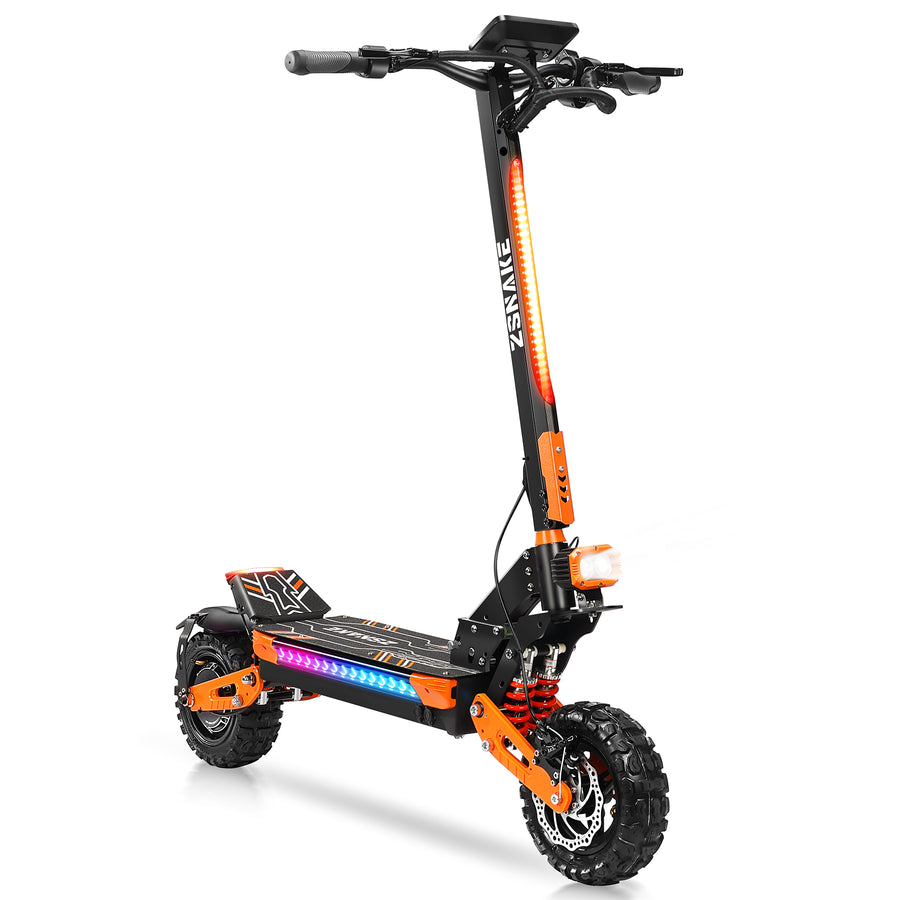
From our experience at TopRiding, a 500-watt motor serves as the baseline for capable adult commuting. While lower-wattage models (250W or 350W) struggle with inclines and heavier payloads, a 500W motor provides a balanced blend of torque and top-end speed. However, speed is never determined by wattage alone in a vacuum. In this technical article, we will thoroughly explore how fast will a 500W electric scooter go under various real-world conditions, contrast it with high-powered alternatives like the 2800W TopRiding ZSNAKE Z35, and help you determine the exact specifications required for your riding environment.
1. The Baseline: How Fast Will a 500W Electric Scooter Go?
Under optimal conditions—riding on smooth, flat asphalt with a fully charged battery and an average rider weight of 165 lbs (75 kg)—how fast will a 500W electric scooter go? You can generally expect a continuous top speed ranging between 18 MPH and 22 MPH (29 km/h to 35 km/h). This speed bracket is considered the sweet spot for urban commuting, allowing riders to keep pace with localized city traffic and navigate bike lanes efficiently. For riders seeking speeds in this exact commuting tier, you can explore our resources on the best 25 mph electric scooters.
It is crucial to differentiate between "continuous power" and "peak power." A scooter advertised with a 500W continuous motor may actually peak at 700W or 800W during sudden acceleration or while climbing a steep hill. This peak power burst ensures that the speed a 500W electric scooter go does not instantly drop the moment you hit a slight gradient. However, if your daily commute involves aggressive hills or you require a higher payload capacity, a standard 500W motor will quickly reveal its limitations, forcing the top speed down significantly.
2. Real-World Variables Impacting Top Speed
While lab tests dictate a maximum threshold, several environmental and mechanical variables dictate how fast will a 500W electric scooter go in the real world. From our experience, we recommend that riders factor in the following elements when evaluating potential top speeds:
-
Rider Weight and Payload: Gravity and friction are the primary adversaries of an electric motor. A 500W scooter carrying a 220-lb rider will experience a slower acceleration curve and a lower top speed compared to a 150-lb rider. For heavier adults, pushing a 500W motor to its limit causes excessive battery drain. We highly recommend reviewing our guide on the electric scooter for 400 lbs weight capacity for appropriate alternatives.
-
Battery Voltage: Wattage measures power output, but voltage acts as the "pressure" delivering that power. A 500W motor paired with a 48V battery will achieve higher top speeds and maintain performance longer than the same motor paired with a 36V battery. As the battery depletes, voltage drop occurs, meaning the speed a 500W electric scooter go at 20% battery will be noticeably slower than at 100% capacity.
-
Tire Pressure and Type: Under-inflated pneumatic tires increase rolling resistance. Solid tires, while immune to flats, offer less traction and a rougher ride, slightly diminishing overall kinetic efficiency.
-
Wind and Aerodynamics: Riding into a strong headwind forces the motor to work harder. At speeds approaching 20 MPH, aerodynamic drag becomes a significant factor in how fast will a 500W electric scooter go.
3. 500W vs. High-Performance Motors: The ZSNAKE Z35 Advantage
While 500W is adequate for flat, urban environments, many riders quickly outgrow this power tier, desiring faster acceleration, superior hill-climbing torque, and extended range. If you are questioning whether a 500W electric scooter go fast enough for your needs, it is time to look at high-performance alternatives. We recommend the TopRiding ZSNAKE Z35, which represents the pinnacle of premium adult scooters.
Instead of a modest 500W hub, the ZSNAKE Z35 is equipped with a monstrous 2800W brushless motor. This immense power output dramatically shifts the performance paradigm. While a 500W electric scooter go 20 MPH and struggles on 10-degree inclines, the ZSNAKE Z35 delivers a thrilling top speed of 33 MPH and easily conquers inclines up to 25 degrees. Furthermore, the ZSNAKE Z35 supports a maximum rider load of 330 lbs, ensuring that performance does not degrade for heavier riders. For those interested in the absolute limits of micromobility, you can also read our review of the most powerful electric scooters in the world.
4. The Role of Battery Voltage and Range
When assessing how fast will a 500W electric scooter go, one must also examine the energy reservoir. A typical 500W scooter features a 36V or 48V battery with a capacity of 10Ah to 13Ah, yielding a real-world range of roughly 15 to 22 miles. However, riding continuously at top speed drastically reduces this range due to high amperage draw.
In contrast, high-power models require massive energy reserves. The TopRiding ZSNAKE Z35 utilizes a premium 60V 15AH lithium battery managed by an Intelligent Battery Management System (BMS). This 60V architecture is crucial; it provides the sustained high voltage required to push the 2800W motor to 33 MPH without suffering from immediate voltage sag. The result is a substantial max range of 35 miles on a single charge. Additionally, the ZSNAKE Z35 features dual charging ports, reducing the charging time to a mere 3-5 hours when using two chargers, keeping you on the road longer.
5. Terrain, Suspension, and Ride Comfort
A frequent constraint of the 500W tier is its inability to handle off-road terrain. Generally, to keep costs low, manufacturers equip 500W scooters with basic spring suspension and standard 8.5-inch street tires. If you attempt to take a 500W scooter off the pavement, the motor lacks the torque to push through dirt, and the small tires sink into soft ground.
From our experience, true all-terrain capability requires both massive power and robust structural engineering. We recommend the ZSNAKE Z35 for enthusiasts seeking off-road dominance. It features 11″ Off-Road Explosion-Proof Fat Tires and a sophisticated Front & Rear dual spring suspension system. This setup absorbs massive impacts from rocks, roots, and urban potholes, providing a stable, cloud-like ride at high speeds. For more insights on off-road capable models, check our guide on the best off-road electric scooters under 1000 and the top off-road scooters for adults.
6. Legal Speed Limits and Safety Compliance
When determining how fast will a 500W electric scooter go, it is important to acknowledge that many jurisdictions legally cap the speed of electric scooters. In numerous US states and European countries, public street and bike lane speed limits are restricted to 15 MPH or 20 MPH. Therefore, a 500W scooter is often electronically governed to comply with these local regulations.
If you purchase an unrestricted high-speed scooter like the ZSNAKE Z35 (capable of 33 MPH) or explore the best 50 mph electric scooters 2026, these higher speeds should be reserved for private property, closed tracks, or off-road trails. Regardless of the speed, safety is paramount. The ZSNAKE Z35 ensures optimal control via front and rear disc brakes, providing immediate stopping power. Furthermore, it is fully UL2272 compliant, ensuring the 60V lithium battery has passed rigorous electrical and fire safety testing. Visibility is also guaranteed through its 2 front LED headlights and striking 360° LED ambient lighting.
7. Summary Table: 500W vs. 2800W Specifications
To provide a clear engineering comparison, the table below illustrates the stark differences between a standard 500W commuter scooter and the 2800W TopRiding ZSNAKE Z35.
| Specification Feature |
Standard 500W Commuter Scooter |
TopRiding ZSNAKE Z35 |
| Motor Power |
500W Continuous (Rear Hub) |
2800W Brushless Motor |
| Top Speed |
18 - 22 MPH |
33 MPH |
| Battery System |
36V or 48V (10Ah - 13Ah) |
60V 15AH Lithium Battery with Intelligent BMS |
| Max Range |
15 - 22 Miles |
Up to 35 Miles |
| Climbing Ability |
10° - 15° Incline |
Up to 25° Incline |
| Tires |
8.5" to 10" Street Tires |
11″ Off-Road Explosion-Proof Fat Tires |
| Max Rider Load |
220 LBS |
330 LBS |
| Suspension & Brakes |
Basic Spring / Drum Brakes |
Front & Rear Dual Spring / Dual Disc Brakes |
8. Frequently Asked Questions (FAQs)
How fast will a 500W electric scooter go up a steep hill?
While a 500W electric scooter go roughly 20 MPH on flat ground, its speed will drop significantly on a steep hill. On inclines exceeding 10 to 15 degrees, a 500W motor may slow down to 8-10 MPH or struggle entirely if the rider weighs over 200 lbs. For steep hills, a high-torque model like the ZSNAKE Z35 is strongly recommended.
Is a 500W scooter fast enough for daily commuting?
Yes. From our experience, for the average adult navigating urban streets and dedicated bike lanes, the 18 to 22 MPH top speed provided by a 500W motor is perfectly adequate and aligns with most municipal speed limits. For those seeking highly portable options in this power range, check out our guide on the
best lightweight electric scooters for adults.
Can I make my 500W electric scooter go faster?
In some cases, you can bypass the electronic speed limiter via the scooter's LCD display settings or an accompanying app. However, removing the limiter will drain the battery much faster and may void your warranty. The physical limitation of the motor and battery voltage means that to achieve true high speeds, you must upgrade the hardware entirely.
9. Authoritative References
To ensure a comprehensive understanding of electric vehicle safety standards, motor physics, and road compliance, we recommend reviewing the following authoritative resources: