Introduction: Powering the Extreme Riding Experience
The electrification of personal transport has fundamentally transformed outdoor recreation, pushing the boundaries of what two-wheeled vehicles can achieve in challenging environments. As extreme sports enthusiasts and daily commuters increasingly abandon paved roads for rugged trails, a critical technical question dominates the purchasing process: exactly how long does an off-road scooter battery last? From our experience at TopRiding, answering this question requires a comprehensive understanding of lithium-ion chemistry, motor power draw, payload capacities, and intelligent power management systems.

High-performance electric vehicles operating in dirt, gravel, and steep inclines face immense energetic demands compared to their urban counterparts. When you navigate a 45-degree incline, the amperage drawn from the power cells spikes exponentially. Therefore, evaluating how long an off-road scooter battery lasts is not a simple matter of reading a brochure; it requires analyzing the synergy between the battery's voltage and amp-hour rating against the machine's mechanical output. In this authoritative guide, we will dissect the engineering behind extreme mobility powerplants, detailing exactly what you can expect in terms of both daily range and multi-year longevity.
Defining the Metric: Per-Charge Range vs. Total Lifecycle
When consumers ask how long does an off-road scooter battery last, they are typically conflating two distinct engineering metrics: the per-charge range (measured in miles or hours of continuous riding) and the total hardware lifecycle (measured in charge cycles or years of service before replacement is necessary). To provide a professional assessment, we must separate these variables.
The per-charge range is entirely dependent on the total watt-hours (Wh) stored within the deck and how aggressively that energy is depleted by the motors. Conversely, the total lifecycle determines how long an off-road scooter battery lasts before its maximum capacity degrades below 80 percent of its original factory specification. Both metrics are heavily influenced by rider habits, environmental temperatures, and the sophisticated electronics managing the power flow.
Factors Influencing How Long an Off-Road Scooter Battery Lasts Per Charge

To accurately estimate your ride time on a single charge, you must account for the physical forces acting against the vehicle. Off-road riding introduces severe rolling resistance and gravitational challenges that directly impact how long an off-road scooter battery lasts.
Motor Power Output and Terrain Demands
The primary consumer of electrical energy is the motor configuration. Extreme terrain requires massive torque to prevent stalling. When traversing mud, loose gravel, or steep mountainous paths, the rolling resistance forces the motors to draw maximum continuous amperage. If you are climbing an incline, gravity constantly pulls against the forward momentum, resulting in rapid battery depletion. We recommend calculating your expected range by factoring in the terrain; a battery that provides 60 miles on flat asphalt may only provide 35 miles on a continuous, aggressive mountain trail.
Rider Payload and Aerodynamic Drag
Physics dictates that moving a heavier mass requires more energy. The net weight of the vehicle combined with the rider's weight dictates the base power consumption. High-end machines are designed to accommodate significant payloads, sometimes up to 440 lbs. However, pushing that maximum weight limit will predictably reduce how long an off-road scooter battery lasts per charge. Additionally, at high speeds, aerodynamic drag becomes a severe energy sink. Riding in an upright, un-tucked position at high velocities forces the battery to work exponentially harder to maintain speed.
Riding Modes and Throttle Management
Modern power controllers offer variable output settings. Aggressive acceleration and constant top-speed riding will drastically reduce how long an off-road scooter battery lasts. Conversely, utilizing an ECO mode, which limits the maximum amperage sent to the motors, can stretch your ride time by hours. Intelligent throttle management—coasting where possible and applying gradual acceleration rather than pinning the throttle—is the most effective way a rider can manually extend their per-charge range.
Total Lifecycle: How Long Does an Off-Road Scooter Battery Last in Years?
Beyond the daily ride, owners need to know the financial implications of battery degradation. So, in terms of hardware longevity, how long does an off-road scooter battery last? Premium lithium-ion cells used in high-performance mobility are typically rated for 500 to 1,000 full charge cycles. A charge cycle is defined as completely draining the battery from 100 percent to 0 percent and recharging it back to full.
For the average enthusiast riding aggressively twice a week, 500 charge cycles translates to approximately three to five years of optimal performance. After crossing this threshold, the battery does not simply stop working; rather, its maximum capacity permanently degrades. A battery that originally offered 60 miles of range may only provide 45 miles after five years of heavy use. Therefore, when assessing how long an off-road scooter battery lasts, you must plan for a gradual reduction in per-charge range over a multi-year timeline.
Case Study in Endurance: The TopRiding FOHOLO F19
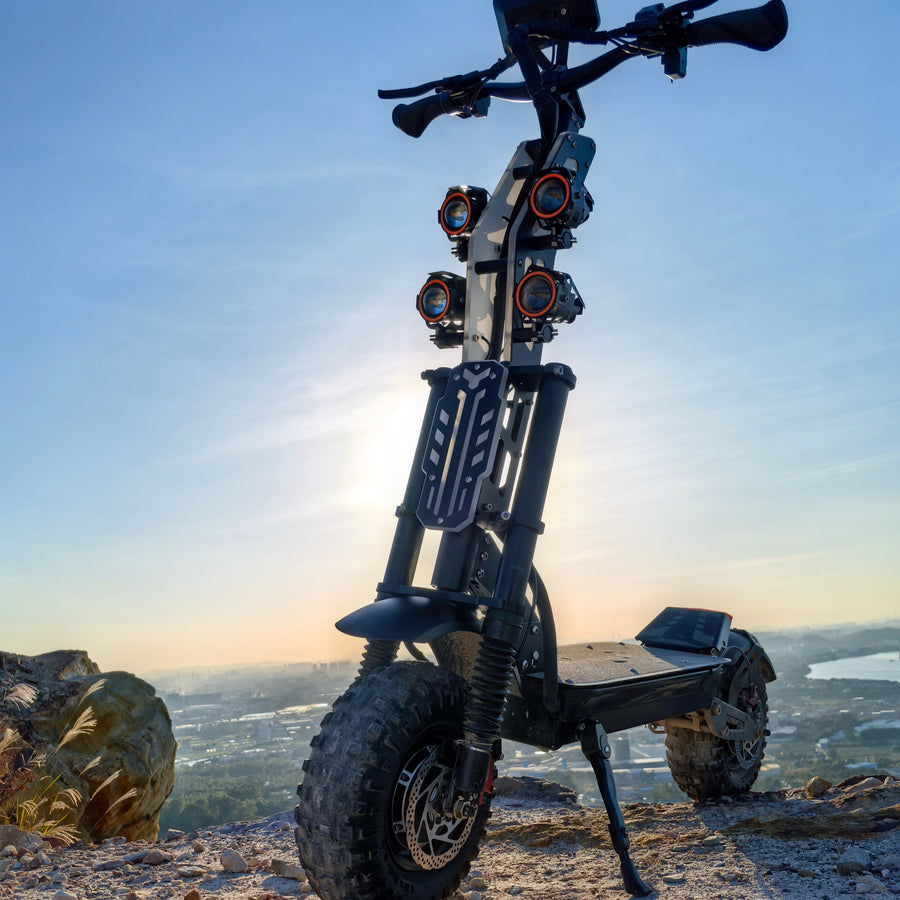
To practically illustrate how modern engineering maximizes both range and lifespan, we present the TopRiding FOHOLO F19. This Super-Fast Long Range Electric Scooter perfectly answers the question of how long does an off-road scooter battery last by integrating massive capacity with intelligent power management.
At the heart of the FOHOLO F19 is a massive 60V 33AH lithium battery. This high-voltage, high-capacity reservoir is strictly necessary to feed the 7000W dual brushless motor (3500W x 2). Despite this staggering power output—capable of propelling the 105 lbs chassis to a top speed of 55 MPH and conquering up to 45-degree inclines—the efficient power delivery ensures a max range of 65+ miles under optimal conditions. This proves that high performance does not have to compromise how long an off-road scooter battery lasts on a single ride.
From our experience, managing 7000 watts of power requires sophisticated hardware. The FOHOLO F19 utilizes an Intelligent Battery Management System (BMS) that actively balances cell voltage, prevents thermal runaway, and protects against deep discharge, directly extending the multi-year lifespan of the pack. To minimize downtime, the deck is equipped with 2 chargers and 2 charging ports, effectively halving the charging time to a highly efficient 5-8 hours.
Furthermore, the vehicle's structural components impact energy efficiency. The 13-inch All-Terrain Explosion-Proof Fat Tires provide maximum traction, preventing the motors from wasting energy spinning in the mud. The Triple Clamp Hydraulic Fork and Dual Spring Rear suspension keep the tires planted, ensuring continuous forward momentum. Finally, the rider has absolute control over how long an off-road scooter battery lasts via the 6 + 1 Riding Modes (Sport x3, Standard x3, ECO), all selectable on the large multi-function LCD. Fully compliant with UL2272 certification, the FOHOLO F19 sets the industry standard for safe, enduring power.
Expert Maintenance Tips to Extend Battery Longevity
The lifespan of your lithium-ion cells is not entirely predetermined by the manufacturer. How you store, charge, and ride your vehicle plays a massive role in dictating how long an off-road scooter battery lasts. We recommend adhering to the following professional maintenance protocols to protect your investment.
-
Avoid Deep Discharges: Lithium-ion chemistry degrades rapidly if repeatedly drained to zero percent. We recommend treating 20 percent as your absolute minimum threshold. Recharge the unit before it completely dies to reduce stress on the cells.
-
Maintain Optimal Storage Voltages: If you are storing the vehicle for the winter, do not leave it at 100 percent or 0 percent. Storing a lithium battery at approximately 50 to 60 percent charge in a climate-controlled environment is the proven method to maximize how long an off-road scooter battery lasts over years of ownership.
-
Manage Thermal Extremes: Heat is the ultimate enemy of battery chemistry. Avoid leaving your vehicle in direct sunlight or the trunk of a hot car for extended periods. Conversely, charging a battery when its internal temperature is below freezing can cause permanent lithium plating. Always allow the deck to reach room temperature before plugging it in.
-
Utilize the Intelligent BMS: Trust the built-in electronics. Ensure you only use the factory-supplied chargers (such as the dual charger setup on the FOHOLO F19) that are specifically calibrated to communicate with the onboard Intelligent BMS.
Summary Table: Battery Performance Metrics
To assist riders in calculating their expected endurance, we have compiled a responsive reference matrix illustrating how different variables impact how long an off-road scooter battery lasts.
| Operating Variable |
Impact on Per-Charge Range |
Impact on Total Lifecycle (Years) |
| Riding in ECO Mode |
Significantly Increases (Maximizes the 65+ mile potential) |
Increases (Lowers thermal stress on cells) |
| Riding in Sport Mode (55 MPH) |
Significantly Decreases (High continuous amp draw) |
Decreases Slightly (Higher heat generation) |
| Max Payload (e.g., 440 LBS) |
Decreases (Requires more torque to overcome inertia) |
Neutral (Unless constantly riding up steep inclines) |
| Frequent 45° Incline Climbing |
Drastically Decreases (Maximum motor strain) |
Decreases (Causes rapid heat buildup in the battery pack) |
| Charging with Dual 2-Port Chargers |
Neutral (Restores range in 5-8 hours) |
Neutral (Provided they are OEM chargers communicating with BMS) |
Frequently Asked Questions (FAQs)
Does leaving my scooter plugged in overnight ruin the battery?
Modern high-end vehicles equipped with an Intelligent BMS, such as the TopRiding FOHOLO F19, are designed to automatically cut off the current once the 60V 33AH lithium battery reaches 100 percent capacity. However, from our experience, routinely leaving it plugged in for days after it is fully charged can hold the cells at maximum voltage tension, which slightly reduces how long an off-road scooter battery lasts over several years. We recommend unplugging it once the charger indicator turns green.
How long does an off-road scooter battery last if I only ride it in the winter?
Cold temperatures temporarily increase internal electrical resistance within lithium-ion cells. If you ride in sub-freezing conditions, you will notice a temporary drop in your per-charge range (sometimes up to a 20 percent reduction). This is a temporary chemical limitation, not permanent damage. However, you must never charge the battery while it is physically freezing, as this will permanently ruin how long an off-road scooter battery lasts.
Why do I need hydraulic disc brakes on a high-powered scooter?
When operating a vehicle equipped with a 7000W dual brushless motor capable of 55 MPH, standard mechanical brakes are entirely insufficient to dissipate the massive kinetic energy generated. Hydraulic disc brakes provide superior stopping power, precise modulation, and fade resistance. While this does not directly affect how long an off-road scooter battery lasts, it is a non-negotiable safety feature required to manage extreme velocity and heavy payloads up to 440 lbs.
What does UL2272 compliance mean for my battery?
UL2272 is a rigorous international safety certification that tests the electrical drive train system, battery, and charger combinations for fire and electrical hazards. A vehicle with UL2272 compliance guarantees that the battery pack has survived brutal short-circuit, overcharge, and thermal runaway testing. It is the ultimate assurance of safety and heavily contributes to how long an off-road scooter battery lasts without catastrophic failure.
Industry References
To further support our technical analysis of lithium-ion chemistry, intelligent power management, and electric vehicle safety standards, we recommend reviewing the following authoritative organizations:


