Every motorcycling season, urban commuters, long-distance tourers, and speed enthusiasts ask the exact same provocative question: are there 1000cc scooters on the market today? Riders love the idea of combining the effortless twist-and-go convenience, weather protection, and plush step-through ergonomics of a scooter with the blistering acceleration and highway-passing muscle of a 1000cc liter-class superbike. Yet, when prospective buyers browse showroom floors or search dealership inventories, they hit a confusing wall of 300cc commuters, 500cc twin-cylinders, and 750cc adventure crossovers, but never an official 1000cc badge. In the powersports industry, manufacturers face strict laws of mechanical physics, transmission thermal limits, and chassis dynamics. As experienced riders and hardware specialists who test everything from high-displacement engines to cutting-edge brushless electric drivetrains, we take an uncompromising look at why the true 1000cc scooter remains an elusive mechanical unicorn, what production machines came closest, and whether chasing four-digit engine displacement is actually worth your money when superior modern alternatives exist.

Quick Answer: Are There 1000cc Scooters in Production?
The definitive answer to whether are there 1000cc scooters is no, there are no mass-production 1000cc gas scooters available on the global market today. The absolute pinnacle of production scooter displacement peaked with the Italian-engineered Aprilia SRV 850 (and its predecessor, the Gilera GP 800), which utilized an 839.3cc 90-degree V-twin engine generating 76 horsepower and reaching 120 mph. Currently, the largest modern production maxi-scooter is the Honda Forza 750 / X-ADV 750 platform (745cc twin-cylinder with Dual Clutch Transmission), followed by legacy icons like the Suzuki Burgman 650 and Yamaha TMAX 560. Manufacturers deliberately avoid the 1000cc threshold because the immense torque shreds traditional continuously variable transmission (CVT) rubber belts, step-through frames suffer structural flex, and curb weight balloons past 600 pounds, defeating the purpose of a scooter. If your primary goal is rapid acceleration, effortless hill climbing, and high-speed personal transit without wrestling a massive 600-pound gas machine, modern high-torque electric platforms like those featured in our Fast electric scooters for adults deliver the punch you want without the maintenance nightmare.
The 1000cc Scooter Myth: Separating Internet Rumors from Production Reality
When investigating whether are there 1000cc scooters, riders frequently encounter viral social media clips showing custom garage builds: a stretched Yamaha TMAX fitted with a turbocharged Yamaha YZF-R1 engine, or a stripped-down drag frame housing a 1000cc Honda CBR motor. While these custom engineering projects prove that a talented mechanic can shoehorn a liter-class motorcycle engine into a scooter chassis with custom steel welding, they are not production vehicles. They lack weather protection, have no under-seat storage, run manual sequential foot shifters, and are borderline unrideable in regular traffic.
In the commercial manufacturing sector, major powersports brands like Honda, Yamaha, Suzuki, BMW, and Piaggio/Aprilia have repeatedly analyzed the business case for a 1000cc scooter and walked away. The term scooter historically implies three foundational design principles:
-
Step-Through Architecture: A low central tunnel or open floorboard allowing the rider to mount without swinging a leg over a high fuel tank.
-
Twist-and-Go Automatic Transmission: No manual clutch lever and no foot-operated gear shifter.
-
Integrated Weather Protection and Storage: Enclosed bodywork, leg shields, a windscreen, and cavernous under-seat cargo space.
From our experience testing large-bore two-wheelers, once an internal combustion engine crosses the 800cc mark, those three foundational scooter benefits collapse under mechanical compromises. The structural bracing needed to prevent high-speed speed wobbles fills in the step-through floorboard. The massive engine cases eliminate under-seat storage. The cooling radiators require wide automotive-scale fairings. Ultimately, you end up with a vehicle that weighs as much as a Honda Gold Wing, costs as much as a sport-touring motorcycle, yet lacks the pure structural rigidity of an aluminum perimeter motorcycle frame.
Quick Summary Table: The Largest Scooters in Production History
| Vehicle Model |
Actual Engine Displacement |
Engine & Transmission Architecture |
Power & Torque Output |
Curb Weight |
Top Speed |
| Aprilia SRV 850 (The Record Holder) |
839.3cc |
90° V-Twin, 8-Valve SOHC; Heavy-Duty CVT Belt |
76.0 HP / 56.4 lb-ft |
549 lbs (249 kg) dry |
120 MPH (193 km/h) |
| Gilera GP 800 |
839.3cc |
90° V-Twin, Liquid-Cooled; Automatic CVT |
75.0 HP / 53.8 lb-ft |
540 lbs (245 kg) dry |
118 MPH (190 km/h) |
| Honda Forza 750 / X-ADV 750 |
745.0cc |
Parallel-Twin SOHC; 6-Speed Dual Clutch (DCT) |
57.8 HP / 50.9 lb-ft |
520 lbs (236 kg) wet |
106 MPH (171 km/h) |
| BMW C 650 GT / Sport |
647.0cc |
Parallel-Twin, DOHC; Stepless CVT Automatic |
60.0 HP / 48.7 lb-ft |
575 lbs (261 kg) wet |
112 MPH (180 km/h) |
| Suzuki Burgman 650 Executive |
638.0cc |
Parallel-Twin, DOHC; Electronically Controlled SECVT |
54.0 HP / 45.7 lb-ft |
613 lbs (278 kg) wet |
110 MPH (177 km/h) |
| Yamaha TMAX 560 Tech MAX |
562.0cc |
Forward-Inclined Parallel Twin; V-Belt Automatic |
47.6 HP / 41.1 lb-ft |
485 lbs (220 kg) wet |
103 MPH (165 km/h) |
Why Manufacturers Do Not Build 1000cc Scooters: The Engineering Roadblocks
When asking whether are there 1000cc scooters, one must examine the severe mechanical challenges that engineers face when attempting to scale scooter components to liter-bike output levels. In modern motorcycle design, four insurmountable engineering barriers prevent 1000cc production scooters from reaching showroom floors:
1. The Mechanical Friction and Thermal Limits of the CVT Belt
The vast majority of scooters rely on a continuously variable transmission (CVT). A CVT uses a drive pulley connected to the crankshaft, a driven pulley connected to the rear wheel, and a heavy-duty reinforced rubber or aramid-fiber belt running between cone-shaped sheaves. The transmission changes gear ratios dynamically via centrifugal rollers or electronic servos as engine RPM changes.
In our testing across high-displacement powertrains, CVTs function reliably up to about 50 to 60 horsepower. Beyond that threshold, the sheer rotational torque generated by a 1000cc engine (typically 75 to 85 lb-ft of torque) induces massive friction. Under heavy acceleration, the rubber belt slips against the steel pulleys, generating intense thermal energy. The internal transmission case turns into an oven, degrading the elastomeric compounds in the belt and causing catastrophic belt snaps within a few thousand miles. Aprilia had to engineer a massive, bespoke Kevlar-reinforced drive belt paired with an exposed final chain drive just to survive the 76 horsepower of their 839cc twin; scaling that to 100+ horsepower makes the transmission impractically large and maintenance-heavy.
2. Structural Torsional Flex in Step-Through Frames
A conventional motorcycle gets its structural rigidity from an overhead aluminum twin-spar or tubular steel trellis frame that connects the front steering head directly to the rear swingarm pivot in a straight line over the top of the engine. A scooter, by contrast, relies on a "step-through" or "underbone" frame geometry where the steel tubes dip down low between the rider's feet.
When accelerating at high speeds, a 1000cc engine exerts immense twisting forces on the frame. Without an upper structural spine, an underbone chassis flexes along its longitudinal axis under heavy throttle or aggressive cornering. This frame flex causes terrifying high-speed weaves and wobble oscillations that endanger the rider. Reinforcing an underbone frame to handle 1000cc forces requires heavy steel gusseting that completely fills in the center floorboard, effectively turning the machine into a motorcycle with body cladding.
3. Extreme Unsprung Weight and Rear Suspension Packaging
In traditional small and mid-size scooters, the engine, transmission, and swingarm are built as a single unified unit that pivots with the rear wheel. Every time the rear tire hits a pothole, the entire weight of the engine bounces up and down. This represents unsprung mass. While high-end maxi-scooters mount the engine firmly inside the central frame to mitigate this, packaging a 1000cc twin or four-cylinder engine alongside an automatic transmission, exhaust catalytic converters, fuel injection manifolds, and rear suspension linkages leaves zero room for the rider's legs or under-seat storage.
4. Severe Curb Weight Penalties
A Suzuki Burgman 650 already tips the scales at an immense 613 pounds (278 kg) wet. Scaling that powertrain to a 1000cc engine pushes total curb weight well past 650 to 680 pounds. At that weight, maneuvering the scooter at parking-lot speeds, paddling backward out of a driveway, or filtering through urban gridlock becomes exhausting and dangerous for all but the largest riders.
The Closest Contenders: The 4 Largest Maxi-Scooters Ever Built
While the market has never seen a true 1000cc model, several brave manufacturers pushed displacement limits into territory that came remarkably close. These four machines represent the outer limits of large-bore scooter engineering:
1. Aprilia SRV 850 (The Discontinued Super-Scooter King)
Produced between 2012 and 2016, the Aprilia SRV 850 remains the undisputed heavyweight champion of production scooter displacement. Sharing its mechanical platform with the earlier Gilera GP 800, the SRV 850 was styled after Aprilia's RSV4 superbike, complete with triple headlamps and aggressive aerodynamic winglets.
Power came from an 839.3cc 90-degree V-twin engine breathing through a single 38mm throttle body with twin spark plugs. It generated a staggering 76 horsepower at 7,750 RPM and 56.4 lb-ft of torque. Unlike typical scooters, the SRV 850's engine was mounted solidly in a double-cradle steel frame, transferring power through a heavy CVT and a final enclosed chain drive. Cracking the throttle resulted in genuine 120-mph top speeds. However, its 549-pound dry weight, high fuel consumption, and complex maintenance cycles made it a niche commercial product that was eventually dropped when Euro 4 emissions standards took effect.
2. Honda X-ADV 750 / Forza 750 (The Smart Modern Approach)
Recognizing the inherent limits of rubber CVT belts, Honda approached large-displacement automatic riding from a completely different engineering angle. Instead of using a CVT, Honda utilizes a 745cc parallel-twin engine paired with their automotive-derived Dual Clutch Transmission (DCT).
The DCT uses real, computer-controlled steel gears and dual wet clutches. It provides true twist-and-go automatic riding with zero manual clutching, yet eliminates the slipping, thermal buildup, and power loss of a rubber belt. Pumping out 57.8 horsepower and 50.9 lb-ft of torque, the X-ADV 750 handles highway speeds with ease while offering rugged, crossover styling. For urban commuters wanting highway capability, the Forza/X-ADV platform is the most technologically refined heavy-displacement automatic two-wheeler in production today.
3. Suzuki Burgman 650 Executive (The Two-Wheeled Luxury Sedan)
For nearly two decades, the Suzuki Burgman 650 stood as the gold standard of luxury touring scooters. Powered by a 638cc parallel-twin engine, its defining engineering achievement was the Suzuki Electronically-controlled Continuously Variable Transmission (SECVT). Riders could choose between standard fully automatic drive modes or switch into manual mode, selecting pre-programmed digital gear ratios via handlebar-mounted push buttons.
With an electronically adjustable windshield, heated grips, heated seats, and 50 liters of under-seat storage capable of swallowing two full-face helmets, the Burgman 650 was a luxury touring machine. However, at 613 pounds wet, it was heavier than many 1000cc adventure motorcycles, and overhauling a worn SECVT transmission frequently cost more than the market value of a used scooter.
4. BMW C 650 GT (Bavarian Highway Mile-Eater)
BMW entered the maxi-scooter market with the C 650 GT, targeting riders who wanted BMW RT touring luxury in an automatic commuter format. Utilizing a 647cc parallel-twin engine engineered by BMW and built by Kymco, it produced a healthy 60 horsepower and 48.7 lb-ft of torque.
The C 650 GT featured advanced rider aids, including optional Blind Spot Detection radar, ABS brakes, and automated stability control. It cruise effortlessly at 85 mph on North American interstates. Yet, like its Japanese competitors, it struggled with high acquisition costs ($11,000+ MSRP) and heavy curb weight that discouraged entry-level riders.
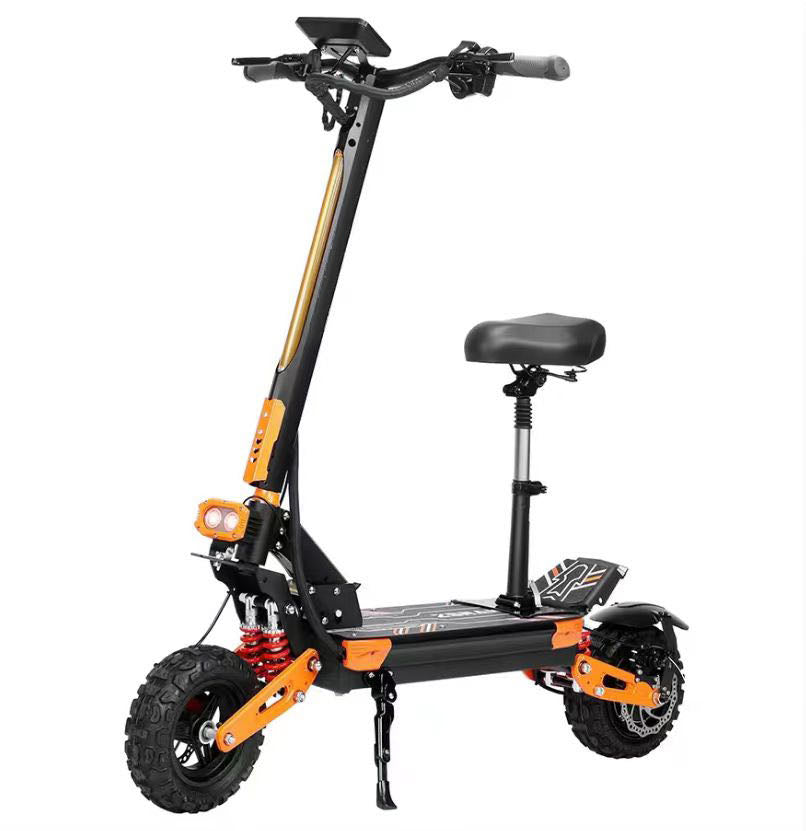
High-Torque Modern Alternative: TopRiding ZSNAKE Z35
If you are exploring whether are there 1000cc scooters because you crave instant passing power, rapid acceleration, and heavy-duty load capacity without the 600-pound bulk, gas bills, and clutch maintenance of an oversized motorcycle, modern high-power electric platforms deliver the torque you need.
| Motor Architecture |
High-Output 2800W Brushless Single Motor (Instant Electronic Torque) |
| Battery Chemistry |
Heavy-Duty 60V 15Ah High-Capacity Lithium-Ion Battery (DUAL Port Charging) |
| Top Speed & Range |
33 MPH Top Velocity; up to 35 Miles Maximum Operating Range |
| Chassis & Safety |
UL 2272 Electrical Fire Safety Certified; Heavy-Duty Full Spring Suspension |
| Tires & Braking |
11-inch Off-Road Pneumatic Fat Tires; Front and Rear Mechanical Disc Brakes |
| Payload Rating |
Engineered for Adult Riders up to a Maximum Load of 330 LBS |
Rider Recommendation: Discover how instant brushless electric torque eliminates gas engine weight and CVT maintenance on the TopRiding ZSNAKE Z35 Product Portal, or explore our curated selection of Top off-road scooters for adults.
Direct Technical Comparison: Maxi-Scooter vs. Electric Hyper-Scooter vs. 1000cc Motorcycle
| Performance Attribute |
Heavy Gas Maxi-Scooter (Aprilia SRV 850 / Burgman 650) |
High-Power Electric Scooter (TopRiding ZSNAKE Class) |
True 1000cc Sport/Touring Motorcycle (e.g., Kawasaki Ninja 1000SX) |
| 0 to 30 MPH Acceleration |
Moderate (CVT belt windup delay) |
Instantaneous (Immediate peak electric torque) |
Fast (Requires skilled clutch feathering) |
| Curb Weight & Handling |
Extremely Heavy (540 to 615 lbs) |
Light & Portable (70 to 85 lbs) |
Heavy (500 to 520 lbs) |
| Transmission Maintenance |
High (Frequent belt, roller & fluid changes) |
Zero (Direct-drive hub motor; no belts/gears) |
Moderate (Chain cleaning, oil changes, clutch plates) |
| Licensing & Endorsement |
Full Motorcycle License (M1/M2) mandatory |
Standard driver's license or no endorsement in most states |
Full Motorcycle License (M1/M2) mandatory |
| Fuel / Operating Expense |
High ($4.00+/gal premium gas + oil filters) |
Fractional pennies per charge from standard 110V wall outlet |
High ($4.00+/gal premium fuel + tune-ups) |
| Urban Storage & Parking |
Requires full motorcycle street parking space |
Folds up into apartment, office, or vehicle trunk |
Requires dedicated parking spot or garage |
Pros and Cons of Heavyweight High-Displacement Scooters
| Powertrain Classification |
Real-World Advantages (Pros) |
Operational Liabilities & Drawbacks (Cons) |
Large-Bore Gas Maxi-Scooters
(650cc to 850cc Twin-Cylinder) |
- Relaxed, low-RPM highway cruising at 75 to 85 MPH.
- Spacious under-seat storage swallows full-face helmets and groceries.
- Broad windshields and fairings deflect rain and highway wind buffeting.
- No manual clutch lever to fatigue your hand in stop-and-go traffic.
|
- Exorbitant curb weight (550+ lbs) makes parking maneuvers difficult.
- CVT belt replacements can cost $400 to $900 in shop labor.
- High purchase price rivaling full-size adventure motorcycles.
- Poor fuel efficiency (38 to 48 MPG) compared to standard commuter scooters.
|
Modern High-Torque Electric Scooters
(2000W+ Brushless Drivetrains) |
- Instant torque delivery out accelerates gas engines from a dead stop.
- Zero gasoline, zero engine oil, zero CVT belts, and zero tailpipe emissions.
- Foldable frames store easily inside apartments, elevators, and trunks.
- Significantly lower purchase and operating costs.
|
- Limited top speed (typically 30 to 45 MPH) compared to highway motorcycles.
- Cannot legally operate on limited-access interstate freeways.
- Battery range requires planning for multi-hour recharging cycles.
|
Who Benefits from Large Maxi-Scooters vs. Who Should Choose Electric Power
Every dollar committed to personal transit must match your daily route, storage reality, and licensing status. Understanding these trade-offs helps you determine whether a heavy maxi-scooter makes sense, or if an electric alternative is the smarter move.
Who Should Buy a 650cc to 750cc Maxi-Scooter:
-
Long-Distance Interstate Commuters (40+ Miles Each Way): If your daily commute requires traveling at 70 to 80 mph down multi-lane interstate freeways alongside commercial semi-trucks, a 650cc to 750cc twin-cylinder machine like the Honda X-ADV or Suzuki Burgman provides the physical mass and horsepower needed for highway survival.
-
Two-Up Touring Couples: If you and a passenger want to tour scenic mountain byways together on weekends without managing a manual clutch, the spacious pillion seat, backrest, and luggage capacity of a maxi-scooter deliver exceptional touring comfort.
Who Should Choose a High-Torque Electric Scooter Instead:
-
Urban and Suburban Daily Commuters (Under 20 Miles): If your daily travel consists of city streets, secondary roads, and campus corridors with speed limits between 25 and 45 mph, a heavy gas maxi-scooter is overkill. Deploying practical Electric scooters for commuting daily use gets you through traffic faster, lets you filter past gridlock, and eliminates parking fees entirely.
-
Heavyweight Riders Demanding Real Hill-Climbing Muscle: Adult riders carrying extra body weight often think they need a massive gas engine to climb steep neighborhood hills. In reality, instantaneous electric torque crushes steep inclines effortlessly. Review our technical guide on whether Can a 300 lb person ride an electric scooter to understand how high-wattage brushless electric hub motors deliver instant hill-climbing power.
-
Apartment Dwellers Without Private Garages: Storing a 600-pound gas scooter on city streets leaves it vulnerable to weather and theft. High-performance electric scooters fold down in seconds, wheel into elevators, and store safely inside your apartment.
Common Mistakes Buyers Make When Chasing Scooter Displacement
Rider Safety Advisory: The most dangerous mistake new riders make is assuming that because a machine is called a "scooter," it is gentle and easy to handle. An 850cc maxi-scooter weighs nearly 600 pounds, reaches 120 mph, and hits 60 mph in under 5.5 seconds. Treating it like an entry-level 50cc moped leads straight to high-speed crashes.
-
Assuming Large Scooters Are Exempt from Motorcycle Licensing: A surprisingly common myth is that scooters never require a motorcycle license. In all 50 US states and across Europe, any two-wheeler with an engine larger than 50cc—or capable of speeds over 30 mph—is legally classified as a motorcycle. Riding a 650cc or 850cc maxi-scooter without a full motorcycle endorsement will get your vehicle impounded. Before buying, review regional licensing rules in our breakdown on Do you need a license for an electric scooter and state-specific frameworks like Electric scooter laws in California.
-
Underestimating Ongoing CVT Transmission Maintenance Costs: Buyers focus on the purchase price while ignoring the complex transmission inside. On a heavy maxi-scooter, replacing the internal drive belt, centrifugal variator rollers, and clutch shoes every 10,000 to 15,000 miles requires disassembling half the bike's plastic bodywork, running up steep dealership labor bills.
-
Buying a 600-Pound Maxi-Scooter for Short Inner-City Errands: Buying a Suzuki Burgman 650 or BMW C 650 just to grab coffee three blocks away is an ergonomic nightmare. Wrestling 600 pounds off the center stand, waiting for the liquid-cooled engine to warm up, and trying to park a machine the size of a couch on crowded sidewalks defeats the core purpose of scooter transit.
-
Ignoring Off-Pavement Limitations: Despite having large, comfortable seats, gas maxi-scooters have tiny 14-inch or 15-inch front wheels and low ground clearance. Taking one down a gravel driveway or dirt trail will high-center the exhaust and crack your under-chassis bodywork. If your routes involve mixed dirt and pavement, exploring Can electric scooters go off road shows how dual-suspension, fat-tire electric platforms handle rough terrain with far better agility.
Essential Buying Considerations: Transmissions, Curb Weight, and Legalities
Before putting down cash or financing any high-displacement two-wheeler, evaluate these four critical checkpoints with your practical riding needs in mind:
1. Transmission Type: Rubber CVT vs. Dual Clutch (DCT) vs. Direct Electric
If you are committed to buying a gas-powered maxi-scooter above 600cc, pay close attention to the transmission architecture. Traditional rubber-belt CVTs in high-displacement engines generate considerable heat under aggressive riding. If you want maximum reliability in a large gas displacement machine, choose a platform utilizing an automatic geared transmission, such as Honda's Dual Clutch Transmission (DCT). If you prefer zero maintenance, direct-drive brushless electric hub motors eliminate belts, clutches, and gearboxes entirely.
2. True Wet Curb Weight vs. Physical Garage Strength
Always inspect the wet weight on the manufacturer specification sheet, not the stripped dry weight. A machine claiming 490 pounds dry often weighs over 560 pounds once you add 4 gallons of gasoline, engine oil, radiator coolant, and battery acid. Make sure you can comfortably hold that weight upright at a stoplight on an off-camber hill with a passenger on the back.
3. Real-World Acceleration vs. Top-End Paper Specs
Ask yourself where you actually do 90% of your riding. If you spend your time between 0 and 45 mph on suburban avenues and city streets, having a theoretical 120-mph top speed on highway asphalt is meaningless. High-torque electric motors deliver their full peak torque instantly from zero RPM, meaning a lightweight 2800W electric scooter will frequently beat a heavy 650cc gas maxi-scooter across an intersection to 30 mph.
4. Local Traffic Laws and Route Accessibility
Verify where you can legally ride. Heavy gas scooters must follow all standard motorcycle rules: you cannot ride them in bike lanes, park them at bicycle racks, or push them through pedestrian zones. Understanding operational boundaries—such as our guides on Electric scooter laws in New York and global analysis on Where electric scooters are not allowed—ensures you choose a ride that fits smoothly into your local daily routine.
Expert Sourcing & Riding Verdict
In our professional assessment as powersports technicians and urban mobility specialists, asking whether are there 1000cc scooters leads to an important realization about two-wheeled engineering: a 1000cc gas scooter does not exist because building one breaks the very qualities that make scooters great. Crossing past 800cc turns a scooter into a heavy, complex, heat-stressed machine that costs as much as a luxury touring motorcycle while sacrificing the agility and convenience that riders love.
If your mission requires cruising at 80 mph down multi-lane interstate highways for hours at a time, skip the non-existent 1000cc scooter and buy a proven maxi-scooter like the Honda X-ADV 750 or a pre-owned Suzuki Burgman 650 Executive. You get all the highway stability and weather protection possible in an automatic two-wheeler.
However, if you are searching for a high-power scooter because you want fast acceleration, effortless hill climbing, and heavy-duty adult payload capacity for real-world commuting, do not buy a 600-pound gas machine. Choose a modern, high-torque electric platform like the TopRiding ZSNAKE Z35. By pairing a potent 2800W motor with 11-inch off-road pneumatic tires, front and rear disc brakes, and UL 2272 electrical safety certification, you gain the instant torque and reliable power you want, while leaving heavy frames, oil changes, and CVT belt replacements behind for good.
Frequently Asked Questions
Are there 1000cc scooters currently in mass production?
No major motorcycle or scooter manufacturer currently produces a true 1000cc gas-powered scooter. The largest displacement production maxi-scooter ever built was the Aprilia SRV 850 (and its platform sibling, the Gilera GP 800), which featured an 839cc 90-degree V-twin engine. Any vehicle using a true 1000cc engine is either a custom one-off engineering swap or a conventional sport-touring motorcycle.
Why do manufacturers avoid building 1000cc scooters?
Building a 1000cc scooter introduces severe mechanical challenges: continuously variable transmissions (CVTs) suffer massive thermal and friction breakdown under the heavy torque of a 1000cc engine, structural step-through frames experience excessive torsional flex, and the resulting 600-plus-pound curb weight destroys the agility, low-speed balance, and urban utility that define a scooter.
What is the closest alternative to a 1000cc scooter for fast commuting?
For riders seeking motorcycle-grade power with twist-and-go convenience, the closest gas alternatives are large maxi-scooters like the Honda X-ADV 750, Honda Forza 750, and Suzuki Burgman 650. For urban and suburban riders who prioritize instant torque, lower maintenance, and lightweight control without motorcycle licensing hurdles, high-power electric scooters equipped with 2000W to 3000W motors provide blistering sub-40 mph acceleration.
Do you need a motorcycle license to ride a large-displacement scooter?
Yes. Any gas scooter with an engine displacement exceeding 50cc, or capable of speeds greater than 30 mph, is legally classified as a motorcycle in virtually every jurisdiction across North America and Europe. Riding a 650cc to 850cc maxi-scooter requires a full motorcycle endorsement, valid vehicle registration, and mandatory liability insurance.
Authoritative Automotive Standards & Industry References


