A fat tire electric bike with 1500W peak power can be an excellent choice for riders who regularly deal with steep hills, loose gravel, sand, uneven trails, or heavier loads. But there is a buying mistake we see too often: choosing an e-bike based on its advertised wattage without checking its actual continuous motor rating, battery capacity, torque, brakes, and suspension.
A 1500W peak motor does not necessarily mean a bike delivers 1500W continuously. Some of the most practical models advertise 750W rated power and 1500W peak output. That distinction matters for performance, battery consumption, and legal classification.
For this guide, we compare five fat tire electric bike options and buying configurations, focusing on motor output, battery performance, terrain capability, comfort, and overall value. We also explain where the TopRiding R2 fits into the market and why its combination of a 1500W peak rear hub motor, 1300Wh battery, full suspension, and four-piston hydraulic brakes deserves attention.
Quick Answer: Which 1500W Fat Tire E-Bike Should You Buy?
Our recommendation: If you want a powerful-looking motorcycle-inspired fat tire e-bike with substantial battery capacity and full suspension, the TopRiding R2 is worth considering. It combines a 750W rated, 1500W peak rear hub motor with a 52V 25Ah battery, 100Nm maximum torque, and 20 x 4.0-inch tires.
For budget-conscious buyers: Consider a 750W-rated/1500W-peak folding fat tire model, but check the battery and brake specifications carefully.
For longer-distance riding: Prioritize battery watt-hours over peak motor wattage. A large battery can be more valuable than a higher advertised power number.
For off-road riding: Look for hydraulic brakes, appropriate suspension, reliable tire construction, and sufficient torque.
Important: A bike advertised as 1500W peak is not automatically a legally classified 1500W e-bike. Check its continuous rating and the regulations where you ride.
| Buying Category |
Recommended Option |
Main Advantage |
Best For |
| Best overall featured option |
TopRiding R2 |
1300Wh battery, 100Nm torque, full suspension |
Comfort-focused recreational and mixed-terrain riding |
| Best folding alternative |
Burchda R5 Pro |
750W rated / 1500W peak configuration |
Riders who prioritize folding convenience |
| Best dual-battery concept |
OUXI V8 Max |
Advertised dual 48V 15Ah battery configuration |
Buyers prioritizing battery capacity |
| Best value-oriented alternative |
AMYET V9-G60 |
Peak 1500W positioning and competitive pricing |
Budget-conscious recreational users |
| Best alternative to investigate |
Ridstar C20 |
Dedicated fat-tire 1500W product positioning |
Buyers comparing high-power configurations |
This is a buying shortlist, not a laboratory performance ranking. Specifications, prices, configurations, and availability can change. Confirm the exact model version and current seller documentation before purchasing.
1. What Is a 1500W Fat Tire Electric Bike?
A 1500W fat tire electric bike is an electric bicycle marketed with a motor output or peak power rating of approximately 1500 watts and wide tires designed to improve traction and stability on challenging surfaces.
Most fat tire e-bikes use tires around 4 inches wide. Compared with conventional commuter bicycle tires, these wider tires provide a larger contact area and allow riders to use lower tire pressures when appropriate for the tire and rim specifications.
The combination of electric assistance and wide tires makes these bikes useful for more than ordinary paved-road commuting. Depending on their frame, suspension, motor, and tire design, they can handle gravel roads, packed dirt, sandy paths, and some snow-covered routes.
Rated power versus peak power: The distinction buyers must understand
Motor wattage is one of the most heavily advertised specifications in the e-bike market. However, there are two different figures that buyers need to distinguish.
-
Rated or nominal power: The manufacturer's stated continuous operating power under specified conditions.
-
Peak power: The maximum output the motor system can deliver for a limited period under suitable operating conditions.
A 750W rated motor with 1500W peak output is not the same as a motor rated for continuous 1500W operation. The difference affects thermal performance, battery demand, regulatory classification, and how the bike should be used.
Legal consideration: In the United States, the federal low-speed electric bicycle definition in 15 U.S.C. §2085 specifies a motor of less than 750 watts and a maximum motor-only speed below 20 mph under the stated test conditions. State and local rules may differ, and higher-powered configurations may fall outside ordinary e-bike classifications. Always verify local requirements before riding.
What makes fat tires useful?
Fat tires are not simply a styling feature. They are useful when a rider needs additional flotation and traction on surfaces where narrow tires may sink, lose grip, or feel unstable.
For example, a rider traveling on loose gravel may appreciate the extra contact area and cushioning of a 20 x 4.0-inch tire. A recreational rider using forest access roads may prefer a wider tire because it can make uneven surfaces feel less harsh.
However, wider tires also add rolling resistance and can make a bike heavier. For predominantly smooth urban commuting, a conventional tire configuration may be more efficient.
For a deeper explanation, read our guide on whether fat tire e-bikes are actually better.
2. How Does a 1500W Fat Tire Electric Bike Work?
A fat tire electric bike uses a battery, motor controller, motor, pedal-assist sensor, and sometimes a throttle to provide electric assistance. The battery supplies energy, while the controller regulates how much power reaches the motor.
Motor and torque
The motor produces rotational force to move the rear wheel or, in some configurations, both wheels. Torque is especially important when starting from a stop, climbing hills, and moving over loose terrain.
For this reason, we recommend comparing torque figures rather than judging two bikes only by wattage. A bike with a well-matched motor controller, gearing, and battery system can deliver a more useful riding experience than a model with an impressive headline power figure but poorly balanced components.
Battery capacity and range
Battery capacity is normally measured in watt-hours (Wh). It is calculated by multiplying voltage by amp-hours.
For example, the TopRiding R2 uses a 52V 25Ah battery:
52V × 25Ah = 1300Wh.
This is a substantial energy capacity for a recreational fat tire e-bike. However, actual riding range depends on rider weight, terrain, temperature, tire pressure, assist level, speed, wind resistance, and throttle usage.
Suspension and braking
Suspension reduces the impact of uneven terrain and helps maintain tire contact with the ground. Full suspension adds a rear shock to the front suspension system, making it useful for riders who regularly travel over rough surfaces.
Braking is equally important. A heavier, faster electric bike requires a dependable braking system. Four-piston hydraulic disc brakes can provide strong and controllable braking when properly maintained and matched to the bike's weight and riding conditions.
Professional buying principle: A powerful motor is only one part of a capable electric bike. Battery quality, thermal management, braking performance, frame strength, suspension, and tire selection determine whether the entire package is suitable for its intended use.
3. Top 5 Fat Tire Electric Bike 1500W Options
Rather than treating advertised wattage as the only ranking factor, we compare these five options according to their product positioning and the type of rider they may suit. Some use a 1500W peak rating rather than a 1500W continuous motor, so check the exact specification of the version you intend to buy.
1. TopRiding R2 – Best Overall Featured Option
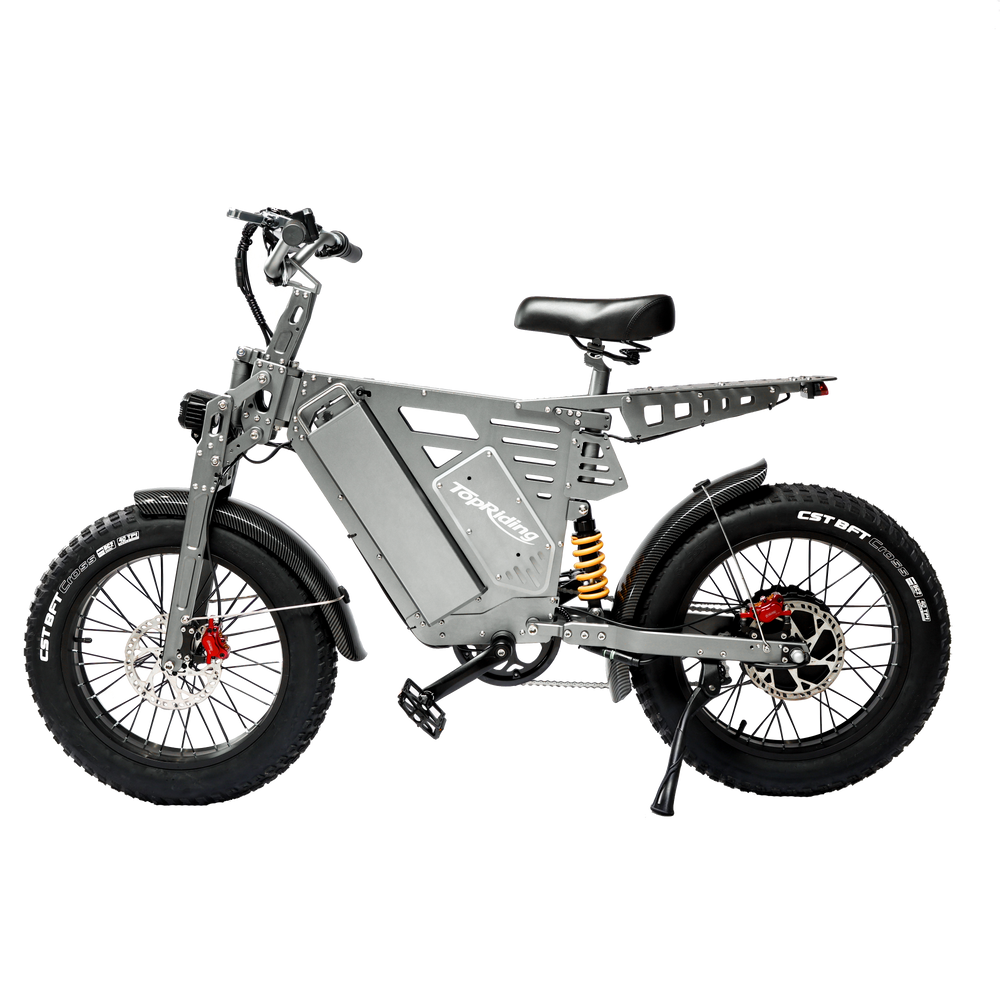
TopRiding R2 Full CNC Moto-Style eBike
$1,999.00
1500W Peak 1300Wh Battery Full Suspension 20 x 4.0 Tires
The TopRiding R2 is designed for riders who want a more substantial motorcycle-inspired e-bike rather than a conventional lightweight commuter. Its strongest selling points are the large battery, full suspension, high-torque rear hub motor, and four-piston hydraulic braking system.
Its motor is rated at 750W with 1500W peak output and up to 100Nm maximum torque. This distinction is important: the R2 should be evaluated as a 750W rated, 1500W peak configuration, not as a continuously rated 1500W motor.
| Specification |
TopRiding R2 |
| Motor type |
Rear hub motor |
| Rated power |
750W |
| Peak power |
1500W |
| Maximum torque |
100Nm |
| Factory speed limit |
20 MPH |
| Battery |
52V 25Ah lithium-ion |
| Battery capacity |
1300Wh |
| Battery cells |
21700 |
| Battery removable |
Yes |
| Claimed maximum range |
Up to 60 miles |
| Charging |
Dual charging ports; one charger included |
| Charging time |
6.5 hours from 0–100% with two chargers |
| Frame |
Full CNC-machined aluminum |
| Bike weight |
82 lbs |
| Maximum payload |
330 lbs |
| Suspension |
Full suspension |
| Front travel |
100mm |
| Rear travel |
100mm |
| Tire size |
20 x 4.0 inches |
| Brakes |
4-piston hydraulic disc brakes |
| Water and dust resistance |
IP65 as specified by manufacturer |
| Access |
NFC and app |
Why we recommend it: The 1300Wh battery is one of the most meaningful features. It provides a substantial energy reserve for longer recreational rides, while the 100Nm torque rating supports a strong climbing-oriented configuration. Full suspension and hydraulic brakes also make the package more complete than a motor-only specification suggests.
The 20 x 4.0-inch tires offer a different riding character from traditional 26-inch fat tire bicycles. They contribute to the R2's compact motorcycle-inspired proportions, although buyers should assess fit and handling before purchasing.
Limitations: At 82 lbs, it is heavy. It is not an ideal choice if you frequently carry an e-bike up stairs, load it into a small vehicle without assistance, or need a lightweight apartment commuter. The 330 lbs payload also needs to include the rider and any carried cargo.
Best for: Recreational riders who value battery capacity, full suspension, strong torque, and a distinctive motorcycle-inspired design.
Explore the TopRiding R2 specifications and product details.
2. Burchda R5 Pro – Best Folding Fat Tire Alternative
The Burchda R5 Pro is worth comparing if folding convenience is a major buying requirement. Its listed configuration includes a 750W rated motor with 1500W peak power and approximately 85Nm torque. The product is positioned as a folding fat tire electric mountain bike.
Its appeal is straightforward: buyers can consider a more compact storage arrangement without giving up the wider tire format. This can be useful for people with limited storage space or riders who transport their bikes occasionally.
However, folding capability should not be confused with portability. Fat tire folding e-bikes can still be heavy, and folding hinges introduce additional components that need inspection and maintenance.
What to check before buying: Confirm the battery capacity, exact frame-folding dimensions, brake configuration, suspension travel, and warranty coverage for the version being sold. The product listing and price may vary by configuration.
Best for: Riders who need folding convenience and want a fat tire configuration with advertised 1500W peak output.
View Burchda R5 Pro product information.
3. OUXI V8 Max – Best Dual-Battery Configuration to Compare
The OUXI V8 Max is an interesting alternative for shoppers who prioritize battery capacity. Its product listing advertises a 1500W motor configuration, dual 48V 15Ah batteries, hydraulic brakes, and fat tires.
Two 48V 15Ah batteries represent a combined nominal capacity of 1440Wh when the system is configured to use both packs as specified. That is an important distinction because battery capacity directly affects how much energy is available for riding.
Before purchasing, confirm how the dual batteries connect to the electrical system, whether both are included in the selected package, whether they can be removed independently, and what charging arrangements are supplied.
We would also check the continuous motor rating, since the term 1500W in a listing does not automatically establish whether the figure is nominal or peak power.
Best for: Riders comparing high-capacity battery configurations and looking for a fat tire e-bike with hydraulic braking.
View OUXI V8 Max product information.
4. AMYET V9-G60 – Best Value-Oriented Alternative
The AMYET V9-G60 is another model to consider when comparing advertised 1500W peak fat tire electric bikes. It is positioned as an adult electric bike with a 48V battery configuration and a 1500W peak power claim.
Its appeal is primarily its value-oriented market positioning. For buyers who do not need a premium CNC-machined frame or an elaborate full-suspension setup, it may be worth comparing against more expensive options.
But do not let an attractive price make the decision for you. Verify the exact battery capacity, rated motor power, brake type, frame material, suspension arrangement, payload, and battery certification documentation.
For everyday commuting, a well-supported bike with dependable braking and a suitable battery is a better purchase than a cheaper model with impressive advertising but unclear specifications.
Best for: Budget-conscious buyers comparing 1500W peak fat tire configurations.
View AMYET V9-G60 product information.
5. Ridstar C20 – Best Additional Model for Comparison Shopping
The Ridstar C20 is marketed as a 1500W fat tire electric bike and provides another option to include when comparing this category. Its product positioning targets riders looking for a more powerful fat tire setup.
We would treat this as a comparison candidate rather than automatically ranking it above the other models. The exact battery configuration, continuous motor rating, braking equipment, tire dimensions, and suspension details need to be checked against the current product version.
For heavy-duty applications, do not buy a bike simply because its product title includes 1500W. Ask the seller for the technical specification sheet and confirm that the battery, controller, motor, and brakes are matched to the intended riding conditions.
Best for: Shoppers who want another dedicated fat tire 1500W product to compare before making a final decision.
View Ridstar C20 product information.
4. Why the TopRiding R2 Deserves Special Attention
Among the five options, the TopRiding R2 has the clearest documented combination of specifications in the product information provided for this guide. Its appeal is not simply the 1500W peak rating. It is the way the motor, battery, suspension, and braking equipment work together.
1300Wh battery capacity is a meaningful advantage
Many buyers focus on motor power while overlooking the battery. In practical riding, a powerful motor without enough battery energy can become frustrating, particularly when the rider frequently uses throttle assistance or travels on challenging terrain.
The R2's 52V 25Ah battery provides 1300Wh of nominal energy. This gives riders a substantial battery reserve compared with smaller-capacity configurations.
The advertised range is up to 60 miles. We recommend treating this as a best-case manufacturer claim rather than a guaranteed everyday result. A rider using higher power levels, carrying heavy cargo, or climbing steep hills should expect range to decrease.
100Nm torque for climbing-oriented riding
Torque is especially relevant when starting on an incline or moving across loose terrain. The R2's specified maximum torque of 100Nm is a useful figure for buyers who want a stronger-feeling rear hub motor setup.
However, maximum torque alone does not determine climbing ability. Rider weight, controller limits, motor temperature, gearing, tire grip, and the duration of the climb also matter.
Full suspension for uneven terrain
The R2 includes a custom four-link front fork with 100mm travel and a rear coil spring shock absorber with 100mm travel. This full-suspension arrangement is relevant for riders who encounter uneven surfaces regularly.
For paved commuting, full suspension may be less important. For mixed terrain, gravel access roads, and rough recreational routes, it can improve comfort and help maintain better tire contact with the ground.
Four-piston hydraulic brakes
Braking equipment deserves more attention than many buyers give it. A bike weighing 82 lbs before the rider and cargo needs dependable stopping power, particularly when traveling downhill.
The R2's four-piston hydraulic disc brakes are a valuable feature. Nevertheless, brake performance still depends on rotor size, pad condition, hydraulic maintenance, tire grip, and rider technique.
Full CNC-machined aluminum frame
The R2 uses an aluminum frame with full CNC machining and an anodized finish. This contributes to its premium product positioning and distinctive appearance.
Buyers should still check frame inspection requirements, payload limits, warranty coverage, and the availability of replacement components. A premium finish cannot replace proper structural testing and after-sales support.
Our assessment: The R2 is most attractive to buyers who value a large battery, high specified torque, full suspension, and hydraulic brakes. Its 82 lb weight is the trade-off. If carrying convenience matters more than riding comfort and battery capacity, a lighter or folding model may be a better decision.
5. Comparison: What Matters When Choosing a 1500W Fat Tire E-Bike?
The following table separates verified TopRiding R2 specifications from the comparison details that should be confirmed directly with other manufacturers. This is more useful than pretending all five products have equally documented specifications.
| Buying Factor |
TopRiding R2 |
Burchda R5 Pro |
OUXI V8 Max |
AMYET V9-G60 |
Ridstar C20 |
| Power positioning |
750W rated / 1500W peak |
750W rated / 1500W peak listing |
1500W advertised; verify rated power |
1500W peak positioning; verify exact version |
1500W product positioning; verify rated power |
| Battery information |
52V 25Ah, 1300Wh |
Confirm exact version |
Advertised dual 48V 15Ah |
Confirm exact version |
Confirm exact version |
| Torque |
100Nm |
85Nm listed |
Confirm specification |
Confirm specification |
Confirm specification |
| Suspension |
Full suspension |
Confirm exact version |
Front suspension listed |
Confirm exact version |
Confirm exact version |
| Brakes |
4-piston hydraulic |
Confirm exact version |
Hydraulic listed |
Confirm exact version |
Confirm exact version |
| Tire configuration |
20 x 4.0 inches |
Fat tire folding format |
Fat tire format |
Confirm exact version |
Fat tire format |
| Best buying priority |
Battery and comfort |
Folding convenience |
Battery capacity |
Budget |
Additional comparison |
Our recommendation is to compare complete specifications rather than headline motor ratings. If a seller cannot confirm the rated motor power, battery capacity, braking configuration, and certification status, treat that missing information as a purchasing risk.
6. Pros and Cons of a 1500W Peak Fat Tire Electric Bike
| Advantages |
Limitations |
| Strong acceleration potential when the controller and battery support the motor. |
Higher power demand can reduce riding range. |
| Fat tires provide useful flotation and grip on suitable loose surfaces. |
Wide tires can increase rolling resistance on smooth pavement. |
| Useful for riders who regularly encounter hills and mixed terrain. |
Not every 1500W peak bike has the same climbing performance. |
| Full-suspension configurations can improve comfort on rough routes. |
More suspension components add weight and maintenance requirements. |
| Large battery configurations can support longer rides. |
Large batteries increase cost and can make the bike heavier. |
| Hydraulic brakes offer controllable braking when correctly maintained. |
Brake maintenance and replacement can cost more than basic mechanical systems. |
| Suitable configurations can handle recreational off-road riding. |
Not all public trails allow higher-powered electric bikes. |
7. Best Uses: Where Does a 1500W Peak Fat Tire E-Bike Make Sense?
Gravel roads and forest access routes
For gravel roads, wide tires and sufficient torque can make a noticeable difference. The larger contact area can help maintain traction on loose surfaces, while front and rear suspension can improve comfort over repeated bumps.
For this type of riding, we recommend checking tire tread, brake performance, and suspension quality before focusing on motor output.
Our guide to the features that make an e-bike all-terrain explains why motor power alone is not enough.
Hunting and outdoor access
Hunters and outdoor enthusiasts may benefit from fat tire e-bikes when traveling along permitted access roads and established routes. However, quiet operation and battery range are only part of the decision.
Payload, cargo racks, tire grip, braking, and the ability to manage the bike on uneven ground are equally important. If you carry equipment, calculate the combined weight of the rider, accessories, and cargo before choosing a bike.
For a more specialized buying guide, see our article on the best hunting e-bikes under $2,000.
Snow and sand
Fat tires can be useful on snow and sand because they can spread the load across a wider contact area. However, tire pressure, tread, surface depth, and rider technique are critical.
A 1500W peak label does not guarantee that a bike can ride through deep sand or heavy snow. In these conditions, traction and controlled power delivery matter more than simply having a higher wattage figure.
Daily commuting
For daily commuting, a powerful fat tire bike may be more than you need. The extra weight and rolling resistance can become disadvantages when riding primarily on smooth roads.
If your main priority is convenient urban transport, compare the TopRiding commuter e-scooter range as an alternative. Riders who want a seated scooter configuration can also explore electric scooters with seats.
8. How to Choose the Right 1500W Fat Tire Electric Bike
1. Check continuous motor power and peak power
Ask the manufacturer to provide both figures. A bike with 750W rated and 1500W peak output should be described accurately. Avoid sellers who use the peak figure without explaining the continuous rating.
2. Prioritize battery watt-hours
Calculate battery capacity using voltage multiplied by amp-hours. Compare Wh rather than assuming a higher voltage automatically means longer range.
For example, a 52V 25Ah battery provides 1300Wh, while a 48V 15Ah battery provides 720Wh. The former has considerably more nominal energy, although actual range still depends on efficiency and riding conditions.
3. Evaluate torque and hill-climbing capability
For hilly routes, compare maximum torque, controller output, and the manufacturer's operating limits. Also consider whether the bike can maintain performance during extended climbs without overheating.
4. Choose the right tire size
20 x 4.0-inch tires and 26 x 4.0-inch tires have different riding characteristics. Smaller wheels can contribute to a compact frame design, while larger wheels may roll more easily over certain obstacles.
Neither configuration is universally better. Select based on your height, riding posture, terrain, and storage requirements.
5. Inspect the braking system
Hydraulic disc brakes are worth prioritizing for heavy e-bikes and frequent off-road use. Ask about rotor dimensions, brake model, pad availability, and maintenance requirements.
6. Evaluate the suspension system
For rough trails, full suspension can justify a higher purchase price. For smooth pavement and occasional gravel, a quality front suspension fork may be sufficient.
Our guide to full-suspension e-bikes under $2,000 provides more context for buyers comparing suspension configurations.
7. Confirm battery safety certification
Battery safety should never be an afterthought. Ask for documentation relating to the complete e-bike electrical system and battery pack, and verify that the documentation applies to the exact model and configuration.
UL 2849 addresses the electrical system of an e-bike, not merely the individual battery cell. A certification claim should be supported by verifiable documentation rather than a generic logo on a product page.
8. Check payload and total bike weight
Do not confuse maximum payload with rider weight. Payload limits generally need to account for the rider and any additional carried equipment, subject to the manufacturer's definition.
The TopRiding R2 weighs 82 lbs and has a specified maximum payload of 330 lbs. This is important for riders who need to transport the bike or regularly carry additional cargo.
9. Investigate warranty and after-sales service
Ask whether replacement batteries, brake pads, controllers, displays, and suspension components are available. A lower purchase price is less attractive if essential replacement parts are difficult to obtain.
For commercial buyers or fleet operators, we recommend requesting written warranty terms and a clear parts-support process before placing a larger order.
9. Cost-Benefit Analysis: Is a 1500W Fat Tire E-Bike Worth Buying?
The value of a 1500W peak fat tire e-bike depends on how often you use its capabilities. If you ride mostly on flat paved roads, the additional motor output and wide tires may not justify the higher purchase cost.
For mixed-terrain riders, however, the investment can make more sense. A bike with a large battery, full suspension, hydraulic brakes, and strong torque can provide a more complete package for recreational riding.
Where spending more makes sense
-
Battery: Worth upgrading when you regularly travel longer distances or use high assistance levels.
-
Brakes: Worth prioritizing when the bike is heavy or used on steep routes.
-
Suspension: Worth the additional cost for regular rough-terrain riding.
-
Frame construction: Important when buying a heavy-duty recreational bike.
-
Service support: Worth paying attention to because battery and electrical repairs can be expensive.
Where spending more may not be necessary
Do not automatically pay extra for the largest advertised wattage, an oversized display, decorative lighting, or a high top-speed claim if those features do not match your riding needs.
For many buyers, a dependable 750W rated motor with a 1500W peak output and a large battery is a more practical combination than an unverified high-wattage model with a small battery and basic brakes.
10. Common Mistakes When Buying a 1500W Fat Tire E-Bike
Mistake 1: Assuming peak power is continuous power
This is the most important specification mistake. Always ask for rated and peak motor output separately.
Mistake 2: Believing the maximum advertised range
Range figures are highly dependent on test conditions. Real-world performance changes with rider weight, terrain, speed, temperature, tire pressure, and assistance level.
Mistake 3: Ignoring the bike's weight
An 80 lb electric bike may be enjoyable to ride but inconvenient to carry, store, or transport. Consider your actual storage and transportation arrangements.
Mistake 4: Choosing motor power over brakes
More acceleration without adequate braking is a poor purchasing decision. Evaluate the complete braking system and maintenance requirements.
Mistake 5: Ignoring local e-bike regulations
Higher-powered e-bikes may not qualify for ordinary e-bike access rules. Confirm local restrictions for roads, bike paths, parks, and off-road trails before purchasing.
Mistake 6: Treating fat tires as a replacement for suspension
Wide tires can provide cushioning, but they do not perform the same job as a suspension fork or rear shock. For repeated rough-terrain use, the complete suspension system matters.
Mistake 7: Buying without checking certification documents
Ask for verifiable battery and electrical-system safety documentation. A general statement that a product is safe is not a substitute for certification evidence.
11. Maintenance and Safety Tips
A powerful fat tire e-bike needs regular inspection. Its greater weight, electrical components, and riding demands make routine maintenance particularly important.
Check tire pressure regularly
Use the tire manufacturer's recommended pressure range and adjust appropriately for rider weight and terrain. Do not assume that the lowest possible pressure always provides the best traction.
Inspect brakes before every demanding ride
Check brake response, rotor condition, pad wear, and hydraulic leaks. If braking feels inconsistent, do not continue riding until the issue has been resolved.
Maintain the battery correctly
Use the supplied or manufacturer-approved charger. Avoid charging a damaged or wet battery, and do not leave a charging battery unattended. Follow the manufacturer's temperature and storage recommendations.
Inspect suspension and frame components
Check fasteners, suspension mounts, wheel alignment, and frame components periodically. Heavy off-road use increases the importance of regular inspections.
Ride within legal and mechanical limits
Use protective equipment, maintain a controlled speed, and avoid riding beyond the terrain capability of the bicycle. A powerful motor does not make a bicycle suitable for every trail or weather condition.
12. Our Expert Recommendation: Which One Should You Choose?
After comparing the major buying considerations, we would not recommend selecting a fat tire electric bike simply because its product title includes 1500W. The strongest purchasing decision comes from matching motor output, battery energy, braking equipment, suspension, and frame design to your actual riding requirements.
Choose the TopRiding R2 if you want a motorcycle-inspired design, a 1300Wh battery, 100Nm maximum torque, full suspension, and four-piston hydraulic brakes. Its 750W rated and 1500W peak motor configuration is clearly specified, making it easier to evaluate than products that publish only a headline wattage figure.
Choose a folding alternative if storage and transportation are more important than premium suspension and battery capacity. However, check the folding mechanism and total bike weight before buying.
Choose a dual-battery configuration if longer rides and additional battery capacity are your main priorities. Verify the combined watt-hours and charging arrangement rather than relying on the number of batteries alone.
Choose a value-oriented model if your riding is occasional and you do not need premium components. Do not compromise on braking performance, battery safety, or after-sales support to save a small amount of money.
For riders who want more off-road recommendations, our guide to the top off-road electric bikes for adults offers another useful comparison.
TopRiding's approach is to offer electric mobility options for different riding needs, from recreational e-bikes to electric scooters. If your daily transportation requirements are better suited to a scooter, you can also compare our off-road electric scooters and high-performance dual-motor scooters.
Final verdict: The TopRiding R2 is our featured recommendation for riders who value battery capacity, full suspension, torque, and a substantial overall build. It is not the lightest option, nor is it a continuously rated 1500W motor. Its actual specification balance is what makes it worth considering.
13. Frequently Asked Questions About 1500W Fat Tire Electric Bikes
1. Is a 1500W fat tire electric bike powerful enough for hills?
A 1500W peak configuration can provide useful assistance on hills, particularly when combined with adequate torque and battery output. However, climbing performance also depends on rider weight, incline, controller settings, gearing, motor temperature, and traction.
2. What is the difference between a 750W and 1500W e-bike?
A 750W rated motor with 1500W peak output is different from a motor continuously rated at 1500W. The first can deliver higher temporary output under suitable conditions. Always check the manufacturer's rated and peak figures separately.
3. How far can a 1500W fat tire electric bike travel?
Range varies considerably with battery capacity, terrain, speed, rider weight, and riding mode. The TopRiding R2 has a 52V 25Ah battery with 1300Wh capacity and a manufacturer-claimed range of up to 60 miles. Actual range may be lower depending on riding conditions.
4. Are fat tire electric bikes good for off-road riding?
Yes, suitable fat tire electric bikes can work well on gravel, dirt, sand, and some snow-covered routes. Tire tread, pressure, suspension, braking, motor control, and trail restrictions all influence suitability.
5. Is a full-suspension fat tire e-bike worth the extra money?
For frequent riding on uneven terrain, full suspension can be worth the investment because it improves comfort and helps maintain tire contact with the ground. For smooth roads and occasional gravel, a good front suspension fork may be sufficient.
6. What battery capacity is good for a 1500W fat tire electric bike?
There is no universal minimum, but a larger watt-hour rating provides more stored energy. A 52V 25Ah battery has 1300Wh of nominal capacity, which is a substantial configuration for recreational riding. Actual range depends on power consumption and riding conditions.
7. Are 1500W fat tire electric bikes legal in the United States?
Not automatically. The federal low-speed e-bike definition uses a motor rating below 750W and a specified motor-only speed below 20 mph. State and local regulations can impose additional requirements. Higher-powered configurations may be treated differently from conventional e-bikes, so check local laws before riding.
8. Are hydraulic brakes necessary for a heavy fat tire e-bike?
They are strongly worth considering, particularly for heavier bikes, steep routes, and off-road riding. Proper rotor sizing, brake maintenance, tire grip, and riding technique remain essential regardless of brake type.
9. Is the TopRiding R2 a true 1500W electric bike?
The TopRiding R2 is specified with a 750W rated rear hub motor and 1500W peak power. It should therefore be described accurately as a 750W rated, 1500W peak e-bike rather than a continuously rated 1500W model.
10. What should I check before buying a high-power fat tire e-bike?
Check continuous and peak motor ratings, battery watt-hours, torque, brake specifications, suspension, tire dimensions, payload, total bike weight, certification documentation, warranty, and local riding regulations. These details are more useful than the headline wattage alone.
14. Authoritative References and Safety Resources
Before purchasing or riding a higher-powered electric bicycle, consult the following primary sources for regulatory and electrical safety information.
-
United States Code – 15 U.S.C. §2085, Low-Speed Electric Bicycles. Federal definition and consumer product regulatory framework for low-speed electric bicycles.
-
U.S. Consumer Product Safety Commission – Consumer Safety and Micromobility Devices. Safety information covering bicycle requirements and electrical-system standards.
-
UL Solutions – E-Bike Electrical System Safety and UL 2849. Explains the electrical-system safety approach covering the motor, battery, charger, and related components.
Choosing the right fat tire electric bike 1500W configuration requires more than comparing motor labels. Battery energy, torque, braking, suspension, weight, certification, and local regulations determine whether a model is a sensible investment. For riders who want a substantial battery and full-suspension setup, the TopRiding R2 is a strong option to put on the shortlist.


