TopRiding electric scooters are certified to meet UL 2272 safety standards, covering critical electrical and fire safety requirements for the electrical system and battery.
This certification helps ensure safer, more reliable riding.
Over 100,000 electric scooters sold, backed by 5,000+ verified reviews and an average rating of 4.7+ stars.
Chosen by riders worldwide for reliable performance, and everyday riding confidence.
Expert support. local service.
Expert Customer Service
As a U.S.-based company, TopRiding provides 24/7 expert customer service and local after-sales support across multiple regions in North America.
Our dedicated support team is here to ensure fast responses, professional assistance, and reliable service — whenever you need it.
TEST RIDES AND SERVICE
Safety Certified
Designed to Meet UL 2272 Safety Standards
Our electric scooters are designed in accordance with UL 2272 safety requirements for electrical and battery systems, helping enhance overall safety and reliability.
Trusted by a global riding community
100,000+ Units Sold
Over 100,000 electric mobility vehicles sold, backed by 5,000+ verified reviews and an average rating of 4.7+ stars.
Chosen by riders worldwide for reliable performance, safety, and everyday riding confidence.
Expert Support. Local Service.
Expert Customer Service
As a U.S.-based company, TopRiding provides 24/7 expert customer service and local after-sales support across multiple regions in North America.
Our dedicated support team is here to ensure fast responses, professional assistance, and reliable service—whenever you need it.
7 Popular Off-Road Electric Bike Options for Black Friday 2026
7 Popular Off-Road Electric Bike Options for Black Friday 2026
senkan
Shopping for an off-road electric bike during Black Friday is an opportunity to get more performance for your money, but a discounted bike is not automatically a good trail bike. Motor output, battery capacity, suspension, tire construction, braking performance, and actual trail compatibility matter much more than an impressive promotional price.
For Black Friday 2026, we recommend starting with the kind of terrain you intend to ride rather than choosing a bike based on its advertised wattage. A fat-tire electric bike may be ideal for sandy access roads and hunting properties, while a full-suspension model makes more sense for riders regularly tackling rough trails. A moto-style electric bike offers another combination of comfort, power, and everyday recreational usability.
In this guide, TopRiding compares seven popular off-road electric bike configurations, explains where each one makes sense, and highlights the specifications worth checking before purchasing. We also examine the TopRiding R2 Full CNC Moto-Style eBike as a concrete option for buyers looking for a distinctive high-capacity recreational electric bike.
Quick Answer: Which Off-Road Electric Bike Should You Buy?
Our recommendation: Choose a fat-tire electric bike for mixed terrain, a full-suspension model for repeated rough-trail riding, and a high-capacity moto-style eBike if comfort, battery capacity, and a robust recreational design are your priorities.
For buyers who want a combination of fat tires, full suspension, a large removable battery, and a CNC-machined aluminum frame, the TopRiding R2 is worth considering at its listed $1,999 price.
However, do not buy solely because a bike has a powerful peak motor. Check its legal classification, battery certification, braking system, payload capacity, warranty, and whether the intended riding area permits that particular vehicle.
Buying Priority
Best Off-Road Electric Bike Option
Our Recommendation
All-around recreational riding
Fat-tire electric bike
Best starting point for mixed surfaces
Rocky and uneven trails
Full-suspension e-bike
Prioritize suspension and hydraulic brakes
Comfort and distinctive styling
Moto-style electric bike
Consider the TopRiding R2
Hunting and property access
Hunting e-bike
Check payload and quiet operation
Transport and storage
Folding fat-tire e-bike
Best when portability matters
Experienced trail riders
Electric mountain bike
Choose trail-specific geometry
Higher-speed recreational riding
High-power electric bike
Verify legal classification and permitted terrain
1. What Is an Off-Road Electric Bike?
An off-road electric bike is an electrically assisted bicycle designed to handle surfaces and riding conditions beyond ordinary paved roads. Depending on its construction and legal classification, it may be suitable for gravel roads, dirt paths, forest access roads, sandy ground, snow, private property, or designated mountain-bike trails.
Unlike a standard commuter e-bike, an off-road electric bike typically emphasizes traction, braking control, frame durability, ground clearance, and suspension performance. These characteristics determine whether the bike can maintain control when the surface becomes loose, uneven, or unpredictable.
How Does an Off-Road Electric Bike Work?
An electric motor supplies additional power through pedal assistance, a throttle, or both, depending on the model and applicable regulations. The battery stores electrical energy, while the controller manages motor output based on the rider's inputs and system settings.
Most models use one of two motor configurations:
Rear hub motor: Transfers power directly through the rear wheel. It is relatively straightforward and often offers strong acceleration, making it attractive for recreational and fat-tire designs.
Mid-drive motor: Transfers power through the drivetrain. It can use the bicycle's gearing to maintain efficient operation on changing gradients, which is particularly useful for demanding climbing applications.
Battery capacity also deserves attention. A 52V 25Ah battery stores approximately 1,300Wh of energy. That is a meaningful capacity for recreational riding, but actual range depends on rider weight, terrain, speed, temperature, tire pressure, and assistance level.
What Makes an E-Bike Suitable for Off-Road Use?
From our experience evaluating the specifications that matter in this category, a genuine off-road setup needs more than wide tires and a large motor. We look for:
Suitable tire width and tread for the intended surface.
Front or full suspension matched to the terrain.
Reliable hydraulic or appropriately specified mechanical disc brakes.
A structurally sound frame and adequate payload rating.
A battery system with suitable protection and credible safety documentation.
Practical ground clearance and stable handling.
Components that can be serviced or replaced when worn.
2. 7 Popular Off-Road Electric Bike Options for Black Friday 2026
These seven options represent different vehicle configurations and riding priorities rather than seven identical products. That distinction matters because the best off-road electric bike for a recreational rider may be a poor investment for someone who regularly rides technical mountain trails.
Option 1: Fat-Tire Off-Road Electric Bikes
Best for: Gravel, sand, loose dirt, snow, and mixed recreational terrain.
Fat-tire electric bikes are among the most versatile choices for riders who want one vehicle for several different surfaces. Their wide tires create a larger contact area and allow lower tire pressures when the tire and rim manufacturer's specifications permit it.
This can improve flotation on soft ground and increase comfort over smaller surface irregularities. The trade-off is additional rolling resistance, tire weight, and sometimes less precise handling compared with narrower mountain-bike tires.
We recommend a fat-tire configuration for recreational riders, property owners, and beginners who prioritize versatility over technical trail performance. It is particularly attractive when riding conditions change throughout the year.
However, do not assume a fat tire makes every bike suitable for serious mountain biking. Frame geometry, suspension, braking, and overall weight still determine handling.
Best for: Uneven trails, rocky routes, roots, and repeated off-road riding.
Full-suspension e-bikes have suspension at both the front and rear. This arrangement can improve wheel contact, rider comfort, and control when the ground contains repeated bumps and obstacles.
For experienced riders, suspension is not simply a comfort feature. Better wheel contact helps maintain traction, particularly when braking or cornering over uneven surfaces.
The downside is higher purchase and maintenance costs. Rear suspension adds moving parts, bearings, seals, and additional components that require inspection. It also increases complexity and can add weight.
In most professional situations, we recommend spending more on a well-engineered suspension system rather than buying a cheap full-suspension bike with poorly specified components.
Best for: Recreational riding, comfort-oriented designs, and riders who prefer motorcycle-inspired styling.
Moto-style electric bikes combine bicycle-like controls and electric propulsion with a visually distinctive frame design. Many use wide tires, substantial batteries, and suspension systems designed around a more substantial vehicle platform.
For buyers who value appearance and a comfortable riding position, this category is worth investigating. However, a moto-inspired appearance does not automatically mean the bike is a road-legal motorcycle or a trail-approved electric mountain bike.
Weight is an important purchasing consideration. Some designs are considerably heavier than conventional e-MTBs, which affects transport, lifting, maneuverability, and emergency handling.
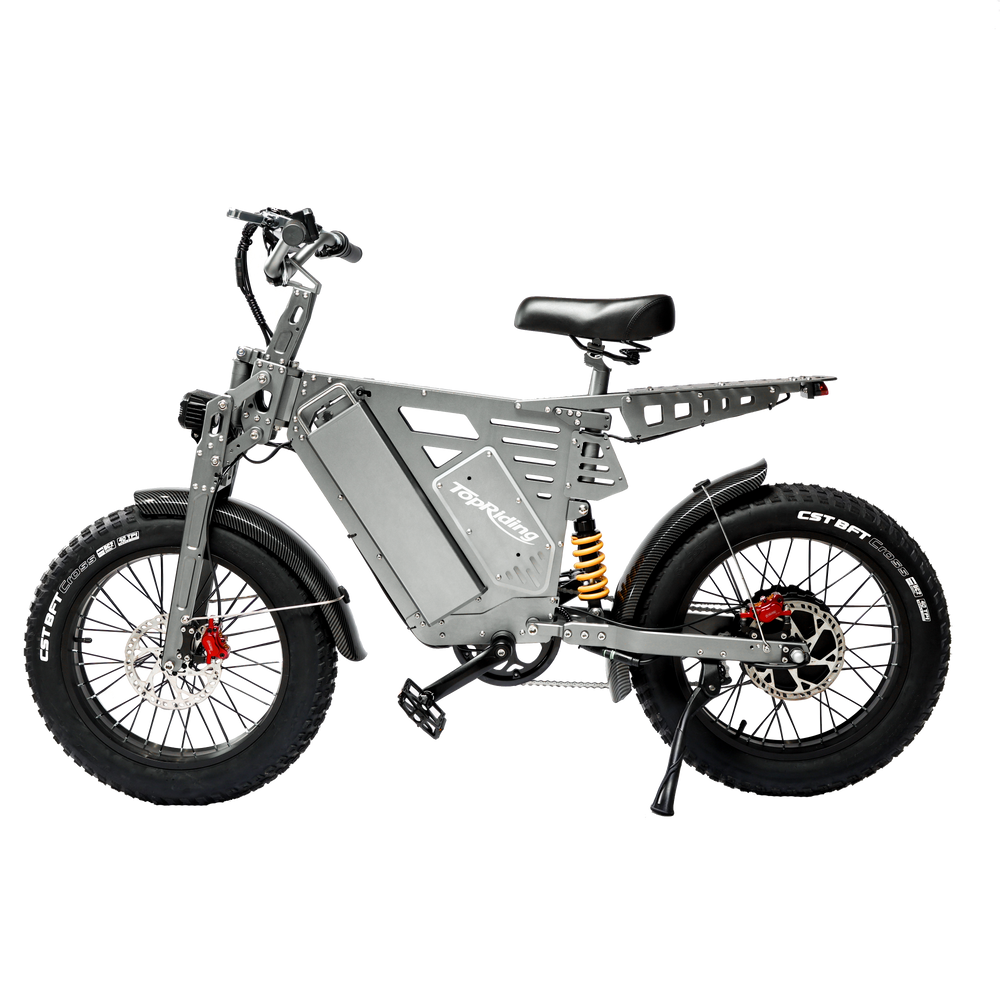
The TopRiding R2 is a relevant example in this category. Its full CNC-machined aluminum frame, 52V 25Ah battery, 20 x 4.0-inch tires, and full suspension create an interesting package for riders seeking a powerful recreational platform.
Option 4: Hunting Electric Bikes
Best for: Private land, hunting properties, equipment transport, and long access roads.
Hunting e-bikes are designed around practical access rather than maximum trail speed. Their appeal comes from quiet electric assistance, broad tires, useful carrying capacity, and the ability to travel through suitable access routes without relying on a conventional vehicle.
For commercial users, land managers, and hunters, payload capacity deserves particular attention. The total load includes the rider, backpack, accessories, and any additional equipment. A bike with insufficient carrying capacity can become unstable even if its motor has adequate power.
Check rack compatibility, battery range under load, tire puncture resistance, and whether the intended property permits the vehicle.
Best for: Riders with limited storage, vehicle transport requirements, and occasional off-road use.
Folding e-bikes solve a different problem. They are designed to reduce storage and transportation demands, making them practical for apartment owners, RV users, and people who need to place their bike inside a vehicle.
Some folding models combine wider tires with suspension, providing reasonable versatility on gravel roads and light dirt paths.
However, folding joints introduce additional structural considerations. Before buying, inspect the locking mechanism, frame construction, hinge design, and maximum payload. For repeated aggressive off-road use, a rigid one-piece frame is generally the more straightforward choice.
We recommend this option when portability is a genuine requirement, not simply because the folding feature looks convenient.
Option 6: Electric Mountain Bikes (eMTBs)
Best for: Dedicated mountain-bike trails and riders who prioritize handling and climbing performance.
Electric mountain bikes are designed around mountain-bike geometry and trail-specific components. Compared with many moto-style and fat-tire recreational bikes, they generally prioritize maneuverability, efficient pedaling, suspension control, and predictable handling.
A dedicated eMTB is usually the better purchase for riders who regularly encounter switchbacks, technical descents, steep climbs, and obstacles that require precise positioning.
For beginners, a well-designed hardtail may be sufficient for smoother trails. Experienced riders tackling more demanding terrain should consider a full-suspension configuration with appropriate brakes and suspension travel.
One important point: trail access depends on the e-bike's classification and local land-management rules. Do not assume that every electric bike is permitted on every mountain-bike trail.
Best for: Experienced riders using suitable private property or designated motorized riding areas.
High-power electric bikes attract buyers looking for stronger acceleration, additional climbing assistance, and higher performance under demanding loads.
But maximum wattage is one of the most misunderstood specifications in the electric bike industry. Advertised peak power is not the same as continuous rated power, and neither figure automatically establishes the vehicle's legal classification.
For example, a bike advertised with a 1,500W peak motor may have a 750W rated motor. Those figures describe different aspects of motor performance.
We recommend checking rated output, controller limitations, speed settings, brake capacity, battery current capability, and legal classification together. More power is not necessarily more useful if the frame, tires, suspension, or braking system cannot manage it safely.
3. TopRiding R2: A Detailed Look at a Moto-Style Off-Road Electric Bike
Among the seven configurations, the moto-style category deserves special attention because it combines several features that buyers often have to compromise on: battery capacity, wide tires, suspension, and a distinctive frame design.
The TopRiding R2 Full CNC Moto-Style eBike is a concrete option for shoppers considering a premium recreational electric bike around the $2,000 price point.
TopRiding R2 Full CNC Moto-Style eBike
$1,999.00
A high-capacity, full-suspension recreational e-bike featuring a CNC-machined aluminum frame, wide CST tires, and a removable 52V battery.
Battery capacity is one of the strongest features of the R2. Its 52V 25Ah configuration provides approximately 1,300Wh of nominal energy storage.
That capacity gives recreational riders more flexibility than many smaller-battery configurations. It can be useful for longer rides, higher assistance settings, and routes where convenient charging is unavailable.
The manufacturer advertises a range of up to 60 miles. Buyers should treat this as a best-case reference rather than a guaranteed real-world distance. A heavier rider, steep gradients, frequent acceleration, cold weather, and soft surfaces can all reduce range.
Our recommendation is to calculate your expected round-trip distance and retain a meaningful battery reserve rather than planning a ride around the maximum advertised range.
Full CNC Aluminum Frame: What Is the Practical Advantage?
The R2 uses a full CNC-machined aluminum frame with an anodized finish. CNC machining provides controlled manufacturing of the specified components and can support precise design details.
For buyers, the important question is not whether CNC sounds more premium. It is whether the complete frame design provides adequate structural integrity, durability, and serviceability for the intended riding conditions.
The R2's stated 330 lb maximum payload is a useful specification for riders who need to evaluate their total load. Remember that accessories and carried equipment contribute to the overall payload.
Full Suspension and 4-Piston Hydraulic Brakes
The R2 features a custom four-link front fork with 100mm of travel and a rear coil spring shock absorber with 100mm of travel.
This arrangement is attractive for riders who want additional comfort and control over uneven recreational routes. The 4-piston hydraulic disc brakes are another meaningful specification because braking performance becomes increasingly important as vehicle weight, speed, and rider load increase.
However, 100mm of travel should not be confused with a dedicated downhill mountain-bike suspension platform. For highly technical terrain, buyers should evaluate suspension geometry, component quality, and the manufacturer's intended-use recommendations.
Is the TopRiding R2 Worth $1,999?
We consider the R2 worth evaluating if your priorities include a large battery, full suspension, a distinctive moto-style appearance, and a substantial aluminum frame.
It is not automatically the best choice for every rider. At 82 lbs, it is relatively heavy compared with many conventional electric mountain bikes. Transporting it upstairs, loading it onto a standard bicycle rack, or maneuvering it through tight technical trails may be inconvenient.
The 20 MPH factory speed limit is also important. Buyers seeking a faster vehicle should not assume that the motor's 1,500W peak specification overrides the factory speed setting or applicable legal restrictions.
Our verdict: The R2 makes the most sense for recreational riders who value battery capacity, comfort-oriented suspension, wide tires, and a substantial moto-style design. If your main priority is a lightweight, technical mountain-bike experience, a dedicated eMTB may be a better investment.
4. Off-Road Electric Bike Comparison: Which Type Is Best?
Choosing between off-road electric bike options becomes easier when you compare their strengths against the conditions in which they will actually be used.
Bike Type
Terrain Suitability
Comfort
Portability
Best Buyer
Main Trade-Off
Fat-tire e-bike
Gravel, sand, snow, dirt
Good
Low to medium
Mixed-terrain riders
Higher rolling resistance
Full-suspension e-bike
Rough trails, rocks, roots
Very good
Low
Regular trail riders
Higher maintenance costs
Moto-style e-bike
Suitable recreational routes
Good
Low
Comfort-oriented riders
Greater weight
Hunting e-bike
Property roads, access trails
Good
Low to medium
Hunters and landowners
Payload and accessory costs
Folding e-bike
Light dirt and gravel
Moderate
High
Travelers and commuters
Hinge and frame limitations
Electric mountain bike
Designated MTB trails
Depends on setup
Medium
Technical trail riders
Higher component costs
High-power e-bike
Permitted motorized areas
Depends on setup
Low
Experienced riders
Legal and safety restrictions
Fat-Tire vs. Full-Suspension Electric Bikes
This is one of the most common comparisons in the market. A fat-tire bike offers a practical advantage on soft or loose ground, while full suspension provides better support over repeated bumps and rough terrain.
For mixed recreational use, we generally favor a well-built fat-tire model with suitable suspension. For riders who spend most of their time on established mountain-bike trails, we favor a dedicated full-suspension eMTB.
Moto-Style vs. Traditional Electric Mountain Bikes
Moto-style designs generally appeal to riders who prioritize appearance, comfort, and substantial components. Traditional eMTBs are more appropriate for people who want bicycle-like handling and technical trail performance.
Do not pay extra for motorcycle-inspired styling if you actually need lightweight climbing performance. Likewise, do not buy a lightweight trail bike if your main goal is relaxed recreational riding on private property.
Off-Road E-Bike vs. Off-Road Electric Scooter
An electric bike offers pedal assistance, bicycle-style positioning, and the flexibility to contribute human power. An electric scooter generally emphasizes standing or seated operation, compact controls, and motor-driven travel.
For long mixed-terrain rides and situations where pedal assistance is useful, we recommend an e-bike. For shorter trips on compatible surfaces, an off-road electric scooter may be more convenient.
Off-road electric bikes offer real advantages, but buyers should understand their limitations before spending money on a premium model.
Advantages
Limitations
Electric assistance reduces the physical effort required on climbs.
Motor and battery systems increase purchase cost.
Fat tires can improve flotation on soft surfaces.
Wide tires may increase rolling resistance.
Suspension can improve comfort over rough terrain.
Suspension components need periodic maintenance.
Removable batteries offer charging flexibility.
Large batteries add weight and replacement expense.
Useful for recreational riding and private property access.
Trail access is restricted in many locations.
Multiple riding configurations suit different needs.
Heavy models can be difficult to transport.
Who Should Buy an Off-Road Electric Bike?
Recreational riders who want to explore suitable dirt and gravel routes.
Property owners who need convenient transportation across larger properties.
Hunters who require suitable access to permitted hunting areas.
Experienced cyclists who want assistance on demanding climbs.
Riders looking for a versatile electric vehicle for outdoor activities.
Who Does Not Need One?
People who only ride short distances on smooth paved roads.
Buyers who cannot safely store or lift a heavy electric bike.
Riders whose local trails prohibit the selected vehicle classification.
People who need a dedicated downhill or competition mountain bike but are considering an unsuitable recreational model.
Anyone who cannot afford appropriate maintenance, protective equipment, and battery replacement.
6. Black Friday 2026 Off-Road Electric Bike Buying Guide
Black Friday 2026 falls on November 27, with Cyber Monday on November 30. The promotion period can be useful for comparing different models, but the best purchase is not necessarily the bike with the largest advertised discount.
We recommend evaluating the following factors before making a purchase.
1. Compare Rated Motor Power and Peak Power
Motor specifications can be confusing because manufacturers frequently advertise peak output more prominently than continuous rated output.
Rated power is a more useful starting point when comparing the motor's nominal specification. Peak power indicates a higher temporary output under suitable operating conditions.
For example, the TopRiding R2 lists a 750W rated motor and 1,500W peak power. These are two different measurements, not two interchangeable descriptions of the motor.
For beginners, a balanced motor configuration with predictable power delivery is often more useful than an excessively powerful setup.
2. Check Battery Capacity and Realistic Range
Do not compare battery voltage alone. Calculate watt-hours by multiplying nominal voltage by amp-hours.
For example:
Battery capacity calculation: 52V x 25Ah = 1,300Wh
A larger battery generally provides more stored energy, but the relationship between capacity and range is affected by riding conditions. A heavy rider climbing steep trails will consume substantially more energy than a lighter rider cruising on level ground.
For commercial users and frequent recreational riders, we recommend prioritizing battery capacity, removable-battery design, replacement availability, and charger specifications.
3. Evaluate Suspension Quality, Not Just Suspension Type
A bike advertised as full suspension is not necessarily a high-performance trail bike.
Inspect suspension travel, fork construction, rear shock design, adjustment options, serviceability, and compatibility with the rider's weight. For demanding terrain, suspension performance can make a greater difference than a small increase in motor output.
4. Prioritize Braking Performance
Heavy electric bikes need reliable braking systems. Hydraulic disc brakes generally offer more consistent lever feel and better modulation than basic mechanical disc systems.
For heavier models, we recommend examining rotor diameter, brake caliper design, replacement-pad availability, and the manufacturer's maintenance instructions.
The R2's 4-piston hydraulic disc brakes are a notable specification in its product configuration.
5. Confirm Frame Strength and Payload Capacity
Always check the maximum payload before buying. Include your body weight, backpack, accessories, and additional equipment in the calculation.
Do not assume that an aluminum frame is automatically suitable for aggressive off-road riding. Material, geometry, manufacturing quality, welds or machining, fatigue resistance, and structural testing all matter.
6. Verify Battery and Electrical Safety
Battery safety should be a non-negotiable purchasing consideration. Ask whether the complete electrical system has been evaluated against applicable safety standards, including UL 2849 for e-bike electrical systems.
Check the battery, charger, battery management system, and manufacturer documentation. A certification claim should be supported by verifiable documentation for the actual product configuration.
Never charge a damaged battery or use an incompatible charger simply because its connector fits.
7. Understand Local Laws and Trail Access
This is particularly important for American buyers. E-bike classification, motor output, throttle operation, speed limits, and permitted trail use can vary by jurisdiction.
Some public trails permit certain Class 1 eMTBs while restricting throttle-assisted or higher-speed vehicles. Other locations have separate motorized recreation rules.
Before buying, verify the rules for your intended riding location. If a vehicle exceeds the applicable e-bike definition, it may be classified differently, with different registration, insurance, equipment, and operating requirements.
8. Compare the Total Black Friday Purchase Cost
A discount is meaningful only when the final purchase delivers better value.
Compare the same model and configuration across the promotional period. Check the original price, final checkout price, shipping, taxes, accessories, warranty, return costs, and availability of replacement parts.
We recommend calculating the total ownership cost over at least two years rather than focusing exclusively on the initial price.
Buying Factor
What to Check
Our Buying Advice
Motor
Rated and peak power
Prioritize appropriate output and predictable control.
Battery
Voltage, Ah, Wh, certification
Choose capacity according to actual riding distance.
Suspension
Travel, components, serviceability
Match the system to terrain.
Brakes
Hydraulic or mechanical, rotor size
Do not compromise on braking quality.
Frame
Material, construction, payload
Check structural documentation and load limits.
Warranty
Battery, motor, frame, electronics
Get coverage details in writing.
Legal status
Classification and trail access
Verify local regulations before ordering.
Final price
Discount, delivery, accessories
Compare the complete checkout cost.
7. Common Mistakes When Buying an Off-Road Electric Bike
Mistake 1: Buying Based on Peak Wattage Alone
A high peak power number looks attractive in an advertisement, but it does not tell you everything about climbing ability, efficiency, thermal management, braking, or overall handling.
Our advice is to compare the complete motor and battery system rather than purchasing the largest advertised number.
Mistake 2: Assuming Every Fat-Tire Bike Is an All-Terrain Bike
Wide tires are useful, but they cannot compensate for poor frame design, unsuitable suspension, weak brakes, or inadequate ground clearance.
Check the entire specification before deciding that a bike is suitable for your terrain.
Mistake 3: Treating Advertised Range as Guaranteed Range
Manufacturers usually provide maximum-range figures under favorable conditions. Actual riding conditions can produce significantly different results.
Choose a battery with enough reserve for your normal route rather than relying on the maximum advertised figure.
Mistake 4: Ignoring Vehicle Weight
A heavier bike may provide a substantial battery and comfortable ride, but weight affects transportation and maneuverability.
For example, the R2 weighs 82 lbs. That may be acceptable for riders with suitable storage and transport arrangements, but it is not an ideal weight for someone who needs to carry a bike up several flights of stairs.
Mistake 5: Ignoring Trail Regulations
Not all off-road electric bikes qualify for the same trail access. Some models may be restricted to motorized areas or private property.
Check the vehicle's actual classification and the specific land manager's requirements rather than relying on the phrase "off-road ready."
Mistake 6: Choosing the Cheapest Black Friday Deal
Low-priced bikes can become expensive if replacement batteries, brake components, chargers, and electrical parts are difficult to obtain.
We recommend choosing a manufacturer that provides accessible technical support, clear warranty terms, and replacement-part information.
8. Maintenance and Safety: How to Get More Value From Your Electric Bike
Off-road riding creates additional demands on tires, brakes, suspension, drivetrain components, and electrical connections. A maintenance routine is essential if you want to preserve performance and avoid unnecessary repair costs.
Before Every Ride
Check tire pressure and inspect the tire surface for cuts or embedded objects.
Test front and rear brakes before entering a trail.
Inspect the frame, handlebar, stem, and wheel fasteners.
Check the battery mounting mechanism and electrical connections.
Confirm that the battery has sufficient charge for the planned route.
After Riding in Mud, Sand, or Wet Conditions
Clean the frame and wheels using an appropriate low-pressure cleaning method. Avoid directing high-pressure water at the motor, battery connections, bearings, or display.
Dry the bike before storage and inspect the braking system for contamination. Pay particular attention to the drivetrain, chain, suspension seals, and tire condition.
Battery Charging and Storage
Use the manufacturer's supplied or approved charger. Charge in a suitable, dry location away from combustible materials, and follow the manufacturer's recommended temperature and storage conditions.
Do not leave a damaged, swollen, or unusually hot battery in service. Stop using it and contact the manufacturer or a qualified service provider.
Protective Equipment
For off-road riding, we recommend a properly fitted helmet, gloves, eye protection, and suitable footwear. Riders on rough terrain should also consider additional protective equipment appropriate to the speed and type of riding.
Start with familiar routes, maintain a controlled speed, and avoid riding through deep mud or loose surfaces beyond your skill level.
9. Our Expert Recommendation: Which Off-Road Electric Bike Is Worth Buying?
After comparing the seven configurations, our position is straightforward: the best off-road electric bike is the one that matches your actual terrain, riding frequency, and transportation needs.
Best Overall Choice for Mixed Recreational Terrain
We recommend a well-equipped fat-tire electric bike for riders who want flexibility across gravel, dirt roads, sandy routes, and everyday recreational use. It is a sensible balance between traction, comfort, and versatility.
Best for Dedicated Technical Trails
Choose a dedicated electric mountain bike with appropriate geometry, quality suspension, and dependable brakes. For repeated rough-trail use, component quality is worth paying for.
Best for Comfort and Battery Capacity
The TopRiding R2 deserves consideration in this category. Its 1,300Wh battery, full suspension, 4-piston hydraulic brakes, 20 x 4.0-inch tires, and CNC-machined aluminum frame make it an interesting option at its listed $1,999 price.
We particularly like the fact that the published specification provides useful information about rated power, peak power, battery capacity, payload, and suspension travel. These are the details buyers should evaluate instead of relying on marketing descriptions alone.
Best for Hunting and Property Access
Choose a hunting-oriented fat-tire configuration with adequate payload capacity, removable battery access, and practical carrying options. The most powerful bike is not necessarily the most useful when your objective is simply to reach a remote location with equipment.
Should You Buy During Black Friday?
Yes, if you have already identified a suitable model and can verify that the promotional price represents genuine savings.
We would rather see a customer purchase a correctly specified $1,999 bike than save a few hundred dollars on an unsuitable model with poor braking, limited battery capacity, or inadequate after-sales support.
For TopRiding customers, the most sensible approach is to compare the complete product specification, verify availability, and confirm the final purchase terms before placing an order.
Final buying advice: If you want a lightweight, technical trail machine, prioritize a dedicated eMTB. If you want broad recreational versatility, start with fat tires. If you want a large battery, full suspension, and moto-inspired design, take a closer look at the TopRiding R2.
10. Frequently Asked Questions About Off-Road Electric Bike Options
1. What is the best off-road electric bike for beginners?
A fat-tire electric bike with predictable power delivery, dependable brakes, and a comfortable riding position is a practical starting point for many beginners. Choose a model with a manageable weight and a suitable speed setting. Beginners should prioritize control and braking performance over maximum motor output.
2. Are off-road electric bikes worth buying on Black Friday?
Yes, provided the promotional price is genuine and the bike meets your requirements. Compare the final price, battery capacity, motor specifications, brakes, warranty, shipping costs, and replacement-part availability. Do not choose a model simply because it advertises a large discount.
3. How much motor power do I need for an off-road electric bike?
There is no universal motor-power requirement. A properly configured 750W-rated electric bike can provide substantial recreational assistance, while steeper climbs and heavier loads may require a different drivetrain configuration. Always distinguish rated power from peak power and verify applicable local regulations.
4. How far can an off-road electric bike travel on one charge?
Range depends on battery capacity, rider weight, terrain, speed, tire pressure, temperature, and assistance level. Some large-battery recreational models advertise ranges of up to 60 miles or more under favorable conditions. Actual range can be considerably lower, especially on steep or soft terrain.
5. Is a fat-tire electric bike better than a full-suspension e-bike?
Neither is universally better. Fat tires are useful on sand, snow, gravel, and loose surfaces, while full suspension improves comfort and wheel contact over repeated bumps and rough trails. Choose based on your primary terrain rather than appearance or tire width alone.
6. Is the TopRiding R2 suitable for off-road riding?
The TopRiding R2 has several features relevant to recreational off-road use, including 20 x 4.0-inch tires, full suspension, a 52V 25Ah battery, and 4-piston hydraulic disc brakes. Its suitability depends on the intended terrain and local vehicle regulations. It should not automatically be treated as a dedicated technical mountain-bike or downhill platform.
7. Are all off-road electric bikes legal on public trails?
No. Trail access depends on vehicle classification, local laws, land-management policies, and the specific trail. Some locations allow certain Class 1 eMTBs but restrict throttle-assisted or higher-speed vehicles. Always verify the rules with the relevant land manager before riding.
8. What should I check before buying an off-road electric bike?
Check rated and peak motor power, battery watt-hours, realistic range, suspension quality, brake specifications, frame construction, payload capacity, battery safety documentation, warranty, replacement-part availability, and legal classification. Also consider bike weight and whether you can transport and store it conveniently.
9. Is a 750W off-road electric bike powerful enough?
A 750W-rated model can offer substantial assistance for many recreational applications. Actual performance depends on torque, controller configuration, gearing, battery output, rider weight, and terrain. Check whether the manufacturer specifies continuous rated power and peak output separately.
10. What is a reasonable budget for a quality off-road electric bike?
Your budget should reflect the intended use and component quality. Entry-level recreational models may cost less, while full-suspension and premium battery configurations can approach or exceed $2,000. For example, the TopRiding R2 is listed at $1,999. Buyers should compare the complete specification and after-sales support rather than setting a budget based only on motor wattage.
11. References and Industry Resources
When evaluating off-road electric bikes, we recommend consulting the relevant safety authorities and trail-management organizations in addition to manufacturer specifications.
International Mountain Bicycling Association (IMBA):eMTB Access and Management. Provides guidance on electric mountain-bike classifications, trail access, and responsible management.
Product specifications and prices in this article are based on the supplied TopRiding R2 product information and may change. Verify the current product listing, warranty, safety documentation, and applicable local regulations before purchasing.
Le choix d'une sélection entraîne l'actualisation d'une page entière.